
Medicines
SmPC of 10/07/2026
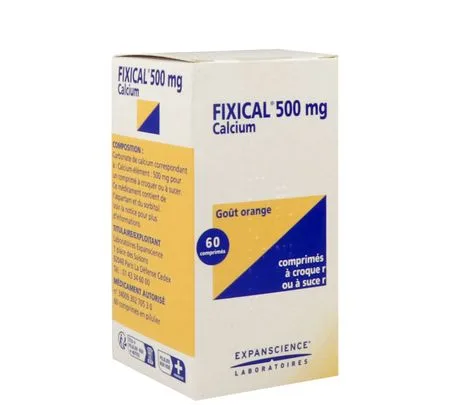
FIXICAL 500 mg, chewable or sucking tablet
Composition
Calcium carbonate........................................................................................................................ 1248,75 mg
Quantity corresponding to calcium element .................................................................................... 500,00 mg
For a chewable or sucking tablet
Excipients with known effect: aspartame, sorbitol.
Sorbitol, aspartame, orange flavouring (alpha pinene, myrcene, limonene, octanal, decanal, linalool, citral, gum arabic), magnesium stearate and pregelatinised maize starch.
Indications
Calcium deficiencies, particularly during growth, pregnancy and breastfeeding.
Adjunctive treatment of osteoporosis (senile, postmenopausal, under corticosteroid therapy, immobilisation-related, upon resumption of mobility).
This medicine is indicated in adults and children over 6 years of age.
Dosage and administration
Dosage
In adults:
Calcium deficiencies and osteoporosis: 1 to 1,5 g of elemental calcium per day, i.e. 2 to 3 chewable or sucking tablets per day.
Paediatric population
In children:
Calcium deficiencies during growth:
• child aged 6 to 10 years: 500 mg of elemental calcium per day, i.e. 1 chewable or sucking tablet per day,
• child aged over 10 years: 1 g of elemental calcium per day, i.e. 2 chewable or sucking tablets per day.
Method of administration
Oral use.
The tablets are to be chewed then swallowed with a large glass of water, or allowed to dissolve in the mouth.
Contraindications
• Hypersensitivity to any of the constituents,
• Hypercalcaemia, hypercalciuria, calcium urolithiasis, tissue calcifications,
• Prolonged immobilisation accompanied by hypercalcaemia and/or hypercalciuria: calcium treatment should only be administered upon resumption of mobility,
• Phenylketonuria, due to the presence of aspartame.
Warnings and precautions
Concomitant administration of calcium and vitamin D must be carried out under strict monitoring of serum calcium and urinary calcium.
In cases of renal insufficiency, regularly monitor serum calcium and urinary calcium and avoid administering high doses.
In case of long-term treatment and/or renal insufficiency, it is necessary to monitor calciuria and to reduce or temporarily interrupt the treatment if it exceeds 7,5 mmol/24 h (300 mg/24 h) in adults.
This medicine contains 15 mg of aspartame per tablet. Aspartame contains a source of phenylalanine and may be harmful for people with phenylketonuria.
This medicine contains 413,5 mg of sorbitol per tablet. Patients with hereditary fructose intolerance (HFI) must not take this medicine.
Interactions
Associations requiring precautions for use
+ Tetracyclines
Decreased digestive absorption of tetracyclines.
Take calcium salts apart from cyclines (more than 2 hours apart, if possible).
+ Digitalis glycosides
Risk of rhythm disorders.
Clinical monitoring and, where appropriate, monitoring of the ECG and serum calcium.
+ Bisphosphonates
Decreased digestive absorption of bisphosphonates.
Take calcium salts apart from bisphosphonates (more than 2 hours, if possible).
+ Oral iron salts
Decreased digestive absorption of iron salts.
Take iron salts away from meals and in the absence of calcium.
+ Estramustine
Decreased digestive absorption of estramustine.
Take calcium salts at a distance from estramustine (more than 2 hours, if possible).
+ Thyroid hormones
Decreased absorption of thyroid hormones.
Take calcium salts at a distance from thyroid hormones (more than 2 hours, if possible).
+ Strontium
Decreased digestive absorption of strontium.
Take strontium at a distance from calcium salts (at least 2 hours, if possible).
+ Zinc
Decreased digestive absorption of zinc by calcium.
Take calcium salts apart from zinc (more than 2 hours, if possible).
Associations to be taken into account
+ Thiazide diuretics and related agents
Risk of hypercalcemia due to decreased urinary elimination of calcium.
Fertility, pregnancy and breastfeeding
This product may be used during pregnancy and breastfeeding. However, the daily dose must not exceed 1500 mg of calcium.
Adverse effects
Adverse effects are listed below, by System Organ Class and by frequency. Frequencies are defined as follows: uncommon (≥ 1/1 000 ; < 1/100), rare (≥ 1/10 000 ; < 1/1 000).
Skin and subcutaneous tissue disorders:
Rare: Pruritus, skin rash and urticaria.
Gastrointestinal disorders:
Rare: Digestive disorders such as constipation, flatulence, nausea.
Metabolism and nutrition disorders:
Uncommon: Hypercalciuria, hypercalcaemia (in case of prolonged treatment at high doses).
Reporting of suspected adverse reactions
Reporting suspected adverse reactions after authorisation of the medicinal product is important. It allows continued monitoring of the benefit/risk balance of the medicinal product. Healthcare professionals are asked to report any suspected adverse reaction via the national reporting system: National Agency for the Safety of Medicines and Health Products (ANSM) and the network of Regional Centres of Pharmacovigilance - Website: https://signalement.social-sante.gouv.fr/.
Overdose
Symptoms
Thirst, polyuria, polydipsia, nausea, vomiting, dehydration, arterial hypertension, vasomotor disorders, constipation.
Treatment
Discontinuation of all calcium intake and, where applicable, of vitamin D, rehydration and, depending on the severity of the intoxication: use alone or in combination, of diuretics, corticosteroids, calcitonin, possibly combined with peritoneal dialysis.
Pharmacodynamics
Pharmacotherapeutic class: CALCIUM / MINERAL ELEMENT (A: alimentary tract and metabolism), ATC code: A12AA04.
• Calcium intake corrects dietary calcium deficiency.
• Daily calcium requirements are on the order of 1000 to 1500 mg of elemental calcium.
Pharmacokinetics
Absorption
In the gastric environment, calcium carbonate releases the calcium ion depending on the pH. Calcium is essentially absorbed in the upper part of the small intestine by a saturable active transport mechanism dependent on vitamin D. The absorption rate of calcium in this form is on the order of 30% of the ingested dose.
Elimination
Calcium is eliminated by sweat and digestive secretions. Urinary calcium depends on glomerular filtration and the rate of tubular reabsorption of calcium.
SPECIAL PRECAUTIONS FOR DISPOSAL AND OTHER HANDLING
No special requirements.
Any unused medicinal product or waste material should be disposed of in accordance with local requirements.
Prescription, supply and reimbursement
| Marketing authorisation (AMM) |
|
| Price: |
|
- Indication(s) appearing in the marketing authorisation at the date of publication of this decree
Collection.
26 AVENUE TONY GARNIER
69007 LYON
Tel: 04 72 72 60 72 Tel (toll-free): 0811 65 27 76
contact@laboratoire-arrow.com
http://www.laboratoire-arrow.com/
Source: VIDAL · Updated on 10/11/2026. This information does not replace advice from a healthcare professional.