
Medicines
SmPC of 28/09/2026
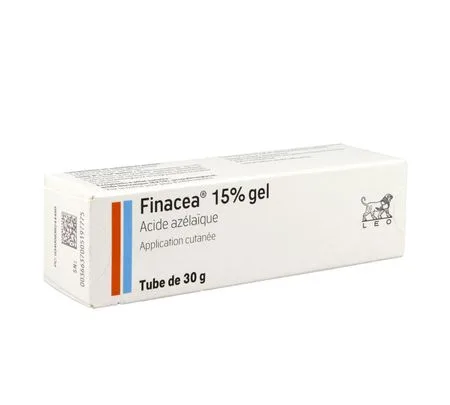
FINACEA 15 % gel
Composition
Azelaic acid...........................................................................................................................................150 mg
For 1 g of gel.
Excipients with known effect: 1 g of gel contains 1 mg of benzoic acid, 0,12 g of propylene glycol and 15 mg of polysorbate 80
Benzoic acid (E210)
Carbomers
Purified water
Disodium edetate
Sodium hydroxide
Lecithin
Polysorbate 80
Propylene glycol
Medium-chain triglycerides
Indications
Treatment of mild to moderate papulopustular acne of the face.
Topical treatment of papulopustular rosacea.
Dosage and administration
FINACEA is for cutaneous use only.
Dosage
FINACEA should be applied to the affected skin twice daily (morning and evening), facilitating its penetration by gentle massage.
Approximately 0,5 g, equivalent to 2,5 cm of gel, is sufficient for the entire face.
Paediatric population
Use in adolescents (aged 12 to 18 years) in the treatment of acne vulgaris. It is not necessary to adjust the dose of FINACEA when used in adolescents aged 12 to 18 years.
The safety and efficacy of FINACEA in the treatment of acne vulgaris have not been established in children under 12 years of age.
The safety and efficacy of FINACEA in the treatment of papulopustular rosacea have not been established in children under 18 years of age.
Elderly patients
No specific studies have been conducted in patients over 65 years of age.
Patients with impaired hepatic function
No specific studies have been conducted in patients with impaired hepatic function.
Patients with impaired renal function
No specific studies have been conducted in patients with impaired renal function.
Method of administration
Before applying FINACEA, the skin must be carefully cleansed with water and dried. Use of a mild make-up remover is possible.
Occlusive dressings or bandages must not be used, and hands must be washed after applying the gel.
In case of skin irritation (see section Adverse effects), the amount of gel per application must be reduced or the frequency of use of FINACEA reduced to one application daily until the irritation disappears. If necessary, treatment should be interrupted for a few days.
It is important to use FINACEA without interruption throughout the entire duration of treatment. The duration of treatment with FINACEA varies from patient to patient and also depends on the severity of the skin condition.
Acne :
As a general rule, a marked improvement appears after 4 weeks of treatment. To obtain an optimal result, FINACEA may be used for several months depending on the clinical outcome. In the absence of improvement after one month, or in case of exacerbation of acne, FINACEA must be discontinued and other therapeutic alternatives should be considered.
Rosacea :
As a general rule, a marked improvement appears after 4 weeks of treatment. To obtain an optimal result, FINACEA may be used for several months depending on the clinical outcome. In the absence of improvement after 2 months or in case of exacerbation of rosacea, FINACEA must be discontinued and other therapeutic alternatives should be considered.
Contraindications
Hypersensitivity to the active substance or to any of the excipients listed in section Composition
Warnings and precautions
For external use only.
Care must be taken to avoid any contact with the eyes, mouth and any other mucous membranes when using FINACEA, and patients must be warned of this (see section Preclinical safety). In case of accidental contact with the eyes, mouth and/or mucous membranes, copious rinsing with water must be performed. If eye irritation persists, patients should consult a doctor. Hands must be washed after each application of FINACEA
FINACEA contains 1 mg of benzoic acid per gram of gel. Benzoic acid may cause local irritation.
FINACEA contains 120 mg of propylene glycol per gram of gel.
FINACEA contains 15 mg of polysorbate 80 per gram of gel. Polysorbates may cause allergic reactions.
Concomitant use of make-up removers, dyes and alcohol-based astringents, abrasive and exfoliating agents is not recommended in patients using FINACEA for the treatment of rosacea.
Worsening of asthma in patients treated with azelaic acid has been reported in rare cases during post-marketing surveillance.
Interactions
No interaction studies have been performed. The composition of FINACEA does not suggest the existence of undesirable interactions with any other product that could affect the safety of the medicinal product. No specific drug interaction was identified during controlled clinical studies.
Fertility, pregnancy and breastfeeding
Pregnancy
There are no adequate and well-controlled studies of cutaneous administration of azelaic acid in pregnant women.
Studies performed in animals have shown a risk of effects on pregnancy, embryo-foetal development, delivery or post-natal development. Nevertheless, the dose without observed harmful effect in animals varies, depending on the studies, from 3 to 32 times the maximum recommended human dose based on body surface area (see section Preclinical safety).
Caution is required when prescribing azelaic acid to a pregnant woman.
Breast-feeding
In vivo, it is not known whether azelaic acid is excreted in human milk. Nevertheless, passage of this substance into human milk has been demonstrated in vitro by an equilibrium dialysis technique.
However, the passage of azelaic acid into breast milk is not likely to cause a significant change in the initial level of azelaic acid in breast milk. Azelaic acid does not concentrate in milk, and after cutaneous application of FINACEA, less than 4% of azelaic acid is absorbed into the systemic circulation, which does not increase endogenous exposure beyond the physiological level.
However, caution is required when FINACEA is administered to a woman who is breastfeeding.
Children must not be brought into contact with the treated area (skin/breast).
Fertility
There are no data on the effect of FINACEA on human fertility. Studies performed in animals did not show any effect on fertility in male or female rats (see section Preclinical safety).
Adverse effects
Based on clinical trials and post-marketing surveillance data, the most frequently observed adverse reactions were: pruritus, burning and pain at the application site.
The frequencies of adverse reactions observed during clinical studies and from post-marketing surveillance, listed in the table below, are defined according to MedDRA frequency conventions:
Very common (≥ 1/10),
Common (≥ 1/100, < 1/10),
Uncommon (≥ 1/1000, <1/100),
Rare (≥ 1/10 000, < 1/1 000),
Very rare (< 1/10 000),
Frequency not determinable (cannot be estimated from the available data).
|
System Organ Classes |
Very common |
Common |
Uncommon |
Rare1 |
|
Immune system disorders |
|
|
|
hypersensitivity (which may occur with one or more of the following adverse reactions: angioedema, eye swelling, facial swelling, dyspnoea) |
|
Worsening of asthma (see section Warnings and precautions) |
||||
|
Skin and subcutaneous tissue disorders |
|
|
Contact dermatitis |
Skin irritation |
|
Acne* |
Urticaria |
|||
|
General disorders and administration site conditions |
Burning at the application site |
Rash at the application site |
Erythema at the application site, |
|
|
Exfoliation** at the application site |
||||
|
Heat** at the application site |
||||
|
Discoloration** at the application site |
||||
|
Pain at the application site |
Paraesthesia at the application site |
Discomfort* at the application site |
||
|
Pruritus at the application site |
Dryness at the application site |
|||
|
Oedema* at the application site |
Urticaria* at the application site |
* in the rosacea indication
** in the acne indication
1These adverse effects have been reported during the post-marketing use of FINACEA.
Local skin irritations regress during treatment (see management in the section Dosage and administration).
Paediatric population
Treatment of acne vulgaris in adolescents aged 12 to 18 years:
In four phase II and II/III clinical studies that included adolescents aged 12 to 17 years (120/383; 31%), the overall incidence of adverse effects observed with FINACEA was similar in the 12-17 years (40%) and over 18 years (37%) groups and in the total patient population (38%). This similarity was also found with the 12-20 years group (40%).
Reporting of suspected adverse reactions
Reporting suspected adverse reactions after authorisation of the medicinal product is important. It allows continued monitoring of the benefit/risk balance of the medicinal product. Healthcare professionals are asked to report any suspected adverse reactions via the national reporting system: National Agency for the Safety of Medicines and Health Products (ANSM) and the network of Regional Pharmacovigilance Centres - Website: https://signalement.social-sante.gouv.fr/.
Pharmacodynamics
Pharmacotherapeutic class: other anti-acne preparations for topical use, ATC code: D10A X03.
Acne:
The therapeutic efficacy of azelaic acid in acne is presumed to rest on an antimicrobial action and a direct effect on follicular hyperkeratosis.
In vitro and in vivo, azelaic acid inhibits keratinocyte proliferation and normalises the final stages of epidermal differentiation that are disturbed in acne.
Clinically, a significant decrease in the colonisation density of Propionibacterium acnes and a significant decrease in the fraction of free fatty acids in the lipids of the skin surface are observed.
In two randomised, double-blind clinical studies, FINACEA was significantly superior to its excipients alone with respect to the median decrease in the sum of papules and pustules, and was 6 % less effective than benzoyl peroxide 5 % (p = 0,056). In these studies, the efficacy of FINACEA on comedones was assessed as a secondary criterion. FINACEA was more effective than the excipients alone in terms of median relative reduction of comedones and was less effective than benzoyl peroxide 5 %.
Rosacea:
Although the pathophysiology of rosacea is not fully elucidated, it is increasingly accepted that inflammation involving the elevation of several pro-inflammatory effector molecules such as kallikrein-5 and cathelicidin, as well as reactive oxygen species (ROS), is a central process of this disease.
It has been shown that azelaic acid modulates the inflammatory response of normal human keratinocytes by: a) activating the peroxisome proliferator-activated receptor gamma (PPARγ); b) inhibiting the trans-activation of nuclear factor kB (NF-kB); c) inhibiting the production of pro-inflammatory cytokines and d) inhibiting the release of ROS by neutrophils, as well as the direct scavenging effects on existing ROS.
In addition, azelaic acid has been shown to directly inhibit kallikrein-5 and cathelicidin expression in three models: in vitro (human keratinocytes), on murine skin and on the facial skin of patients with rosacea.
These anti-inflammatory properties of azelaic acid may play a role in the treatment of rosacea.
Although the clinical significance of these findings with regard to kallikrein-5 and cathelicidin and their impact on the pathophysiology of rosacea has not yet been fully demonstrated in a large clinical study, initial studies on human facial skin appear to confirm the in vitro results and the results in the murine model.
In two 12-week studies in papulopustular rosacea, controlled against the vehicle alone, FINACEA was statistically superior to its vehicle in reducing inflammatory lesions, the investigator's global assessment, the overall rate of improvement and improvement of erythema.
In the clinical study in papulopustular rosacea versus metronidazole 0,75%, FINACEA was shown to be significantly superior in reducing the number of lesions (72,7% versus 55,8%), the overall rate of improvement and improvement of erythema (56% versus 42%).
The rate of cutaneous adverse effects, which in most cases were mild to moderate, was 25,8% with FINACEA and 7,1% with metronidazole 0,75% gel. There was no notable effect on telangiectasia during these three clinical studies.
Pharmacokinetics
Azelaic acid penetrates all layers of the skin after topical application of the gel. Penetration is faster in damaged skin than in healthy skin. A fraction of 3,6% of the applied dose was absorbed percutaneously after a single topical application of 1 g of azelaic acid (administered as 5 g of SKINOREN 20% cream). Clinical studies conducted in patients with acne showed similar absorption rates of azelaic acid with FINACEA and SKINOREN 20% cream.
A portion of the azelaic acid absorbed through the skin is excreted unchanged in the urine. The remaining fraction is degraded by β-oxidation into shorter-chain dicarboxylic acids (C7, C5), which have also been found in the urine.
Steady-state plasma levels of azelaic acid in patients treated twice daily for 8 weeks with FINACEA for rosacea were of the same order as those observed in volunteers and in patients with acne on a normal diet. This indicates that percutaneous absorption of FINACEA after twice-daily administration does not alter the systemic amounts of azelaic acid from dietary and endogenous sources in a clinically significant way.
Preclinical safety
Non-clinical data from conventional repeated-dose toxicity and reproductive toxicity studies did not reveal any particular risk for humans.
In embryo-foetal development studies conducted in rats, rabbits and monkeys, orally administered azelaic acid during the organogenesis period demonstrated embryotoxicity at doses associated with maternal toxicity. No teratogenic effect was observed. The no observed adverse effect level (NOAEL) for embryo-foetal development corresponded to 32 times the maximum recommended human dose (MRHD) based on body surface area (BSA) in rats, 6,5 times in rabbits and 19 times in monkeys (see section Fertility, pregnancy and breastfeeding).
In a peri- and post-natal development study conducted in rats, orally administered azelaic acid from gestation day 15th to post-partum day 21th revealed slight disturbances in the post-natal development of the offspring at oral doses associated with maternal toxicity. In this study, the NOAEL corresponded to 3 times the MRHD based on BSA. No effect on sexual maturation of the offspring was observed in this study.
Studies in vitro and in vivo with azelaic acid did not reveal mutagenic effects on germ cells or somatic cells. No conventional carcinogenicity study following oral administration of azelaic acid has been conducted. In a dermal carcinogenicity study conducted over 26 weeks in transgenic male and female mice (Tg.Ac), FINACEA and the gel vehicle increased the number of papillomas at the treated site in male animals after 2 applications per day. This effect was not observed after single administration in male and female mice. This effect may be associated with application of the vehicle. The clinical relevance of these animal findings has not been established in humans, particularly given the questionable validity of the Tg.Ac test system.
Azelaic acid brought into contact with the eyes of monkeys and rabbits caused moderate to severe irritation reactions. Therefore, eye contact should be avoided.
Single intravenous administration of azelaic acid showed no effects on the nervous system (Irwin test), cardiovascular function, intermediary metabolism, smooth muscles, or hepatic and renal function.
Prescription, supply and reimbursement
| Marketing authorisation (AMM) |
|
IMMEUBLE AMPERE E + LA DÉFENSE 34-40 RUE HENRI REGNAULT
92400 COURBEVOIE-LA-DÉFENSE
Tél : 01 30 14 40 00 leo.group@leo-pharma.com
https://www.leo-pharma.fr/
Source: VIDAL · Updated on 10/11/2026. This information does not replace advice from a healthcare professional.