Medicines
SmPC of 20/06/2022
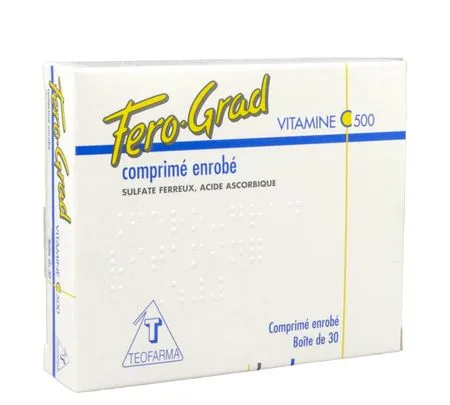
FERO-GRAD VITAMIN C 500, coated tablet
Composition
Ferrous sulfate........................................................................................................................................325,00 mg
corresponding quantity of iron........................................................................................................................105,00 mg
Ascorbic acid for direct compression*....................................................................................555,56 mg
corresponding quantity of ascorbic acid..............................................................................................500,00 mg
For one film-coated tablet.
*Containing 90% ascorbic acid and 10% starch (maize) and lactose monohydrate.
One tablet contains 105 mg of iron.
Excipient with known effect: lactose.
Methyl acrylate-methyl methacrylate copolymer, magnesium stearate, povidone, macrogol 8000, microcrystalline cellulose, ethylcellulose (45 cps), macrogol 400, talc, hypromellose (15 cps), titanium dioxide (E171), quinoline yellow (E104).
Indications
Anaemia due to iron deficiency.
Preventive treatment of iron deficiency in pregnant women.
Dosage and administration
Dosage
FOR ADULTS ONLY
Curative treatment:
IN ADULTS:
100 to 200 mg of elemental iron per day, i.e. 1 to 2 tablets per day.
Preventive treatment:
IN PREGNANT WOMEN: on average 1 tablet per day, during the last two trimesters of pregnancy (or from the 4th month).
Duration of treatment:
It should be sufficient, 3 to 6 months, to correct the anaemia and restore iron stores which, in adults, are approximately 1000 mg.
Method of administration
Oral use.
The tablets must not be sucked, chewed or held in the mouth, but swallowed whole with water.
The tablets should be taken before or during meals, depending on gastrointestinal tolerance. In order to limit adverse effects and because of a stimulating effect of vitamin C, it is advised to take this medicine on an empty stomach in the morning or before lunch, but the timing of intake and possibly the dosage should be adjusted according to digestive tolerance.
Contraindications
Iron overload, in particular normocytic or hypersideremic anemia such as thalassemia, refractory anemia, anemia due to bone marrow failure.
Warnings and precautions
Special warnings
Hyposideremia associated with inflammatory syndromes is not responsive to iron (martial) treatment.
Iron (martial) treatment should, as far as possible, be combined with treatment of the underlying cause (etiological treatment).
This medicine contains lactose. Its use is not recommended in patients with lactose intolerance.
Precautions for use
Prevention of iron (martial) deficiency in infants relies on the early introduction of a diversified diet.
High consumption of tea inhibits the absorption of iron.
Due to the risk of oral ulcerations and discoloration of the teeth, the tablets must not be sucked, chewed or held in the mouth, but swallowed whole with water.
Aspiration of ferrous sulfate tablets into the airways may induce necrosis of the bronchial mucosa, which may cause cough, hemoptysis, bronchial stenosis and/or lung infection (even if the aspiration occurred days or months before the onset of these symptoms). Elderly patients and patients with swallowing difficulties should only be treated with ferrous sulfate tablets after careful assessment of their individual risk of aspiration. The use of other formulations should be considered. Patients should seek medical advice if they suspect aspiration.
A check of efficacy is useful after 3 months of treatment: it should focus on correction of the anemia (Hb, MCV) and restoration of iron stores (serum iron and transferrin saturation).
Interactions
Combinations not recommended
+ Iron (salts) injectable route
Lipothymia, or even shock, attributed to rapid release of iron from its complex form and to saturation of transferrin.
Associations subject to Precautions for use
+ Tetracyclines (oral route)
Decreased digestive absorption of cyclines (formation of complexes).
Take iron salts away from cyclines (more than 2 hours, if possible).
+ Diphosphonates (oral route)
Decreased absorption of diphosphonates.
Take iron salts at a distance from diphosphonates (more than 2 hours, if possible).
+ Fluoroquinolones
Decreased bioavailability of fluoroquinolones through chelation and a non-specific effect on the absorption capacity of the digestive tract.
Take iron salts at a distance from fluoroquinolones (more than 2 hours, if possible).
+ Penicillamine
Decreased digestive absorption of penicillamine.
Take iron salts at a distance from penicillamine (more than 2 hours, if possible).
+ Salts, oxides and hydroxides of magnesium, aluminium and calcium (intestinal topicals)
Decreased digestive absorption of iron salts.
Take gastro-intestinal topicals at a distance from iron salts (more than 2 hours, if possible).
+ Thyroxine
Decreased digestive absorption of thyroxine and hypothyroxinaemia.
Take iron salts at a distance from thyroxine (more than 2 hours, if possible).
Fertility, pregnancy and breastfeeding
Pregnancy
Negative clinical data, covering several thousand treated women, appear to rule out a harmful effect of ferrous sulfate.
Consequently, this medicine, under normal conditions of use, may be prescribed during pregnancy.
Breast-feeding
The passage of ferrous sulfate into breast milk has not been evaluated, but given the nature of the molecule, administration of this medicine is possible in breastfeeding women.
Adverse effects
Post-marketing: the following adverse effects have been reported in the context of post-marketing surveillance. The frequency of these reactions is considered undetermined (it cannot be estimated from the available data).
Gastrointestinal disorders :
Possible gastro-intestinal disorders such as nausea, constipation or diarrhoea.
Usual darkening of stools to black or blackish-grey.
- Oral ulcerations*
*in the case of incorrect administration, when the tablets are chewed, sucked or held in the mouth. Elderly patients and patients with swallowing disorders may also be prone to oesophageal lesions or bronchial necrosis in the event of aspiration.
Immune system disorders :
- Allergic reactions such as rash, urticaria and, exceptionally, anaphylactic shock have been reported.
Respiratory, thoracic and mediastinal disorders:
Bronchial stenosis (see section Warnings and precautions).
Reporting of suspected adverse reactions
Reporting suspected adverse reactions after authorisation of the medicinal product is important. It allows continued monitoring of the benefit/risk balance of the medicinal product. Healthcare professionals are asked to report any suspected adverse reaction via the national reporting system: National Agency for the Safety of Medicines and Health Products (ANSM) and the network of Regional Centres of Pharmacovigilance - Website: www.signalement-sante.gouv.fr.
Overdose
In the event of massive ingestion of iron salts, cases of overdose have been reported, particularly in children under 2 years:
- The symptoms include signs of intense irritation or necrosis of the digestive mucosa leading to abdominal pain, vomiting, often bloody diarrhoea, which may be accompanied by a state of shock with acute renal failure, hepatic involvement, and coma, often convulsive.
- Remote from the poisoning, digestive stenoses are possible.
- Treatment should be initiated as early as possible by performing gastric lavage with a sodium bicarbonate solution at 1%.
- The use of a chelating agent is effective, the most specific being deferoxamine, mainly when the serum iron concentration is greater than 5 microg/ml. Shock, dehydration and acid-base disturbances are treated conventionally.
Pharmacodynamics
Pharmacotherapeutic class: ANTIANAEMIC - FERROUS SULFATE BY ORAL ROUTE (B: blood and blood-forming organs).
Iron is an essential constituent of the body; it is necessary for the formation of haemoglobin and for the oxidation processes of living tissues.
Pharmacokinetics
Absorption
Ferrous sulfate, like ferrous salts in general, is poorly absorbed (10 to 20 % of the ingested dose).
It is contained in an inert, porous matrix; this inert matrix is excreted in the stools.
Absorption of ferrous sulfate is increased when iron stores are depleted.
It occurs mainly in the duodenum and the proximal part of the jejunum.
Prescription, supply and reimbursement
| Marketing authorisation (AMM) |
|
| Price: |
|
Collection.
VIA F.LLI CERVI, 8
27010 VALLE SALIMBENE (PAVIA)
Tel: 00 39 0382 422 008 amministrazione@teofarma.it
https://www.teofarmasrl.it/
Source: VIDAL · Updated on 10/11/2026. This information does not replace advice from a healthcare professional.