
Medicines
SmPC of the 13/01/2022
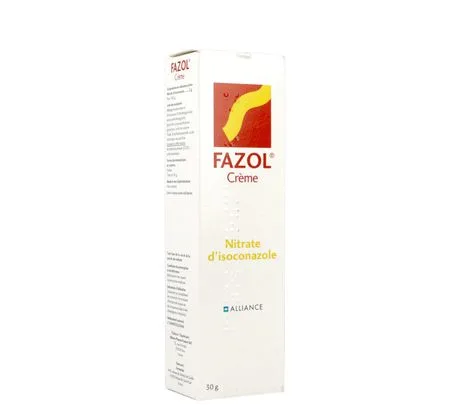
FAZOL, cream
Composition
Micronised isoconazole nitrate........................................................................................................................2 g
For 100 g.
Excipients with known effect: butylhydroxyanisole (E320), benzoic acid.
Mixture of mono and distearic esters of ethylene glycol and polyoxyethylene glycols, polyoxyethylene glycolysed glycerides, liquid petrolatum oil, butylhydroxyanisole, benzoic acid, purified water.
Indications
1°) Candidiasis:
Cutaneous candidiasis encountered in human clinical practice is usually due to Candida albicans. However, in the absence of suggestive clinical symptoms, the mere detection of Candida on the skin cannot in itself constitute an indication.
- Treatment:
- Intertrigo of the major folds, in particular genito-crural, anal, interdigital buttock, axillary, submammary;
- Intertrigo of the minor folds: interdigital, interdigital toes, angular cheilitis),
- Vulvitis, anitis.
In some cases, it is recommended to simultaneously treat the digestive tract.
- Adjunctive treatment of onychia and perionychia.
2°) Dermatophytoses:
- Treatment:
- Dermatophytoses of glabrous skin,
- Genital and crural intertrigo,
- Intertrigo of the toes.
- Adjunctive treatment:
- Tinea,
- Trichophyton folliculitis.
An associated systemic antifungal treatment is necessary.
3°) Pityriasis versicolor
Dosage and administration
Dosage
Regular twice-daily application until complete disappearance of the lesions.
The duration of treatment depends on the condition (on average 2 to 4 weeks).
Method of administration
Apply the cream to the lesions to be treated with the fingertips, by gentle massage until complete penetration.
Contraindications
Hypersensitivity to imidazole derivatives or to any of the excipients mentioned in section Composition.
Warnings and precautions
- Avoid any contact with the eyes.
- Candidiasis: use of an acidic pH soap is not recommended (a pH that promotes the multiplication of Candida).
FAZOL, cream contains butylhydroxyanisole (E320)
Butylhydroxyanisole may cause local skin reactions (for example contact dermatitis) or irritation of the eyes and mucous membranes.
FAZOL, cream contains benzoic acid (E210)
Benzoic acid may cause local irritation and increase the risk of jaundice (yellowing of the skin and eyes) in newborns (up to 4 weeks).
Adverse effects
The occurrence of systemic effects is unlikely given the low rate of absorption through intact skin. However, on damaged skin, over a large area, and in infants (due to the surface-area-to-weight ratio and the occlusive effect of nappies), attention should be paid to this possibility.
Exceptionally, the following have been observed:
- General allergic manifestations, in particular urticaria and Quincke's oedema.
- Local reactions such as pruritus or burning sensations that subside as soon as treatment is stopped.
- Cases of contact eczema (notably related to the presence of butylhydroxyanisole and benzoic acid).
Reporting of suspected adverse reactions
Reporting suspected adverse reactions after authorisation of the medicinal product is important. It allows continued monitoring of the benefit/risk balance of the medicinal product. Healthcare professionals are asked to report any suspected adverse reaction via the national reporting system: National Agency for the Safety of Medicines and Health Products (ANSM) and the network of Regional Centres of Pharmacovigilance - Website: www.signalement-sante.gouv.fr
Pharmacodynamics
Pharmacotherapeutic class: LOCAL ANTIFUNGAL, ATC code: D01AC05
Mechanism of action
Isoconazole nitrate, an imidazole derivative, has both a broad-spectrum fungicidal action and a bactericidal action against Gram-positive organisms.
Isoconazole nitrate is active against:
- Dermatophytes (Trichophyton, Epidermophyton, Microsporum),
- Yeasts (Candida, Pityrosporum),
- Various fungi (Aspergillus, Nocardia, Streptomyces),
- Gram-positive bacilli and cocci (streptococci, staphylococci).
In vivo At a concentration of 10 micrograms/ml, isoconazole nitrate inhibits the multiplication of most pathogenic species.
The fungicidal activity becomes apparent from a concentration of 50 micrograms/ml.
At a concentration of 500 micrograms/ml, fungicidal activity is very rapid, since the proportion of blastospores killed is 92 percent in two hours and more than 99 percent in twenty-four hours.
Pharmacokinetics
The active ingredient is concentrated mainly in the stratum corneum, where it reaches fungicidal concentrations. The stratum corneum constitutes a barrier that prevents absorption of isoconazole. Its penetration through intact skin is so low that it could not be measured.
Prescription, supply and reimbursement
| Marketing authorisation (AMM) |
|
| Price: |
|
Collection.
13 RUE PAUL VALÉRY
75016 PARIS
Tél : 01 53 76 11 11 commande@allianceph.com
www.alliancepharmaceuticals.com
Source: VIDAL · Updated on 10/11/2026. This information does not replace advice from a healthcare professional.