
Medicines
SmPC of 06/08/2025
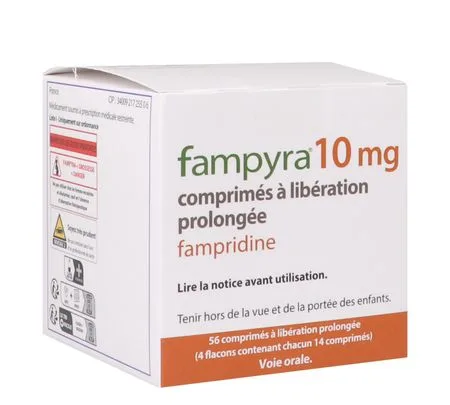
FAMPYRA 10 mg, prolonged-release tablets
Forms and presentations
Prolonged-release tablet.
Off-white, film-coated, oval, biconvex prolonged-release tablet measuring 13 x 8 mm, with a flat edge and bearing the inscription A10 on one face.
Composition
Each prolonged-release tablet contains 10 mg of fampridine.
Tablet core: hypromellose, microcrystalline cellulose, colloidal anhydrous silica, magnesium stearate.
Film-coating: hypromellose, titanium dioxide (E-171), polyethylene glycol 400.
Indications
Fampyra is indicated to improve walking ability in adult patients with multiple sclerosis who have walking disability (EDSS 4-7).
Dosage and administration
Treatment with fampridine must be initiated and monitored by physicians experienced in the management of MS.
Dosage
The recommended dose is one 10 mg tablet twice daily, 12 hours apart (one tablet in the morning and one tablet in the evening). Fampridine must not be administered at a higher frequency or dose than recommended (see section Warnings and precautions). The tablets must be taken without food (see section Pharmacokinetics).
Missed dose
The usual dosing schedule must always be followed. Do not take a double dose to make up for a missed dose.
Initiation and evaluation of treatment with Fampyra
- The initial prescription must be limited to two to four weeks of treatment as clinical benefits are generally observed within two to four weeks after initiation of Fampyra.
- An evaluation of walking ability, for example the timed Timed 25 Foot Walk test (T25FW) or the multiple sclerosis walking scale Multiple Sclerosis Walking Scale (MSWS-12), is recommended in order to assess improvement in walking after two to four weeks of treatment. In the absence of improvement, treatment should be discontinued.
- Treatment with this medicinal product must be discontinued in the absence of benefit reported by the patients.
Re-evaluation of treatment with Fampyra
In the event of a reduction in walking ability, physicians must consider interrupting treatment in order to re-evaluate the benefits of fampridine (see above). The re-evaluation must include discontinuation of this medicinal product and an evaluation of walking ability. In the absence of a persistent beneficial effect of fampridine on patients' walking, treatment must be discontinued.
Special populations
Elderly subjects
Renal function should be assessed in elderly subjects before initiating treatment with this medicinal product. It is recommended to monitor renal function in order to detect possible renal impairment in elderly subjects (see section Warnings and precautions)
Patients with renal impairment
Fampridine is contraindicated in patients with moderate or severe renal impairment (creatinine clearance < 50 mL/min) (see sections Contraindications and Warnings and precautions).
Patients with hepatic impairment
It is not necessary to adjust the dosage in patients with hepatic impairment.
Pediatric population
The safety and efficacy of this medicine in children aged 0 to 18 years have not been established. No data are available.
Method of administration:
Fampyra should be administered orally.
The tablet must be swallowed whole. Do not cut, crush, dissolve, suck or chew it.
Contraindications
Hypersensitivity to fampridine or to any of the excipients listed in section Composition.
Concomitant treatment with other medicines containing fampridine (4-aminopyridine).
Epileptic patients or patients with a history of epilepsy.
Patients with moderate or severe renal impairment (creatinine clearance < 50 mL/min).
Concomitant use of Fampyra and medicines that are inhibitors of the organic cation transporter (OCT2) such as cimetidine.
Warnings and precautions
Risk of seizure
Treatment with fampridine increases the risk of occurrence of seizures (see section Adverse effects).
This medicine should be administered with caution in the presence of any factor likely to lower the epileptogenic threshold.
Treatment with fampridine should be discontinued in patients experiencing a seizure while on treatment.
Renal impairment
Fampridine is excreted primarily unchanged via the renal route. Patients with renal impairment have higher plasma levels of fampridine, associated with a greater number of adverse effects, in particular neurological. It is recommended to assess renal function before treatment and to monitor it regularly during treatment in all patients (in particular in elderly subjects in whom renal function may be decreased). Creatinine clearance can be estimated using the Cockcroft-Gault formula.
Caution is required when Fampyra is prescribed in patients with mild renal impairment or in patients treated with medicines that are substrates of OCT2, such as, for example, carvedilol, propranolol and metformin.
Hypersensitivity reactions
Since marketing, serious hypersensitivity reactions (anaphylactic reaction, in particular) have been reported; the majority of these cases occurred during the first week of treatment. Particular attention is required in patients with a history of allergic reactions. In the event of an anaphylactic reaction or other serious allergic reaction, treatment with this medicine should be discontinued and never reinitiated.
Other warnings and precautions
Fampridine should be administered with caution in patients with cardiac rhythm disorders as well as in patients with sinoatrial or atrioventricular cardiac conduction disorders (these effects have occurred in case of overdose). Safety information in these patients is limited.
The increased incidence of dizziness and balance disorders observed with fampridine may lead to an increased risk of falls. Therefore, patients should use a walking aid if necessary.
In clinical studies, low leukocyte counts were observed in 2,1 % of patients treated with Fampyra versus 1,9 % of patients receiving placebo. Infections have been reported in clinical studies (see section Adverse effects), an increase in the rate of infections and an alteration of the immune response cannot be excluded.
Interactions
Interaction studies have been performed in adults only.
Concomitant treatment with other medicinal products containing fampridine (4-aminopyridine) is contraindicated (see section Contraindications).
Fampridine is primarily eliminated via the renal route, by active renal secretion at 60 % (see section Pharmacokinetics). The OCT2 is the transporter responsible for the active secretion of fampridine. Therefore, the concomitant use of fampridine and medicinal products inhibiting OCT2, such as cimetidine, is contraindicated (see section Contraindications). Caution is advised when using fampridine concomitantly with medicinal products that are substrates of OCT2, for example, carvedilol, propranolol and metformin (see section Warnings and precautions).
Interferon: fampridine has been administered concomitantly with interferon-beta treatment: no pharmacokinetic interaction with the medicinal product was observed.
Baclofen: fampridine has been administered concomitantly with baclofen: no pharmacokinetic interaction with the medicinal product was observed.
Fertility, pregnancy and breastfeeding
Pregnancy
There are limited data on the use of fampridine in pregnant women.
Animal studies have shown reproductive toxicity (see section Preclinical safety). As a precautionary measure, it is preferable to avoid the use of fampridine during pregnancy.
Breast-feeding
It is not known whether fampridine is excreted in human milk or in animal milk. Fampyra is therefore not recommended during breast-feeding.
Fertility
Animal studies have not shown any effect on fertility.
Driving and using machines
Fampyra has a moderate influence on the ability to drive and use machines (see section Adverse effects).
Adverse effects
Summary of the safety profile
The safety of Fampyra has been evaluated in randomised controlled clinical studies, long-term open-label studies and post-marketing surveillance.
The identified adverse reactions are primarily neurological and include: seizures, insomnia, anxiety, balance disorder, dizziness, paraesthesia, tremor, headache and asthenia. These effects correspond to the pharmacological activity of fampridine. The adverse reaction reported with the highest incidence during the controlled versus placebo-controlled studies conducted in patients with multiple sclerosis receiving fampridine at the recommended dose was urinary tract infection (in approximately 12 % of patients).
Tabulated list of adverse reactions
Adverse reactions are presented below by system organ class and absolute frequency. Regarding frequency, an adverse reaction is defined as: very common (≥ 1/10); common (≥ 1/100, < 1/10); uncommon (≥ 1/1 000, < 1/100); rare (≥ 1/10 000, < 1/1 000); very rare (< 1/10 000); not known (cannot be estimated from the available data).
Within each frequency category, adverse reactions are presented in order of decreasing seriousness.
|
MedDRA system organ class (SOC) |
Adverse reaction |
Frequency category |
|
Infections and infestations |
Urinary tract infection1 |
Very common |
|
Influenza1 |
Frequent |
|
|
Rhinopharyngitis1 |
Frequent |
|
|
Viral infection1 |
Frequent |
|
|
Immune system disorders |
Anaphylaxis |
Uncommon |
|
Angioedema |
Uncommon |
|
|
Hypersensitivity |
Uncommon |
|
|
Psychiatric disorders |
Insomnia |
Frequent |
|
Anxiety |
Frequent |
|
|
Nervous system disorders |
Dizziness |
Frequent |
|
Headaches |
Frequent |
|
|
Balance disorders |
Frequent |
|
|
Vertigo |
Frequent |
|
|
Paresthesias |
Frequent |
|
|
Tremors |
Frequent |
|
|
Epileptic seizures2 |
Uncommon |
|
|
Trigeminal neuralgia3 |
Uncommon |
|
|
Cardiac disorders |
Palpitations |
Frequent |
|
Tachycardia |
Uncommon |
|
|
Vascular disorders |
Hypotension4 |
Uncommon |
|
Respiratory, thoracic and mediastinal disorders |
Dyspnea |
Frequent |
|
Laryngopharyngeal pain |
Frequent |
|
|
Gastrointestinal disorders |
Nausea |
Frequent |
|
Vomiting |
Frequent |
|
|
Constipation |
Frequent |
|
|
Dyspepsia |
Frequent |
|
|
Skin and subcutaneous tissue disorders |
Rash |
Uncommon |
|
Urticaria |
Uncommon |
|
|
Musculoskeletal and connective tissue disorders |
Back pain |
Frequent |
|
General disorders and administration site conditions |
Asthenia |
Frequent |
|
Chest discomfort4 |
Uncommon |
1 See section Warnings and precautions.
2 See sections Contraindications and Warnings and precautions.
3 Includes both the symptoms de novo and the exacerbation of an existing trigeminal neuralgia.
4 These symptoms were observed in the context of hypersensitivity.
Description of certain adverse reactions
Hypersensitivity
Since marketing, hypersensitivity reactions have been reported (anaphylaxis, in particular) they were accompanied by one or more of the following symptoms: dyspnoea, chest discomfort, hypotension, angioedema, rash and urticaria. For more details on hypersensitivity reactions, refer to the sections Contraindications and Warnings and precautions.
Reporting of suspected adverse reactions
The reporting of suspected adverse reactions after authorisation of the medicinal product is important. It allows continuous monitoring of the benefit/risk balance of the medicinal product. Healthcare professionals report any suspected adverse reaction via the national reporting system: Agence nationale de sécurité du médicament et des produits de santé (ANSM) and network of Regional Pharmacovigilance Centres - Website: https://signalement.social-sante.gouv.fr.
Overdose
Symptoms
The acute symptoms of fampridine overdose correspond to hyperstimulation of the central nervous system and include: confusion, tremor, profuse sweating, seizure and amnesia.
The adverse reactions affecting the central nervous system triggered by high doses of 4-aminopyridine include: dizziness, confusion, seizures, status epilepticus, involuntary and choreoathetoid movements. Other adverse reactions at high doses have included cases of cardiac arrhythmias (for example supraventricular tachycardias and bradycardias) and ventricular tachycardia resulting from a possible prolongation of the QT segment. Cases of hypertension have also been reported.
Management
In case of overdose, patients should receive appropriate management. Repeated seizures should be treated with benzodiazepines, phenytoin or other appropriate antiepileptic treatments.
Pharmacodynamics
Pharmacotherapeutic group: other nervous system drugs, ATC code: N07XX07.
Pharmacodynamic effects
Fampyra is a potassium channel inhibitor. By blocking potassium channels, fampridine reduces the ionic current through these channels, and consequently prolongs repolarisation and improves action potential formation in demyelinated axons as well as neurological function. By improving action potential formation, fampridine may improve conduction in the central nervous system.
Clinical efficacy and safety
Three phase III, randomised, double-blind, placebo-controlled studies (MS-F203, MS-F204 and 218MS305) were conducted. The percentage of responders was independent of concomitant immunomodulatory treatment (including interferons, glatiramer acetate, fingolimod and natalizumab). The dose of Fampyra was 10 mg twice daily.
Studies MS-F203 and MS-F204
The primary endpoint of the MS-F203 and MS-F204 studies was the responder rate for walking speed, measured by the timed 8-foot walk test (Timed 25-foot Walk - T25FW). A responder was defined as a patient whose walking speed was increased during at least three of the four visits performed during the double-blind period, compared to the maximum value measured during the five visits without treatment.
A significantly greater percentage of patients treated with Fampyra were responders to treatment, compared to patients on placebo (MS-F203: 34,8 % vs 8,3 %, p < 0,001; MS-F204: 42,9 % vs 9,3 %, p < 0,001).
The walking speed of responders to Fampyra was increased on average by 26,3 %, versus 5,3 % in the placebo group (p < 0,001) (MS-F203) and by 25,3 % versus 7,8 % (p < 0,001) (MS-F204). The improvement appeared rapidly after treatment initiation (after a few weeks).
Statistically and clinically significant improvements in walking were observed, using the scale assessing walking in multiple sclerosis (MSWS-12 scale with 12 items).
|
STUDY* |
MS-F203 |
MS-F204 |
||
|
Placebo |
Fampyra
|
Placebo |
Fampyra
|
|
|
Number of subjects |
72 |
224 |
118 |
119 |
|
Confirmed improvement |
8,3 % |
34,8 % |
9,3 % |
42,9 % |
|
Difference |
26,5 % |
33,5 % |
||
|
CI95 % |
17,6 % ; 35,4 % |
23,2 % ; 43,9 % |
||
|
p value |
< 0,001 |
< 0,001 |
||
|
Improvement ≥ 20 % |
11,1 % |
31,7 % |
15,3 % |
34,5 % |
|
Difference |
20,6 % |
19,2 % |
||
|
CI95 % |
11,1 % ; 30,1 % |
8,5 % ; 29,9 % |
||
|
p value |
< 0,001 |
< 0,001 |
||
|
Walking speed |
Feet/sec |
Feet/sec |
Feet/sec |
Feet/sec |
|
Feet/second |
||||
|
Baseline value |
2,04 |
2,02 |
2,21 |
2,12 |
|
Value on treatment |
2,15 |
2,32 |
2,39 |
2,43 |
|
Change |
0,11 |
0,30 |
0,18 |
0,31 |
|
Difference |
0,19 |
0,12 |
||
|
p value |
0,010 |
0,038 |
||
|
Mean % change |
5,24 |
13,88 |
7,74 |
14,36 |
|
Difference |
8,65 |
6,62 |
||
|
p value |
< 0,001 |
0,007 |
||
|
MSWS-12 Score
|
||||
|
Baseline value |
69,27 (2,22) |
71,06 (1,34) |
67,03 (1,90) |
73,81 (1,87) |
|
Mean change |
-0,01 (1,46) |
-2,84 (0,878) |
0,87 (1,22) |
-2,77 (1,20) |
|
Difference |
2,83 |
3,65 |
||
|
p value |
0,084 |
0,021 |
||
|
LEMMT (mean, SEM)
|
||||
|
Baseline value |
3,92 (0,070) |
4,01 (0,042) |
4,01 (0,054) |
3,95 (0,053) |
|
Mean change |
0,05 (0,024) |
0,13 (0,014) |
0,05 (0,024) |
0,10 (0,024) |
|
Difference |
0,08 |
0,05 |
||
|
p value |
0,003 |
0,106 |
||
|
Ashworth Score
|
||||
|
Baseline value |
0,98 (0,078) |
0,95 (0,047) |
0,79 (0,058) |
0,87 (0,057) |
|
Mean change |
-0,09 (0,037) |
-0,18 (0,022) |
-0,07 (0,033) |
-0,17 (0,032) |
|
Difference |
0,10 |
0,10 |
||
|
p value |
0,021 |
0,15 |
||
Study 218MS305
The study 218MS305 was conducted in 636 patients with multiple sclerosis presenting with walking disability. The duration of double-blind treatment was 24 weeks, with a follow-up period of 2 weeks after treatment. The primary endpoint was improvement in walking ability, measured as the percentage of patients achieving over 24 weeks a mean improvement ≥ 8 points in the MSWS-12 score compared with baseline. In this study, a statistically significant difference between treatments was observed, with a higher percentage of patients showing improvement in walking ability in the group treated with Fampyra than in the group receiving placebo (relative risk of 1,38 [CI at 95 %: 1,06 ; 1,70]). The improvements generally appeared within two to four weeks following initiation of treatment and disappeared within two weeks following discontinuation of treatment.
Patients treated with fampridine also showed a statistically significant improvement in the score of the timed chair stand test Timed Up and Go (TUG), a measure of static and dynamic balance and physical mobility. For this secondary endpoint, the percentage of patients achieving over a period of 24 weeks a mean improvement ≥ 15 % in speed compared with the TUG test performed at inclusion was higher in the group treated with fampridine than in the group receiving placebo. The difference with the balance assessment scale Berg Balance Scale (BBS; a measure of static balance) was not statistically significant.
In addition, compared with patients receiving placebo, patients treated with Fampyra showed a statistically significant mean improvement in the physical domain score of the multiple sclerosis impact assessment scale Multiple Sclerosis Impact Scale (MSIS-29) compared with baseline (LS mean difference -3,31, p < 0,001).
|
Over 24 weeks |
Placebo
|
Fampyra 10 mg
|
Difference (CI at 95 %)
|
|
|
Percentage of patients showing a mean improvement ≥ 8 points in the MSWS-12 score compared with baseline |
34 % |
43 % |
Risk difference:
|
|
|
MSWS-12 Score |
LS mean: -4,14 |
|||
|
Baseline |
65,4 |
63,6 |
(-6,22 ; -2,06) |
|
|
Improvement compared with baseline |
-2,59 |
-6,73 |
< 0,001 |
|
|
TUG
|
35 % |
43 % |
Risk difference:
|
|
|
TUG |
LS mean: -1,36 |
|||
|
Baseline |
27,1 |
24,9 |
(-2,85 ; 0,12) |
|
|
Improvement compared with baseline |
-1,94 |
-3,3 |
< 0,07 |
|
|
MSIS-29 physical domain score |
LSM: -3,31 |
|||
|
Baseline |
55,3 |
52,4 |
(-5,13 ; -1,50) |
|
|
Improvement compared with baseline |
-4,68 |
-8,00 |
< 0,001 |
|
|
BBS score |
LSM: 0,41 |
|||
|
Baseline |
40,2 |
40,6 |
(-0,13 ; 0,95) |
|
|
Improvement compared with baseline |
1,34 |
1,75 |
0,141 |
|
* Intention-to-treat population = 633; LSM = least squares mean
The European Medicines Agency has granted a waiver of the obligation to submit the results of studies conducted with Fampyra in all subgroups of the paediatric population treated for multiple sclerosis and presenting with walking impairment (see section Dosage and administration for information on paediatric use).
Pharmacokinetics
Absorption
With immediate-release oral dosage forms, fampridine is absorbed rapidly and completely from the gastrointestinal tract. Fampridine has a narrow therapeutic index. The absolute bioavailability of Fampyra prolonged-release tablets has not been evaluated, but the relative bioavailability (compared to an aqueous oral solution) is 95 %. However, absorption is slower from the Fampyra prolonged-release tablet, resulting in a lower and delayed peak concentration, without change in overall absorption.
When Fampyra prolonged-release tablets are taken with food, the area under the plasma concentration-time curve (AUC0-∞) of fampridine is reduced by approximately 2 to 7 % (for a dose of 10 mg). The small reduction in AUC should not result in a decrease in therapeutic efficacy. However, the Cmax increases by 15 to 23 %. Since there is a clear relationship between Cmax and dose-related adverse effects, it is recommended to take Fampyra away from meals (see section Dosage and administration).
Distribution
Fampridine is a lipophilic active substance that readily crosses the blood-brain barrier. Fampridine is mainly unbound to plasma proteins (the bound fraction ranges between 3 and 7 % in human plasma). The volume of distribution of fampridine is approximately 2,6 L/kg.
Fampridine is not a substrate for P-glycoprotein.
Biotransformation
In humans, fampridine is metabolised by oxidation to 3-hydroxy-4-aminopyridine and subsequently conjugated to form 3-hydroxy-4-aminopyridine sulfate. In vitro, no pharmacological activity of fampridine metabolites has been demonstrated on the selected potassium channels.
The 3-hydroxylation of fampridine to 3-hydroxy-4-aminopyridine by human liver microsomes appears to be catalysed by the enzyme cytochrome P2 1E450 (CYP2E1).
There is evidence of direct inhibition of CYP2E1 by fampridine at 30 μM (approximately 12 % inhibition), which corresponds to approximately 100 times the mean plasma concentration of fampridine observed with the 10 mg tablet.
Treatment of human hepatocyte cultures with fampridine had little or no effect on the induction of CYP1A2, CYP2B6, CYP2C9, CYP2C19, CYP2E1 or CYP3A4/5 enzyme activity.
Elimination
The main route of elimination of fampridine is renal excretion, with approximately 90 % of the dose recovered in urine as unchanged active substance within 24 hours. The renal clearance of fampridine (CLR 370 mL/min) is considerably higher than the glomerular filtration rate, since fampridine undergoes glomerular filtration and also active secretion by the renal transporter OCT2. Faecal excretion accounts for less than 1 % of the administered dose.
The pharmacokinetics of fampridine are linear (dose-proportional) with a terminal elimination half-life of approximately 6 hours. The maximum plasma concentration (Cmax) and, to a lesser extent, the area under the plasma concentration-time curve (AUC) increase in proportion to the dose. When fampridine was administered at the recommended dose to patients with normal renal function, no clinical signs of fampridine accumulation were observed. In patients with renal impairment, fampridine accumulation varies according to the degree of renal impairment.
Special populations
Elderly subjects
Fampridine is mainly excreted unchanged by the kidneys and, given the decline in creatinine clearance with age, it is recommended to monitor renal function in elderly patients (see section Dosage and administration).
Pediatric population
No data are available.
Patients with renal impairment
Fampridine is mainly eliminated by the kidneys in unchanged form; it is therefore advisable to assess the renal function of patients in whom it could be impaired. Patients with mild renal impairment may have fampridine concentrations 1,7 to 1,9 times higher than those of patients with normal renal function. Do not administer Fampyra to patients with moderate or severe renal impairment (see sections Contraindications and Warnings and precautions).
Preclinical safety
Toxicity studies following repeated oral administration of fampridine have been conducted in several animal species.
Adverse effects following oral administration of fampridine appeared rapidly, most often within the 2 first hours after intake. The clinical signs observed after single high doses or repeated administration of lower doses were similar in all species studied and included: tremors, convulsions, ataxia, dyspnoea, dilated pupils, prostration, abnormal vocalisation, accelerated breathing and hypersalivation. Gait abnormalities and hyperexcitability were also observed. These signs were expected and are due to an increase in the pharmacological effects of fampridine. In addition, isolated fatal cases of urinary tract obstruction were observed in rats. The clinical relevance of these observations has not yet been elucidated, but a causal link with fampridine cannot be excluded.
Reproduction studies in rats and rabbits showed a reduction in foetal and neonatal weight and viability after administration of maternotoxic doses of fampridine to the mother. However, no increased risk of malformations or harmful effects on fertility was observed.
In a series of studies in vitro and in vivo, fampridine did not show mutagenic, clastogenic or carcinogenic potential.
Special storage precautions
Store at a temperature not exceeding 25 °C. Store the tablets in the original package, protected from light and moisture.
Prescription, supply and reimbursement
Prescription restricted to specialists in neurology.
| Marketing authorisation (AMM) |
|
| Price: |
|
Collection.
MERZ THERAPEUTICS FRANCE TOUR EQHO - 2 AVENUE GAMBETTA
92400 COURBEVOIE
Tel: 01 47 29 16 77 RHMerzFrance@merz.com
https://www.merz.com/ - https://merztherapeutics.com/fr/
Source: VIDAL · Updated on 10/11/2026. This information does not replace advice from a healthcare professional.