
Medicines
SmPC of 04/07/2025
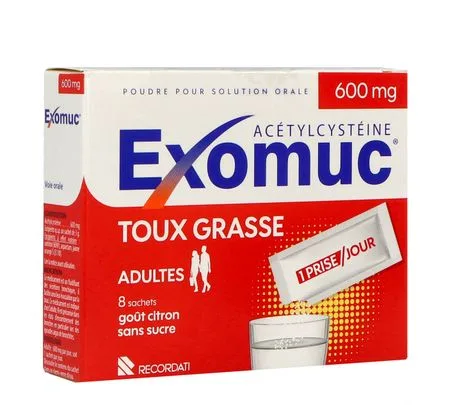
EXOMUC 600 mg, powder for oral solution in sachet
Composition
Acetylcysteine.......................................................................................................................................... 600,0 mg
Per sachet.
Excipients with known effect: 2170,00 mg of sorbitol (60W), 78,00 mg of aspartame, 2.00 mg of sunset yellow S (E110) and 109,5 mg of maltodextrin (glucose) per sachet.
Sorbitol (60W), aspartame, lemon flavour, sunset yellow S (E110).
Composition of lemon flavour : concentrated lemon juice, lemon essential oil, citric acid, citral and maltodextrin.
Dosage and administration
RESERVED FOR ADULTS.
Dosage
Adults: 600 mg per day, i.e. 1 sachet per day.
EXOMUC 600 mg, powder for oral solution in sachet must not be used in children and adolescents; other forms and dosages better suited are available.
Method of administration
Oral use.
Dissolve the powder for oral solution in half a glass of water.
Duration of treatment
Acetylcysteine is intended for symptomatic treatment and must not be used for more than 6 days without medical advice.
Contraindications
• Hypersensitivity to the active substance or to any of the excipients listed in section Composition.
• In general, acetylcysteine is contraindicated in children under 2 years of age.
• Due to the presence of aspartame, this medicine is contraindicated in cases of phenylketonuria.
Warnings and precautions
Special warnings
Productive coughs, which are a fundamental element of bronchopulmonary defence, should be preserved.
Combining bronchial mucomodifiers with antitussives and/or secretion-drying substances (anticholinergics) is not logical.
Treatment with EXOMUC should be reassessed in case of persistence or worsening of symptoms or of the condition.
Mucolytics may induce bronchial overload in infants. Indeed, their capacity to drain bronchial mucus is limited, due to the physiological particularities of their respiratory tree. They must therefore not be used in infants.
Administration of acetylcysteine, mainly at the start of treatment, may liquefy bronchial secretions and increase their volume. If the patient is not able to expectorate effectively, postural drainage and broncho-aspiration must be performed.
Acetylcysteine has a dose-dependent effect on histamine release by mast cells. Because of the bronchial hyperreactivity of asthmatic patients, there is a risk of bronchospasm occurring in these patients treated with EXOMUC. If bronchospasm occurs, treatment must be stopped immediately.
Serious skin reactions such as Stevens-Johnson syndrome and Lyell's syndrome have been reported very rarely with the administration of acetylcysteine. However, the role of acetylcysteine in the occurrence of these reactions could not be clearly established. In most cases, concomitant administration of at least one other suspect drug, more likely responsible for the occurrence of the mucocutaneous syndrome, could be identified. As a precaution, if skin or mucosal lesions appear, treatment must be stopped immediately and a doctor must be consulted.
Studies in vitro Literature data have shown that acetylcysteine causes a decrease in platelet aggregation. The clinical significance of these observations is not known. Caution is recommended in patients at high risk of bleeding.
This medicine contains an azo colouring agent (orange yellow E110) and may cause allergic reactions.
This medicine contains 78 mg of aspartame per sachet. Aspartame contains a source of phenylalanine. May be harmful to people with phenylketonuria (PKU), a rare genetic disease characterised by the accumulation of phenylalanine that cannot be properly eliminated.
This medicine contains 2170 mg of sorbitol per sachet. Sorbitol is a source of fructose. The additive effect of concomitantly administered products containing sorbitol (or fructose) and dietary intake of sorbitol (or fructose) must be taken into account. The sorbitol content in medicines for oral use may affect the bioavailability of other medicines for oral use administered concomitantly. Patients with hereditary fructose intolerance (HFI) must not take this medicine.
This medicine contains maltodextrin (glucose). Patients with glucose-galactose malabsorption syndrome (a rare hereditary disease) must not take this medicine.
Precautions for use
Caution is recommended when the product is used in patients with gastroduodenal ulcer or a history of this condition, particularly in case of concomitant administration of other medicines with a known irritant effect on the gastric mucosa.
Interactions
The combination of bronchial mucomodifiers with an antitussive and/or a secretion-drying substance (anticholinergic) is not logical.
Fertility, pregnancy and breastfeeding
Pregnancy
The results of studies conducted in animals did not demonstrate a teratogenic effect.
These data do not allow anticipation of a malformative effect in humans.
Breast-feeding
To be avoided in the absence of available data on passage into breast milk.
Fertility
There are no data on the effect of acetylcysteine on human fertility. Animal studies have not shown harmful effects on human fertility at the recommended doses (see section Preclinical safety).
Driving and using machines
No effect on the ability to drive vehicles or use machines has been observed.
Adverse effects
The assessment of adverse effects is generally based on the following definition of frequencies of occurrence:
Very common (≥ 1/10), common (≥ 1/100 to < 1/10); uncommon (≥ 1/1 000 to 1/100); rare (≥ 1/10 000 to < 1/1 000); very rare (< 1/10 000), frequency not known (cannot be estimated from the available data).
• Immune system disorders
Frequency not known: hypersensitivity, anaphylactic shock, anaphylactic and anaphylactoid reactions.
• Respiratory, thoracic and mediastinal disorders
Frequency not known: bronchial obstruction (particularly in infants and in certain patients unable to expectorate effectively, see sections Contraindications and Warnings and precautions), bronchospasm particularly in asthmatic patients (see section Warnings and precautions).
• Gastrointestinal disorders:
Frequency unknown: upper abdominal pain, nausea, vomiting, diarrhoea.
It is then advised to reduce the dose.
• Skin and subcutaneous tissue disorders:
Frequency unknown: allergic dermatitis, pruritus, erythematous rash, urticaria, angioedema, Stevens-Johnson and Lyell's syndromes (see section Warnings and precautions).
Reporting of suspected adverse reactions
Reporting suspected adverse reactions after authorisation of the medicinal product is important. It allows continuous monitoring of the benefit/risk balance of the medicinal product. Healthcare professionals should report any suspected adverse reaction via the national reporting system: National Agency for the Safety of Medicines and Health Products (ANSM) and the network of Regional Pharmacovigilance Centres. Website: https://signalement.social-sante.gouv.fr/
Pharmacodynamics
Pharmacotherapeutic class: MUCOLYTIC – ATC code: R05CB01.
Acetylcysteine is a mucomodifier of the mucolytic type. It acts on the gel phase of mucus by breaking the disulfide bridges of glycoproteins.
Pharmacokinetics
Acetylcysteine is rapidly absorbed after oral administration. The particular affinity of lung tissue and bronchial secretions for this molecule makes it possible to obtain active concentrations approximately 3 hours after taking the medicinal product.
Elimination of acetylcysteine and its metabolites occurs mainly via the kidney.
Preclinical safety
Non-clinical data from conventional studies of repeated-dose toxicity, genotoxicity, and reproductive and developmental function did not reveal any particular risk for humans.
Prescription, supply and reimbursement
| Marketing authorisation (AMM) |
|
LABORATOIRES BOUCHARA-RECORDATI S.A.S. TOUR HEKLA - 52 AVENUE DU GÉNÉRAL DE GAULLE
92800 PUTEAUX
Tel: 01 45 19 10 00 infomed@recordati.com
https://recordati.com/
Source: VIDAL · Updated on 10/11/2026. This information does not replace advice from a healthcare professional.