
Medicines
SmPC of 10/04/2026
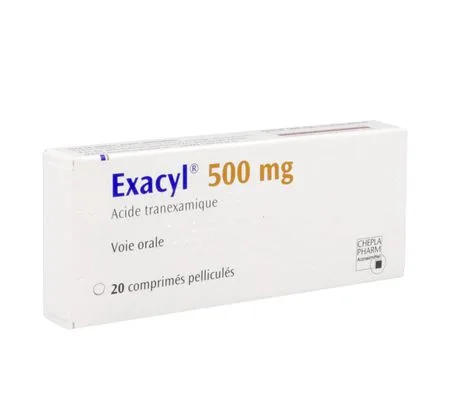
EXACYL 500 mg, film-coated tablet
Composition
For a film-coated tablet:
Tranexamic acid: 500 mg
Excipients with known effect : sucrose, wheat starch (gluten).
Wheat starch, magnesium stearate, sucrose.
Film coating: Butyl methacrylate copolymer, (2-dimethyl aminoethyl) methacrylate and methyl methacrylate copolymer 1:2:1, carnauba wax.
Indications
- Haemorrhagic accidents due to a generalised primary fibrinolytic state.
- Haemorrhagic accidents during treatment with a fibrinolytic effect.
- Haemorrhagic accidents sustained by local fibrinolysis, as is the case in:
- menorrhagia and metrorrhagia:
- due to hormonal dysfunction,
- secondary to traumatic, infectious or degenerative lesions of the uterus.
- digestive haemorrhages,
- haematuria of lower origin:
- prostatic adenomas,
- malignant prostatic and bladder neoplasms,
- lithiasis,
- and more generally haemorrhagic urinary disorders, following prostatic surgical interventions and surgical procedures involving the urinary tract.
- operative otorhinolaryngological haemorrhages (adenoidectomies and tonsillectomies).
- menorrhagia and metrorrhagia:
Dosage and administration
Dosage
In adults, the dosage is, depending on the condition to be treated, from 2 to 4 g every 24 hours, to be divided into 2 or 3 doses (i.e. 4 to 8 tablets per day).
Paediatric population
In children, for the currently approved indications described in the section Indications, the dosage is of the order of 20 mg/kg/day.
However, efficacy, dosage and safety data for these indications are limited.
Method of administration
Oral use.
Contraindications
- Hypersensitivity to the active substance or to any of the excipients listed in section Composition.
- Acute venous or arterial thrombosis (see section Warnings and precautions).
- Fibrinolytic states reactive to consumption coagulopathy, with the exception of states associated with predominant activation of the fibrinolytic system with severe acute haemorrhage (see section Warnings and precautions).
- Severe renal insufficiency (risk of accumulation).
- History of convulsions.
- This medicine is contraindicated in patients with an allergy to wheat (other than coeliac disease).
Warnings and precautions
Special warnings
Thromboembolic events
Risk factors for thromboembolic disease must be taken into account before using tranexamic acid. In patients with a history of thromboembolic diseases or in patients with an increased incidence of thromboembolic events in their family history (patients at high risk of thrombophilia), tranexamic acid should only be administered where there is a strong medical indication, after consultation with a haemostasis specialist and under strict medical supervision (see section Contraindications).
Oestro-progestogens
Tranexamic acid should be administered with caution in female patients taking oestro-progestogens (oral contraception and hormone replacement therapy) due to the increased risk of thrombosis.
Treatment must be stopped immediately if arterial or venous thromboembolic disorders occur.
Visual disorders
Attention should be paid to possible visual disturbances, including visual impairment, blurred vision, and disturbance of colour vision. If necessary, treatment should be interrupted. Regular ophthalmological examinations (eye examinations including in particular visual acuity, colour vision, fundus of the eye, visual field, etc.) are indicated during continuous and prolonged use of tranexamic acid. If pathological ophthalmic changes are observed, particularly in the presence of retinal diseases, the physician should consult a specialist to decide on the need for long-term use of tranexamic acid in each individual case.
Precautions for use
Convulsions
Cases of convulsions have been reported in association with treatment with tranexamic acid. During coronary artery bypass graft (CABG) surgery, most of these cases were reported after intravenous (IV) injection of tranexamic acid at high doses. When the lower recommended doses of tranexamic acid were used, the incidence of postoperative seizures was similar to that observed in untreated patients.
Hematuria
In case of haematuria originating from the upper urinary tract, there is a risk of urethral obstruction.
Renal impairment
In cases of renal insufficiency entailing a risk of accumulation, the dose of tranexamic acid will be reduced according to serum creatinine.
When serum creatinine is within the range:
- between 120 and 250 micromol/l, the dose will be 10 mg/kg, twice a day,
- between 250 and 500 micromol/l, the dose will be 10 mg/kg, once every 24 hours,
- of 500 micromol/l and above, the dose will be 5 mg/kg, every 24 hours.
Excipients with known effect
This medicine contains sucrose. Patients with fructose intolerance, glucose-galactose malabsorption syndrome or sucrase/isomaltase deficiency (rare hereditary diseases) must not take this medicine.
This medicine contains a very low gluten content (from wheat starch). It is considered "gluten-free" and is therefore unlikely to cause problems in cases of coeliac disease. A film-coated tablet contains no more than 9.7 micrograms of gluten. This medicine must not be taken by patients with an allergy to wheat (other than coeliac disease)..
Interactions
No interaction studies have been performed. Concomitant treatment with anticoagulants must be administered under the strict supervision of a physician specialised in this field.
Medicinal products that act on haemostasis must be administered with caution to patients treated with tranexamic acid.
Furthermore, the antifibrinolytic effect of the medicinal product may be antagonised by thrombolytics.
There is a theoretical risk of increased thrombus formation, as with oestrogens.
Fertility, pregnancy and breastfeeding
Pregnancy
As a precaution, it is preferable not to use tranexamic acid during the first trimester of pregnancy. Indeed, clinical data are insufficient, although animal data have not shown any teratogenic effect.
Limited clinical data on the use of tranexamic acid in certain haemorrhagic complications during the second and third trimesters of pregnancy have not shown any major foetotoxic effect.
Breast-feeding
Tranexamic acid is excreted in breast milk. Consequently, breastfeeding is not recommended during the duration of treatment.
Fertility
There are no clinical data on the effects of tranexamic acid on fertility.
Driving and using machines
Drivers of vehicles and users of machinery are advised of the risk of vertigo associated with the use of this medicinal product.
Adverse effects
Adverse reactions reported in clinical studies and post-marketing pharmacovigilance are listed below by system organ class.
Table listing the adverse reactions
The reported adverse effects are presented in the table below. Adverse effects are listed according to the main MedDRA system organ classes. Within each system organ class, adverse effects are presented by frequency. Within each frequency group, adverse effects are presented in order of decreasing seriousness. Frequencies were defined as follows: very common (≥ 1/10); common (≥ 1/100 to < 1/10); uncommon (≥ 1/1 000 to < 1/100); frequency not known (cannot be estimated from the available data).
|
MedDRA system organ class |
Frequency |
Adverse effects |
|
|
Immune system disorders |
Frequency not known |
Hypersensitivity reactions including anaphylactic reactions (urticaria, angioedema, anaphylactic shock) and various skin eruptions. |
|
|
Nervous system disorders |
Frequency not known |
Convulsions, particularly in the presence of risk factors or a history of convulsions, as well as in cases of misuse (see sections Contraindications and Warnings and precautions) |
|
|
Eye disorders |
Frequency not known |
Visual disturbances, including disturbances of colour perception |
|
|
Vascular disorders |
Frequency not known |
Malaise with hypotension, with or without loss of consciousness (usually after too rapid intravenous injection, exceptionally after oral administration)
|
|
|
Gastrointestinal disorders |
Common |
Digestive disorders such as:
|
|
|
Skin and subcutaneous tissue disorders |
Uncommon |
Allergic dermatitis |
|
|
Frequency not known |
Fixed pigmented erythema |
||
|
Renal and urinary disorders |
Frequency not known |
Acute renal cortical necrosis |
|
Reporting of suspected adverse reactions
Reporting suspected adverse reactions after authorisation of the medicinal product is important. It allows continued monitoring of the benefit/risk balance of the medicinal product. Healthcare professionals are asked to report any suspected adverse reactions via the national reporting system: National Agency for the Safety of Medicines and Health Products (ANSM) and the network of Regional Pharmacovigilance Centres - Website: https://signalement.social-sante.gouv.fr/.
Overdose
Signs and symptoms of overdose may include dizziness, headache, hypotension and convulsions. Convulsions have been shown to tend to occur more frequently as the dose increases.
Management of an overdose consists of symptomatic treatment.
Pharmacodynamics
Pharmacotherapeutic class: ANTIFIBRINOLYTIC, ATC code: B02AA02.
Tranexamic acid exerts an antihemorrhagic action by inhibiting the fibrinolytic activities of plasmin.
A complex is thus formed between tranexamic acid and plasminogen, with tranexamic acid remaining bound to plasminogen when it is converted to plasmin.
Plasmin bound to tranexamic acid is said to have considerably reduced activity toward fibrin compared with free plasmin.
Finally, various studies show that, in vivo, tranexamic acid at high doses exerts an inhibitory activity on activation of the complement system.
Pharmacokinetics
Absorption
Orally (20 mg/kg), rapid absorption with maximum blood concentration between the 2th and 3th hour, the product no longer being detectable at the 6th hour.
Distribution
- in the cellular compartment,
- in the cerebrospinal fluid in a delayed manner.
The volume of distribution is 33 p. 100 of body mass.
Elimination
The elimination half-life is approximately 1 hour.
Ninety percent of the administered dose is eliminated unchanged in the urine within the first 12 hours (glomerular excretion without tubular reabsorption).
Renal impairment
Plasma concentrations are increased in cases of renal insufficiency.
Pregnancy
Tranexamic acid crosses the placenta.
Prescription, supply and reimbursement
| Marketing authorisation (AMM) |
|
| Price: |
|
Marketing Authorisation Holder : Cheplapharm Arzneimittel GmbH, Ziegelhof 24, 17489 Greifswald, Germany.
CHEPLAPHARM France
68, rue Marjolin. 92300 Levallois-Perret
Tel: 08 09 54 20 23
https://www.cheplapharm.fr
Source: VIDAL · Updated on 10/11/2026. This information does not replace advice from a healthcare professional.