
Medicines
SPC of the 22/05/2026
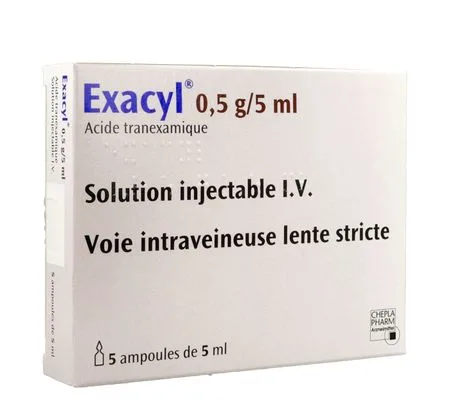
EXACYL 0,5 g/5 ml I.V., injectable solution
Forms and presentations
Injectable solution IV (clear, colorless and sterile).
Ampoule of 5 ml. Box of 5.
Composition
For one ampoule of 5 ml:
Tranexamic acid: 0,5 g
Concentrated hydrochloric acid, water for injectable preparations.
Indications
Prevention and treatment of haemorrhages due to general or local fibrinolysis in adults and children from one year of age.
Specific indications include:
- Haemorrhages caused by general or local fibrinolysis such as:
- Menorrhagia and metrorrhagia,
- Gastrointestinal haemorrhages,
- Haemorrhagic urinary disorders, following prostatic surgery or surgical procedures affecting the urinary tract,
- Otorhinolaryngological surgery (adenoidectomy, tonsillectomy, tooth extractions),
- Gynaecological surgery or disorders of obstetric origin,
- Thoracic and abdominal surgery and other major surgical procedures such as cardiovascular surgery,
- Management of haemorrhages due to administration of a fibrinolytic agent.
Dosage and administration
Dosage
Adults
Unless otherwise prescribed, the following doses are recommended:
- Standard treatment of local fibrinolysis:
- 0,5 g (1 ampoule of 5 ml) to 1 g (1 ampoule of 10 ml or 2 ampoules of 5 ml) of tranexamic acid (TXA) by slow intravenous injection (= 1 ml/minute) two to three times a day.
- Standard treatment of general fibrinolysis:
- 1 g (1 ampoule of 10 ml or 2 ampoules of 5 ml) of tranexamic acid (TXA) by slow intravenous injection (= 1 ml/minute) every 6 to 8 hours, equivalent to 15 mg/kg of body weight.
Renal impairment
In case of renal impairment leading to a risk of accumulation, the use of tranexamic acid is contraindicated in patients with severe renal impairment (see section Contraindications). In patients with mild to moderate renal impairment, the dose of tranexamic acid should be reduced according to the serum creatinine level:
|
Serum creatinine |
IV dose |
Administration |
|
|
micromol/L |
mg/dL |
||
|
120 to 249 |
1,35 to 2,82 |
10 mg/kg of body weight |
Every 12 hours |
|
250 to 500 |
2,82 to 5,65 |
10 mg/kg of body weight |
Every 24 hours |
|
> 500 |
> 5,65 |
5 mg/kg of body weight |
Every 24 hours |
Hepatic impairment
No dose adjustment is necessary in patients with hepatic impairment.
Paediatric population
In children from 1 year of age, for the currently approved indications described in section Indications, the dose is of the order of 20 mg/kg/day. However, data on efficacy, dosing and safety of use are limited for these indications.
The efficacy, dosing and safety of use of tranexamic acid in children undergoing cardiac surgery have not been fully established. The currently available data are limited and described in section Pharmacodynamics.
Elderly population
No dose reduction is necessary except in cases of proven renal impairment.
Method of administration
Administration must be given strictly by slow intravenous injection.
TRANEXAMIC ACID MUST BE ADMINISTERED BY INTRAVENOUS ROUTE ONLY and must not be administered by intrathecal or epidural route (see sections Contraindications and Warnings and precautions).
TO REDUCE THE RISK OF FATAL MEDICATION ERRORS DUE TO INCORRECT ROUTE OF ADMINISTRATION OF TRANEXAMIC ACID, IT IS STRONGLY RECOMMENDED TO LABEL SYRINGES CONTAINING TRANEXAMIC ACID (see sections Contraindications, Warnings and precautions and Disposal and handling).
Contraindications
- Hypersensitivity to the active substance or to any of the excipients listed in section Composition,
- Acute venous or arterial thrombosis (see section Warnings and precautions),
- Fibrinolytic states following consumption coagulopathy, with the exception of states associated with predominant activation of the fibrinolytic system with acute severe haemorrhage (see section Warnings and precautions),
- Severe renal impairment (risk of accumulation),
- History of convulsions,
- Intrathecal, epidural, intraventricular injections and intracerebral application (risk of cerebral oedema and of convulsions and death).
Warnings and precautions
The indications and mode of administration described above must be strictly followed:
- intravenous injections must be administered very slowly
- tranexamic acid must not be administered by intramuscular route.
Risk of medication errors due to incorrect route of administration
Exacyl must be administered by intravenous route only. Intrathecal, epidural, intraventricular and intracerebral use of Exacyl is contraindicated (see section Contraindications). Serious adverse reactions, including fatal events, have been reported when tranexamic acid was inadvertently administered by intrathecal route. These events included severe back, buttock and lower limb pain, myoclonus and generalised convulsive seizures, as well as cardiac arrhythmias.
Care must be taken to ensure that the route of administration of Exacyl is correct. Healthcare professionals must be aware of the risk of confusion of Exacyl with other injectable products, which could result in inadvertent intrathecal administration of Exacyl. This includes in particular injectable products administered by intrathecal route that may be used during the same procedure as tranexamic acid.
Syringes containing Exacyl must be clearly labelled with the intravenous route of administration.
Convulsions
Cases of convulsions have been reported in association with treatment with tranexamic acid. During coronary artery bypass graft (CABG) surgery, most of these cases were reported after intravenous (I.V.) injection of tranexamic acid at high doses. When the lower recommended doses of tranexamic acid were used, the incidence of postoperative seizures was similar to that observed in untreated patients.
Visual disorders
Attention should be paid to possible visual disturbances, including visual impairment, blurred vision, and disturbance of colour vision.
If necessary, treatment must be discontinued.
Regular ophthalmological examinations (eye examinations including visual acuity, colour vision, fundus of the eye, visual field, etc.) are indicated during continuous and prolonged use of a tranexamic acid injectable solution.
If pathological ophthalmic changes are observed, particularly in the presence of retinal disease, the physician should consult a specialist to decide on the need for long-term use of a tranexamic acid injectable solution in each individual case.
Hematuria
In cases of haematuria originating from the upper urinary tract, there is a risk of urethral obstruction.
Thromboembolic events
Risk factors for thromboembolic disease must be considered before using tranexamic acid. In patients with a history of thromboembolic disease or in patients with an increased incidence of thromboembolic events in their family history (patients at high risk of thrombophilia), tranexamic acid injectable solution should only be administered in the presence of a strong medical indication, after consultation with a haemostasis specialist and under strict medical supervision (see section Contraindications).
Tranexamic acid should be administered with caution to female patients receiving oral contraceptives due to the increased risk of thrombosis (see section Interactions).
Disseminated intravascular coagulation
In the majority of cases, patients with disseminated intravascular coagulation must not be treated with tranexamic acid (see section Contraindications). Administration of tranexamic acid must be restricted to individuals with predominant activation of the fibrinolytic system with acute severe haemorrhage.
The haematological profile is approximately characterised as follows: decreased euglobulin lysis time; prolonged Quick time; reduced plasma levels of fibrinogen, factors V and VIII, plasminogen-derived fibrinolysin and alpha-2 macroglobulin; normal plasma levels of P and the P complex (prothrombin complex), i.e. factors II (prothrombin), VIII and X; increased plasma levels of fibrinogen degradation products; a normal platelet count. The above assumes that the underlying pathological condition does not itself alter the various elements of this profile.
In such acute cases, a single dose of 1 g of tranexamic acid is often sufficient to control the haemorrhage. Administration of tranexamic acid in disseminated intravascular coagulation should only be considered if appropriate haematology laboratory facilities and qualified personnel are available.
Acute renal injury in the context of management of postpartum haemorrhage
Cases of acute renal injury (including cortical necrosis) have been reported with the use of tranexamic acid at doses > 2 g (total doses) in the treatment of postpartum haemorrhage.
As a precautionary measure, and since the causal relationship between tranexamic acid and acute renal injury could not be excluded, the use of doses > 2 g (total doses) of tranexamic acid should be carried out with caution in postpartum haemorrhage. »
Interactions
No interaction studies have been performed.
Concomitant treatment with anticoagulants must be administered under the strict supervision of a physician specialised in this field.
Medicinal products acting on haemostasis must be administered with caution to patients treated with tranexamic acid. There is a theoretical risk of increased thrombus formation, as with oestrogens. Furthermore, the antifibrinolytic effect of the medicinal product may be antagonised by thrombolytics.
Fertility, pregnancy and breastfeeding
Women of childbearing potential must use effective contraception during treatment.
Pregnancy
There are no sufficient clinical data on the use of tranexamic acid in pregnant women.
Consequently, although animal studies have not shown teratogenic effects, and as a precaution, tranexamic acid is not recommended during the first trimester of pregnancy.
Limited clinical data on the use of tranexamic acid in various haemorrhagic clinical situations during the second and third trimesters have not shown any harmful effect on the fetus. Tranexamic acid should only be used during pregnancy if the expected benefit justifies the potential risk.
Breast-feeding
Tranexamic acid is excreted in breast milk. Therefore, breastfeeding is not recommended.
Fertility
There are no clinical data on the effects of tranexamic acid on fertility.
Driving and using machines
No studies have been performed on the ability to drive vehicles and use machines.
Adverse effects
Adverse reactions reported in clinical studies and post-marketing pharmacovigilance are listed below by system organ class.
Table listing the adverse reactions
The reported adverse reactions are presented in the table below. Adverse reactions are listed according to the main MedDRA system organ classes. Within each system organ class, adverse reactions are presented by frequency. Within each frequency group, adverse reactions are presented in order of decreasing seriousness. Frequencies were defined as follows: very common (≥ 1/10); common (≥ 1/100 to < 1/10); uncommon (≥ 1/1 000 to < 1/100); frequency not known (cannot be estimated from the available data).
|
MedDRA system organ class |
Frequency |
Adverse effects |
|
Immune system disorders |
Frequency not known |
Hypersensitivity reactions including anaphylactic reactions (urticaria, angioedema, anaphylactic shock) and various skin eruptions |
|
Nervous system disorders |
Frequency not known |
Convulsions, particularly in cases of misuse (see sections Contraindications and Warnings and precautions) |
|
Eye disorders |
Frequency not known |
Visual disturbances, including disturbances of colour perception |
|
Vascular disorders |
Frequency not known |
Malaise with hypotension, with or without loss of consciousness (usually after too rapid intravenous injection, exceptionally after oral administration)
|
|
Gastrointestinal disorders |
Common |
Diarrhoea
|
|
Skin and subcutaneous tissue disorders |
Uncommon |
Allergic dermatitis |
|
Frequency not known |
Fixed pigmented erythema |
|
|
Renal and urinary disorders |
Frequency not known |
Acute renal cortical necrosis |
Reporting of suspected adverse reactions
Reporting suspected adverse reactions after authorisation of the medicinal product is important. It allows continued monitoring of the benefit/risk balance of the medicinal product. Healthcare professionals are asked to report any suspected adverse reactions via the national reporting system: National Agency for the Safety of Medicines and Health Products (ANSM) and the network of Regional Pharmacovigilance Centres - Website: https://signalement.social-sante.gouv.fr/.
Overdose
No cases of overdose have been reported.
Signs and symptoms may include dizziness, headache, hypotension and convulsions. It has been shown that convulsions tend to occur at a higher frequency when the dose is increased.
Management of an overdose consists of symptomatic treatment.
Pharmacodynamics
Pharmacotherapeutic class: antihaemorrhagics, antifibrinolytics, ATC code: B02AA02.
Tranexamic acid exerts an antihaemorrhagic action by inhibiting the fibrinolytic activities of plasmin.
A complex is thus formed between tranexamic acid and plasminogen, tranexamic acid being bound to plasminogen when it is transformed into plasmin.
The activity of the complex between tranexamic acid and plasmin on fibrin activity is weaker than the activity of free plasmin alone.
Studies in vitro have shown that tranexamic acid administered at high doses reduces complement activity.
Paediatric population
In children from one year of age:
A review of the literature identified 12 efficacy studies in paediatric cardiac surgery, including 1 073 children, of whom 631 received tranexamic acid. Most of them were placebo-controlled studies. The population studied was heterogeneous in terms of age, type of surgical intervention and dosage regimens.
The results of the studies suggest that tranexamic acid reduces bleeding and transfusion requirements in paediatric cardiac surgery under extracorporeal circulation (ECC), and at high risk of haemorrhage, particularly in cyanotic or re-operated patients.
The most suitable dosage regimen appears to be the following:
- an initial bolus of 10 mg/kg after induction of anaesthesia and before skin incision,
- a continuous infusion of 10 mg/kg/h,
- a final injection of 10 mg/kg at the end of ECC.
Although studied in a very small number of patients, the limited data suggest that the infusion maintains a therapeutic plasma concentration throughout the procedure.
No specific dose-effect study has been conducted in children.
Pharmacokinetics
Absorption
Maximum plasma concentrations of tranexamic acid are obtained rapidly after a brief intravenous infusion; plasma concentrations then decline in a multi-exponential manner.
Distribution
The plasma protein binding of tranexamic acid is of the order of 3% at therapeutic plasma levels and appears to result entirely from its binding to plasminogen. Tranexamic acid does not bind to serum albumin. The initial volume of distribution is approximately between 9 and 12 litres.
Tranexamic acid crosses the placenta. After an intravenous injection of 10 mg/kg to 12 pregnant women, the serum concentration of tranexamic acid ranged from 10 to 53 micrograms/ml whereas that of umbilical cord blood ranged from 4 to 31 micrograms/ml.
Tranexamic acid diffuses rapidly into joint fluid and the synovial membrane. After an intravenous injection of 10 mg/kg to 17 patients undergoing knee surgery, concentrations in joint fluids were similar to the concentrations observed in the corresponding serum samples.
The concentration of tranexamic acid in a number of other tissues represents a fraction of the concentration observed in blood (breast milk, one hundredth; cerebrospinal fluid, one tenth; aqueous humour, one tenth).
Tranexamic acid has been detected in semen where it inhibits fibrinolytic activity but has no effect on sperm migration.
Elimination
Tranexamic acid is excreted mainly in the urine in unchanged form. Urinary excretion by glomerular filtration is the main elimination route. Renal clearance is equivalent to plasma clearance (110 to 116 ml/min). Excretion of tranexamic acid is approximately 90 % within the first 24 hours following intravenous administration of 10 mg/kg of body weight. The elimination half-life of tranexamic acid is approximately 3 hours
Special populations
Renal impairment
Plasma concentrations increase in patients with renal impairment.
Paediatric population
A study evaluated pharmacokinetic data in a population of 21 children (aged 2,5 to 8,7 years with a weight of 11,5 to 25,3 kg) during cardiac surgery under extracorporeal circulation (CPB). Weight was reported as the main covariate affecting the pharmacokinetics of tranexamic acid in this population. Within the weight range studied (10 to 30 kg), plasma clearance decreased with increasing weight (from 0,95 to 0,72 ml/min/kg), consistent with an increase in the elimination half-life (10 to 12,6 hours).
Preclinical safety
Non-clinical data from conventional safety pharmacology, repeated-dose toxicity, genotoxicity, carcinogenesis and reproductive and developmental toxicity studies did not reveal any particular risk for humans.
An epileptogenic activity has been observed in animals with intrathecal use of tranexamic acid.
INCOMPATIBILITIES
In vitro, etamsylate causes a slight decrease in the activity of EXACYL by shortening the lysis time. Vitamin K1 and tiemonium methylsulfate would appear to slightly increase the action of Exacyl by prolonging the lysis time.
EXACYL must not be mixed with or injected simultaneously with urokinase.
Parenteral administration of EXACYL mixed with certain antihypertensives (noradrenaline bitartrate, deoxyepinephrine hydrochloride, metaraminol bitartrate), with benzylpenicillins, tetracyclines (tetracycline hydrochloride, rolitetracycline nitrate, rolitetracycline), with dipyridamole, diazepam or midazolam should be avoided, as colour changes or precipitates may appear.
SPECIAL PRECAUTIONS FOR DISPOSAL AND OTHER HANDLING
Health professionals are strongly recommended to label Exacyl syringes at the time of withdrawing the product from the ampoule for clear identification and correct route of administration, in order to prevent any inadvertent medication error during administration to the patient.
Prescription, supply and reimbursement
| Marketing authorisation (AMM) |
|
| Price: |
|
CHEPLAPHARM France
68, rue Marjolin. 92300 Levallois-Perret
Tel: 08 09 54 20 23
https://www.cheplapharm.fr
Source: VIDAL · Updated on 10/11/2026. This information does not replace advice from a healthcare professional.