
Medicines
SmPC of 08/09/2025
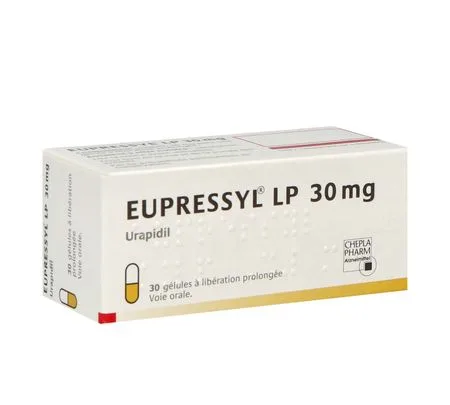
EUPRESSYL LP 30 mg, prolonged-release capsule
Forms and presentations
Prolonged-release capsule (with a dark yellow transparent body and an opaque white cap).
Bottle of 30, with desiccant (silica gel). Box of 1.
Composition
For a prolonged-release capsule:
Urapidil: 30,000 mg
Excipient(s) with known effect: sucrose
Methacrylic acid and methyl methacrylate copolymer (1:2) (Eudragit S at 12,5%), neutral microgranules (sucrose, maize starch), talc, fumaric acid, hypromellose, ethylcellulose, hypromellose phthalate, stearic acid, diethyl phthalate
Composition of the capsule shell : gelatin, titanium dioxide (E171), erythrosine (E127), quinoline yellow (E104)
Dosage and administration
Dosage
In adults on monotherapy, the recommended dose is 120 mg per day in 2 doses. This dose should be adjusted to the therapeutic response without, however, exceeding 180 mg per day in 2 doses.
In some patients, a dose of 60 mg per day in 2 doses is sufficient.
Special populations
In elderly subjects on monotherapy, the recommended dose is 60 mg per day in 2 doses; in case of inefficacy it may be increased to 120 mg per day in 2 doses.
In patients with moderate to severe renal impairment, a dose reduction may be considered in the case of long-term treatment.
In patients with severe hepatic impairment, a dose reduction may be considered.
Method of administration
Prolonged-release capsules must be taken during the morning and evening meals, and must be swallowed with a little liquid.
No exaggerated first-dose effect has been demonstrated, and there has been no rebound effect on abrupt discontinuation of treatment.
It is not necessary to modify the dose in prolonged treatments due to the absence of tachyphylaxis.
Combination with other antihypertensive medicinal products is possible, in particular diuretics and beta-blockers
Contraindications
Hypersensitivity to the active substance or to any of the excipients listed in section Composition.
Warnings and precautions
- Particular monitoring should be carried out in patients with cardiac insufficiency of mechanical origin, that is to say aortic or mitral stenosis, pulmonary embolism, or disturbance of cardiac function linked to a pericardial pathology.
- In patients who are hypovolaemic (diarrhoea, vomiting) and/or depleted of sodium, initial doses will be low, then adjusted to the clinical and biological course (risk of increasing the antihypertensive action of urapidil).
- In elderly subjects (see section Dosage and administration).
- In patients with moderate to severe renal impairment (see section Dosage and administration).
- In case of severe impairment of hepatic function, it is recommended to reduce doses, particularly for long-term treatment.
- In cases of general anaesthesia for major surgery or when anaesthesia is performed with potentially hypotensive agents, urapidil may cause a certain degree of hypotension which will need to be corrected by volume expansion.
- Patients with fructose intolerance, glucose-galactose malabsorption syndrome or sucrase/isomaltase deficiency (rare hereditary diseases) must not take this medicine.
Paediatric population
- In the absence of available data, do not use in children.
Interactions
Combinations not recommended
+ Urological alpha-blockers
Potentiation of the hypotensive effect. Risk of severe orthostatic hypotension.
Associations requiring precautions for use
+ Baclofen : Increased risk of hypotension, particularly orthostatic. Monitoring of blood pressure and dose adjustment of the antihypertensive if necessary.
+ Phosphodiesterase type 5 inhibitors (sildenafil, tadalafil, vardenafil): Risk of orthostatic hypotension, particularly in elderly subjects. Start treatment at the recommended minimum doses and gradually adjust doses if needed.
Associations to be taken into account
+ Amifostine : Increased hypotension, particularly orthostatic.
+ Tricyclic antidepressants : Increased risk of hypotension, particularly orthostatic.
+ Neuroleptics : Increased risk of hypotension, particularly orthostatic.
+ Antihypertensives except alpha-blockers : Increased hypotensive effect. Increased risk of orthostatic hypotension.
+ Nitrates and related compounds: Increased risk of hypotension, particularly orthostatic hypotension.
+ Glucocorticoids (except hydrocortisone as substitution therapy) and mineralocorticoids: Decreased antihypertensive effect (sodium and water retention by corticosteroids).
Fertility, pregnancy and breastfeeding
Pregnancy
There are no data or there are limited data on the use of urapidil in pregnant women.
Studies performed in animals have demonstrated reproductive toxicity (see section Preclinical safety).
Urapidil is not recommended during pregnancy and in women of childbearing potential not using contraception.
Breast-feeding
In the absence of data on passage into breast milk, breastfeeding is not recommended during treatment with urapidil.
Fertility
Animal studies have shown a decrease in fertility (see section Preclinical safety).
Driving and using machines
Response to treatment may vary from patient to patient. Urapidil may impair the ability to drive vehicles or operate machinery, particularly at the start of treatment, when the treatment is changed, and when alcohol is taken concomitantly.
Adverse effects
Cardiovascular disorders:
- Uncommon: palpitations, tachycardia;
- Very rare: orthostatic hypotension.
Gastrointestinal disorders:
- Common: nausea;
- Rare: stomach pain, dry mouth, vomiting, diarrhoea.
Skin disorders:
- Very rare: hypersensitivity such as pruritus, erythema and skin rash;
- Frequency not known: angioedema, urticaria.
Changes in biological parameters:
- Very rare: reversible elevation of liver enzymes, thrombocytopenia.
General disorders and administration site conditions:
- Rare: asthenia.
Central nervous system disorders:
- Common: dizziness, headache.
Psychiatric disorders:
- Rare: sleep disorders, agitation.
Genitourinary disorders:
- Very rare: worsening of urinary incontinence, urinary urgency, ejaculation disorder, impotence or priapism.
Respiratory, thoracic and mediastinal disorders:
- Nasal congestion.
Reporting of suspected adverse reactions
Reporting suspected adverse reactions after authorisation of the medicinal product is important. It allows continued monitoring of the benefit/risk balance of the medicinal product. Healthcare professionals are asked to report any suspected adverse reactions via the national reporting system: National Agency for the Safety of Medicines and Health Products (ANSM) and the network of Regional Pharmacovigilance Centres - Website: https://signalement.social-sante.gouv.fr.
Overdose
Symptoms :
The clinical manifestations are circulatory and neurological in type:
- Circulatory system: dizziness, orthostatic hypotension, collapse;
- Central nervous system: fatigue, decreased reaction speed.
Action to be taken:
Lay the patient down and institute standard treatment for arterial hypotension (volume expansion, catecholamines if necessary).
Pharmacodynamics
Pharmacotherapeutic class: Antihypertensive, peripherally acting adrenolytic/Alpha blocker, ATC code: C02CA06.
Vasodilator acting through blockade of post-synaptic peripheral alpha-1-adrenergic receptors and through an effect on the central regulation of blood pressure and sympathetic tone by inhibition of alpha-1-adrenergic receptors and stimulation of 5-HT receptors1A serotonergic. In hypertensive patients, these effects rapidly translate into a decrease in systolic and diastolic blood pressures, supine, standing, at rest and on exertion, without reflex increase in heart rate.
The decrease in blood pressure is secondary to a reduction in total peripheral resistance (for example at the renal level where flow increases) without change in cardiac output.
When pulmonary resistance is increased, for the same dose of urapidil, the decrease in these resistances is greater than that of total peripheral resistance.
No potentiation of bronchospasm was observed. Renin and aldosterone secretions are not increased. No first-dose effect, tachyphylaxis or rebound phenomenon was observed.
In studies, urapidil did not modify hydroelectrolytic balance, lipid metabolism, carbohydrate tolerance, hepatic and renal functions and/or haematological parameters.
Urapidil has no deleterious effect on lipid parameters, and some studies showed in hypertensive and hypercholesterolaemic patients a tendency toward lowering of blood total cholesterol and triglyceride levels. The clinical significance of these changes is not established.
In patients suffering from lung disease with chronic respiratory insufficiency (hypoxia and hypercapnia) and secondary pulmonary arterial hypertension, several studies showed that urapidil had a vasodilating action on the pulmonary circulation; there is no harmful effect on ventilatory function, bronchial reactivity and gas exchange.
Pharmacokinetics
After oral administration, peak serum concentration is reached after 4-6 h. Absolute bioavailability is 72 %. The mean serum elimination half-life is 4,7 h.
Urapidil is metabolised mainly in the liver into three metabolites, the main one in humans being the parahydroxylated derivative (M1), which is inactive.
30 to 50 % of the administered dose is eliminated as metabolites in the urine, as well as 10 to 15 % of unchanged parent product. The remainder is eliminated in the faeces.
Plasma protein binding is 80 %.
Renal impairment : in patients with advanced renal insufficiency, clearance is reduced and plasma half-life is longer.
Hepatic impairment : in patients with advanced hepatic insufficiency, clearance is reduced and plasma half-life is longer.
Preclinical safety
Prolongation of the oestrous cycle has been observed in rats and mice, but its relevance for humans is not known. Although there was no impact on fertility in mice, a decrease in fertility has been reported in rats. Embryo-foetal developmental toxicity studies showed an embryo-lethal effect, but no teratogenic effect in mice, rats and rabbits. In a pre- and post-natal developmental toxicity study, a decrease in perinatal survival and body weight was observed in the pups of the F1 generation.
Prescription, supply and reimbursement
| Marketing authorisation (AMM) |
|
| Price: |
|
CHEPLAPHARM France
68, rue Marjolin. 92300 Levallois-Perret
Tel: 08 09 54 20 23
https://www.cheplapharm.fr
Source: VIDAL · Updated on 10/11/2026. This information does not replace advice from a healthcare professional.