Medicines
SmPC of 21/05/2026
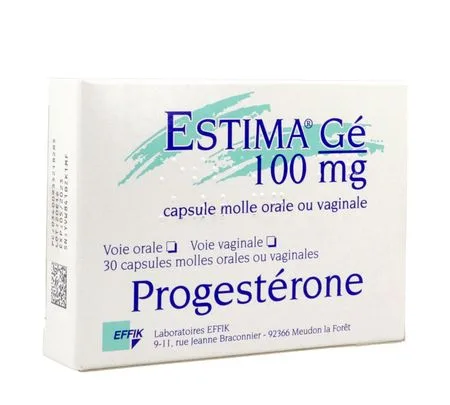
ESTIMA 100 mg, oral or vaginal soft capsule
Composition
Progesterone..........................................................................................................................................100,00 mg
For one soft capsule
Excipients: peanut oil, soya lecithin.
Peanut oil, soya lecithin
Capsule shell :
Gelatin, glycerol, titanium dioxide (E171).
Indications
Oral use
Disorders related to progesterone insufficiency, in particular:
• premenstrual syndrome,
• menstrual irregularities due to dysovulation or anovulation,
• benign mastopathies,
• premenopause,
• hormone replacement therapy for menopause (in addition to estrogen therapy).
Vaginal route
• progesterone replacement in ovarian insufficiency or complete deficiency in ovarian-deficient women (oocyte donation),
• luteal phase support during in vitro fertilization (IVF) cycles,
• luteal phase support during spontaneous or induced cycles, in cases of hypofertility or primary or secondary infertility, notably due to dysovulation,
• in cases of threatened miscarriage or prevention of recurrent miscarriage due to luteal insufficiency, up to the 12th week of pregnancy.
In all other indications of progesterone, the vaginal route represents an alternative to the oral route in cases of:
• side effects due to progesterone (drowsiness after oral intake).
Dosage and administration
In all therapeutic indications, it is important to strictly adhere to the recommended dosages.
Whatever the indication and route of administration (oral or vaginal), the dose must not exceed 200 mg per dose
Oral use
In progesterone insufficiency, the average dose is 200 to 300 mg of micronized progesterone per day.
It is recommended to take the medicine away from meals, preferably in the evening at bedtime.
• In luteal insufficiency (premenstrual syndrome, benign mastopathies, menstrual irregularities, premenopause), the usual therapeutic regimen is 200 to 300 mg per day:
- i.e. 200 mg in 1 dose taken in the evening at bedtime,
- or 300 mg in 2 doses,
10 days per cycle, usually from the 17th to the 26th day inclusive.
• In hormone replacement therapy for menopause, estrogen therapy alone is not recommended (risk of endometrial hyperplasia): progesterone should be added at a dose of 200 mg per day:
- in two doses of 100 mg each,
- or in a single dose of 200 mg in the evening at bedtime, i.e. 12 to 14 days per month, or the last two weeks of each therapeutic sequence.
This treatment will be followed by an interruption of all replacement therapy for about one week, during which a withdrawal bleed is usually observed.
For these indications, one will use the vaginal route, at the same doses as the oral route, in case of side effects due to progesterone (drowsiness after oral absorption).
Vaginal route
Each capsule must be inserted deep into the vagina.
• Progesterone replacement in ovarian insufficiency or complete deficiency in ovarian-deprived women (oocyte donors).
The therapeutic regimen (in addition to appropriate estrogen treatment) is as follows:
- 100 mg of micronized progesterone per day on the 13th and 14th day of the transfer cycle, then,
- 200 mg of micronized progesterone per day from the 15th to the 25th day of the cycle, divided into one or two doses per day, then,
- from the 26th day of the cycle and in case of early pregnancy, this dose may reach a maximum of 600 mg/day divided into 3 doses.
This dosage will be continued until the 60th day, and at the latest until the 12th week of pregnancy.
• Luteal phase support during IVF cycles:
The recommended dose is 400 to 600 mg/day, in two to three doses per day, from the day of the hCG injection until the 12th week of pregnancy.
• Luteal phase support during spontaneous or induced cycles, in case of subfertility or primary or secondary infertility, particularly due to anovulation: the recommended dose is 200 to 300 mg/day, in two doses, from the 17th day of the cycle for 10 days.
Treatment will be promptly resumed in case of absence of return of menses and pregnancy diagnosis, until the 12th week of pregnancy.
• Threatened early miscarriage or prevention of recurrent miscarriage due to luteal insufficiency: the recommended dosage is 200 to 400 mg/day in two doses, until the 12th week of pregnancy.
Contraindications
This medicine is contraindicated in cases of severe impairment of liver function.
This medicine contains peanut oil; it is contraindicated in cases of allergy to peanut or soya.
This medicine contains soya lecithin; it is contraindicated in cases of allergy to peanut or soya.
Warnings and precautions
Warnings :
• more than half of early spontaneous miscarriages are due to genetic accidents. In addition, infectious phenomena and mechanical disorders may be responsible for early miscarriages. The administration of progesterone would then have the sole effect of delaying the expulsion of a dead egg (or the interruption of a non-viable pregnancy).
• the use of progesterone should be reserved for cases where the secretion of the corpus luteum is insufficient.
• the treatment under the recommended conditions of use is not contraceptive.
• the use of ESTIMA during pregnancy is reserved for the first trimester and for the vaginal route. ESTIMA is not a treatment for threatened premature labour.
• cases of cytolytic-type liver damage and cases of gestational cholestasis have exceptionally been reported with the administration of micronised progesterone during the 2th and 3th trimesters of pregnancy.
Fertility, pregnancy and breastfeeding
Numerous epidemiological studies involving more than a thousand patients have not found an association between progesterone and foetal malformations.
Driving and using machines
Attention is drawn, particularly to vehicle drivers and machine users, to the risks of drowsiness and/or dizziness associated with the use of this medicine by the oral route.
Adverse effects
Oral use
• Drowsiness or fleeting dizziness occurring 1 to 3 hours after taking the product. In this case,
- reduce the dose per dose,
- or change the timing of doses (for example, for a dose of 200 mg/day, take the 200 mg in the evening at bedtime as a single dose, away from meals),
- switch to the vaginal route.
• Shortening of the menstrual cycle or intercurrent bleeding.
Delay the start of treatment later in the cycle (for example start on day 19th of the cycle instead of day 17th).
These effects most often indicate an overdose.
Due to the presence of peanut oil and soya lecithin, risk of hypersensitivity reaction (anaphylactic shock, urticaria).
Vaginal route
• No local intolerance (burning, pruritus or greasy discharge) was observed during the various clinical studies.
• No general side effects, in particular drowsiness or dizziness, were reported during clinical studies at the recommended dosages.
Reporting of suspected adverse reactions
Reporting suspected adverse reactions after authorisation of the medicinal product is important. It allows continued monitoring of the benefit/risk balance of the medicinal product. Healthcare professionals are asked to report any suspected adverse reaction via the national reporting system: National Agency for the Safety of Medicines and Health Products (ANSM) and the network of Regional Centres of Pharmacovigilance - Website: https://signalement.social-sante.gouv.fr/.
Pharmacodynamics
Pharmacotherapeutic class: PROGESTOGEN, ATC code: G03DA04.
(G: Genito-urinary system and sex hormones)
The properties of ESTIMA are comparable to those of natural progesterone, in particular: progestogen, antioestrogen, weakly antiandrogen, antialdosterone.
Pharmacokinetics
Oral use
Absorption
Micronised progesterone is absorbed by the digestive route.
Elevation of progesteronemia begins from the first hour, and the highest plasma levels are observed 1 to 3 hours after intake.
Pharmacokinetic studies in healthy volunteers showed that after simultaneous ingestion of two ESTIMA 100 mg capsules, progesteronemia rises on average from 0,13 ng/ml to 4,25 ng/ml after 1 hour, 11,75 ng/ml at 2 hours, 8,37 ng/ml at 4 hours, 2,00 ng/ml at 6 hours and 1,64 ng/ml at 8 hours.
Given the tissue retention time of the hormone, it appears necessary, in order to achieve impregnation throughout the nychthemeron, to divide the dosage into two intakes spaced about 12 hours apart.
There are marked individual variations; however, the same individual retains the same pharmacokinetic characteristics several months apart, which allows good individual adaptation of the dosage.
Metabolism
In plasma, the main metabolites are the 20α - hydroxy, Δ4 α pregnanolone and the 5α - dihydroprogesterone.
Urinary elimination occurs for 95% in the form of glucuroconjugated metabolites, the main one being the 3 α, 5 β - pregnanediol (pregnandiol). These plasma and urinary metabolites are identical to those found during the physiological secretion of the ovarian corpus luteum.
Vaginal route
Absorption
After vaginal insertion, absorption of progesterone through the vaginal mucosa is rapid, as evidenced by the rise in plasma progesterone levels from the first hour following administration.
The maximum plasma concentration of progesterone is reached 2 to 6 hours after application and is maintained at an average concentration over 24 hours of 9,7 ng/ml after administration of 100 mg morning and evening. This recommended average dosage therefore induces physiological and stable plasma concentrations of progesterone, similar to those observed during the luteal phase of a normal ovulatory menstrual cycle. The small inter-individual variations in progesterone levels allow the expected effect to be predicted precisely with a standard dosage.
At doses above 200 mg/day, the progesterone concentrations obtained are comparable to those described during the first trimester of pregnancy.
Metabolism
In plasma, the concentration of the 5β-pregnanolone is not increased.
Urinary elimination occurs mainly in the form of 3α, 5β-pregnanediol (pregnandiol), as shown by the progressive increase in its concentration (reaching a maximum concentration of 142 ng/ml at the 6th hour).
Prescription, supply and reimbursement
| Marketing authorisation (AMM) |
|
| Price: |
|
- Premenopause (Plq/30, Plq/90)
- Subfertility due to luteal insufficiency (Plq/30, Plq/90)
- Benign mastopathy (Plq/30, Plq/90)
- Menopause, treatment associated with oestrogen therapy (of) (Plq/30, Plq/90)
- Premenstrual syndrome (Plq/30, Plq/90)
- Menstrual irregularity (Plq/30, Plq/90)
- Gynaecological disorders due to luteal insufficiency (Plq/30, Plq/90)
- Luteal phase supplementation during ART (Plq/30, Plq/90)
Collection.
BUILDING LE NEWTON 9-11 RUE JEANNE BRACONNIER
92360 MEUDON-LA-FORÊT CEDEX
Tel: 01 41 28 20 20 contact@effik.fr
https://effik.fr/
Source: VIDAL · Updated on 10/11/2026. This information does not replace advice from a healthcare professional.