
Medicines
RCP of 25/03/2024
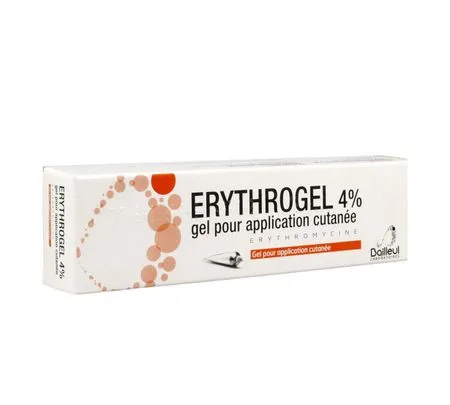
ERYTHROGEL 4 %, gel for cutaneous application
Composition
For 100 g of gel:
Erythromycin: 4,00 g
Excipient(s) with known effect: ethanol
Hyprolose, ethanol at 96 percent.
Indications
Topical treatment of acne, in particular polymorphic acne with an inflammatory component (papulopustular).
Official recommendations concerning the appropriate use of antibacterial agents should be taken into account.
Dosage and administration
Dosage
One to two applications daily for three months.
Paediatric population
Not applicable.
Method of administration
Cutaneous use.
Wash the face with a non-alkaline, low-detergent soap. Rinse thoroughly. When the skin is dry, apply the amount of one drop of ERYTHROGEL to the face and massage gently to allow it to penetrate.
Contraindications
Hypersensitivity to the active substance, erythromycin, or to the macrolide family and related substances, or to any of the excipients mentioned in the section Composition.
Warnings and precautions
Avoid contact with mucous membranes and fragile areas (alcoholic excipient).
In case of application to mucous membranes, eyes, mouth, nostrils or to an open wound, rinse thoroughly with lukewarm water.
Avoid washing too frequently, in particular with alkaline soaps, which promote sebum production.
Avoid the use of perfumes, eaux de toilette, eaux de Cologne, etc., for the entire duration of treatment.
Do not swallow.
Do not leave within the reach of children.
As with other macrolides, severe and rare allergic reactions, including acute generalised exanthematous pustulosis (AGEP), have been reported. If an allergic reaction occurs, administration of the medicine must be discontinued and appropriate treatment must be initiated. Physicians should be informed of the possibility of recurrence of allergic symptoms when symptomatic treatment is discontinued.
This medicine contains 952.5 mg of alcohol (ethanol at 96 %) in 1 g of product, equivalent to 952.5 mg/g. This may cause a burning sensation on damaged skin.
Interactions
Associations requiring precautions for use
Cross-resistance may be induced when using other antibiotics, in particular antibiotics of the macrolide group, clindamycin and lincomycin.
Fertility, pregnancy and breastfeeding
Pregnancy
Data from a large number of patients treated during pregnancy with systemic erythromycin indicate to date no adverse effects on pregnancy or on the health of the foetus and newborn.
Erythromycin may be used during pregnancy if necessary.
Breast-feeding
Erythromycin is excreted into breast milk in very small quantities because the systemic exposure of the breastfeeding woman after cutaneous administration of erythromycin is negligible. To date, no effect on the breastfed child has been reported.
Erythromycin may be used during breastfeeding.
Do not apply to the breasts during breastfeeding.
Adverse effects
Skin and subcutaneous tissue disorders:
Frequency not known: acute generalised exanthematous pustulosis (AGEP)
A sensation of dry skin may appear at the start of treatment. Exceptionally, cases of skin irritation and erythema have been reported.
A few rare cases of skin intolerance have been reported; they generally disappear with continued treatment.
Reporting of suspected adverse reactions
Reporting suspected adverse reactions after authorisation of the medicinal product is important. It allows continued monitoring of the benefit/risk balance of the medicinal product. Healthcare professionals are asked to report any suspected adverse reactions via the national reporting system: National Agency for the Safety of Medicines and Health Products (ANSM) and the network of Regional Pharmacovigilance Centres - Website: https://signalement.social-sante.gouv.fr/.
Pharmacodynamics
Pharmacotherapeutic class: anti-infective for the treatment of acne, ATC code: D10AF02.
In the current state of knowledge, the pathogenesis of acne involves several factors:
- Seborrhoeic hypersecretion (under the control of androgens).
- Sebum retention, due to an abnormality of keratinisation of the infra-infundibulum of the pilosebaceous follicle, leading to the formation of comedones and microcysts (essential clinical features).
- Inflammatory reaction induced by saprophytic germs (Propionibacterium acnes, Staphylococcus epidermidis...) and certain irritant components of sebum, leading to the formation of inflammatory papules, pustules and nodules.
- Erythromycin is an antibiotic of the macrolide group.
Its interest in the topical treatment of acne is that it is active against the Propionibacterium acnes (a few rare cases of resistance of this germ have, however, been reported in the literature).
This antibacterial activity is accompanied by an anti-inflammatory reaction.
ANTIBACTERIAL ACTIVITY SPECTRUM
Critical concentrations separate susceptible strains from strains of intermediate susceptibility, and the latter from resistant ones:
S < 1 mg/l and R > 4 mg/l
The prevalence of acquired resistance can vary according to geography and time for certain species. It is therefore useful to have information on local resistance prevalence, especially for the treatment of severe infections. These data can only provide guidance on the probabilities of the susceptibility of a bacterial strain to this antibiotic.
Where the variability of resistance prevalence in France is known for a bacterial species, it is indicated in the table below:
|
Categories |
Frequency of acquired resistance in France (> 10 %) (extreme values) |
|
SENSITIVE SPECIES |
|
|
Gram-positive aerobes |
|
|
Bacillus cereus |
|
|
Corynebacterium diphtheriae |
|
|
Enterococci |
50-70 % |
|
Rhodococcus equi |
|
|
Staphylococcus spp. meti-S |
|
|
Staphylococcus spp. meti-R* |
70-80 % |
|
Streptococcus B |
|
|
Streptococcus non-groupable |
30-40 % |
|
Streptococcus pneumoniae |
35-70 % |
|
Streptococcus pyogenes |
16-31 % |
|
Gram-negative aerobes |
|
|
Bordetella pertussis |
|
|
Branhamella catarrhalis |
|
|
Campylobacter |
|
|
Legionella |
|
|
Moraxella |
|
|
Anaerobes |
|
|
Actinomyces |
|
|
Bacteroides |
30-60 % |
|
Eubacterium |
|
|
Mobiluncus |
|
|
Peptostreptococcus |
30-40 % |
|
Porphyromonas |
|
|
Prevotella |
|
|
Propionibacterium acnes |
|
|
Other |
|
|
Borrelia burgdorferi |
|
|
Chlamydia |
|
|
Coxiella |
|
|
Leptospires |
|
|
Mycoplasma pneumoniae |
|
|
Treponema pallidum |
|
|
MODERATELY SENSITIVE SPECIES |
|
|
(in vitro intermediate susceptibility) |
|
|
Gram-negative aerobes |
|
|
Haemophilus |
|
|
Neisseria gonorrhoeae |
|
|
Anaerobes |
|
|
Clostridium perfringens |
|
|
Other |
|
|
Ureaplasma urealyticum |
|
|
RESISTANT SPECIES |
|
|
Gram-positive aerobes |
|
|
Corynebacterium jeikeium |
|
|
Nocardia asteroides |
|
|
Gram-negative aerobes |
|
|
Acinetobacter |
|
|
Enterobacteria |
|
|
Pseudomonas |
|
|
Anaerobes |
|
|
Fusobacterium |
|
|
Other |
|
|
Mycoplasma hominis |
* The frequency of resistance to methicillin is approximately 30 to 50 % of all staphylococci and is found mainly in hospital settings.
Remark : this spectrum corresponds to that of the systemic forms of erythromycin. With the local pharmaceutical presentations, the concentrations obtained in situ are much higher than plasma concentrations. Some uncertainties remain regarding the kinetics of the in situ concentrations, the local physicochemical conditions that may modify the activity of the antibiotic, and the stability of the product in situ.
Prescription, supply and reimbursement
| Marketing authorisation (AMM) |
|
| Price: |
|
GIULIANI GROUP 264 RUE DU FAUBOURG SAINT-HONORÉ
75008 PARIS
Tel: 01 56 33 11 11 accueil@bailleul.com
https://bailleul.com/france/
Source: VIDAL · Updated on 10/11/2026. This information does not replace advice from a healthcare professional.