
Medicines
SmPC of 15/03/2024
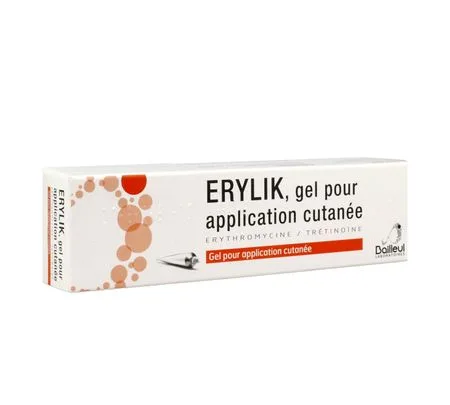
ERYLIK, gel for cutaneous application
Composition
For 100 g:
Erythromycin: 4,000 g
Tretinoin: 0,025 g
Excipient with known effect : butylhydroxytoluene, ethanol
Butylhydroxytoluene, hydroxypropylcellulose, ethanol at 96 %.
Indications
Moderate acne.
Official recommendations concerning the appropriate use of antibacterial agents should be taken into account.
Dosage and administration
Dosage
The starting dosage is one application, in the evening. The frequency of applications will be adjusted according to the reactions obtained.
In case of significant primary irritation, switch to one application every other day.
In the absence of any local reaction, the frequency of applications may be increased to 2 per day. From the end of the second week until the end of the initial treatment (12th at 14th week), the rhythm of applications is on average once a day or less in case of persistent irritation.
An application frequency must be prescribed such that it avoids unpleasant irritation reactions; only mild erythema, moderate desquamation, or even a slight burning sensation are acceptable.
Stronger reactions must be anticipated in subjects with thin skin and blond or red hair, and the most suitable dosage must be chosen.
To obtain the best result, the patient must be warned of the normal reactions that mark the start of treatment: primary irritation and transient efflorescence; he must be reviewed regularly to adjust the dosage and minimize primary irritation.
He/she should be informed of the delayed nature of the improvement, of the benefit of continuing therapy until the third month to obtain an optimal result, and of the need for maintenance treatment to prevent relapses.
Improvement is clearly visible by week 6th of treatment, it continues to achieve the best possible result by week 12th or week 14th week.
At this date, or earlier if all acne lesions have disappeared, maintenance treatment with 2 or 3 applications per week may be started.
Paediatric population
Not applicable.
Method of administration
Cutaneous use.
After washing and thoroughly drying the skin, apply a thin layer of gel to the lesions by gently massaging, avoiding the eyes, eyelids, lips, and nostrils.
Wash hands after using the product.
In case of polytherapy, the methods of use should be adjusted.
Contraindications
- Hypersensitivity to the active substances or to any of the excipients listed in section Composition.
- Pregnancy (see section Fertility, pregnancy and breastfeeding).
- Women planning a pregnancy.
Warnings and precautions
As with other macrolides, severe and rare allergic reactions, including acute generalised exanthematous pustulosis (AGEP), have been reported. If an allergic reaction occurs, administration of the medicine must be discontinued and appropriate treatment must be initiated. Physicians must be informed of the possibility of recurrence of allergic symptoms upon discontinuation of symptomatic treatment.
Because of possible intolerance phenomena such as edema and eczematization of a transient nature, a repeated test on a reduced skin surface (test patch) is advisable during the first applications.
If a hypersensitivity-type reaction or severe irritation occurs, treatment must be temporarily or even permanently discontinued.
In case of accidental application to mucous membranes, eyes, mouth, nostrils, or an open wound, rinse thoroughly with lukewarm water.
Due to the irritant nature of the treatment, concomitant use of astringent cleansing cosmetic products and drying or irritating agents (such as perfumed or alcohol-containing products) should be avoided.
Exposure to sunlight and ultraviolet lamps causing additional irritation should be avoided.
Treatment may, however, be continued if sun exposure is reduced to a minimum (protection by wearing a hat and use of a sunscreen cream) and the frequency of applications is adjusted.
In case of exceptional sun exposure (for example a day at the sea), do not apply the day before, on the same day, or the day after.
If prior exposure has caused sunburn, wait for complete recovery before starting treatment.
This medicine contains butylhydroxytoluene and may cause local skin reactions (for example: eczema) or irritation of the eyes and mucous membranes.
This medicine contains 929,25 mg of alcohol (ethanol at 96 %) per 1 g of cream, equivalent to 929,25 mg/g. This may cause a burning sensation on damaged skin.
Interactions
Due to the irritating nature of this preparation, it is preferable to avoid any product that may cause local irritation (alcohol-based solutions in particular).
Fertility, pregnancy and breastfeeding
Oral retinoids are associated with congenital abnormalities. When used in accordance with the prescribing information, topical retinoids are generally considered to result in low systemic exposure due to minimal dermal absorption. However, individual factors (for example: skin lesion, excessive use) may contribute to increased systemic exposure.
Fertility
Not applicable.
Pregnancy
In animals : tretinoin has been shown to be teratogenic by oral route; by topical route and at high doses, it induces minor skeletal malformations.
In men : ERYLIK, gel for cutaneous application is contraindicated (see section Contraindications) in pregnant women or women planning a pregnancy.
If used in a pregnant patient, or if a patient treated with this medicine becomes pregnant, treatment must be discontinued.
Breast-feeding
It is not known whether erythromycin and tretinoin are secreted into breast milk after administration of ERYLIK, but it is known that orally administered retinoids and their metabolites are secreted into breast milk. Therefore, ERYLIK must not be used in breastfeeding women.
Adverse effects
Skin and subcutaneous tissue disorders
Frequency not known: acute generalised exanthematous pustulosis (AGEP).
Reversible skin irritation may occur, disappearing when treatment is interrupted or applications are spaced out. A feeling of warmth or slight tingling may occur after application.
Reporting of suspected adverse reactions
Reporting suspected adverse reactions after authorisation of the medicinal product is important. It allows continued monitoring of the benefit/risk balance of the medicinal product. Healthcare professionals are asked to report any suspected adverse reactions via the national reporting system: National Agency for the Safety of Medicines and Health Products (ANSM) and the network of Regional Pharmacovigilance Centres - Website: https://signalement.social-sante.gouv.fr/.
Pharmacodynamics
Pharmacotherapeutic class: anti-infectives for the treatment of acne, ATC code: D10AF52.
This medicine is a combination of tretinoin and erythromycin.
Although polytherapy is frequent in the treatment of acne, the classification adopted: severe, moderate, minor to moderate acne was established in the context of monotherapy.
Mechanism of action
As a combination of tretinoin and erythromycin, this medicine has the properties of both substances:
Tretinoin: its activity is based on a mechanism of action that corresponds point by point to the pathogenesis of acne:
- Tretinoin opposes and prevents the formation of acne lesions: by stimulating the follicular epithelium, the increased proliferation of non-cohesive keratinized cells is intensified. These free horny cells are evacuated with the sebum to the surface of the skin. The horny plug cannot form and the formation of new lesions is thus prevented;
- Tretinoin causes the expulsion of retention lesions (open comedones, microcysts). In addition to the superficial desquamation of the epidermis, tretinoin exerts a deep action at the level of the follicular epithelium: it stimulates the proliferation of free horny cells, which, combined with the reduced cohesiveness of the horny plug, leads to the expulsion of the microcyst or comedone;
- Tretinoin accelerates the evolution of inflammatory lesions (papules, pustules).
Applied at the beginning of the inflammatory phase, tretinoin increases the permeability of the follicular wall to the irritant agents responsible for inflammatory phenomena (keratin fragments, free fatty acids...) and accelerates to the same extent the evolution of papules and pustules and their elimination. It thus prevents the transformation of these lesions into cystic nodules.
Erythromycin base is an antibiotic of the macrolide family whose interest in the topical treatment of acne is to exert:
- An anti-inflammatory action, by reducing in proportion to the reduction in the number of bacteria, the level of proteases and irritant free fatty acids at the origin of inflammation;
- An antibiotic effect through its direct action on Propionibacterium acnes, the number of which it reduces within the pilosebaceous follicle.
ANTIBACTERIAL ACTIVITY SPECTRUM OF ERYTHROMYCIN
Critical concentrations separate susceptible strains from strains of intermediate susceptibility, and the latter from resistant ones:
S ≤ 1 mg/l and R > 4 mg/l
The prevalence of acquired resistance can vary according to geography and time for certain species. It is therefore useful to have information on local resistance prevalence, especially for the treatment of severe infections. These data can only provide guidance on the probabilities of the susceptibility of a bacterial strain to this antibiotic.
Where the variability of resistance prevalence in France is known for a bacterial species, it is indicated in the table below:
|
Categories |
Frequency of acquired resistance in France (> 10 %) (extreme values) |
|
SUSCEPTIBLE SPECIES |
|
|
Gram-positive aerobes |
|
|
Bacillus cereus |
|
|
Corynebacterium diphtheriae |
|
|
Enterococci |
50-70 % |
|
Rhodococcus equi |
|
|
Staphylococcus spp. meti-S |
|
|
Staphylococcus spp. meti-R* |
70-80 % |
|
Streptococcus B |
|
|
Streptococcus non-groupable |
30-40 % |
|
Streptococcus pneumoniae |
35-70 % |
|
Streptococcus pyogenes |
16-31 % |
|
Gram-negative aerobes |
|
|
Bordetella pertussis |
|
|
Branhamella catarrhalis |
|
|
Campylobacter |
|
|
Legionella |
|
|
Moraxella |
|
|
Anaerobes |
|
|
Actinomyces |
|
|
Bacteroides |
30-60 % |
|
Eubacterium |
|
|
Mobiluncus |
|
|
Peptostreptococcus |
30-40 % |
|
Porphyromonas |
|
|
Prevotella |
|
|
Propionibacterium acnes |
|
|
Other |
|
|
Borrelia burgdorferi |
|
|
Chlamydia |
|
|
Coxiella |
|
|
Leptospires |
|
|
Mycoplasma pneumoniae |
|
|
Treponema pallidum |
|
|
MODERATELY SUSCEPTIBLE SPECIES |
|
|
(in vitro of intermediate susceptibility) |
|
|
Gram-negative aerobes |
|
|
Haemophilus |
|
|
Neisseria gonorrhoeae |
|
|
Anaerobes |
|
|
Clostridium perfringens |
|
|
Other |
|
|
Ureaplasma urealyticum |
|
|
RESISTANT SPECIES |
|
|
Gram-positive aerobes |
|
|
Corynebacterium jeikeium |
|
|
Nocardia asteroides |
|
|
Gram-negative aerobes |
|
|
Acinetobacter |
|
|
Enterobacterales |
|
|
Pseudomonas |
|
|
Anaerobes |
|
|
Fusobacterium |
|
|
Other |
|
|
Mycoplasma hominis |
* The frequency of resistance to methicillin is approximately 30 to 50 % of all staphylococci and is found mainly in hospital settings.
Remark : this spectrum corresponds to that of the systemic forms of this antibiotic. With the local pharmaceutical presentations, the concentrations obtained in situ are much higher than plasma concentrations. Some uncertainties remain regarding the kinetics of the concentrations in situ, on the local physico-chemical conditions that may modify the activity of the antibiotic, and on the stability of the product in situ.
Pharmacokinetics
The percutaneous absorption rates of tretinoin or retinoic acid, in preparations for topical use, although variable (dosage form, site, treated surface area, duration of treatment...), remain low at therapeutic doses. Retinoic acid is rapidly metabolised (48 h).
Preclinical safety
- Erythromycin:
In subacute, subchronic and chronic toxicity studies with administration of erythromycin in the diet of mice and rats, granulomas in the liver and, with low incidence in the spleen, and reticular cell hyperplasia of the bone marrow were observed at high doses in rats. Lymphoid hyperplasia in the bladder was observed in female mice at a slightly higher incidence at high doses.
Erythromycin has no genotoxic potential in in vitro tests. In long-term carcinogenesis studies carried out with administration of erythromycin in the diet of rats and mice, no evidence of carcinogenic activity was observed.
No apparent effect was observed on the fertility of males or females in rats receiving erythromycin (base) at levels up to 0,25 % of the diet, before and during mating, during gestation and until weaning of two successive litters. Furthermore, erythromycin was not teratogenic in rats and mice and caused only minimal adverse effects on embryo-fetal development, such as a slight decrease in fetal weight at very high doses.
Erythromycin is generally well tolerated on topical application to the skin. Erythromycin is not photosensitising and the contact sensitisation potency is very low.
- Tretinoin:
In repeated-dose toxicity studies conducted mainly by the oral route and in a few cases by the parenteral or dermal route in mice and rats, but also in a few studies in rabbits and dogs, tretinoin exerted marked toxicity at high doses, mainly causing fractures of the long bones as a sign of disturbed bone mineralisation, and testicular atrophy with impaired spermatogenesis. Dermal administration of approximately 0,5 mg/kg body weight in rats and rabbits as a 1 % formulation did not cause systemic signs of toxicity, but induced transient local erythema.
Tretinoin was not mutagenic in the Ames test in bacteria in vitro, but induced sister chromatid exchanges in human fibroblasts in vitro. The specific photo-carcinogenicity study showed an increase in skin tumours caused by ultraviolet light during treatment with tretinoin.
No effect of tretinoin on female fertility was reported, but toxic doses resulted in impaired spermatogenesis in males. Tretinoin was highly embryotoxic and teratogenic in mice, rats, rabbits and monkeys, inducing a high incidence of cleft palate and other malformations. The NOAEL following oral administration was determined to be 0,5 to 1,0 mg/kg body weight in the rat, and the NOAEL following subcutaneous administration was determined to be 1,0 mg/kg body weight in the rabbit. In studies on embryo-foetal development effects following cutaneous application, although no systemic level of tretinoin after topical application was detected in the rat, skeletal or cardiac malformations were described. These abnormalities are consistent with the effects of retinoids and occur at 16 times the recommended clinical dose, assuming 100 % absorption, based on comparison of body surface area. In a peri- and postnatal toxicity study in rats, tretinoin exerted toxic effects at doses above 2 mg/kg body weight following oral administration.
Topical application of tretinoin to the skin may cause reversible skin irritation with erythema, oedema, epithelial proliferation, acanthosis, hyperkeratosis and exfoliation of the superficial layer.
Combination of erythromycin and tretinoin:
In the maximisation test performed on guinea pigs, the combined preparation did not cause any cutaneous hypersensitivity, although some cases of sensitisation and local intolerance have been reported with the use of this combination.
Prescription, supply and reimbursement
| Marketing authorisation (AMM) |
|
GIULIANI GROUP 264 RUE DU FAUBOURG SAINT-HONORÉ
75008 PARIS
Tel: 01 56 33 11 11 accueil@bailleul.com
https://bailleul.com/france/
Source: VIDAL · Updated on 10/11/2026. This information does not replace advice from a healthcare professional.