
Medicines
SPC of 19/07/2023
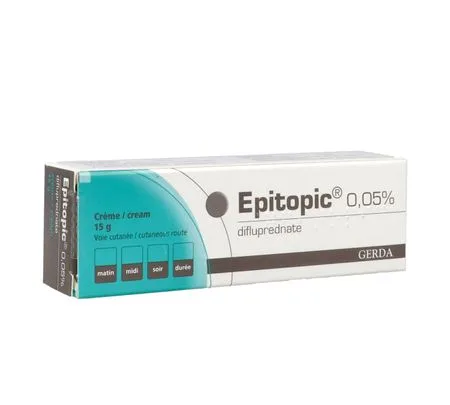
EPITOPIC 0,05 PERCENT, cream
Composition
Difluprednate................................................................................................................................................0,050 g
For 100 g of cream.
Excipient with notable effect: propylene glycol (E1520).
Propylene glycol (E1520), carbomer 5984, glycerol monostearate.
Indications
• Preferred indications where topical corticosteroid therapy is considered the best treatment:
- contact eczema
- atopic dermatitis
- lichenification
• Indications where topical corticosteroid therapy is one of the usual treatments:
- stasis dermatitis
- psoriasis (excluding very extensive plaques)
- lichen
- non-parasitic prurigo
- dyshidrosis
- genital lichen sclerosus et atrophicus
- granuloma annulare
- discoid lupus erythematosus
- seborrheic dermatitis except of the face
- symptomatic treatment of pruritus in mycosis fungoides
• Circumstantial indications for a short duration:
- insect bites and parasitic prurigo after etiological treatment.
The cream form is particularly intended for acute, weeping lesions.
Each dermatosis must be treated with a corticosteroid of the most appropriate level, knowing that, depending on the results, one may be led to substitute a product of stronger or weaker activity over all or part of the lesions.
Dosage and administration
Dosage
Treatment must be limited to 1 to 2 applications per day.
An increase in the number of daily applications would risk worsening adverse effects without improving therapeutic effects.
Treatment of large areas requires monitoring of the number of tubes used.
It is advised to apply the product in spaced dabs, then spread it by massaging lightly until it is completely absorbed.
Certain dermatoses (psoriasis, atopic dermatitis...) make a gradual discontinuation desirable. It may be achieved by reducing the frequency of applications and/or by using a less potent or less concentrated corticosteroid.
Method of administration
Cutaneous use.
Contraindications
• Hypersensitivity to the active substance or to any of the excipients listed in section Composition.
• Primary bacterial, viral, fungal or parasitic infections.
• Ulcerated lesions.
• Acne.
• Rosacea.
• Application to the eyelids (risk of glaucoma).
Warnings and precautions
Special warnings
Prolonged use of potent corticosteroids on the face exposes to the occurrence of corticosteroid-induced and paradoxically corticosteroid-sensitive dermatitis, with rebound after each discontinuation. A gradual withdrawal, which is particularly difficult, is then necessary.
Due to the passage of the corticosteroid into the general circulation, treatment over large areas or under occlusion may cause the systemic effects of general corticosteroid therapy, particularly in infants and young children. These consist of Cushingoid syndrome and slowed growth. These adverse effects disappear when treatment is stopped, but abrupt discontinuation may be followed by acute adrenal insufficiency.
Precautions for use
In infants, it is preferable to avoid high-activity corticosteroids. Particular caution should be exercised regarding spontaneous occlusion phenomena that may occur in skin folds or under diapers.
In case of bacterial or mycotic infection of a corticosteroid-sensitive dermatosis, precede the use of the corticosteroid with a specific treatment.
If local intolerance appears, treatment must be discontinued and the cause must be investigated.
Propylene glycol may cause skin irritation. This medicine contains propylene glycol; do not use it on open wounds or large areas of damaged or injured skin (burns) without informing your doctor or pharmacist.
Interactions
The data available to date do not suggest the existence of clinically significant interactions.
Fertility, pregnancy and breastfeeding
Pregnancy
No teratogenicity study has been performed with topical corticosteroids.
Nevertheless, studies concerning the intake of corticosteroids per os have not demonstrated a malformative risk greater than that observed in the general population.
Breast-feeding
During treatment per os, breastfeeding should be avoided because corticosteroids are excreted in breast milk.
Topically, the transdermal passage and therefore the risk of corticosteroid excretion into breast milk will depend on the treated surface area, the degree of epidermal damage and the duration of treatment.
Adverse effects
Prolonged use of potent corticosteroids may lead to skin atrophy, telangiectasias (to be particularly feared on the face), striae (especially at the root of the limbs, and occurring more readily in adolescents), ecchymotic purpura secondary to atrophy, and skin fragility.
On the face, corticosteroids may cause perioral dermatitis or worsen rosacea (see sections Contraindications and Warnings and precautions).
A delay in healing of atonic wounds, bedsores, and leg ulcers may be observed (see section Contraindications)
Possibility of systemic effects (see section Warnings and precautions).
Acneiform or pustular eruptions, hypertrichosis, and depigmentation have been reported.
Secondary infections, particularly under occlusive dressings or in folds, and allergic contact dermatoses have also been reported with the use of topical corticosteroids.
Reporting of suspected adverse reactions
Reporting suspected adverse reactions after authorisation of the medicinal product is important. It allows continued monitoring of the benefit/risk balance of the medicinal product. Healthcare professionals are asked to report any suspected adverse reaction via the national reporting system: National Agency for the Safety of Medicines and Health Products (ANSM) and the network of Regional Centres of Pharmacovigilance - Website: www.signalement-sante.gouv.fr.
Overdose
No cases of overdose have been reported.
However, in case of excessive or prolonged use of topical corticosteroids, there is a risk of exacerbation of adverse effects, and the possibility of systemic effects should not be ruled out.
In case of systemic overdose, appropriate symptomatic treatment is indicated.
Pharmacodynamics
Pharmacotherapeutic class: DERMOCORTICOID, ATC code: D07AC19.
Dermocorticoids are classified into 4 levels of activity according to skin vasoconstriction tests: very strong, strong, moderate, weak activity.
EPITOPIC, cream is of strong activity.
Active on certain inflammatory processes (for example: contact hypersensitivity) and the pruritic effect linked to them. Vasoconstrictor. Inhibits cell multiplication.
Pharmacokinetics
The extent of transdermal passage and systemic effects depends on the size of the treated surface area, the degree of epidermal damage and the duration of treatment. These effects are all the more to be feared the longer the treatment is prolonged.
Prescription, supply and reimbursement
| Marketing authorisation (AMM) |
|
| Price: |
|
Collection.
7 AVENUE DU PORT
92120 MONTROUGE
Tel: 01 78 90 41 00 contact@ethyxpharmaceuticals.com
https://www.ethyxpharmaceuticals.com/
Source: VIDAL · Updated on 10/11/2026. This information does not replace advice from a healthcare professional.