
Medicines
SmPC of 09/12/2022
ENTACAPONE VIATRIS 200 mg, film-coated tablet
Forms and presentations
Film-coated tablet.
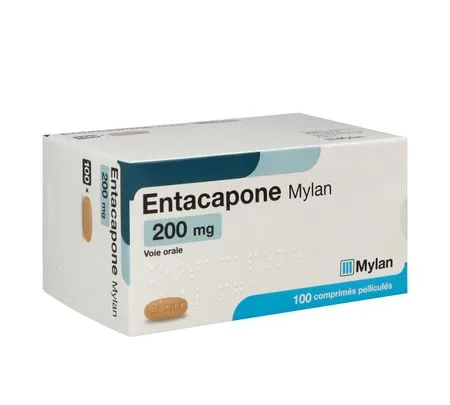
Light orange, oval, biconvex, film-coated tablet engraved "EE200" on one side and "M" on the other side.
Composition
Entacapone ........................................................................................................................................................200 mg
For each film-coated tablet
Excipient with known effect : each tablet contains 0,136 mg of sucrose.
Tablet core
Microcrystalline cellulose, mannitol, low-substituted hydroxypropylcellulose, magnesium stearate, hydrogenated vegetable oil.
Film coating
Hypromellose, titanium dioxide (E171), glycerol, magnesium stearate, sucrose, polysorbate 80, yellow iron oxide (E172), red iron oxide (E172).
Indications
Entacapone is indicated as an adjunct to standard treatments with levodopa/benserazide or levodopa/carbidopa in adult patients with Parkinson's disease and end-of-dose motor fluctuations that cannot be stabilised with these combinations.
Dosage and administration
Entacapone should be used only in combination with levodopa / benserazide or levodopa / carbidopa. The information regarding the prescription of levodopa-based medicinal products applies to their concomitant use with entacapone.
Dosage
Take one tablet of 200 mg with each dose of levodopa/dopa decarboxylase inhibitor.
The recommended maximum dose is 200 mg ten times a day, i.e. 2 000 mg of entacapone.
Entacapone increases the effects of levodopa. Therefore, to reduce levodopa-related dopaminergic adverse reactions, such as dyskinesias, nausea, vomiting and hallucinations, it is often necessary to adjust the levodopa dose during the first days or first weeks of treatment with entacapone. Depending on the patient's clinical condition, the daily dose of levodopa may be reduced by approximately 10 to 30% by increasing the interval between doses and/or reducing the amount of levodopa per dose.
If treatment with entacapone is stopped, it is necessary to adjust the dose of other antiparkinsonian treatments, particularly levodopa, in order to achieve adequate control of parkinsonian symptoms.
Entacapone increases the bioavailability of levodopa slightly more (by 5 to 10%) from standard levodopa/benserazide preparations than from standard levodopa/carbidopa preparations. Consequently, for patients treated with standard levodopa/benserazide preparations, a greater reduction in the levodopa dose may be necessary when initiating treatment with entacapone.
Renal impairment: renal impairment does not influence the pharmacokinetic profile of entacapone and therefore dose adjustment is not necessary. However, an increase in the interval between doses may be considered in dialysis patients (see section Pharmacokinetics).
Hepatic impairment (see section Contraindications).
Elderly subjects: no adjustment of the entacapone dose is necessary in elderly patients.
Paediatric population
ENTACAPONE VIATRIS should not be used in children under 18 years of age due to the lack of data on safety and efficacy.
Method of administration
Entacapone is administered orally simultaneously with each dose of levodopa/carbidopa or levodopa/benserazide.
Entacapone may be taken with or without food (see section Pharmacokinetics).
Contraindications
- Hypersensitivity to the active substance or to any of the excipients listed in section Composition.
- Hepatic impairment.
- Pheochromocytoma.
- Concomitant use of entacapone and non-selective monoamine oxidase inhibitors (MAO-A and MAO-B inhibitors), such as phenelzine and tranylcypromine, is contraindicated.
- Concomitant use of entacapone and a combination of selective MAO-A inhibitor and selective MAO-B inhibitor is contraindicated (see section Interactions).
- History of neuroleptic malignant syndrome (NMS) and/or non-traumatic rhabdomyolysis.
Warnings and precautions
Rare cases of rhabdomyolysis secondary to severe dyskinesias or neuroleptic malignant syndromes (NMS) have been observed in patients with Parkinson's disease.
NMS, including rhabdomyolysis and hyperthermia, is characterised by motor symptoms (rigidity, myoclonus, tremors), psychiatric disorders (for example, agitation, confusion, coma), hyperthermia, autonomic nervous system disorders (tachycardia, blood pressure variation) and elevated serum creatine phosphokinase (CPK) levels. In some cases, only a few of these symptoms and/or findings may appear.
Neither NMS nor rhabdomyolysis has been reported in association with entacapone treatment in controlled studies upon abrupt treatment interruption. Since marketing, isolated cases of NMS have been reported, particularly following a reduction or abrupt cessation of entacapone and other associated dopaminergic medicinal products. If necessary, the interruption of entacapone and other dopaminergic treatments will be gradual, and if signs and/or symptoms appear despite gradual cessation of entacapone, an increase in the levodopa dose may be necessary.
Entacapone should be administered with caution in patients with ischaemic heart disease.
Due to its mode of action, entacapone may interfere with the metabolism of medicinal products containing a catechol group and potentiate their action. Entacapone should therefore be administered with caution to patients treated with medicinal products metabolised by catechol-0-methyl transferase (COMT), such as rimiterole, isoprenaline, adrenaline, noradrenaline, dopamine, dobutamine, alpha-methyldopa and apomorphine (see also section Interactions).
Entacapone is always administered as an adjunct to levodopa. Consequently, the precautions for use of levodopa must also be taken into consideration during treatment with entacapone. Entacapone increases the bioavailability of levodopa from standard levodopa/benserazide preparations (by 5 to 10% more) than from standard levodopa/carbidopa preparations. Consequently, dopaminergic adverse effects may be more frequent when entacapone is combined with levodopa/benserazide treatment (see also section Adverse effects). To reduce levodopa-related dopaminergic adverse reactions, it is often necessary to adjust the levodopa dosage during the first days or weeks following initiation of entacapone treatment, depending on the patient's clinical condition (see sections Dosage and administration and Adverse effects).
Entacapone may aggravate levodopa-induced orthostatic hypotension.
Entacapone should be given with caution to patients taking other medicinal products that may cause orthostatic hypotension.
In clinical studies, dopaminergic adverse effects, e.g. dyskinesias, were more frequently observed in patients receiving the combination of entacapone plus dopamine agonists (such as bromocriptine), selegiline or amantadine than in those receiving the combination of placebo plus dopamine agonists, selegiline or amantadine. The dosage of other antiparkinsonian medicinal products may therefore require adjustment when entacapone treatment is initiated.
Somnolence and episodes of sudden onset sleep have been observed with entacapone in combination with levodopa in patients with Parkinson's disease.
Particular caution is recommended when driving vehicles or operating machinery (see also section Driving and using machines).
For patients presenting with diarrhoea, weight monitoring is recommended to avoid potential excessive weight loss. Prolonged or persistent diarrhoea occurring during entacapone treatment may be a sign of colitis. In case of prolonged or persistent diarrhoea, the medicinal product should be discontinued and appropriate medical treatment and investigations should be considered.
Impulse control disorder
Patients should be closely monitored for impulse control disorders. Patients and their carers should be informed that behavioural disorders affecting impulse control, including pathological gambling, increased libido and hypersexuality, compulsive spending or buying, and binge eating or food cravings, may occur in patients treated with dopamine agonists or other levodopa-containing dopaminergic treatments, including ENTACAPONE VIATRIS in combination with levodopa. Treatment should be reviewed if such symptoms develop.
For patients presenting with progressive anorexia, asthenia and weight loss over a relatively short period, a general medical examination including assessment of liver function should be considered.
ENTACAPONE VIATRIS tablets contain sucrose. Its use is not recommended in patients with fructose intolerance, glucose-galactose malabsorption syndrome or sucrase/isomaltase deficiency.
Interactions
No interaction between entacapone and carbidopa has been observed within the recommended dosage range. The pharmacokinetic interaction with benserazide has not been studied.
In single-dose studies conducted in healthy volunteers, no interaction was observed between entacapone and imipramine or between entacapone and moclobemide. Likewise, no interaction was found between entacapone and selegiline in repeated-dose studies conducted in patients with Parkinson's disease. However, clinical experience is limited for the use of entacapone in combination with certain medicinal products, such as MAO-A inhibitors, tricyclic antidepressants, noradrenaline reuptake inhibitors (such as desipramine, maprotiline and venlafaxine) and medicinal products metabolised by COMT (e.g., catechol-containing substances: rimiterol, isoprenaline, adrenaline, noradrenaline, dopamine, dobutamine, alpha-methyldopa, apomorphine and paroxetine). Combination of these medicinal products with entacapone should be undertaken with caution (see sections Contraindications and Warnings and precautions).
Entacapone may be used with selegiline (a selective MAO-B inhibitor), but the daily doses of selegiline must not exceed 10 mg.
Entacapone may form chelates with iron in the gastrointestinal tract. Entacapone and iron-containing preparations should therefore be administered at least 2 to 3 hours apart (see section Adverse effects).
Entacapone binds to site II of human albumin, to which a number of other medicinal products also bind, including diazepam and ibuprofen. No clinical interaction study with diazepam and non-steroidal anti-inflammatory drugs has been conducted. According to studies in vitro, no significant displacement is expected at the therapeutic concentrations of these medicinal products.
Due to its affinity in vitro for cytochrome P450 2C9 (see section Pharmacokinetics), entacapone may potentially interfere with medicinal products whose metabolism is dependent on this isoenzyme, such as S-warfarin. However, in a drug interaction study in healthy volunteers, entacapone did not modify plasma levels of S-warfarin, whereas the AUC of R-warfarin increased on average by 18% [CI90 11% - 26%]. INR values increased on average by 13% [CI90 6% - 19%]. Therefore, INR monitoring is recommended when treatment with entacapone is initiated in patients on warfarin.
Fertility, pregnancy and breastfeeding
Pregnancy
No obvious teratogenic effect or primary foetotoxic effect was observed in animal studies, in which the doses of entacapone were markedly higher than the therapeutic doses used in humans. In the absence of data on the use of entacapone in pregnant women, entacapone should not be used during pregnancy.
Breast-feeding
In animal studies, entacapone was excreted in milk. The tolerance of entacapone in newborns is unknown. Women treated with entacapone must not breast-feed.
Driving and using machines
ENTACAPONE VIATRIS, in combination with levodopa, may have a significant influence on the ability to drive vehicles and use machines. Entacapone, combined with levodopa, may cause dizziness and symptomatic orthostatic hypotension. Consequently, caution is required when driving vehicles or using machines.
Patients treated with entacapone in combination with levodopa who experience somnolence and/or episodes of sudden onset of sleep must be informed that they must not drive vehicles or engage in activities where impaired alertness could expose themselves or others to a risk of serious accident or death (for example, operating machinery) until these effects resolve (see section Warnings and precautions).
Adverse effects
The most frequently reported adverse reactions with entacapone are related to increased dopaminergic activity and occur most often at the beginning of treatment. Reducing the levodopa dosage can decrease the severity and frequency of these effects. Other frequent adverse reactions are gastrointestinal symptoms including nausea, vomiting, abdominal pain, constipation and diarrhoea. Urine may take on a brown-red colouration under the effect of entacapone, but this is a benign phenomenon.
Usually, adverse reactions related to entacapone are of mild to moderate intensity. In clinical studies, the most frequent adverse reactions leading to discontinuation of entacapone treatment were gastrointestinal symptoms (diarrhoea 2,5%, for example) as well as adverse reactions related to increased dopaminergic activity of levodopa (dyskinesia 1,7% for example).
According to data gathered from clinical studies including 406 patients treated with the medicinal product and 296 patients treated with placebo, dyskinesia (27%), nausea (11%), diarrhoea (8%), abdominal pain (7%) and dry mouth (4,2%) were reported significantly more frequently with entacapone than with placebo.
Certain adverse reactions such as dyskinesia, nausea and abdominal pain may be more frequent when high doses of entacapone (1 400 to 2 000 mg per day) are administered than when lower doses are administered.
The adverse reactions listed in Table 1 below are those collected in clinical studies conducted with entacapone and since its marketing authorisation.
Table 1: Adverse reactions
Adverse reactions are listed in decreasing order of frequency, according to the following convention: Very common (≥ 1/10); common (≥ 1/100 to < 1/10); uncommon (≥ 1/1 000 to < 1/100); rare (≥ 1/10 000 to < 1/1 000); very rare (< 1/10 000), frequency not known (cannot be estimated from the available data).
|
Psychiatric disorderses |
|
|
insomnia, hallucinations, confusion, abnormal dreams. |
|
agitation. |
|
Nervous system disorders |
|
|
dyskinesias. |
|
worsening of parkinsonian syndrome, vertigo, dystonia, hyperkinesia. |
|
Cardiac disorders* |
|
|
manifestations of ischaemic cardiomyopathy other than myocardial infarction (for example, angina). |
|
myocardial infarction. |
|
Gastrointestinal disorders |
|
|
nausea. |
|
diarrhoea, abdominal pain, dry mouth, constipation, vomiting. |
|
anorexia. |
|
colitis. |
|
Hepatobiliary disorders |
|
|
abnormal liver function tests. |
|
cholestatic-type hepatitis (see section Warnings and precautions). |
|
Skin and subcutaneous tissue disorders |
|
|
erythematous or maculopapular rash. |
|
urticaria. |
|
abnormal discolouration of the skin, hair, beard and nails. |
|
Renal and urinary disorders |
|
|
discolouration of the urine. |
|
General disorders and administration site conditions |
|
|
Fatigue, hyperhidrosis, fall. |
|
Weight loss. |
* The incidences of myocardial infarction and other manifestations of ischaemic cardiomyopathy (0,43% and 1,54% respectively) are derived from an analysis of 13 double-blind studies involving 2 082 patients with end-of-dose motor fluctuations receiving entacapone.
Isolated cases of excessive daytime sleepiness and episodes of sudden onset of sleep have been reported with entacapone in combination with levodopa.
Impulse control disorders :
Pathological gambling, increased libido, hypersexuality, compulsive spending or buying, compulsive eating or food cravings may occur in patients treated with dopamine agonists and/or other dopaminergic treatments containing ENTACAPONE VIATRIS combined with levodopa (see section Warnings and precautions).
Isolated cases of NMS have been reported following a reduction or abrupt withdrawal of entacapone and other dopaminergic medicinal products.
Isolated cases of rhabdomyolysis have been reported.
Reporting of suspected adverse reactions
Reporting suspected adverse reactions after authorisation of the medicinal product is important. It allows continued monitoring of the benefit/risk balance of the medicinal product. Healthcare professionals are asked to report any suspected adverse reaction via the national reporting system: National Agency for the Safety of Medicines and Health Products (ANSM) and the network of Regional Centres of Pharmacovigilance - Website: www.signalement-sante.gouv.fr.
Overdose
Isolated cases of overdose in which the highest reported daily dose was 16 000 mg have been reported after marketing. In these cases, the acute symptoms and signs of overdose reported included confusion, decreased activity, drowsiness, hypotonia, abnormal skin coloration and urticaria. Treatment of acute intoxication is symptomatic.
Pharmacodynamics
Pharmacotherapeutic class: antiparkinsonian drugs, other dopaminergic agents, ATC code: N04 BX 02.
Mechanism of action
Entacapone belongs to a new therapeutic class, the class of catechol O-methyltransferase (COMT) inhibitors. It is a specific and reversible COMT inhibitor that acts mainly peripherally, and that is intended to be administered in combination with medicinal products containing levodopa.
Entacapone reduces the biotransformation of levodopa to 3-O-methyldopa (3-0MD) by inhibition of the COMT enzyme. This leads to an increase in the AUC (Area Under the Curve) of levodopa. The amount of levodopa available to the brain is increased. Entacapone therefore prolongs the clinical response to levodopa.
Pharmacodynamic effects
Entacapone inhibits the COMT enzyme mainly in peripheral tissues. The inhibition of COMT in erythrocytes is proportional to the plasma concentration of entacapone, clearly indicating that the inhibition of COMT is reversible.
Efficacy and safety clinical
In two double-blind phase III studies involving a total of 376 patients with Parkinson's disease and end-of-dose motor fluctuations, entacapone or placebo was administered with each dose of levodopa/dopa decarboxylase inhibitors. The results are shown in Table 2. Measured in study I, the daily ON period (in hours) from patient diaries and in study II, the daily proportion of ON period.
Table 2: Daily ON period (mean ±SD)
|
Study I: Daily ON period (h) |
|||
|
|
Entacapone (n=85) |
Placebo (n=86) |
Difference |
|
Baseline value |
9,3 ±2,2 |
9,2 ±2,5 |
|
|
Weeks 8-24 |
10,7 ±2,2 |
9,4 ±2,6 |
1 h 20 min (8,3 %) CI95% 45 min, 1 h 56 min |
|
Study II: Proportion of daily ON period (%) |
|||
|
|
Entacapone (n=103) |
Placebo (n=102) |
Difference |
|
Baseline value |
60,0 ±15,2 |
60,8 ±14,0 |
|
|
Weeks 8-24 |
66,8 ±14,5 |
62,8 ±16,80 |
4,5 % (0 h 35 min) CI95% 0,93 % ; 7,97 % |
Corresponding decreases in OFF periods were observed.
The reduction in OFF periods from baseline was -24% in the entacapone group and 0% in the placebo group in study I. The corresponding values for study II were -18% and -5%.
Pharmacokinetics
General characteristics of the active substance
Absorption
Intra- and inter-individual variations in the absorption of entacapone are significant.
The maximum plasma concentrations (Cmax) are generally reached about 1 hour after administration of a 200 mg tablet of entacapone. The product is subject to a significant first-pass hepatic effect. The bioavailability of entacapone is about 35 % after oral administration of a dose. Food does not have a significant influence on the absorption of entacapone.
Distribution
After absorption from the gastrointestinal tract, entacapone is rapidly distributed into peripheral tissues with a steady-state volume of distribution of 20 litres (Vdss). About 92 % of the dose is eliminated during the β phase with a short elimination half-life of 30 minutes. The total clearance of entacapone is about 800 ml/min.
Entacapone is highly bound to plasma proteins, mainly albumin. In human plasma, the unbound fraction is about 2,0 %, within the range of therapeutic concentrations. At these same concentrations, entacapone does not alter the binding of highly protein-bound molecules (e.g. warfarin, salicylic acid, phenylbutazone or diazepam). Entacapone is also not displaced significantly by these medicinal products at therapeutic or higher concentrations.
Biotransformation
A small amount of entacapone, which is the (E) isomer, is converted to the (Z) isomer. The (E) isomer represents 95 % of the AUC of entacapone. The (Z) isomer and other metabolites found in trace amounts make up the remaining 5 %.
Data from studies in vitro using human liver microsomal preparations indicate that entacapone inhibits cytochrome P450 2C9 (IC50~4 μM). Entacapone has shown weak or no inhibition of other P450 isoenzyme types (CYP1A2, CYP2A6, CYP2D6, CYP2E1, CYP3A and CYP2C19) (see section Interactions).
Élimination
Elimination of entacapone occurs mainly via non-renal metabolic pathways. It is estimated that about 80 to 90 % of the dose is excreted in the faeces, although this has not been demonstrated in humans. About 10 to 20 % is excreted in the urine. Unchanged entacapone is detected only in trace amounts in the urine.
The major part (95 %) of the product excreted in the urine is found as glucuronide conjugates. Only about 1 % of the metabolites found in the urine result from oxidative metabolism.
Other special populations
Elderly patients
The pharmacokinetic properties of entacapone are similar in young and elderly adults.
Hepatic impairment
Biotransformation of the medicinal product is slowed in patients with mild to moderate hepatic impairment (Child-Pugh Class A and B). This results in increased plasma concentrations of entacapone in the absorption and elimination phases (see section Contraindications).
Renal impairment
Renal impairment does not alter the pharmacokinetics of entacapone. However, less frequent dosing may be considered in dialysis patients.
Preclinical safety
Preclinical data from conventional safety pharmacology, repeated-dose toxicity, genotoxicity and carcinogenicity studies revealed no particular risk for humans. In repeated-dose toxicity studies, anaemias, probably mainly due to the iron-chelating properties of entacapone, were observed. Regarding reproductive toxicity, a decrease in foetal weight and a slight delay in skeletal development were observed in rabbits at systemic exposure levels within the therapeutic range.
Shelf life
3 years
Bottles: After first opening of the bottle, the medicinal product must be stored for a maximum of 100 days.
SPECIAL PRECAUTIONS FOR DISPOSAL AND OTHER HANDLING
Any unused medicinal product or waste material should be disposed of in accordance with local requirements.
Prescription, supply and reimbursement
| Marketing authorisation (AMM) |
|
| Price: |
|
Collection.
1 RUE DE TURIN
69007 LYON
Tel: 04 37 25 75 00 https://www.viatris.fr/
Source: VIDAL · Updated on 10/11/2026. This information does not replace advice from a healthcare professional.