
Medicines
SmPC of 07/05/2024
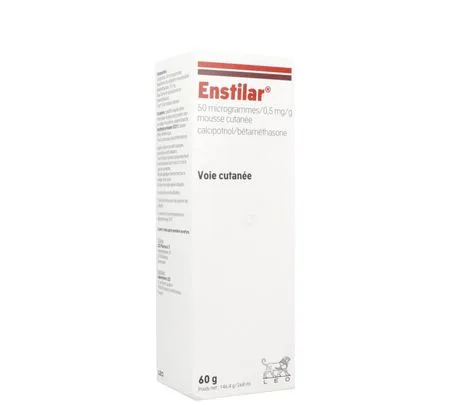
ENSTILAR 50 micrograms/0,5 mg/g, cutaneous foam
Forms and presentations
Cutaneous foam.
After spraying, a white to off-white foam forms.
The foam has the appearance of a non-expandable foam that gradually retracts after spraying.
Composition
Calcipotriol ....................................................................................................................50 micrograms
As calcipotriol monohydrate
Betamethasone..............................................................................................................................0,5 mg
As betamethasone dipropionate
For 1 g of cutaneous foam.
Excipient with known effect: 1 g of cutaneous foam contains 50 micrograms of butylhydroxytoluene (E321).
Liquid paraffin, polyoxypropylene stearyl ether, all-rac-alpha-tocopherol, white soft paraffin, butylhydroxytoluene (E321), butane, dimethyl ether.
Dosage and administration
Dosage
Treatment of flares
ENSTILAR must be applied once daily to the lesions. The recommended duration of treatment is 4 weeks. After this period, if it is necessary to continue or resume treatment, it should be continued after medical advice and under regular monitoring.
Long-term maintenance treatment
A long-term maintenance treatment may be considered in patients who responded to a treatment of 4 weeks with ENSTILAR once daily. ENSTILAR should be applied twice weekly on two non-consecutive days to areas previously affected by plaque psoriasis. Applications should be spaced by 2 to 3 days without treatment with ENSTILAR.
In the presence of signs of relapse, treatment of flares as described above should be reinstated.
Maximum dose
The maximum daily dose of ENSTILAR must not exceed 15 g. This means that a bottle of 60 g must last for at least 4 days of treatment. 15 g corresponds to the quantity delivered by the bottle if the diffuser nozzle is pressed continuously for approximately 1 minute.
One two-second application delivers approximately 0,5 g. For information, 0,5 g of foam should cover an area of skin roughly corresponding to an adult's hand.
If other topical products containing calcipotriol are used in addition to ENSTILAR, the total dose of calcipotriol-containing products must not exceed 15 g per day.
The total body surface area treated must not exceed 30 %.
Special populations
Renal and hepatic impairment
The safety and efficacy of ENSTILAR in patients with severe renal impairment or severe hepatic disorders have not been evaluated.
Paediatric population
The safety and efficacy of ENSTILAR in children under the age of 18 years have not been established.
Data currently available in children aged 12 to 17 years are described in the sections Adverse effects and Pharmacodynamics but no dosage recommendation can be made.
Method of administration
Cutaneous use.
The vial should be shaken for a few seconds before use. ENSTILAR should be applied by spraying while holding the vial at least 3 cm from the skin. The foam can be sprayed holding the vial in any orientation except horizontally.
ENSTILAR should be sprayed directly onto psoriasis lesions and then gently massaged.
If used on the scalp, ENSTILAR should be sprayed into the palm of the hand, then applied to scalp lesions with the fingertips. Hair washing instructions are provided in the leaflet.
Hands should be washed after using ENSTILAR (unless ENSTILAR is used to treat the hands) to avoid accidental transfer to other parts of the body as well as unwanted absorption of the medicine through the hands. Application under occlusive dressing should be avoided as it increases systemic absorption of corticosteroids. It is recommended not to shower or bathe immediately after applying ENSTILAR. Leave the foam in contact with the scalp and/or skin overnight or during the day.
Contraindications
Hypersensitivity to the active substances or to any of the excipients listed in section Composition.
ENSTILAR is contraindicated in erythrodermic and pustular psoriasis.
Due to the presence of calcipotriol, ENSTILAR is contraindicated in patients with a history of calcium metabolism disorders (see section Warnings and precautions).
Due to the presence of corticosteroid, ENSTILAR is contraindicated in the following cases if they affect the treatment area: skin lesions of viral origin (for example herpes or chickenpox), skin infections of fungal or bacterial origin, parasitic infections, skin involvement related to tuberculosis, perioral dermatitis, skin atrophy, striae, fragility of the venous network, ichthyosis, acne vulgaris, acne rosacea, rosacea, ulcers and wounds (see section Warnings and precautions).
Warnings and precautions
Effects on the endocrine system
Adverse effects observed with systemic corticosteroid treatment, such as suppression of the hypothalamic-pituitary axis or deterioration of glycaemic control in diabetes mellitus, may also occur with topical corticosteroid treatment due to its systemic absorption. Application under occlusive dressing should be avoided as it increases systemic absorption of corticosteroids.
Application over large areas of damaged skin, on mucous membranes or in skin folds should be avoided as it increases systemic absorption of corticosteroids (see section Adverse effects).
Visual disorders
Visual disturbances may occur with systemic or local corticosteroid therapy. In case of blurred vision or the appearance of any other visual symptom during corticosteroid therapy, an ophthalmological examination is required to look for cataract, glaucoma, or rarer lesions such as central serous chorioretinopathy, as described with systemic or local administration of corticosteroids.
Effects on calcium metabolism
Due to the presence of calcipotriol in ENSTILAR, hypercalcaemia may occur. Calcaemia normalises when treatment is stopped. The risk of hypercalcaemia is minimal when the maximum daily dose of ENSTILAR (15 g) is not exceeded (see section Dosage and administration).
Local adverse effects
ENSTILAR contains a class III strong-group corticosteroid and the simultaneous use of other corticosteroids on the same treatment area should be avoided.
The skin of the face and genital region is very sensitive to corticosteroids. The product should not be used on these areas.
The patient should be trained in the correct use of the product to avoid application and accidental transfer to the face, mouth and eyes. Hands should be washed after each application to avoid accidental transfer to these areas as well as unwanted absorption of the medicine through the hands.
Concomitant skin infections
If lesions become superinfected, they should be treated with antimicrobial therapy.
However, if the infection worsens, corticosteroid treatment should be discontinued (see section Contraindications).
Discontinuation of treatment
Treatment of psoriasis with topical corticosteroids carries a risk of rebound effect upon discontinuation of treatment. Medical monitoring should therefore be continued after treatment is stopped.
Long-term treatment
Long-term use of corticosteroids may increase the risk of local and systemic adverse effects. Treatment should be discontinued in case of adverse effects related to long-term corticosteroid use (see section Adverse effects).
Use not evaluated
There are no data on the use of ENSTILAR in guttate psoriasis.
Adverse effects related to excipients
ENSTILAR contains butylated hydroxytoluene (E321) which may cause local skin reactions (for example: contact dermatitis), or irritation of the eyes and mucous membranes.
Fertility, pregnancy and breastfeeding
Pregnancy
There are no sufficiently relevant data on the use of ENSTILAR in pregnant women. Animal studies after oral administration of calcipotriol have not shown teratogenic effects, although reproductive toxicity has been demonstrated (see section Preclinical safety). Animal studies with glucocorticoids have shown reproductive toxicity (see section Preclinical safety), but a number of epidemiological studies (fewer than 300 pregnancies) have not shown congenital abnormalities in children born to mothers treated with corticosteroids during pregnancy. The potential risk for humans is not known with certainty. Consequently, ENSTILAR should be used during pregnancy only when the potential benefit justifies the potential risk.
Breast-feeding
Betamethasone passes into breast milk, but the risk of an adverse effect in the infant is very low at therapeutic doses. There are no data on the excretion of calcipotriol into breast milk. Caution is required when prescribing ENSTILAR to a breastfeeding woman. The patient should be informed not to apply ENSTILAR to the breasts during breastfeeding.
Fertility
Studies in rats after oral administration of calcipotriol or betamethasone dipropionate have demonstrated no impairment of fertility in males or females (see section Preclinical safety). There are no data on human fertility.
Driving and using machines
ENSTILAR has no or negligible influence on the ability to drive vehicles and use machines.
Adverse effects
The estimate of the frequency of adverse effects is based on the pooled analysis of data from clinical studies.
The most frequently reported adverse effects during treatment are application site reactions.
Adverse reactions are presented by MedDRA system organ class (SOC), and individual adverse reactions are presented within each SOC in order of decreasing frequency. Within each frequency category, adverse reactions are presented in order of decreasing seriousness.
Very common (≥ 1/10)
Frequent (≥ 1/100 and < 1/10)
Uncommon (≥ 1/1 000 and < 1/100)
Rare (≥ 1/10 000 and < 1/1 000)
Very rare (< 1/10 000)
Not known (frequency cannot be estimated from the available data)
|
Infections and infestations |
|
|
Uncommon (≥ 1/1 000 and < 1/100) |
Folliculitis |
|
Immune system disorders |
|
|
Uncommon (≥ 1/1 000 and < 1/100) |
Hypersensitivity |
|
Metabolism and nutrition disorders |
|
|
Uncommon (≥ 1/1 000 and < 1/100) |
Hypercalcaemia* |
|
Eye disorders |
|
|
Frequency not known |
Blurred vision** |
|
Skin and subcutaneous tissue disorders |
|
|
Uncommon (≥ 1/1 000 and < 1/100) |
Hypopigmentation of the skin |
|
Frequency not known |
Change in hair colour*** |
|
General disorders and administration site conditions |
|
|
Uncommon (≥ 1/1 000 and < 1/100) |
Rebound effect |
|
Pruritus at the application site |
|
|
Irritation at application site |
|
|
Pain at application site**** |
|
|
Frequency not known |
Erythema at the application site***** |
* A moderate hypercalcaemia has been observed.
** See section Warnings and precautions.
*** A transient yellowish discolouration of white or grey hair at the scalp application site has been reported with products combining calcipotriol and betamethasone.
**** Burns at the application site are included in pain at the application site.
***** Reported since the product was placed on the market.
Paediatric population
No clinically significant difference in the safety profile has been observed between adults and adolescents. A total of 106 adolescents were treated in an open-label clinical trial. See section Pharmacodynamics for further details concerning this trial.
The following adverse effects, considered to be related to the pharmacological class of calcipotriol and betamethasone, are respectively:
Calcipotriol
Adverse reactions include application site reactions, pruritus, skin irritation, burning and stinging sensation, dry skin, erythema, rash, dermatitis, worsening of psoriasis, photosensitivity and hypersensitivity reactions including very rare cases of angioedema and facial oedema.
Systemic effects after topical use may very rarely occur and cause hypercalcaemia or hypercalciuria (see section Warnings and precautions).
Betamethasone (as dipropionate)
Local reactions may occur after topical use, especially with long-term use, including skin atrophy, telangiectasia, striae, folliculitis, hypertrichosis, perioral dermatitis, contact eczema, depigmentation and colloid milium.
When treating psoriasis with topical corticosteroids, there may be a risk of developing generalised pustular psoriasis.
Systemic effects after topical use of corticosteroids are rare in adults but may be severe. Suppression of the hypothalamic-pituitary axis, cataract, infections, deterioration of diabetes mellitus control and increased intraocular pressure may occur, particularly after long-term treatment.
Systemic effects occur more frequently with application under occlusion (plastic, skin folds), with application over large areas of skin and with long-term treatment (see section Warnings and precautions).
Reporting of suspected adverse reactions
Reporting suspected adverse reactions after authorisation of the medicinal product is important. It allows continued monitoring of the benefit/risk balance of the medicinal product. Healthcare professionals are asked to report any suspected adverse reactions via the national reporting system: National Agency for the Safety of Medicines and Health Products (ANSM) and the network of Regional Pharmacovigilance Centres - Website: https://signalement.social-sante.gouv.fr/.
Overdose
Use of doses above the recommended dose may lead to an increase in serum calcium, an effect that is reversible on discontinuation of treatment. Symptoms of hypercalcaemia include polyuria, constipation, muscle weakness, confusion and coma.
Excessive and prolonged use of topical corticosteroids may lead to suppression of the hypothalamic-pituitary axis, usually reversible. In this case, symptomatic treatment is indicated.
In case of chronic toxicity, corticosteroid treatment should be discontinued gradually.
Pharmacodynamics
Pharmacotherapeutic class: OTHER ANTIPSORIATIC PREPARATIONS FOR TOPICAL USE, Calcipotriol, combinations, ATC code: D05AX52.
Mechanism of action
ENSTILAR combines the pharmacological effects of calcipotriol monohydrate, which is a synthetic analogue of vitamin D3, and betamethasone dipropionate, a corticosteroid of synthetic origin.
In psoriasis, vitamin D and its analogues act mainly by inhibiting keratinocyte proliferation and inducing their differentiation. The underlying antiproliferative mechanism of vitamin D in keratinocytes involves induction of the growth-inhibitory factor, transforming growth factor beta (TGF-β) and cyclin-dependent kinase inhibitors, resulting in cell cycle arrest in phase G1 as well as downregulation of two proliferation factors, Early Growth Response-1 and Polo-Like Kinase-2.
In addition, vitamin D has an immunomodulatory effect, suppressing the activation and differentiation of Th17/Th1 cells while simultaneously inducing a Th2/Treg response.
In psoriasis, corticosteroids have an immunosuppressive action, in particular on pro-inflammatory cytokines and chemokines, which inhibits T-cell activation. At the molecular level, corticosteroids act through the intracellular glucocorticoid receptor, and the anti-inflammatory activity is due to inhibition of the action of pro-inflammatory transcription factors such as nuclear factor κB, the activator protein 1, and interferon regulatory factor-3.
In combination, calcipotriol monohydrate and betamethasone dipropionate promote greater anti-inflammatory and antiproliferative effects than the components alone.
Pharmacodynamic effects
Short-term data
Within the limits of maximum conditions of use, in patients with extensive body and scalp psoriasis treated for up to 4 weeks, the adrenal response to ACTH was determined by measuring serum cortisol levels. None of the 35 patients showed zero cortisol at 30 or 60 minutes after ACTH stimulation. It therefore appears that for ENSTILAR, the risk of suppression of the hypothalamic-pituitary-adrenal axis is low when used in the treatment of extensive psoriasis for 4 weeks. Likewise, there is no sign of calcium metabolism disorders following use of ENSTILAR in the treatment of extensive psoriasis for 4 weeks.
Long-term data
The adrenal response to the ACTH stimulation test was evaluated in adult patients with moderate to severe plaque psoriasis affecting at least 10% of body surface area. Patients were randomised to receive ENSTILAR or foam vehicle twice weekly for up to 52 weeks (long-term maintenance treatment). Patients who relapsed were treated with ENSTILAR once daily for 4 weeks, then continued on their randomised treatment.
The study results were consistent with a low risk of suppression of the hypothalamic-pituitary-adrenal axis in patients with extensive psoriasis (BSA: 10-30%) using ENSTILAR twice weekly for up to 52 weeks as described above. This study did not reveal any clinically significant effect on calcium metabolism.
Clinical efficacy and safety
Short-term data
The efficacy of ENSTILAR used once daily was evaluated in three randomised, double-blind or investigator-blinded clinical studies of 4 weeks, including more than 1 100 patients with body psoriasis (and also scalp psoriasis in Study 2) of at least mild severity according to the Physician's Global Assessment (PGA) score, affecting at least 2% of body surface area (BSA), and with a modified Psoriasis Area Severity Index (m-PASI) score of at least 2. The PGA is calculated using a 5-point scale (clear, almost clear, mild, moderate and severe) based on the average severity of lesions.
The primary endpoint was the percentage of patients responding to treatment (patients who were clear or almost clear for those with at least moderate psoriasis at D0, patients who were clear for those with mild psoriasis at D0) according to the PGA at week 4.
|
Study 1 (N = 426) |
Study 2 (N = 302) |
Study 3 (N = 376) |
||
|
Disease severity at D0 (PGA) |
||||
|
Mild |
65 (15,3 %) |
41 (13,6 %) |
63 (16,8 %) |
|
|
Moderate |
319 (74,9 %) |
230 (76,2 %) |
292 (77,7 %) |
|
|
Severe |
42 (9,9 %) |
31 (10,3 %) |
21 (5,6 %) |
|
|
Mean body surface area (range) |
7,5 % (2-30 %) |
7,1 % (2-28 %) |
7,5 % (2-30 %) |
|
|
Mean m-PASI (range) |
7,5 (2,0-47,0) |
7,6 (2,0-28,0) |
6,8 (2,0-22,6) |
|
|
ENSTILAR |
Foam vehicle |
Betamethasone in foam vehicle |
Calcipotriol in the foam vehicle |
Daivobet ointment |
Ointment vehicle |
|
|
Study 1 |
(N = 323) |
(N = 103) |
||||
|
53,3 % |
4,8 % |
|||||
|
Study 2 |
(N = 100) |
(N = 101) |
(N = 101) |
|||
|
45,0 % |
30,7 % |
14,9 % |
||||
|
Study 3 |
(N = 141) |
(N = 49) |
(N = 135) |
(N = 51) |
||
|
54,6 % |
6,1 % |
43,0 % |
7,8 % |
The results for the primary endpoint "percentage of patients responding to treatment" (according to the body PGA) at week 4 showed that ENSTILAR was significantly more effective than all included comparators and that responses were observed in all levels of disease severity assessed at D0.
In Study 2, the effect of ENSTILAR on the scalp was assessed by the percentage of patients responding to treatment according to the scalp PGA at week 4.
|
ENSTILAR |
Betamethasone in foam vehicle |
Calcipotriol in the foam vehicle |
|
|
Study 2 |
(N = 100) |
(N = 101) |
(N = 101) |
|
53,0 % |
47,5 % |
35,6 % |
ENSTILAR was significantly more effective than calcipotriol and was also associated with a higher rate of treatment response than with betamethasone, but this comparison was not significant.
The effect of ENSTILAR on itching and sleep loss due to itching was studied in Study 1 using a visual analogue scale (VAS) ranging from 0 mm (no itching/no sleep loss due to itching) to 100 mm (the worst itching you can imagine/worst imaginable sleep loss). A significantly greater number of patients achieved a reduction in their itching and sleep loss due to itching of 70% in the ENSTILAR group compared with the vehicle group from D3 and throughout treatment.
The effect of ENSTILAR on quality of life was studied in Study 1 using the generic questionnaire EQ-5D-5L and the dermatology-specific questionnaire DLQI. A significantly greater improvement in quality of life in favour of ENSTILAR was demonstrated with the DLQI questionnaire from week 1 and throughout treatment, and with the EQ-5D-5L questionnaire at week 4.
Long-term data
The efficacy and safety of ENSTILAR treatment were evaluated in a randomised, double-blind, vehicle-controlled study (Study 4). Patients received open-label ENSTILAR once daily for 4 weeks, and responders were then randomised to receive either ENSTILAR (long-term maintenance treatment) or the foam vehicle twice weekly for up to 52 weeks. Patients in both treatment arms who relapsed were treated once daily with ENSTILAR for 4 weeks, and responders then continued the randomised treatment.
|
Study 4 (N = 545) |
||
|
Disease severity at D0 (PGA) |
||
|
Mild |
58 (10,6 %) |
|
|
Moderate |
447 (82,0 %) |
|
|
Severe |
40 (7,3 %) |
|
|
Mean body surface area (range) |
8,3 (1,0-38,0) |
|
|
Mean m-PASI (range) |
7,8 (2,0-28,0) |
|
In patients who received long-term maintenance treatment with ENSTILAR, the time to first relapse was longer, the proportion of days in remission during the study was higher, and there were fewer relapses than in patients who received the foam vehicle. The table below shows the effect on relapses in this study.
|
Endpoint |
Data observed in the study |
Results of statistical analysis
|
||
|
Long-term maintenance treatment + relapse treatment (N = 256) |
Vehicle treatment + relapse treatment (N = 265) |
Estimates
|
Value p |
|
|
Primary:
|
Median time to first relapse = 56 days |
Median time to first relapse = 30 days |
HR = 0,57
|
p < 0,001 |
|
Secondary:
|
Median proportion of days = 69,3 % |
Median proportion of days = 56,6 % |
DP = 11 %
|
p < 0,001 |
|
Secondary:
|
Median number of relapses = 2,0 |
Median number of relapses = 3,0 |
RR = 0,54
|
p < 0,001 |
* The statistical analysis compared long-term maintenance treatment + relapse treatment with vehicle + relapse treatment.
DP: Difference in proportion of days per year; HR: Hazard Ratio; CI: Confidence Interval; N: number of randomised patients who received the treatment at least 1 times; RR: Relative Risk.
Paediatric population
Effects on calcium metabolism were studied in an open-label, uncontrolled clinical trial of 4 weeks in 106 adolescents aged 12 to 17 years with scalp and body psoriasis. Patients used up to 105 g per week of ENSTILAR. No cases of hypercalcaemia and no clinically relevant changes in urinary calcium excretion were reported.
The adrenal response to ACTH administration was measured in a subgroup of 33 patients with extensive plaque psoriasis affecting at least 20 % of the scalp surface and 10 % of the body surface area. After 4 weeks of treatment with ENSTILAR, 2 patients had a cortisol level ≤ 18 μg/dl at 30 minutes after ACTH administration, but the response normalised by 60 minutes. At baseline, a third patient had a minimal cortisol response to ACTH administration, which did not allow interpretation of the results after treatment. No clinical manifestations were observed in any of these cases.
Pharmacokinetics
After systemic exposure, both active substances - calcipotriol and betamethasone dipropionate - are rapidly and extensively metabolised.
Calcipotriol is excreted mainly via faeces (rats and guinea pigs) and betamethasone dipropionate via urine (rats and mice). In rats, tissue distribution studies of radiolabelled calcipotriol and betamethasone dipropionate showed that the kidney and liver had the highest levels of radioactivity.
The level of percutaneous absorption of the two active substances after topical application of ENSTILAR was determined in the hypothalamic-pituitary-adrenal axis study in patients with extensive plaque psoriasis (see section Pharmacodynamics). Calcipotriol and betamethasone dipropionate were below the lower limit of quantification in several samples taken from the 35 patients treated 1 times daily for 4 weeks for extensive psoriasis including the body and scalp. Calcipotriol was quantifiable at different times in one patient, while betamethasone dipropionate was quantifiable in 5 patients. Metabolites of calcipotriol and betamethasone dipropionate were detectable in 3 and 27 patients, respectively.
Preclinical safety
Studies performed with corticosteroids in animals have shown embryotoxicity (cleft palate, skeletal malformations). In reproductive function studies performed in rats after prolonged oral administration of corticosteroids, prolonged gestation and prolonged, difficult labour were observed. In addition, a decrease in neonatal survival and a decrease in body weight and weight gain in the offspring were observed. There was no impairment of fertility. The relevance of these data for humans is not known.
Maternal and foetal toxicity in rats and rabbits was observed after oral administration of calcipotriol at doses of 54 μg/kg/day and of 12 μg/kg/day, respectively. The foetal abnormalities observed concomitantly with maternal toxicity included signs indicative of skeletal immaturity (incomplete ossification of the pubic bones and of the phalanges of the forelimbs, and enlarged fontanelles) and an increased incidence of supernumerary ribs.
Non-clinical data from conventional safety pharmacology, repeated-dose toxicity and genotoxicity studies did not reveal any particular risk for humans.
Dermal carcinogenicity studies in mice and oral carcinogenicity studies in rats with calcipotriol and betamethasone dipropionate did not reveal any particular risk for humans.
In a local tolerance study in guinea pigs, ENSTILAR caused mild to moderate skin irritation.
Special storage precautions
Store at a temperature not exceeding 30 °C.
Warning:
Extremely flammable aerosol.
Pressurised container: may burst if heated. Protect from sunlight.
Do not expose to temperatures exceeding 50 ºC.
Do not pierce or burn, even after use.
Do not spray on an open flame or other ignition source.
Keep away from sparks, open flames or other ignition sources.
Do not smoke.
SPECIAL PRECAUTIONS FOR DISPOSAL AND OTHER HANDLING
Any unused medicinal product or waste material should be disposed of in accordance with local requirements.
Prescription, supply and reimbursement
| Marketing authorisation (AMM) |
|
| Price: |
|
- Indication(s) listed in the marketing authorisation at the date of publication of this order (Fl/60g, 2Fl/60g)
Collection.
IMMEUBLE AMPERE E + LA DÉFENSE 34-40 RUE HENRI REGNAULT
92400 COURBEVOIE-LA-DÉFENSE
Tél : 01 30 14 40 00 leo.group@leo-pharma.com
https://www.leo-pharma.fr/
Source: VIDAL · Updated on 10/11/2026. This information does not replace advice from a healthcare professional.