
Medicines
SmPC of 18/10/2024
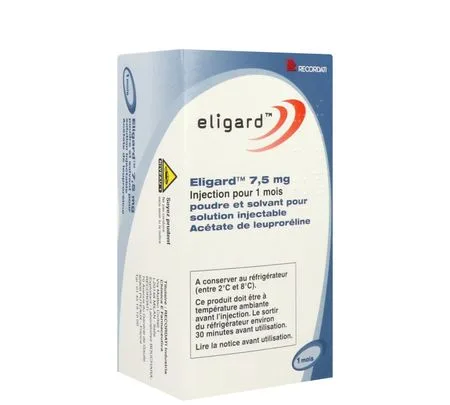
ELIGARD 7,5 mg, powder and solvent for injectable solution
Forms and presentations
Powder and solvent for solution for injection.
Powder (syringe B): pre-filled syringe with a white to off-white powder.
Solvent (syringe A): pre-filled syringe with a clear, colourless to pale yellow/brown solution.
Kit containing 1 thermoformed tray and 1 sterile needle (20 gauge).
The tray contains a system of pre-connected syringes:
- one pre-filled syringe containing the powder + plunger (syringe B)
- one pre-filled syringe containing the solvent + plunger (syringe A)
- one connector with a locking button for syringes A and B.
Box of 1 kit + 1 sachet of desiccant.
Composition
One pre-filled syringe of powder for injectable solution contains 7,5 mg of leuprorelin acetate, corresponding to 6,96 mg of leuprorelin.
Solvent (syringe A): poly (D, L-lactide co-glycolide) (50:50), N-methylpyrrolidone.
Powder (syringe B): no excipients.
Indications
ELIGARD 7,5 mg is indicated for the treatment of advanced hormone-dependent prostate cancer and in combination with radiotherapy for the treatment of high-risk and locally advanced hormone-dependent localised prostate cancer.
Dosage and administration
Dosage
Adult male
ELIGARD 7,5 mg must be administered under the responsibility of a healthcare professional with the necessary competence to monitor the response to treatment.
ELIGARD 7,5 mg is administered once a month, as a single subcutaneous injection. The injected solution forms a solid drug depot and ensures continuous release of leuprorelin acetate for one month.
As a general rule, treatment of advanced prostate cancer with ELIGARD 7,5 mg should be continued long term and should not be interrupted in case of remission or improvement.
ELIGARD 7,5 mg may be used as neoadjuvant or adjuvant treatment in combination with radiotherapy in high-risk and locally advanced localised prostate cancer.
The response to treatment with ELIGARD 7,5 mg should be monitored by clinical examinations and analysis of serum levels of prostate-specific antigen (PSA). Clinical studies have shown that testosterone levels increased during the first 3 days of treatment in most non-orchidectomised patients and subsequently decreased within 3 to 4 weeks to reach values below medical castration levels. Once reached, these levels are maintained as long as treatment is continued (transient testosterone surges < 1 %). If a patient's response appears sub-optimal, it must be ensured that testosterone levels have reached castration levels or are being maintained at these levels. Since a lack of efficacy may occur due to incorrect preparation, reconstitution or administration, testosterone measurement should be performed in case of suspected or confirmed handling error (see section Warnings and precautions).
In patients with castration-resistant metastatic prostate cancer who have not undergone surgical castration, receiving treatment with a GnRH agonist, such as leuprorelin, and eligible for treatment with androgen synthesis inhibitors or androgen receptor inhibitors, the GnRH agonist treatment may be continued.
Paediatric population
The safety and efficacy of ELIGARD 7,5 mg in children aged 0 to 18 years have not been established (see section Contraindications).
Special patient populations
No clinical studies have been conducted in patients with hepatic or renal impairment.
Method of administration
ELIGARD 7,5 mg must be prepared, reconstituted and administered only by a healthcare professional who has read the instructions regarding the reconstitution and administration steps. The reconstitution and administration instructions must be strictly followed (see sections Warnings and precautions and Disposal and handling). If the product is not prepared correctly, it must not be administered.
The contents of the two pre-filled sterile syringes must be mixed just before administration of ELIGARD 7,5 mg by subcutaneous injection.
Based on animal data, intra-arterial or intravenous injection must absolutely be avoided.
As with other medicines administered by subcutaneous injection, it is recommended to change the injection site regularly.
Contraindications
ELIGARD 7,5 mg is contraindicated in women and children.
Hypersensitivity to leuprorelin acetate, to other GnRH agonists or to any of the excipients listed in the section Composition.
In patients who have already undergone orchidectomy (as with other GnRH agonists, ELIGARD 7,5 mg does not cause any additional decrease in serum testosterone levels in cases of surgical castration).
ELIGARD 7,5 mg must not be used as monotherapy in patients with prostate cancer with spinal cord compression or vertebral metastases (see section Warnings and precautions).
Warnings and precautions
Correct reconstitution of the medicine : Cases of handling errors that may occur at any step of the preparation process and may lead to lack of efficacy have been reported. The reconstitution and administration instructions must be strictly followed (see section Disposal and handling). In case of suspected or confirmed handling error, the patient must be adequately monitored (see section Dosage and administration).
Androgen deprivation therapy may prolong the QT interval:
In patients with a history or risk factors for QT interval prolongation, and in patients concomitantly receiving medicines that may prolong the QT interval (see section Interactions), physicians must assess the benefit/risk ratio, taking into account the potential risk of torsades de pointes before initiating treatment with Eligard 7,5 mg.
Cardiovascular diseases : An increased risk of myocardial infarction, sudden cardiac death and stroke has been reported with the use of GnRH agonists in some patients. The risk appears low based on published reports and should be carefully assessed according to the cardiovascular risk factors of patients with prostate cancer when choosing treatment. The onset of symptoms and signs suggestive of cardiovascular disease must be monitored in patients treated with a GnRH agonist and managed in accordance with current recommendations.
Transient increase in testosterone level : Leuprorelin acetate, like other GnRH agonists, causes a transient increase in serum concentrations of testosterone, dihydrotestosterone and acid phosphatases during the first week of treatment. Patients may experience worsening of symptoms or new symptoms such as bone pain, neuropathy, haematuria, ureteral or bladder outlet obstruction (see section Adverse effects). These symptoms usually disappear as treatment continues.
Concomitant administration of an appropriate anti-androgen should be considered, starting 3 days before leuprorelin treatment and continuing for the first two to three weeks of treatment. It has been observed that these measures help prevent the consequences of an initial increase in serum testosterone.
After surgical castration, ELIGARD 7,5 mg does not cause any further decrease in testosterone levels in male subjects.
Bone mineral density : A decrease in bone mineral density has been reported in the medical literature in men who have undergone orchidectomy or have been treated with GnRH agonists (see section Adverse effects).
Anti-androgen treatment significantly increases the risk of fractures secondary to osteoporosis. Only limited data are available on this. Fractures secondary to osteoporosis have been observed in 5 % of patients after 22 months of drug-induced androgen deprivation and in 4 % of patients after 5 to 10 years of treatment. The risk of osteoporotic fractures is generally higher than the risk of pathological fractures. Apart from prolonged testosterone deficiency, advanced age, smoking and alcohol consumption, obesity and lack of physical exercise may also promote the development of osteoporosis.
Pituitary apoplexy : During post-marketing surveillance, rare cases of pituitary apoplexy (a clinical syndrome secondary to infarction of the pituitary gland) have been reported after administration of GnRH agonists, the majority occurring within 2 weeks of the first administration, and some within the first hour. In these cases, pituitary apoplexy presented as sudden headache, vomiting, visual disturbances, ophthalmoplegia, altered mental status, and sometimes cardiovascular collapse. Immediate medical management is required.
Metabolic changes: Hyperglycaemia and an increased risk of developing diabetes have been reported in men receiving GnRH agonists. Hyperglycaemia may be related to the onset of diabetes mellitus or to deterioration of glycaemic control in diabetic patients. Blood glucose and/or glycosylated haemoglobin (HbA1c) levels should be monitored periodically in patients receiving a GnRH agonist, and these patients should be managed following current practice regarding the treatment of hyperglycaemia or diabetes. Metabolic changes associated with GnRH agonists may also include hepatic steatosis.
Convulsions : Cases of seizures have been reported post-marketing in patients treated with leuprorelin acetate, with or without a history of predisposing factors. These seizures must be managed according to current clinical practice.
Idiopathic intracranial hypertension: Cases of idiopathic intracranial hypertension (serous meningitis) have been reported in patients receiving leuprorelin. Patients must be warned of the possibility of signs and symptoms of idiopathic intracranial hypertension, including severe or recurrent headaches, visual disturbances and tinnitus. In the presence of idiopathic intracranial hypertension, discontinuation of leuprorelin treatment should be considered.
Severe cutaneous adverse reactions: Severe cutaneous adverse reactions (SCARs), including Stevens-Johnson syndrome (SJS) and toxic epidermal necrolysis (TEN, or Lyell's syndrome), which may be life-threatening or fatal, have been reported in association with leuprorelin treatment. At the time of prescription, patients must be informed of the signs and symptoms and closely monitored for severe skin reactions. If signs and symptoms suggestive of these reactions appear, leuprorelin treatment must be stopped immediately and an alternative treatment should be considered (where applicable).
Other events : Cases of ureteral obstruction and spinal cord compression, which may lead to paralysis with or without fatal complications, have been reported with GnRH agonists. The onset of spinal cord compression or renal insufficiency requires initiation of standard treatment for these complications.
Patients with vertebral and/or cerebral metastases, as well as patients with urinary tract obstruction, must be closely monitored during the first weeks of treatment.
Interactions
No pharmacokinetic drug interaction study has been performed with ELIGARD 7,5 mg. There is no description of possible interactions of leuprorelin acetate with other medicinal products.
Androgen suppression therapy may prolong the QT interval; therefore, concomitant use of Eligard 7,5 mg with medicinal products known to prolong the QT interval, or with medicinal products capable of inducing torsades de pointes such as class IA antiarrhythmics (e.g., quinidine, disopyramide) or class III antiarrhythmics (e.g., amiodarone, sotalol, dofetilide, ibutilide), methadone, moxifloxacin, antipsychotics, etc., should be evaluated with caution (see section Warnings and precautions).
Fertility, pregnancy and breastfeeding
Not applicable, as ELIGARD 7,5 mg is contraindicated in women.
Driving and using machines
The effects of ELIGARD 7,5 mg on the ability to drive vehicles and use machines have not been studied.
As fatigue, dizziness and visual disturbances are possible adverse effects of treatment or consequences of the underlying disease, the ability to drive vehicles and use machines may be impaired.
Adverse effects
The adverse effects observed with ELIGARD 7,5 mg are mainly due to the specific pharmacological action of leuprorelin acetate, namely increases and decreases in the levels of certain circulating hormones. The most frequently reported adverse reactions are hot flushes, nausea, malaise and fatigue, as well as transient local irritation at the injection site. Mild to moderate hot flushes occur in approximately 58 % of patients.
Tabulated list of adverse reactions
The following adverse effects were reported in clinical trials conducted in patients with advanced prostate carcinoma treated with ELIGARD. Adverse effects are classified by frequency: very common (≥ 1/10), common (≥ 1/100, < 1/10), uncommon (≥ 1/1 000, < 1/100), rare (≥ 1/10 000, < 1/1 000), very rare (< 1/10 000) and not known (cannot be estimated from the available data).
|
Table 1: Adverse effects in clinical studies with Eligard |
|
|
Infections and infestations |
|
|
Common |
rhinopharyngitis. |
|
Uncommon |
urinary tract infection, local skin infection. |
|
Metabolism and nutrition disorders |
|
|
Uncommon |
worsening of diabetes mellitus |
|
Psychiatric disorders |
|
|
Uncommon |
abnormal dreams, depression, decreased libido. |
|
Nervous system disorders |
|
|
Uncommon |
vertigo, headache, hypoesthesia, insomnia, olfactory and taste disorders, dizziness. |
|
Rare |
abnormal and involuntary movements. |
|
Frequency not known |
idiopathic intracranial hypertension (serous meningitis) (see section Warnings and precautions). |
|
Cardiac disorders |
|
|
Frequency not known |
prolongation of the QT interval (see sections Warnings and precautions and Interactions) |
|
Vascular disorders |
|
|
Very common |
Hot flushes. |
|
Uncommon |
hypertension, hypotension. |
|
Rare |
syncope, collapse. |
|
Respiratory, thoracic and mediastinal disorders |
|
|
Uncommon |
rhinorrhoea, dyspnoea. |
|
Frequency not known |
interstitial lung disease. |
|
Gastrointestinal disorders |
|
|
Common |
nausea, diarrhoea, gastroenteritis/colitis. |
|
Uncommon |
constipation, dry mouth, dyspepsia, vomiting. |
|
Rare |
flatulence, eructation. |
|
Skin and subcutaneous tissue disorders |
|
|
Very common |
ecchymoses, erythema. |
|
Common |
pruritus, night sweats. |
|
Uncommon |
cold sweat, hyperhidrosis. |
|
Rare |
alopecia, skin rash. |
|
Frequency not known |
Stevens-Johnson syndrome (SJS)/toxic epidermal necrolysis (TEN or Lyell's syndrome) (see section Warnings and precautions), toxic skin rash, erythema multiforme. |
|
Musculoskeletal and systemic disorders |
|
|
Common |
arthralgia, limb pain, myalgia, rigidity, asthenia. |
|
Uncommon |
back pain, muscle cramps. |
|
Renal and urinary disorders |
|
|
Common |
decreased frequency of micturition, difficulty in micturition, dysuria, nocturia, oliguria. |
|
Uncommon |
bladder spasms, haematuria, worsening of urinary frequency, urinary retention. |
|
Disorders of the reproductive system and breast |
|
|
Common |
breast tenderness, testicular atrophy, testicular pain, infertility, breast enlargement, erectile dysfunction, decreased size of the penis. |
|
Uncommon |
gynaecomastia, impotence, testicular disorders. |
|
Rare |
breast pain. |
|
General disorders and administration site conditions |
|
|
Very common |
fatigue, burning at the injection site, paraesthesia at the injection site. |
|
Common |
malaise, pain at the injection site, haematoma at the injection site, painful tingling at the injection site. |
|
Uncommon |
pruritus at the injection site, induration at the injection site, lethargy, pain, fever. |
|
Rare |
ulceration at the injection site. |
|
Very rare |
necrosis at the injection site. |
|
Blood and lymphatic system disorders |
|
|
Common |
haematological disorders, anaemia. |
|
Investigations |
|
|
Common |
increased blood creatine phosphokinase, prolonged clotting time. |
|
Uncommon |
increased alanine aminotransferase, increased blood triglycerides, increased prothrombin time, weight gain. |
Other adverse effects have generally been reported with treatment with leuprorelin acetate, including peripheral oedema, pulmonary embolism, palpitations, myalgia, muscle weakness, an alteration in skin sensation, chills, skin rash, amnesia and visual disturbances. Muscle atrophy has been observed with prolonged use of medicinal products belonging to this pharmacological class. Infarction of a pre-existing pituitary apoplexy has rarely been described following administration of a GnRH agonist treatment, whether immediate-acting or long-acting. Rare cases of leukopenia and thrombocytopenia have been reported. Changes in glucose tolerance have been reported.
Convulsions have been reported following administration of a GnRH agonist/analogue (see section Warnings and precautions).
The local adverse events reported after injection of ELIGARD 7,5 mg are similar to those associated with similar products injected subcutaneously.
Generally, these localised adverse events occurring after subcutaneous injection are mild and described as being of short duration.
Rare cases of anaphylactic/anaphylactoid reactions have been reported following administration of a GnRH agonist/analogue.
Changes in bone mineral density
A decrease in bone mineral density has been reported in the medical literature in men who underwent orchidectomy or those treated with a GnRH analogue. It is likely that long-term treatment with leuprorelin will reveal signs of worsening osteoporosis, with regard to the increased risk of osteoporotic fracture (see section Warnings and precautions).
Exacerbation of signs and symptoms of the disease
Treatment with leuprorelin acetate may cause an exacerbation of signs and symptoms of the disease during the first weeks of treatment. Worsening of conditions such as vertebral metastases and/or urinary obstruction or haematuria may cause neurological problems such as weakness and/or paraesthesia of the lower limbs or worsening of urinary symptoms.
Reporting of suspected adverse reactions
Reporting suspected adverse reactions after authorisation of the medicinal product is important. It allows continued monitoring of the benefit/risk balance of the medicinal product. Healthcare professionals are asked to report any suspected adverse reactions via the national reporting system: National Agency for the Safety of Medicines and Health Products (ANSM) and the network of Regional Pharmacovigilance Centres - Website: https://signalement.social-sante.gouv.fr.
Overdose
Misuse and deliberate overdose with ELIGARD 7,5 mg are unlikely. No cases of misuse or overdose have been reported in clinical practice with leuprorelin acetate, but if excessive exposure were to occur, patient monitoring and administration of adjuvant symptomatic treatment are recommended.
Pharmacodynamics
Pharmacotherapeutic class: Gonadotrophin-releasing hormone analogues, ATC code: L02A E02.
Leuprorelin acetate is a synthetic nonapeptide, agonist of the natural gonadotrophin-releasing hormone (GnRH) which, on prolonged administration, leads to inhibition of pituitary gonadotrophin secretion and suppression of testicular steroid synthesis in men. This effect is reversible upon cessation of drug treatment. However, the agonist has a more potent action than the natural hormone and the time required to restore testosterone levels may vary between patients.
Administration of leuprorelin acetate causes an initial rise in circulating levels of luteinising hormone (LH) and follicle-stimulating hormone (FSH), responsible for a transient rise in men in the concentrations of gonadal steroids, testosterone and dihydrotestosterone. Continuous administration of leuprorelin acetate causes a decrease in LH and FSH levels. In men, testosterone decreases below the castration threshold (≤ 50 ng/dL). These decreases appear three to five weeks after initiation of treatment. Mean testosterone levels at six months are 6,1 (±0,4) ng/dL, comparable to levels observed after bilateral orchidectomy. All patients who received the full dose in the pivotal clinical study reached castration levels at 6 weeks; 94 % reached it on day 28 and 98 % on day 35. In the large majority of patients, testosterone levels were below 20 ng/dL: the clinical benefit of these low levels has not yet been established. PSA levels decreased by 94 % over six months.
Long-term studies have shown that continued treatment maintained testosterone levels below the castration threshold for a period of up to seven years, and probably indefinitely.
Tumour size was not measured directly during the clinical study programme, but an indirect beneficial tumour response was observed, as indicated by a reduction of 94 % in the mean PSA level with ELIGARD 7,5 mg.
A randomised phase III clinical trial was conducted in 970 patients with locally advanced prostate cancer (mainly of stages T2c to T4, and with a few patients of stage T1c to T2b presenting with regional lymphadenopathy), of whom 483 received short-term androgen suppression (6 months) in combination with radiotherapy and 487 received long-term androgen suppression (3 years) in combination with radiotherapy. A non-inferiority analysis was performed to compare concomitant and adjuvant short-term and long-term hormonal treatment with a GnRH agonist (triptorelin or goserelin). The overall mortality rate at 5 years was 19,0 % and 15,2 % in the short-term and long-term treatment groups, respectively. The observed Hazard Ratio of 1,42 with an upper limit of 1,79 of the CI at 95,71 % one-sided, or of 1,09 of the CI at 95,71 % two-sided; 1,85 (p = 0,65 for non-inferiority) shows that the combination of radiotherapy and androgen suppression treatment of 6 months induces lower survival compared with radiotherapy combined with androgen suppression treatment of 3 years. Overall survival at 5 years is 84,8 % and 81,0 % with long-term treatment and short-term treatment, respectively. Overall quality of life assessed using the QLQ-C30 questionnaire was not significantly different between the two groups (p = 0,37). The results are mainly due to the population of patients with locally advanced tumours.
The arguments supporting the indication in high-risk localised prostate cancer are based on published studies of radiotherapy combined with GnRH analogues, including leuprorelin acetate. Clinical data from five published studies were analysed (EORTC 22863, RTOG 85-31, RTOG 92-02, RTOG 8610 and D'Amico et al., JAMA, 2004); all demonstrate a benefit of combining a GnRH analogue with radiotherapy. It was not possible to clearly distinguish, in the published studies, the respective study populations for the indications in locally advanced prostate cancer and in high-risk localised prostate cancer.
Clinical data have shown that radiotherapy followed by androgen suppression treatment of 3 years is preferable to radiotherapy followed by androgen suppression treatment of 6 months.
In patients with stage T3 to T4 cancer receiving radiotherapy, the duration of androgen suppression treatment recommended in medical guidelines is 2 to 3 years.
Pharmacokinetics
Absorption
In patients with advanced prostate cancer, mean serum concentrations of leuprorelin increase after the initial injection and reach 25,3 ng/mL after 4-8 hours (Cmax). After the initial increase occurring after each injection (plateau phase observed after each injection on day 2th to day 28th ), serum concentrations remain relatively constant (0,28-1,67 ng/mL). There is no sign of accumulation during repeated-dose administration.
Distribution
The mean volume of distribution of leuprorelin at steady state after intravenous bolus administration to healthy male volunteers was 27 litres. In vitro, binding to human plasma proteins varies between 43 % and 49 %.
Elimination
In healthy male volunteers, intravenous bolus administration of 1 mg leuprorelin acetate resulted in a mean systemic clearance of 8,34 L/h, with a terminal elimination half-life of approximately 3 hours according to a two-compartment model.
No drug excretion study has been performed with ELIGARD 7,5 mg.
No metabolism study of ELIGARD 7,5 mg has been performed.
Preclinical safety
Preclinical studies with leuprorelin acetate showed effects on the reproductive system of both sexes, effects expected given the known pharmacological profile. These effects proved reversible after discontinuation of treatment and an appropriate period of recovery. Leuprorelin acetate did not show teratogenic activity. Embryotoxicity/lethality was observed in rabbits, related to the pharmacological effects of leuprorelin acetate on the reproductive tract.
Carcinogenicity studies were conducted in rats and mice for 24 months. In rats, a dose-dependent increase in pituitary apoplexy was observed after subcutaneous administration at doses of 0,6 to 4 mg/kg/day. No such effect was observed in mice.
Leuprorelin acetate and the 1-month formulation ELIGARD 7,5 mg were not shown to be mutagenic in tests performed in vitro and in vivo.
INCOMPATIBILITIES
The leuprorelin contained in syringe B must be mixed only with the solvent in syringe A and must not be mixed with other medicinal products.
Shelf life
Before reconstitution:
2 years.
A once the product has been removed from the refrigerator, it may be kept in its original packaging at room temperature (not exceeding 25 °C) for a maximum of 4 weeks.
After the first opening of the tray, the powder and solvent for injectable solution must be used immediately to reconstitute the medicinal product and administer it to the patient.
Once reconstituted: administer the product immediately, as the viscosity of the solution increases over time.
Special storage precautions
Store in a refrigerator (between 2 °C and 8 °C).
To be stored in the original outer packaging, protected from moisture.
This product must be at room temperature before injection. Remove it from the refrigerator about 30 minutes before use. Once removed from the refrigerator, the product may be kept in its original packaging at room temperature (not exceeding 25 °C) for a maximum of 4 weeks.
SPECIAL PRECAUTIONS FOR DISPOSAL AND OTHER HANDLING
Allow the product to warm to room temperature by removing it from the refrigerator about 30 minutes before use.
Please first prepare the patient for the injection, then prepare the product, following the instructions below. If the product is not prepared correctly, it must not be administered, since a lack of clinical efficacy may occur due to incorrect reconstitution of the product.
Step 1:
On a clean work surface, open the tray by removing the aluminium foil from the corner to remove the contents. Discard the desiccant sachet.
Remove the pre-connected syringe system (Figure 1.1) from the tray. Open the safety needle packaging (Figure 1.2) by peeling off the paper tab.
Note: Syringe A and syringe B must not yet be aligned.
Step 2:
Take the connector locking button between your finger and thumb and press (Figure 2) until you hear a click. The two syringes will then be aligned. No particular orientation of the syringe system is required to activate the connector. Do not bend the syringe system (this may cause leaks as you risk partially unscrewing the syringes).
Step 3:
Holding the syringes in a horizontal position, transfer the liquid contents of syringe A into syringe B, which contains the leuprorelin acetate powder.
Mix the product thoroughly for 60 cycles by gently pushing the contents of the two syringes back and forth between the two syringes (one cycle corresponds to one push of the plunger for syringe A and one push of the plunger for syringe B) in a horizontal position, to obtain a homogeneous, viscous solution (Figure 3). Do not bend the syringe system (this may cause leaks as you risk partially unscrewing the syringes).
Once thoroughly mixed, the product will appear viscous with a colour range from colourless, to white, to pale yellow (which includes all shades from white to pale yellow).
Important: After mixing, proceed to the next step immediately, as the product becomes increasingly viscous over time. Do not refrigerate the mixed product.
Please note that the product must be mixed as described; SHAKING WILL NOT MIX THE PRODUCT CORRECTLY.
Step 4:
After mixing, hold the syringes in a vertical position, with syringe B at the bottom. The syringes must remain firmly assembled. Transfer all of the mixed product into syringe B (the large syringe) by pushing the plunger of syringe A and gently pulling the plunger of syringe B at the same time (Figure 4).
Step 5:
While ensuring that the plunger of syringe A is fully depressed, hold the connector and unscrew it from syringe B. Syringe A will remain attached to the connector (Figure 5).
Ensure that the product does not leak, as otherwise the needle will not be correctly attached.
Please note: Small air bubbles or one large air bubble may remain in the preparation. This is not a concern.
During this step, please do not try to purge the air bubbles from syringe B, as product could be lost!
Step 6:
- Hold syringe B upright and hold the white plunger in place to avoid any loss of product.
- Attach the safety needle to syringe B by holding the syringe upright and gently turning the needle about three-quarters of a turn clockwise until it is securely fixed (Figure 6).
Do not overtighten, as this may crack the needle hub, causing product to leak during injection. The safety device may also be damaged if the needle is screwed on with excessive force.
If the needle hub cracks, appears damaged or shows any leakage, the product must not be used. The damaged needle must not be substituted/replaced and the product must not be injected. The entire product must be disposed of safely.
If the needle hub is damaged, a new product must be used as a replacement.
Step 7:
Remove the needle safety device and remove the needle protective cap only before administering the product (Figure 7).
Important: Do not engage the needle safety device before administration.
If the needle tip appears damaged or leaking, the product must NOT be used. The damaged needle must NOT be replaced and the product must NOT be injected. In this case, use another box of ELIGARD.
Step 8:
Before administration, purge the large air bubbles from syringe B. Administer the product subcutaneously while keeping the safety device away from the needle.
|
Administration procedure: |
Figure 8 |
|
Step 9:
After injection, lock the safety device by following the instructions listed below:
1. Closing on a flat surface
Press the safety device, lever down, on a flat surface (Figure 9a) to cover the needle and lock the safety device.
A "click" confirms audibly and tactilely that the device is locked. In the locked position, the needle tip is completely covered.
2. Closing with your thumb
Place your thumb on the safety device (Figure 9b), cover the needle tip and lock the safety device.
A "click" confirms audibly and tactilely that the device is locked. In the locked position, the needle tip is completely covered.
Once the safety device is locked, dispose of the needle and syringe immediately in an appropriate waste container.
Prescription, supply and reimbursement
Medication requiring special monitoring during treatment:
- continuation of treatment requires testosterone level measurement every 3 months;
- the prescriber notes on the prescription that this measurement has been performed.
| Marketing authorisation (AMM) |
|
| Price: |
|
BOUCHARA-RECORDATI
Hekla Tower. 52, Avenue du Général-de-Gaulle
92800 Puteaux
Tel: 01 45 19 10 00
Source: VIDAL · Updated on 10/11/2026. This information does not replace advice from a healthcare professional.