
Medicines
SmPC of 21/08/2025
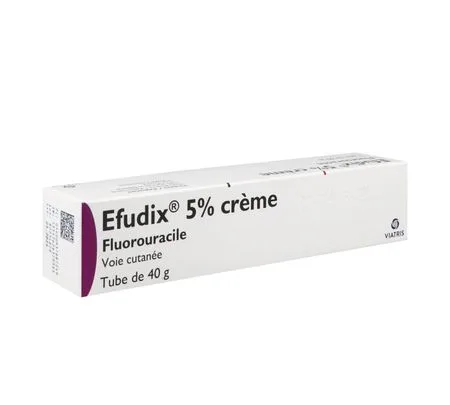
EFUDIX 5 %, cream
Composition
Fluorouracil ...................................................................................................................................... 5,000 g
For 100 g of cream.
Excipients with known effect: propylene glycol, stearyl alcohol, methyl parahydroxybenzoate, propyl parahydroxybenzoate.
Methyl parahydroxybenzoate (E218), propyl parahydroxybenzoate (E216), stearyl alcohol, petrolatum, polysorbate 60, propylene glycol, purified water.
Indications
• Precancerous keratoses.
• Bowen's disease - erythroplasia of Queyrat: when surgery is impossible, this treatment may be used but healing must be monitored.
• Genital condylomas.
Dosage and administration
Before any application, it is necessary to ensure the exact nature of the lesion to be treated: a biopsy may be necessary.
In principle, one to two applications per day in a thin layer and in small quantity, exclusively on the lesions.
Application to healthy skin should be avoided.
Treatment must be continued for several weeks (3 to 4 on average), under medical supervision.
If a lesion persists beyond the normal healing period, a new biopsy will be necessary.
In certain cases, when better penetration of the active substance is desired, the dermal cream will be applied with an occlusive dressing renewed every day.
Application of this medicine may be a useful preparation or a necessary complement to surgical curettage or cryotherapy, chemotherapy, laser.
After application to a lesion, the therapeutic response may manifest in 4 stages:
1. simple or no inflammatory reaction.
2. more severe inflammatory reaction: erythema, burning, edema, vesicle.
3. destruction of the lesion with erosion, ulceration, necrosis.
4. re-epithelialization followed by healing with possible hyperpigmentation.
This normal therapeutic response is not an adverse effect. Its particular significance in certain subjects, at stage 2 and 3, may lead to temporary suspension of treatment or its adaptation: reducing the frequency of applications, stopping an occlusive dressing, using local treatments with emollients or even topical corticosteroids.
Paediatric population
The safety and efficacy of Efudix have not been established in children. No data are available.
Contraindications
This medicine is contraindicated in cases of hypersensitivity to any of the constituents.
The use of topically administered fluorouracil is contraindicated during pregnancy and breastfeeding (see section Fertility, pregnancy and breastfeeding.).
Known deficiency of dihydropyrimidine dehydrogenase (DPD) (see section Warnings and precautions.).
The association with sorivudine and other DPD inhibitor analogues, such as brivudine, is contraindicated (see section Warnings and precautions.).
In association with the yellow fever vaccine (antiamarile) (see section Interactions).
Warnings and precautions
Sun exposure of treated lesions may lead to an increase in the effects of the product. Exposure to UV radiation (e.g. direct sunlight, tanning salon) should be avoided.
The treated skin surface must not measure more than 500 cm2 (approximately 23x23 cm). If the affected area is larger, it should be treated part by part.
Significant systemic toxicity is unlikely from percutaneous absorption of fluorouracil when Efudix is used in accordance with the recommendations in the posology and method of administration section (see section Dosage and administration.). Nevertheless, systemic toxicity may occur if the product is used excessively or on damaged skin (e.g. cut), or when patients have a dihydropyrimidine dehydrogenase (DPD) deficiency (see section Adverse effects).
DPD is a key enzyme involved in the metabolism and elimination of fluorouracil.
Determination of DPD activity should be considered when systemic toxicity is confirmed or suspected.
The incidence of complete DPD deficiency in the Caucasian population is 0.01%.
When systemic toxicity is suspected, discontinuation of treatment should be considered.
A minimum interval of 4 weeks between treatment with sorivudine and other DPD inhibitor analogues, such as brivudine, must be respected.
Excipients such as stearyl alcohol and propylene glycol may cause skin irritation (e.g. contact dermatitis). Methyl parahydroxybenzoate and propyl parahydroxybenzoate may cause allergic reactions (which may be delayed).
Avoid contact with mucous membranes, eyes and healthy skin.
In case of contact, rinse thoroughly with water.
Hands should be washed after application of the dermal cream.
This medicinal product is not recommended with live attenuated vaccines, phenytoin and fosphenytoin, and vitamin K antagonists (see section Interactions).
Occlusive dressings may increase inflammatory skin reactions.
There is a possibility of increased absorption through damaged skin (ulcers or inflammation).
Interactions
INTERACTIONS COMMON TO ALL CYTOTOXICS
Contraindicated combinations (see section Contraindications)
+ Yellow fever vaccine (antiamarile)
Risk of fatal generalised vaccine disease.
Contraindicated combinations (see section Warnings and precautions)
+ Phenytoin (and, by extrapolation, fosphenytoin)
Risk of convulsions due to reduced digestive absorption of phenytoin alone by the cytotoxic, or risk of increased toxicity or loss of efficacy of the cytotoxic due to increased hepatic metabolism of it by phenytoin or fosphenytoin.
+ Live attenuated vaccines except yellow fever (antiamarile)
Risk of possibly fatal generalised vaccine disease. This risk is increased in subjects already immunosuppressed by the underlying disease.
Use an inactivated vaccine where one exists (poliomyelitis).
Associations to be taken into account
+ Immunosuppressants (ciclosporin, everolimus, sirolimus, tacrolimus)
Excessive immunosuppression with risk of lymphoproliferative syndrome.
INTERACTIONS SPECIFIC TO FLUOROURACIL
Contraindicated combinations (see section Contraindications)
+ Nucleoside antiviral anti-herpetic drugs
Nucleoside antiviral anti-herpetic drugs (for example, brivudine, sorivudine and their analogues) are potent inhibitors of DPD, the enzyme that metabolises fluorouracil. For this reason, the combination of these drugs with Efudix is contraindicated.
+ Sorividine, brividine
Risk of increased adverse effects of the cytotoxic agent, due to inhibition of its hepatic metabolism by the antiviral.
Combinations not recommended
+ Vitamin K antagonists
Marked increase in the effect of vitamin K antagonists and in the risk of haemorrhage. If it cannot be avoided, more frequent monitoring of the INR. Adjust the dose of the vitamin K antagonist during treatment with the cytotoxic agent and 8 days after its discontinuation.
Associations to be taken into account
+ Folinic acid
Potentiation of both the cytostatic and the adverse effects of fluorouracil.
+ Interferon alpha
Increased gastrointestinal toxicity of fluorouracil.
+ Metronidazole, omidazole
Increased toxicity of fluorouracil due to decreased clearance.
Fertility, pregnancy and breastfeeding
Pregnancy
There are currently not enough observations to assess a possible malformative or foetotoxic effect of 5FU when administered topically during pregnancy.
Studies performed in animals have demonstrated a teratogenic effect of 5-fluorouracil (see section Preclinical safety).
Clinically, when this medicine is applied to healthy skin, there is a systemic passage that is difficult to assess, which is increased when applied to damaged skin.
Consequently, the use of topically administered 5FU is contraindicated during pregnancy (see section Contraindications).
In case of accidental administration during pregnancy, treatment must be interrupted. This element does not constitute the systematic argument for advising termination of pregnancy but leads to an attitude of caution and targeted prenatal monitoring.
Women of childbearing potential / Contraception in men and women:
Due to the genotoxic potential of fluorouracil (see section Preclinical safety), women of childbearing potential must use effective contraceptive measures during treatment with fluorouracil and for 6 months after the end of treatment.
Men are advised to use effective contraceptive measures and not to father a child during treatment with fluorouracil and for 3 months after the end of treatment.
If pregnancy occurs during treatment, the patient must be informed of the risk to the child of adverse effects associated with the treatment and genetic counselling is recommended.
Breast-feeding
There is no data on the passage of 5FU into breast milk. A risk to the breastfed child cannot be excluded; consequently, the use of Efudix is contraindicated during breastfeeding (see section Contraindications).
If use during breastfeeding is absolutely necessary, breastfeeding must be stopped.
Fertility
No clinical data on the effects of Efudix on fertility is available. Studies in different species have shown impaired fertility after systemic administration of 5-fluorouracil.
Driving and using machines
The treatment is unlikely to affect the ability to drive vehicles and use machines when used according to the posology.
Adverse effects
In the system organ class classification, adverse reactions are listed by frequency (number of patients expected to experience the reaction) using the following categories:
• Very common (≥1/10)
• Frequent (≥1/100 to <1/10)
• Uncommon (≥1/1000 to <1/100)
• Rare (≥1/10 000 to <1/1000)
• Very rare (<1/10 000)
Frequency unknown (cannot be estimated from the available data)
Local reactions associated with exacerbations of the normal therapeutic response (such as pain, pruritus, burning at the application site) (see section Dosage and administration) which are linked to the pharmacological activity of fluorouracil on the skin are the reactions most frequently reported. Allergic-type skin reactions and reactions linked to the systemic toxicity of the medicine are very rarely reported.
If application is made beyond the lesions, erythematous reactions may be observed on healthy skin. They are moderate, transient, but may require a temporary interruption of treatment.
Blood and lymphatic system disorders
Very rare: haematological disorders, associated with the systemic toxicity of the medicine, e.g. pancytopenia, neutropenia, thrombocytopenia.
Immune system disorders
Very rare: immediate hypersensitivity (urticaria, angioedema), delayed hypersensitivity (contact dermatitis, eczema).
Nervous system disorders
Frequency unknown: dysgeusia, headache, dizziness, vertigo
Eye disorders
Frequency unknown: conjunctival irritation, keratitis, increased lacrimal secretion
Gastrointestinal disorders
Very rare: haemorrhagic diarrhoea, diarrhoea, vomiting, abdominal pain, stomatitis, associated with systemic toxicity of the medicine
Frequency unknown: nausea
Skin and subcutaneous tissue disorders
Frequent: skin pain, skin reaction, pruritus, vesicles at the application site, skin irritation, erythema, skin burning sensation, skin exfoliation, skin swelling, skin ulcer, hyperpigmentation (see also the normal therapeutic response in section Dosage and administration)
Frequency unknown: erythema multiforme, generalised rash associated with systemic toxicity of the medicine, photosensitivity reaction, alopecia.
General disorders and administration site conditions
Very rare: fever, chills, associated with systemic toxicity of the medicine.
Frequency unknown: haemorrhage at the application site.
Reporting of suspected adverse reactions
Reporting suspected adverse reactions after authorisation of the medicinal product is important. It allows continued monitoring of the benefit/risk balance of the medicinal product. Healthcare professionals are asked to report any suspected adverse reaction via the national reporting system: National Agency for the Safety of Medicines and Health Products (ANSM) and the network of Regional Centres of Pharmacovigilance - Website: https://signalement.social-sante.gouv.fr/.
Overdose
If Efudix is accidentally ingested, signs of an overdose related to fluorouracil may appear and may include nausea, vomiting and diarrhoea.
Cases of stomatitis and dyscrasia may also occur.
Appropriate measures must be put in place for the prevention of systemic infections, as well as monitoring of the white blood cell count.
Overdose results in an increase in side effects and in particular digestive and haematological disorders. Treatment with fluorouracil must be stopped immediately and symptomatic treatment must be put in place.
Under normal conditions of use of Efudix, significant systemic toxicity is unlikely following percutaneous absorption of fluorouracil. However, a possible overdose should be considered in light of the effects listed above and treated symptomatically; haematological monitoring should be instituted.
Pharmacodynamics
Pharmacotherapeutic class: ANTIMETABOLITE FOR CUTANEOUS USE, ATC code: D. Dermatology
Efudix is a topical cytostatic preparation which exerts a beneficial therapeutic effect on neoplastic and pre-neoplastic skin lesions, while having less effect on healthy cells.
Pharmacokinetics
Cutaneous absorption of fluoro-5 uracil used in dermal cream has been measured: healthy skin absorbs very little of the product, since 87 to 95 % of the fluoro-5 uracil applied is found on the swabs used to clean the skin.
In patients with skin lesions, on average 15 to 20 % of the total dose is excreted in the urine.
The fraction of fluoro-5 uracil that enters the body is metabolised in the liver and excreted partly in the urine and partly in the exhaled air.
Preclinical safety
The 5-fluorouracil is genotoxic in vitro and in vivo.
With systemic administration of high doses of 5-fluorouracil, there is a potential for teratogenic or embryotoxic effects in mice, rats and hamsters (including malformations of the nervous system, palate, skeleton, tail and limbs).
Embryotoxic effects (small foetuses, resorption) have also been observed in monkeys treated with 5-fluorouracil. 5-fluorouracil is classified as a possible teratogen in humans. 5-fluorouracil crosses the placenta in rats.
Fertility studies carried out with systemic 5-FU show a decrease in fertility in adult males and a decrease in pregnancy rates in female rodents.
Prescription, supply and reimbursement
| Marketing authorisation (AMM) |
|
| Price: |
|
Collection.
1 RUE DE TURIN
69007 LYON
Tel: 04 37 25 75 00 https://www.viatris.fr/
Source: VIDAL · Updated on 10/11/2026. This information does not replace advice from a healthcare professional.