
Medicines
SmPC of 22/03/2022
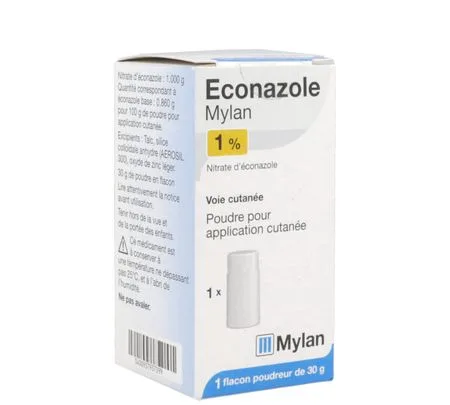
ECONAZOLE VIATRIS 1%, powder for cutaneous application
Composition
Econazole nitrate............................................................................................................................................ 1 g
For 100 g of powder for cutaneous application.
Talc, anhydrous colloidal silica (AEROSIL 300), light zinc oxide.
Indications
Candidiasis :
Cutaneous candidiasis encountered in human clinical practice is usually due to Candida albicans. However, the detection of Candida on the skin cannot in itself constitute an indication.
- Treatment of macerated skin fold mycoses: genital, submammary, interdigital intertrigo.
Antifungal treatment of a possible digestive and/or vaginal focus is required in candidiasis of the inguinal and intergluteal folds to prevent recurrences.
Dermatophytoses :
- Treatment:
- Macerated genital and crural intertrigo.
- Toe intertrigo.
Dosage and administration
Dosage
Apply ECONAZOLE MYLAN to the skin 2 to 3 times a day, without exceeding 3 applications per day. Treatment must be continued for 2 to 4 weeks.
Paediatric population
Not applicable.
Method of administration
Cutaneous use.
Dust the lesions to be treated by sweeping over the entire affected area, after washing and drying the skin.
Contraindications
Hypersensitivity to the active substance or to any of the excipients listed in section Composition.
Warnings and precautions
For external use only.
- Candidiasis: use of an acidic pH soap is not recommended (a pH that promotes the multiplication of Candida).
- The risk of systemic passage must be taken into account in situations where the phenomenon of local occlusion may recur (for example elderly subjects, pressure sores, submammary intertrigo).
- Do not apply in the eye, nose or generally on mucous membranes.
- Drug interaction with vitamin K antagonists: the INR must be monitored more frequently and the dose of the vitamin K antagonist adjusted during treatment with ECONAZOLE MYLAN 1%, powder for cutaneous application and after its discontinuation (see section Interactions).
If a hypersensitivity (allergic) or irritation reaction occurs, treatment must be discontinued.
ECONAZOLE MYLAN 1 %, cutaneous application powder contains talc. Avoid inhalation of the powder to prevent irritation of the respiratory tract, particularly in children and infants.
Interactions
Econazole is an inhibitor of CYP3A4/2C9.
Associations requiring precautions for use
+ Vitamin K antagonists (acenocoumarol, fluindione, warfarin)
Increased effect of the vitamin K antagonist and risk of bleeding.
More frequent monitoring of INR. Possible adjustment of the vitamin K antagonist dose during treatment with econazole and after its discontinuation.
Fertility, pregnancy and breastfeeding
Pregnancy
Preclinical studies have shown reproductive toxicity (see section Preclinical safety).
The systemic absorption of econazole is low (< 10 %) after application to healthy skin in humans. There are no adequate and well-controlled studies on the harmful effects of using ECONAZOLE MYLAN in pregnant women, nor any relevant epidemiological data.
Consequently, ECONAZOLE MYLAN must not be used during the first trimester of pregnancy, unless the physician considers it essential for the mother.
ECONAZOLE MYLAN may be used during the second and third trimesters, if the potential benefit to the mother outweighs the possible risks to the fetus.
Breast-feeding
After oral administration of econazole nitrate to lactating rats, econazole and/or its metabolites were excreted into the milk and were found in the pups.
It is not known whether cutaneous application of ECONAZOLE MYLAN can result in sufficient systemic absorption of econazole to produce detectable amounts in breast milk. Caution should be exercised when ECONAZOLE MYLAN is used by breastfeeding mothers. Do not apply to the breasts during the breastfeeding period.
Adverse effects
The safety of econazole nitrate, in all forms combined, was evaluated in 470 patients who participated in 12 clinical trials treated with either the cutaneous application powder form (8 clinical trials) or the emulsion form (4 clinical trials). The most frequently reported adverse effects were: pruritus (1,3%), burning sensation (1,3%), pain (1,1%).
Adverse effects reported during clinical trials and since marketing of econazole nitrate in all forms combined are classified by System Organ Class and by frequency using the following categories: very common (≥ 1/10), common (≥ 1/100 to < 1/10), uncommon (≥ 1/1 000 to < 1/100), rare (≥ 1/10 000 to < 1/1 000), very rare (< 1/10 000), frequency not known (cannot be estimated from the available data).
|
System Organ Class |
Frequency: adverse effect |
|
Immune system disorders |
Frequency not known: hypersensitivity |
|
Skin and subcutaneous tissue disorders |
Common: pruritus, burning sensation |
|
Uncommon: erythema |
|
|
Frequency not known: angioedema, contact dermatitis, rash, urticaria, skin vesicle, skin exfoliation |
|
|
General disorders and administration site conditions |
Frequent: pain |
|
Uncommon: discomfort, swelling |
Reporting of suspected adverse reactions
Reporting suspected adverse reactions after authorisation of the medicinal product is important. It allows continued monitoring of the benefit/risk balance of the medicinal product. Healthcare professionals are asked to report any suspected adverse reaction via the national reporting system: National Agency for the Safety of Medicines and Health Products (ANSM) and the network of Regional Centres of Pharmacovigilance - Website: www.signalement-sante.gouv.fr.
Overdose
No cases of overdose have been reported to date.
Treatment:
ECONAZOLE MYLAN must only be used cutaneously.
In case of accidental inhalation of ECONAZOLE MYLAN 1%, cutaneous powder containing talc, there is a risk of airway blockage, particularly in infants and young children. Respiratory arrest must be treated in an intensive care unit and requires administration of oxygen. If breathing is compromised, tracheal intubation, removal of the inhaled material, and artificial ventilation should be considered.
In case of accidental ingestion, treatment will be symptomatic.
If this medicine is accidentally applied to the eyes, rinse with clear water or a saline solution and consult a doctor if symptoms persist.
Pharmacodynamics
Pharmacotherapeutic class: ANTIFUNGAL FOR TOPICAL USE – IMIDAZOLE AND TRIAZOLE DERIVATIVES, ATC code: D01AC03.
Mechanism of action
Econazole nitrate is an imidazole derivative with antifungal and antibacterial activity.
The antifungal activity has been demonstrated in vitro and acts on the agents responsible for cutaneous and mucosal mycoses:
- dermatophytes (Trichophyton, Epidermophyton, Microsporum),
- Candida and other yeasts,
- Malassezzia furfur (agent of Pityriasis Capitis and of Pityriasis Versicolor),
- molds and other fungi.
The antibacterial activity has been demonstrated in vitro with respect to Gram-positive bacteria.
Its mechanism of action, which differs from that of antibiotics, operates at several levels: membrane (increased permeability), cytoplasmic (inhibition of oxidative processes at the level of the mitochondria), nuclear (inhibition of RNA synthesis).
- Activity on Corynebacterium minutissimum (erythrasma).
- Actinomycetes.
Pharmacokinetics
In vivo experiments performed in healthy volunteers (with or without occlusive dressing) showed that econazole nitrate penetrated the deepest dermal cell layers. In the upper layers of the dermis and in the epidermis, econazole nitrate reaches fungicidal concentrations.
Econazole nitrate accumulates in large quantities in the stratum corneum and remains there for 5 to 16 hours. The stratum corneum thus acts as a reservoir.
The rate of systemic absorption is approximately 0,5% to 2% of the applied dose.
Transcutaneous passage may be increased on damaged skin.
Preclinical safety
A low neonatal survival rate and fetal toxicity have only been reported in cases of maternal toxicity. In animal studies, econazole nitrate showed no teratogenic effect but was fetotoxic in rodents at maternal doses of 20 mg/kg/day subcutaneously and 10 mg/kg/day orally. The transferability of these observations to humans is unknown.
SPECIAL PRECAUTIONS FOR DISPOSAL AND OTHER HANDLING
No special requirements.
Any unused medicinal product or waste material should be disposed of in accordance with local requirements.
Prescription, supply and reimbursement
| Marketing authorisation (AMM) |
|
| Price: |
|
Collection.
1 RUE DE TURIN
69007 LYON
Tel: 04 37 25 75 00 https://www.viatris.fr/
Source: VIDAL · Updated on 10/11/2026. This information does not replace advice from a healthcare professional.