
Medicines
SmPC of the 03/10/2023
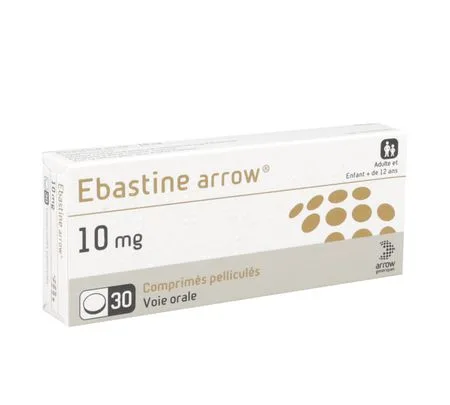
EBASTINE ARROW 10 mg, film-coated tablet
Forms and presentations
Film-coated tablet.
White, round film-coated tablet, engraved "10" on one side.
Composition
Ebastine..........................................................................................................................................................10 mg
For one film-coated tablet
Excipient with known effect: each tablet contains 88,70 mg of lactose monohydrate.
Lactose monohydrate, croscarmellose sodium, microcrystalline cellulose, hypromellose, macrogol 6000, polysorbate 80, talc, magnesium stearate.
Film coating : hypromellose, macrogol 6000, talc and titanium dioxide (E171).
Dosage and administration
Dosage
Reserved for adults and children over 12 years:
• seasonal and perennial allergic rhinitis: 10 to 20 mg per day in 1 daily intake, during or outside meals,
• urticaria: 10 mg per day in 1 daily intake, during or outside meals.
Special populations
Dose adjustment is not necessary in patients with mild, moderate or severe renal impairment or mild to moderate hepatic impairment. There is no experience with doses above 10 mg in patients with severe hepatic impairment. Therefore, the dose of 10 mg must not be exceeded in patients with severe hepatic impairment. Treatment should be continued until symptoms disappear.
Method of administration
Oral use.
Contraindications
• Children under 12 years in the absence of efficacy and safety data
• History of hypersensitivity to the active substance or to any of the excipients listed in section Composition
Warnings and precautions
Special warnings
Ebastine should be prescribed with caution in patients with long QT syndrome, hypokalaemia, or receiving a medicine known to prolong the QT interval or to inhibit CYP3A4, such as azole antifungals such as ketoconazole and itraconazole or macrolides such as erythromycin (see section Interactions).
As there is a pharmacokinetic interaction between antituberculous medicines such as rifampicin (see section Interactions), caution is required when co-prescribing ebastine with molecules from this group.
Precautions for use
Ebastine should be used with caution in patients with severe hepatic impairment (see section Dosage and administration).
Related to excipients
This medicine contains lactose. Patients with galactose intolerance, total lactase deficiency or glucose-galactose malabsorption syndrome (rare hereditary diseases) must not take this medicine.
Interactions
Combinations not recommended
Pharmacokinetic interactions have been observed when ebastine was given with ketoconazole, or itraconazole and erythromycin. These interactions result in an increase in plasma concentrations of ebastine and, to a lesser extent, of carebastine, which were nevertheless not associated with any significant clinical consequence. However, as a precaution, combination with ketoconazole, itraconazole, erythromycin, clarithromycin, josamycin should be avoided: increased risk of occurrence of ventricular rhythm disorders in predisposed subjects (congenital long QT syndrome).
Pharmacokinetic interactions have been observed when ebastine was given with rifampicin. These interactions may lead to lower plasma concentrations of ebastine and reduce the antihistamine effect.
No interaction has been reported between ebastine and theophylline, warfarin, cimetidine, diazepam and alcohol.
Administration of ebastine with food does not modify its clinical effect.
Fertility, pregnancy and breastfeeding
Pregnancy
There is little data on the use of ebastine in pregnant women. Animal toxicity studies do not show direct or indirect harmful effects. As a precaution, it is preferable not to use ebastine during pregnancy.
Breast-feeding
It is unknown whether ebastine is excreted in human milk or not. The high degree of protein binding of ebastine (97%) and its main metabolite, carebastine, suggests that there is no excretion into breast milk. As a precaution, it is preferable not to use ebastine during breastfeeding.
Fertility
There is no fertility data with ebastine in humans.
Driving and using machines
In humans, psychomotor function has been widely studied and no effect has been found. Ebastine at the recommended therapeutic doses does not affect the ability to drive vehicles and use machines. However, in sensitive subjects reacting unusually to ebastine, it is advised to know individual reactions before the patient drives or performs complex activities: drowsiness and dizziness may occur (see section Adverse effects).
Adverse effects
In a pooled analysis of controlled clinical trials versus placebo with 5 708 patients on ebastine, the most frequently reported adverse effects were dry mouth and drowsiness. Treatment-related adverse effects in clinical trials in children (n=460) were similar to those observed in adults.
The table below lists the adverse effects reported in clinical trials and since marketing according to the following convention: very common (≥ 1/10), common (≥ 1/100 and < 1/10), uncommon (≥ 1/1000 and < 1/100), rare (≥ 1/10 000 and < 1/1000), very rare (< 1/10 000) and frequency not known (cannot be estimated from the available data).
|
SOC MedDRA |
Very common ≥ 1/10 |
Common ≥ 1/100 to < 1/10 |
Rare ≥ 1/10 000 to < 1/1000 |
Very rare < 1/10 000 |
Not known |
|
Immune system disorders |
|
|
Hypersensitivity reactions (such as anaphylaxis and Quincke's oedema) |
Severe allergic reactions |
|
|
Psychiatric disorders |
|
|
Nervousness, insomnia |
|
|
|
Nervous system disorders |
Headache |
Somnolence |
Dizziness, hypoesthesia, dysgeusia |
|
|
|
Cardiac disorders |
|
|
Palpitations, tachycardia |
|
|
|
Gastrointestinal disorders |
|
Dry mouth |
Abdominal pain, vomiting, nausea, dyspepsia |
|
|
|
Hepatobiliary disorders |
|
|
Hepatitis, cholestasis, abnormal liver function tests (transaminases, gamma GT, alkaline phosphatase and bilirubin increased) |
|
|
|
Skin disorders |
|
|
Urticaria, skin rash, dermatitis |
|
|
|
Disorders of the reproductive organs |
|
|
Menstrual disorders |
|
|
|
General disorders and administration site conditions |
|
|
Oedema, asthenia |
|
|
|
Metabolism and nutrition disorders |
|
|
|
|
Increased appetite |
|
Investigations |
|
|
|
|
Weight gain |
Reporting of suspected adverse reactions
Reporting suspected adverse reactions after authorisation of the medicinal product is important. It allows continued monitoring of the benefit/risk balance of the medicinal product. Healthcare professionals should report any suspected adverse reaction via the national reporting system: National Agency for the Safety of Medicines and Health Products (ANSM) and network of Regional Centres of Pharmacovigilance - Website: https://signalement.social-sante.gouv.fr
Overdose
In studies conducted with high doses, no significant clinical signs or symptoms were observed up to 100 mg per day.
Management in case of massive overdose:
• no antidote is known to date,
• gastric evacuation,
• symptomatic treatment,
• monitoring of vital functions including ECG monitoring.
Pharmacodynamics
Pharmacotherapeutic class: H1 ANTIHISTAMINE for systemic use, ATC code: R06AX22.
(R: Respiratory System, D: Dermatology)
Ebastine and its active metabolite, carebastine, are selective antihistamines acting on peripheral H1 receptors, which appear to be devoid of sedative and anticholinergic side effects at the recommended doses.
Pharmacokinetics
Ebastine is rapidly absorbed after oral intake and undergoes a very significant intestinal and hepatic first-pass effect. It is almost entirely transformed into its pharmacologically active acid metabolite, carebastine.
After administration of a single oral dose of 10 mg, the peak plasma concentration is reached after 2 to 4 hours, with levels ranging between 80 and 100 ng/ml.
Studies in vitro on human hepatic microsomes shows that ebastine is metabolised mainly to carebastine via the cytochrome CYP3A4.
The half-life of the acid metabolite is between 15 and 19 hours, with urinary excretion of 66%, mainly as conjugated metabolite. After repeated administration of ebastine at a dose of 10 mg per day as a single intake, steady state is reached in 3 to 5 days, with plasma concentration peaks ranging from 130 to 160 ng/ml.
Ebastine and carebastine are strongly bound to plasma proteins, with a binding rate greater than 97%.
The passage of ebastine and its active metabolite, carebastine, across the blood-brain barrier is very low.
Passage into breast milk has not been studied.
Elderly subject
The pharmacokinetic parameters do not differ in a statistically significant way from the values recorded in young adults.
Renal and hepatic impairment
In patients with mild, moderate or severe renal impairment treated with a daily dose of ebastine of 20 mg, as well as in patients with mild to moderate hepatic impairment treated with a daily dose of ebastine of 20 mg, or in patients with severe hepatic impairment treated with a daily dose of ebastine of 10 mg, the concentrations of ebastine and carebastine reached between day 1er and day 5th of treatment were similar to those reached in healthy volunteers.
Consequently, the pharmacokinetic profile of ebastine and its metabolite does not change significantly in patients with varying degrees of renal or hepatic impairment.
Prescription, supply and reimbursement
| Marketing authorisation (AMM) |
|
| Price: |
|
Collection.
26 AVENUE TONY GARNIER
69007 LYON
Tel: 04 72 72 60 72 Tel (toll-free): 0811 65 27 76
contact@laboratoire-arrow.com
http://www.laboratoire-arrow.com/
Source: VIDAL · Updated on 10/11/2026. This information does not replace advice from a healthcare professional.