
Medicines
SmPC of 24/06/2025
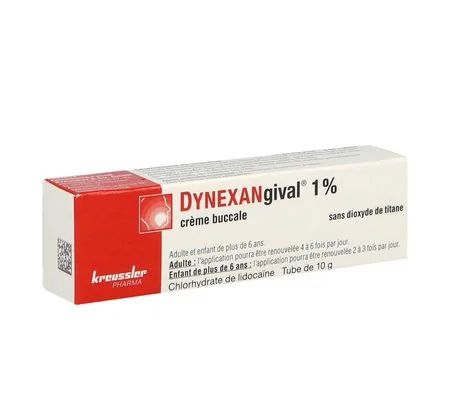
DYNEXANGIVAL 1 %, buccal cream
Composition
For 1 g of cream:
Lidocaine hydrochloride: 10,00 mg
Excipient(s) with known effect: benzalkonium chloride.
Benzalkonium chloride, purified water, guar gum galactomannan, glycerol, liquid paraffin, sodium saccharin, anhydrous colloidal silica, thymol, white petrolatum, flavouring (partially dementholised peppermint oil, peppermint oil).
Indications
Pain due to benign lesions of the oral and gingival mucosa: aphthous ulcers, traumatic and prosthetic wounds, gum irritation.
Dosage and administration
Dosage
Reserved for adults and children over 6 years.
Method of administration
Strictly local use. Buccal and gingival application.
Apply 0,2 g of cream (a small pea) on a clean finger and gently massage the painful spot to properly spread the cream over the area to be treated.
Adult : the application may be repeated 4 to 6 times per day.
Children over 6 years : the application may be repeated 2 to 3 times per day.
The duration of treatment must not exceed 5 days.
Contraindications
Hypersensitivity to the active substance, in particular to lidocaine or to local anesthetics in general, or to any of the excipients listed in the section Composition.
Warnings and precautions
Paediatric population: Do not use in children under 6 years of age.
Follow the administration and dosage advice.
Do not swallow after application to the mucosa.
Because of the local anaesthesia, take into account the risk of biting (lips, cheek, tongue).
If symptoms persist beyond 5 days, the course of action should be reassessed.
Related to excipients
Because of the presence of benzalkonium chloride, this medicine may cause skin reactions.
Interactions
Known interactions of lidocaine (antiarrhythmics, beta-blockers) in principle do not concern its local use on the mucosa of the oral cavity.
However, take into account a risk of systemic passage of lidocaine in case of damaged oral mucosa.
Fertility, pregnancy and breastfeeding
Pregnancy
In the absence of a teratogenic effect in animals, a malformative effect in the human species is not expected. In clinical practice, there are currently no sufficiently relevant data to assess a possible malformative or foetotoxic effect of lidocaine applied systemically during pregnancy. It is therefore preferable not to use lidocaine cream during pregnancy.
Breast-feeding
The use of lidocaine cream is possible during breastfeeding.
Adverse effects
In case of intolerance to any of the components of the oral cream, allergic reactions are possible (localised urticaria, contact dermatitis, anaphylactic shock).
The frequency of all reported symptoms is generally very rare, including isolated cases (< 0,01 %).
Reporting of suspected adverse reactions
Reporting suspected adverse reactions after authorisation of the medicinal product is important. It allows continued monitoring of the benefit/risk balance of the medicinal product. Healthcare professionals are asked to report any suspected adverse reactions via the national reporting system: National Agency for the Safety of Medicines and Health Products (ANSM) and the network of Regional Pharmacovigilance Centres - Website: https://signalement.social-sante.gouv.fr/.
Overdose
An overdose is not expected under normal conditions of use in stomatology.
This cream contains a small amount of terpene derivatives in the excipients (partially dementholised peppermint oil and peppermint oil), which may cause, at excessive doses, neurological accidents such as convulsions, and in particular in the case of a history of epilepsy.
With local application, systemic effects are very rare. However, in case of overdose and systemic absorption, toxic reactions cannot be excluded:
- nervous system: nervousness, agitation, tremors, nystagmus, headaches, nausea,
- respiratory system: tachypnoea then bradypnoea that may lead to apnoea,
- cardiovascular system: decrease in cardiac output and fall in blood pressure.
They must be treated in a specialised setting.
Pharmacodynamics
Pharmacotherapeutic class: Local anaesthetic, for dental use, ATC code: N01BB02.
Mechanism of action
Lidocaine is a local anaesthetic of the amino-amide group, whose effect is rapid and long-lasting.
The mechanism of action is based on the inhibition of nerve impulse conduction by binding of the activated molecule to a specific receptor of the sodium channel in the membrane surrounding the nerve fibre.
The effect appears after one minute and persists for about one hour, as release from the excipients is slightly delayed.
Excipients containing terpene derivatives may lower the epileptogenic threshold.
Pharmacokinetics
Absorption
After local application, absorption of lidocaine is limited. However, certain areas of the oral mucosa may be more permeable than others. The rate of absorption depends on the state of vascularisation of the mucosa.
Elimination
The metabolism of lidocaine is hepatic and its elimination is urinary.
Preclinical safety
The dose without toxic effect of lidocaine administered intramuscularly in mice is 4 mg/kg.
A mutagenic effect of an active metabolite (2,6-xylidine) has been demonstrated in rats from in vitro tests carried out with high doses at toxic concentrations.
In carcinogenicity studies with transplacental exposure and postnatal exposure to this same metabolite, administered at high doses for 2 years in rats, benign and malignant tumours were observed in the nasal cavity.
These data mean that treatment with lidocaine, even topical, must not be administered over a long period and beyond the recommended doses.
SPECIAL PRECAUTIONS FOR DISPOSAL AND OTHER HANDLING
No special requirements for disposal.
Any unused medicinal product or waste material should be disposed of in accordance with local requirements.
Prescription, supply and reimbursement
| Marketing authorisation (AMM) |
|
KREUSSLER PHARMA Laboratory
18, avenue Parmentier. 75011 Paris
Tel: 01 58 39 35 80. Fax: 01 43 70 21 06
Source: VIDAL · Updated on 10/11/2026. This information does not replace advice from a healthcare professional.