
Medicines
SmPC of the 12/02/2025
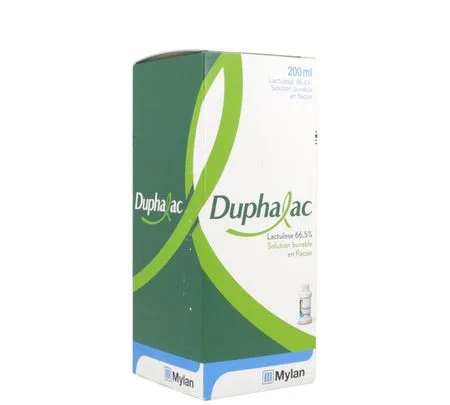
DUPHALAC 66,5 percent, oral solution in bottle
Forms and presentations
Oral solution (colorless to brownish-yellow liquid, clear, viscous.)
Bottle of 200 ml, with measuring cup graduated in ml (from 2,5 to 30 ml). Box of 1.
Composition
For 100 ml of solution:
Lactulose: 66,5 g
In the form of liquid lactulose
DUPHALAC contains residues with a notable effect arising from the synthesis route, see section Warnings and precautions.
None.
Dosage and administration
One graduation of 15 ml of this medicine = 10 g of lactulose.
The graduated measuring cup must be used.
The dose of lactulose must be swallowed in one go and must not be kept in the mouth for a prolonged period.
Dosage
The dosage must be adapted according to the needs of each patient.
In the case of a single daily intake, it must be taken at the same time, for example during breakfast.
During treatment with laxatives, it is recommended to drink sufficient liquid (1,5 to 2 liters, i.e. 6 to 8 glasses) during the day.
Constipation:
DUPHALAC may be administered in one or two intakes per day.
After a few days, depending on the response to treatment, the initial dose must be adjusted to reach the maintenance dose. Several days (2 or 3 days) may be necessary before the treatment takes effect.
The daily dosage is on average:
Infants from 0 to 12 months : up to 5 ml per day.
Children from 1 to 6 years : 1 graduation of 5 ml to 1 graduation of 10 ml per day.
Children from 7 to 14 years :
- initial treatment: 1 graduation of 15 ml per day.
- maintenance treatment: 1 graduation of 10 ml per day.
Adults and adolescents :
- attack treatment: 1 graduation of 15 ml to 3 graduations of 15 ml per day.
- maintenance treatment: 1 graduation of 10 ml to 1 graduation of 25 ml per day.
If diarrhoea occurs, reduce the dosage.
Hepatic encephalopathy
In all cases, the ideal dose is the one that leads to 2 or 3 soft stools per day.
The duration of treatment varies depending on the symptoms:
Attack treatment by gastric tube or enema in case of coma or pre-coma:
- gastric tube: 90 to 150 ml or 3 to 5 graduations of 30 ml, neat or diluted in water,
- retention enema with balloon catheter: 300 ml or 10 graduations of 30 ml in 700 ml of lukewarm water to be retained for 30 minutes to one hour. The procedure must be repeated if necessary 12 hours later.
Relay treatment by oral route: 15 to 30 ml or 1 graduation of 15 ml to 1 graduation of 30 ml, 3 times per day.
Paediatric population
The safety and efficacy in children (from newborns up to 18 years) with hepatic encephalopathy have not been established. No data are available.
Elderly patients and patients with renal or hepatic impairment:
In elderly patients and patients with renal or hepatic impairment, no dose adjustment is necessary because exposure to lactulose is negligible.
Method of administration:
Oral use
This medicine may be taken neat or diluted in a drink.
Rectal route.
This medicine must be dissolved in water.
Contraindications
- Hypersensitivity to the active substance or to any of the excipients listed in section Composition.
- Obstructive or subobstructive syndrome.
- Gastrointestinal perforation or suspicion of gastrointestinal perforation.
- Active inflammatory bowel disease (for example: Crohn's disease, ulcerative colitis).
- Abdominal painful syndromes of undetermined cause.
Warnings and precautions
Prolonged use of this medicine without medical supervision is not recommended.
The dose usually used in the treatment of constipation is not likely to affect diabetic patients: 30 ml of solution provides 116 kJ (28 kcal). The calories are of carbohydrate origin.
The dose used in patients suffering from hepatic encephalopathy is usually much higher and may need to be taken into consideration in diabetic patients.
Drug treatment of constipation is only an adjunct to dietary and lifestyle measures:
- enrichment of the diet with vegetable fibres and fluids,
- Advice on physical activity and rehabilitation of evacuation.
Chronic use at inappropriate doses or misuse may cause diarrhoea and disturb the fluid and electrolyte balance. This medicine should therefore be used with caution in patients prone to fluid and electrolyte disorders (such as patients with impaired renal or hepatic function, or those receiving a diuretic).
When administered as a retention enema, due to the strong cathartic effect, faecal incontinence, soiling of the bed and perianal irritation due to acidic stools can be expected. The hydration status of the patient should be carefully monitored.
It should be taken into account that the normal functioning of the defecation reflex may be hindered during treatment.
Information on excipients with known effect arising from the synthesis route:
This medicine contains lactose, galactose and fructose arising from the synthesis route. Therefore, patients with galactose or fructose intolerance, total lactase deficiency or glucose-galactose malabsorption syndrome (rare hereditary diseases) must not take this medicine.
DUPHALAC should be administered with caution in patients intolerant to lactose.
This product contains sulfites from the synthesis route.
Paediatric population
In infants and children, the prescription of laxatives should be exceptional.
Fertility, pregnancy and breastfeeding
Pregnancy
As systemic exposure to lactulose is negligible, no effect is expected in pregnant women.
DUPHALAC may be used during pregnancy.
Breast-feeding
As systemic exposure to lactulose in breastfeeding women is negligible, no effect is expected in breastfed newborns or infants.
DUPHALAC may be used during breastfeeding.
Fertility
No effect is expected because systemic exposure to lactulose is low.
Driving and using machines
DUPHALAC has no effect or negligible effect on the ability to drive vehicles and use machines.
Adverse effects
Bloating may occur at the start of treatment. In general, it disappears after a few days.
When the medicine is administered at doses higher than the recommended dosage, abdominal pain and diarrhoea may occur. In this case, the dosage should be reduced (see section Overdose).
If high doses are administered over a prolonged period (usually only in cases of hepatic encephalopathy), an electrolyte imbalance may occur due to diarrhoea.
Undesirable effects are classified in the table below according to the different parts of the body affected and their frequency, using the following convention: very common (≥ 1/10); common (≥ 1/100 to < 1/10); uncommon (≥ 1/1 000 to < 1/100); rare (≥ 1/10 000 to < 1/1 000); very rare (< 1/10 000); frequency not known (cannot be estimated from the available data).
|
MedDRA SOC |
Frequency category |
|||
|
Very common |
Common |
Uncommon |
Frequency not known |
|
|
Gastrointestinal disorders |
Diarrhoea |
Flatulence, abdominal pain, nausea, vomiting |
||
|
Investigations |
Electrolyte imbalance due to diarrhoea |
|||
|
Immune system disorders |
Hypersensitivity reactions* |
|||
|
Skin and subcutaneous tissue disorders |
Rash*, pruritus*, urticaria* |
|||
* reported after marketing
Reporting of suspected adverse reactions
Reporting suspected adverse reactions after authorisation of the medicinal product is important. It allows continued monitoring of the benefit/risk balance of the medicinal product. Healthcare professionals are asked to report any suspected adverse reactions via the national reporting system: National Agency for the Safety of Medicines and Health Products (ANSM) and the network of Regional Pharmacovigilance Centres - Website: https://signalement.social-sante.gouv.fr.
Overdose
Symptoms:
Diarrhoea, loss of electrolytes and abdominal pain.
Treatment:
Discontinuation of treatment or reduction of the dosage. Correction of any hydro-electrolytic disturbances in the event of significant fluid loss secondary to diarrhea and vomiting.
Pharmacodynamics
Pharmacotherapeutic class: HYPOAMMONEMIC OSMOTIC LAXATIVE, ATC code: A06AD11.
In the colon, the conversion of lactulose by colonic bacteria into low molecular weight organic acids lowers the pH of the colonic contents and, through an osmotic effect, increases the volume of the colonic contents.
These effects stimulate colonic peristalsis and normalise stool consistency. Constipation disappears and the physiological rhythm of the colon is restored.
In hepatic encephalopathy (HE), the effect has been attributed to the suppression of proteolytic bacteria through an increase in acidophilic bacteria (for example lactobacillus), and to the retention of ammonia in ionic form through acidification of the colonic contents.
Pharmacokinetics
Lactulose is poorly absorbed after oral administration and reaches the colon unchanged, where it is metabolised by the bacterial flora. Metabolism is complete for intakes of up to 40-75 ml; for higher doses, part of the lactulose may be excreted unchanged.
Preclinical safety
The results of acute, sub-acute and chronic toxicity studies in different species show that the active substance is very weakly toxic. The effects observed appear to be related more to the bulk effect in the gastrointestinal tract than to a more specific toxic activity.
No adverse effects were observed in reproduction and teratogenicity studies in rabbits, rats and mice.
Special storage precautions
Store at a temperature not exceeding 25 °C.
Do not refrigerate (risk of crystallization).
Prescription, supply and reimbursement
| Marketing authorisation (AMM) |
|
| Price: |
|
COOPER
Coopération Pharmaceutique Française
Place Lucien-Auvert. 77020 Melun cdx
Tel: 01 64 87 20 00
Source: VIDAL · Updated on 10/11/2026. This information does not replace advice from a healthcare professional.