
Medicines
Update of 12/10/2026
DULCOLAX®
bisacodyl
Forms and presentations
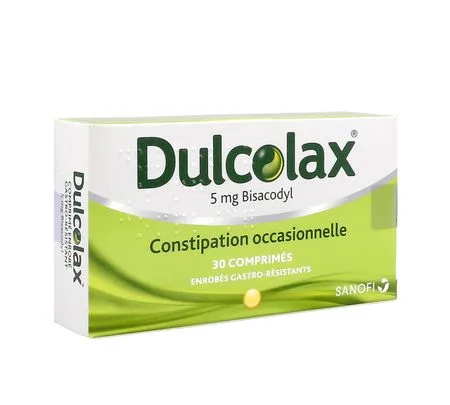
Delayed-release enteric-coated tablet at 5 mg (yellow): Pack of 30, under blister packs.Suppository at 10 mg: Box of 6, under blister pack.
Composition
| Lozenge: | per tablet |
| Bisacodyl (INN)
|
5 mg |
Excipients with known effect: lactose (34,9 mg/tab), sucrose (23,4 mg/tab), castor oil (0,98 mg/tab).
| Suppository: | per suppository |
| Bisacodyl (INN)
|
10 mg |
Indications
- Tablet and suppository:
- Symptomatic treatment of occasional constipation.
- Suppository:
- Preparation for endoscopic examinations of the rectum.
Dosage and administration
Dosage- Lozenge:
-
- Adults: 1 or 2 tablets maximum per day.
- Children aged 6 to 12 years: 1 tablet per day for 2 to 10 days.
Children up to 12 years suffering from chronic or persistent constipation must be treated only under the supervision of a physician.
- Adults: 1 or 2 tablets maximum per day.
- Suppository:
- Reserved for adults.
- 1 suppository per day, half an hour before the chosen time for bowel evacuation.
- The maximum daily dose must not be exceeded.
- Suppositories generally take effect between 10 and 30 minutes.
Method of administration:
- Lozenge:
- It is recommended to start treatment with the lowest dose. The dose may then be adjusted until the dose allowing regular bowel movements is reached.
- The maximum daily dose must not be exceeded.
- Tablets must be swallowed whole without being chewed in the evening (effect 10 hours later) or in the morning on an empty stomach (effect 5 hours later), with a sufficient quantity of liquid.
- Avoid simultaneous intake of products that reduce the acidity of the upper gastrointestinal tract, so as not to dissolve the tablet coating prematurely (see Interactions).
- Suppository:
- They must be removed from their packaging and placed in the rectum flat end first (to prevent expulsion), tapered tip pointing downward.
- Due to the risk of rectal irritation, suppository administration must be kept as short as possible.
Contraindications
- Hypersensitivity to the active substance or to any of the excipients listed in section Composition.
- Severe dehydration state with electrolyte depletion.
- Inflammatory bowel diseases, ulcerative colitis, Crohn's disease.
- Abdominal pain syndromes of undetermined cause, including severe abdominal pain associated with nausea and vomiting that may indicate a more serious condition.
- Obstructive or subobstructive syndromes.
- Children (suppository).
- Children under 6 years (tablet).
Warnings and precautions
Warnings:
Drug treatment of constipation is only an adjunct to dietary and hygiene treatment:
- enrichment of the diet with vegetable fibres and fluids,
- Advice on physical activity and rehabilitation of evacuation.
- laxative dependence with severe functional colopathy, melanosis coli, and hydroelectrolytic abnormalities with hypokalemia;
- a state of dependence with regular need for laxatives, need to increase the dose, and severe constipation upon withdrawal; this dependence, whose onset varies among patients, may develop without the physician's knowledge.
In patients with a precarious fluid balance (for example renally impaired or elderly patients), Dulcolax must be discontinued and may only be reinstituted under medical supervision, due to the increased risk of dehydration from intestinal fluid losses. Symptoms may include thirst and oliguria.
The combination of Dulcolax with medicinal products causing torsades de pointes is not recommended (see Interactions).
Patients may experience rectal bleeding, which is generally mild in intensity and resolves spontaneously. If rectal bleeding occurs, a physician must be consulted.
Dizziness and syncope, which may occur at the time of defecation, have been reported.
Concomitant use of other laxatives may increase the gastrointestinal adverse effects of Dulcolax.
Tablet form:- In children, the prescription of stimulant laxatives should be exceptional: the risk of interfering with the normal functioning of the defecation reflex must be taken into account.
- Due to the presence of lactose (each tablet contains 34,9 mg of lactose, i.e. 69,8 mg of lactose per recommended maximum daily dose in adults) and sucrose (each tablet contains 23,4 mg of sucrose, i.e. 46,8 mg of sucrose per recommended daily dose in adults), this medicinal product is not recommended in cases of fructose or galactose intolerance, glucose and/or galactose malabsorption syndrome, or Lapp lactase deficiency or sucrase-isomaltase deficiency.
- This medicinal product contains castor oil and may cause digestive disorders (mild laxative effect, diarrhoea).
- Suppository form:
- It is preferable not to use suppositories in cases of hemorrhoidal flare-ups, anal fissures, or hemorrhagic rectocolitis.
Interactions
Drug interactionsNot recommended:
- Medicinal products causing torsades de pointes:
- antiarrhythmics: amiodarone, bretylium, disopyramide, quinidine-type agents, sotalol;
- non-antiarrhythmics: astemizole, bepridil, IV erythromycin, halofantrine, pentamidine, sultopride, terfenadine, vincamine.
Use a non-stimulant laxative. - antiarrhythmics: amiodarone, bretylium, disopyramide, quinidine-type agents, sotalol;
Requiring precautions for use:
- Digitalis glycosides: hypokalemia favoring the toxic effects of digitalis glycosides.
Monitoring of kaliemia and, if applicable, ECG.
Use a non-stimulant laxative. - Other hypokalemic agents: hypokalemic diuretics (alone or in combination), amphotericin B (IV route), corticosteroids (glucocorticoids, mineralocorticoids by systemic route), tetracosactide. Increased risk of hypokalemia (additive effect).
Monitoring of kalaemia and, if needed, correction.
Use a non-stimulant laxative. - Tablet: simultaneous intake of products that reduce the acidity of the upper gastrointestinal tract, such as alkaline medicines, antacids, proton pump inhibitors or milk, should be avoided so as not to dissolve the tablet coating prematurely.
Fertility, pregnancy and breastfeeding
Pregnancy:The use of bisacodyl is not recommended during pregnancy, as clinical and animal data are insufficient.
Breastfeeding:
Clinical data show that neither the active fraction of bisacodyl, BHPM (bis-(p-hydroxyphenyl)-pyridyl-2-methane), nor its glucuronides are excreted into the milk of healthy breastfeeding women (detection limit = 1 ng/ml).
Dulcolax can therefore be used during breastfeeding.
Fertility:The effects on fertility have not been studied.
Driving and using machines
The effects of Dulcolax on the ability to drive vehicles and use machines have not been studied.However, patients must be informed that they may experience a vasovagal reaction (for example following abdominal cramps or defecation) which may lead to dizziness and/or syncope.
Adverse effects
Adverse effects are classified by system organ class and frequency according to the following convention: very common (≥ 1/10), common (≥ 1/100 to < 1/10), uncommon (≥ 1/1000 to < 1/100), rare (≥ 1/10 000 to < 1/1000), very rare (< 1/10 000), frequency not known (cannot be estimated from the available data).
The adverse effects most frequently reported during treatment are abdominal pain and diarrhea.
Immune system disorders:- Rare: anaphylactic reactions, angioedema.
- Rare: generalized pruritus.
- Rare: dehydration.
- Frequency not known: hypokalemia.
- Uncommon: dizziness.
- Rare: syncope.
Cases of dizziness or syncope occurring after taking bisacodyl appear to correspond to a vasovagal reaction (for example to abdominal spasms, to defecation).
Gastrointestinal disorders:- Common: abdominal pain, diarrhoea, nausea.
- Uncommon: rectal bleeding, anorectal discomfort (burning sensation and anorectal pain), vomiting.
- Rare: colitis including ischaemic colitis.
Suppository:
As with all laxative suppositories, prolonged use may give rise to anal burning sensations and, exceptionally, congestive proctitis.
Reporting of suspected adverse reactions:Reporting suspected adverse reactions after authorisation of the medicinal product is important. It allows continuous monitoring of the benefit/risk balance of the medicinal product. Healthcare professionals should report any suspected adverse reaction via the national reporting system: National Agency for the Safety of Medicines and Health Products (ANSM) and the network of Regional Pharmacovigilance Centres. Website: https://signalement.social-sante.gouv.fr.
Overdose
Symptoms in case of administration of high doses: diarrhoea, abdominal cramps and clinically significant loss of water, potassium and other electrolytes may occur.
Chronic overdosage of Dulcolax may cause diarrhoea, abdominal pain, hypokalaemia which may be associated with muscle weakness.
Correction of fluid and electrolyte disturbances may be necessary in cases of very substantial fluid loss. This is particularly important in elderly persons and young subjects. Administration of antispasmodics may be useful.
Renal tubular damage, metabolic alkalosis, secondary hyperaldosteronism and renal calculi have also been described in association with chronic abuse of laxatives.
Pharmacodynamics
Pharmacotherapeutic class: Stimulant laxative, ATC code: A06AB02 (A: alimentary tract and metabolism).
Bisacodyl is a locally acting laxative belonging to the phenylmethane derivatives family.
It increases colonic motility and intestinal secretion of water, electrolytes and proteins.
This results in stimulation of defaecation, a reduction in transit time and softening of the stools.
Bisacodyl stimulates the lower part of the gastrointestinal tract. Since its main effect is located in the distal part of the intestine, bisacodyl does not alter the digestion or absorption of calories or essential nutrients in the small intestine.
Onset of action of tablets: 5 to 10 hours.
Onset of action of suppositories: 10 to 30 minutes.
Pharmacokinetics
After oral or rectal administration, only small quantities of the medicinal product are absorbed. Bisacodyl is rapidly hydrolysed by esterases of the intestinal mucosa to give the active principle bis-(p-hydroxyphenyl)-pyridyl-2-methane (BHPM), which acts locally without absorption.
The small absorbed amount is almost completely conjugated to give the inactive BHPM glucuronide.
BHPM is mainly eliminated in the faeces. The form found in the urine is the BHPM glucuronide form.
The amount found in the urine is greater after oral administration than after rectal administration.
Bisacodyl partly follows the enterohepatic cycle.
Preclinical safety
Signs observed in acute toxicity studies were diarrhoea, decreased motor activity and piloerection in rats at doses of 2 g/kg and 15 g/kg in dogs.
Repeated-dose toxicity studies in rats, minipigs and rhesus monkeys, lasting up to 26 weeks, showed severe dose-dependent diarrhoea in all species except minipigs. No particular histopathological changes, and in particular no nephrotoxicity, were observed. In rats treated for 32 weeks, bisacodyl induced proliferative lesions in the bladder; these lesions are considered species-specific.
Bisacodyl showed no signs of genotoxicity in standard in vitro genotoxicity studies.
In a carcinogenicity study conducted in p53 transgenic mice for 26 weeks, no tumour attributable to bisacodyl was observed at doses up to 8000 mg/kg/day.
No conventional carcinogenicity study in rats has been performed.
Teratogenicity studies conducted in rats and rabbits were negative at doses up to 1000 mg/kg/day in rabbits (800 times the recommended dose) and in rats up to 80 times the recommended dosage.
Storage conditions
- Shelf life
- 3 years (tablet and suppository).
- Lozenge:
- This medicine does not require any particular storage precautions.
- Suppository:
- Store at a temperature not exceeding 25 °C.
HANDLING/DISPOSAL INSTRUCTIONS
No special requirements.
Prescription, supply and reimbursement
| Marketing authorisation (AMM) | 3400939069425 (1963/95, SmPC rev 15.09.2026) tablet. |
| 3400933966362 (1963/95, SmPC rev 03.07.2026) suppository. |
| Not reimbursed by Social Security. |
OPELLA HEALTHCARE France SAS
157, av Charles-de-Gaulle. 92200 Neuilly-sur-Seine
Medical information, Pharmacovigilance, Quality complaints, Quality of information and Medical visit ethics:
https://www.opella.com/our-countries/fr-fr
Source: VIDAL · Updated on 10/11/2026. This information does not replace advice from a healthcare professional.