
Medicines
SmPC of 10/08/2026
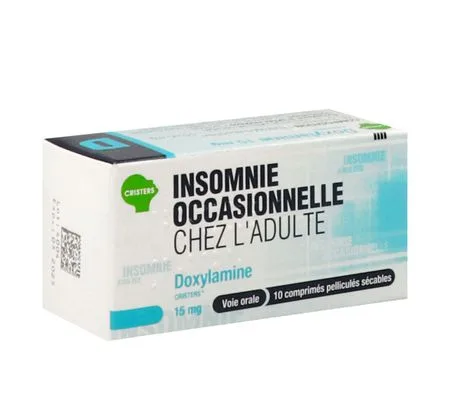
DOXYLAMINE CRISTERS 15 mg, film-coated scored tablet
Forms and presentations
Scored film-coated tablet.
White to substantially white, oblong, biconvex tablets with a break bar.
The tablet can be divided into equal doses.
Composition
Doxylamine hydrogen succinate ......................................................................................... 15,00 mg
For one scored film-coated tablet.
Excipient with known effect : this medicine contains 76,90 mg of lactose monohydrate.
Core :
Lactose monohydrate, microcrystalline cellulose, croscarmellose sodium, magnesium stearate.
Film coating :
Hypromellose (E464), talc, titanium dioxide (E171), macrogol 6000, propylene glycol.
Dosage and administration
Dosage
The recommended dose is 7,5 to 15 mg per day (i.e. ½ to 1 tablet per day). It may be increased to 30 mg per day (i.e. 2 tablets per day) if necessary.
In elderly subjects, patients with renal or hepatic insufficiency : it is recommended to reduce the dose.
Method of administration
Oral use.
A single intake per day in the evening, 15 to 30 minutes before bedtime.
Swallow the tablet with a little water.
Duration of treatment
The duration of treatment is 2 to 5 days.
If insomnia persists for more than 5 days, the clinical situation should be reassessed.
Contraindications
• Known hypersensitivity to antihistamines, to the active substance or to any of the excipients listed in section Composition.
• Personal or family history of acute angle-closure glaucoma.
• Urinary-prostatic disorders at risk of urinary retention.
• Child under 15 years.
Warnings and precautions
Special warnings
Insomnia may have various causes that do not necessarily require the taking of a medicinal product.
Doxylamine hydrogen succinate, like all hypnotics or sedatives, may worsen pre-existing sleep apnea syndrome (increase in the number and duration of apneas).
The risk of abuse and drug dependence is low; however, cases of abuse and drug dependence have been reported. The occurrence of signs suggesting misuse or dependence must be carefully monitored. The duration of treatment must not exceed 5 days. The use of DOXYLAMINE CRISTERS in patients with a history of substance use disorder is not recommended.
Risk of accumulation
Like all medicines, doxylamine hydrogen succinate persists in the body for a period of approximately 5 half-lives (see section Pharmacokinetics).
In elderly patients or those suffering from renal or hepatic impairment, the half-life may be considerably prolonged. On repeated administration, the medicine or its metabolites reach the steady-state plateau much later and at a much higher level. Only after a steady-state plateau has been reached is it possible to assess both the efficacy and the safety of the medicine.
A dose adjustment may be necessary (see section Dosage and administration).
Elderly subject
H antihistamines1 H antihistamines should be used with caution in elderly subjects, due to the risk of cognitive disorders, sedation, slow reactivity and/or dizziness/light-headedness that may promote falls (for example when getting up at night), with consequences often serious in this population.
Precautions for use
Elderly subject, renal or hepatic impairment
An increase in plasma concentrations and a decrease in plasma clearance are observed. It is recommended to reduce the dose.
DOXYLAMINE CRISTERS 15 mg, scored film-coated tablet contains lactose
Patients with galactose intolerance, total lactase deficiency or glucose-galactose malabsorption syndrome (rare hereditary diseases) must not take this medicine.
Interactions
Combinations not recommended
+ Alcohol (beverage or excipient)
Potentiation by alcohol of the sedative effect of H antihistamines1. Impaired alertness may make driving vehicles and using machines dangerous.
Avoid taking alcoholic beverages and medicines containing alcohol.
+ Sodium oxybate
Increased central depression. Impaired alertness may make driving vehicles and using machines dangerous.
Associations to be taken into account
+ Anticholinesterases
Risk of reduced efficacy of the anticholinesterase through antagonism of acetylcholine receptors by the atropinic agent.
+ Other anticholinergic medicinal products
Imipramine-type antidepressants, most H antihistamines1 anticholinergic, anticholinergic antiparkinsonian drugs, anticholinergic antispasmodics, disopyramide, phenothiazine neuroleptics and clozapine.
Additive atropine-like undesirable effects such as urinary retention, constipation, dry mouth...
+ Other sedative medicines
Morphine derivatives (analgesics, antitussives and substitution treatments), neuroleptics; barbiturates; benzodiazepines; anxiolytics other than benzodiazepines (for example, meprobamate); hypnotics; sedating antidepressants (amitriptyline, doxepin, mianserin, mirtazapine, trimipramine); H antihistamines1 sedatives; central antihypertensives; baclofen, thalidomide.
Increased central depression. Impaired alertness may make driving vehicles and using machines dangerous.
+ Other hypnotics
Increased central depression.
+ Opioids
Significant risk of colonic akinesia, with severe constipation.
Fertility, pregnancy and breastfeeding
Pregnancy
Given the available data, the use of doxylamine is possible during pregnancy, regardless of the stage of pregnancy.
In case of treatment at the end of pregnancy, take into account the anticholinergic and sedative properties of this molecule when monitoring the newborn.
Breast-feeding
The passage of doxylamine into breast milk is not known. Given the possibilities of sedation or paradoxical excitation in the newborn, this medicine is not recommended in case of breastfeeding.
Fertility
Not applicable.
Driving and using machines
Warn drivers of vehicles and users of machines of the possible risk of daytime drowsiness.
The combination with other sedative medicines, sodium oxybate, alcoholic beverages or medicines containing alcohol should be avoided or taken into account when driving or using machines (see section Interactions) as they potentiate the sedative effect of antihistamines.
If the duration of sleep is insufficient, the risk of impaired alertness is further increased.
Adverse effects
• Anticholinergic effects: constipation, urinary retention, dry mouth, visual disturbances (accommodation disorders, blurred vision, hallucinations, visual impairment), heart palpitations, confusion.
• Rhabdomyolysis, increased blood creatine phosphokinase (CPK).
• Daytime drowsiness, which requires a dose reduction.
Cases of abuse and dependence have been reported.
Furthermore, the H1 antihistamines are known to cause sedation, cognitive disorders and impairment of psychomotor performance.
Reporting of suspected adverse reactions
The reporting of suspected adverse effects after marketing authorisation of the medicine is important. It allows continuous monitoring of the benefit/risk balance of the medicine. Healthcare professionals report any suspected adverse effect via the national reporting system: National Agency for the Safety of Medicines and Health Products (ANSM) and the network of Regional Centres of Pharmacovigilance - Website: https://signalement.social-sante.gouv.fr/.
Overdose
The first manifestations of acute poisoning are drowsiness and signs of the anticholinergic series: agitation, mydriasis, paralysis of accommodation, dry mouth, redness of the face and neck, hyperthermia and sinus tachycardia.
Delirium, hallucinations and athetoid movements are more often observed in children; they sometimes herald the onset of convulsions, which are rare complications of massive poisoning or even of coma. Even in the absence of convulsions, acute doxylamine poisoning is sometimes responsible for rhabdomyolysis, which may be complicated by acute renal failure. This muscle involvement is not exceptional, which justifies its systematic screening by measuring creatine phosphokinase (CPK) activity.
Treatment is symptomatic. When management is early, administration of activated charcoal (50 g in adults, 1 g/kg in children) is advisable.
Pharmacodynamics
Pharmacotherapeutic class: SYSTEMIC ANTIHISTAMINE, ATC code: R06AA09.
Doxylamine hydrogen succinate is an H1 antihistamine of the ethanolamine class possessing a sedative effect and an atropine-like effect. It has been shown to reduce the time to fall asleep and to improve the duration and quality of sleep.
Pharmacokinetics
Absorption
The maximum concentration (Cmax) in the blood is obtained on average 2 hours (Tmax) after taking doxylamine hydrogen succinate.
Metabolism and elimination
The plasma elimination half-life (T½) is on average 10 hours.
Doxylamine succinate is partially metabolised in the liver by demethylation and N-acetylation.
The various metabolites resulting from the degradation of the molecule are quantitatively of minor importance since 60 % of the administered dose is found in the urine in the form of unchanged doxylamine.
Prescription, supply and reimbursement
| Marketing authorisation (AMM) |
|
22 QUAI GALLIENI
92150 SURESNES
Tel: 01 42 04 88 94 https://www.laboratoirecristers.com/
Source: VIDAL · Updated on 10/11/2026. This information does not replace advice from a healthcare professional.