
Medicines
RCP of 25/03/2024
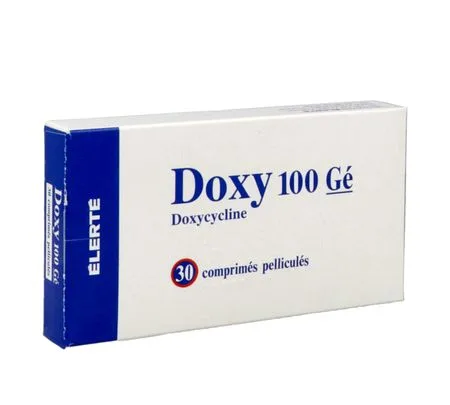
DOXY 100 mg, film-coated tablet
Composition
Doxycycline hyclate........................................................................................................................ 115,42 mg
Corresponding quantity of doxycycline base ................................................................................100,00 mg
For a film-coated tablet.
Sodium lauryl sulfate, crospovidone, anhydrous colloidal silica, magnesium stearate, microcrystalline cellulose (AVICEL PH 102).
Film coating : alkaline methacrylate copolymer (Eudragit E12,5), talc, titanium dioxide (E171), quinoline yellow aluminium lake (E104), magnesium stearate, macrogol 6000.
Indications
They result from both the antibacterial activity and the pharmacokinetic properties of doxycycline.
They take into account both the position of this antibiotic among the antibacterial products currently available and up-to-date knowledge on the resistance of bacterial species.
They are limited to the following infections:
• Brucellosis.
• Pasteurelloses.
• Pulmonary, genitourinary and ophthalmic infections due to Chlamydiae.
• Pulmonary and genitourinary infections due to mycoplasmas.
• Rickettsioses.
• Coxiella burnetii (Q fever).
• Gonococcal infection.
• ENT and bronchopulmonary infections due to Haemophilus influenzae, in particular acute exacerbations of chronic bronchitis.
• Treponemes (in syphilis, tetracyclines are indicated only in case of allergy to beta-lactams).
• Spirochaetes (Lyme disease, leptospirosis).
• Cholera.
• Moderate and severe inflammatory acne and inflammatory component of mixed acne.
• Aggressive periodontitis as an adjunct to local mechanical treatment.
• Rosacea in its cutaneous or ocular manifestations.
• Prophylactic treatment of traveler's malaria in endemic areas in cases of resistance, contraindication or intolerance to mefloquine.
Special situations :
Post-exposure prophylactic treatment and curative treatment of anthrax.
Official recommendations concerning the appropriate use of antibacterial agents should be taken into account.
Dosage and administration
Dosage
Adults:
• subject with body weight greater than 60 kg
200 mg per day in a single dose
• subject with body weight less than 60 kg
200 mg on the first day
100 mg the following days in a single dose.
Special cases :
• Acute gonococcal infections
- adult male
- 300 mg on 1er day (in two doses), followed by 200 mg per day for 2 to 4 days,
- or a single-dose treatment of 500 mg or of 2 doses of 300 mg administered at 1 hour intervals;
- adult female
- 200 mg per day.
• Primary and secondary syphilis
- 300 mg per day in three doses for at least 10 days.
• Uncomplicated urethritis, endocervicitis, proctitis, due to Chlamydia trachomatis
- 200 mg per day for at least 10 days.
• Acne: 100 mg/day for at least three months. In some cases, a half-dose treatment may be used.
• Aggressive periodontitis as an adjunct to local treatment: adult: 200 mg per day in a single dose, preferably in the morning with breakfast, for 14 days. The duration of treatment and dosage may be adapted in children.
Rosacea in its cutaneous or ocular manifestations
Adult: 100 mg per day for 3 months. No clinical data are available beyond 3 months of treatment.
Prophylaxis of malaria :
Treatment will be started the day before departure; it will be continued throughout the duration of the risk of malaria and for 4 weeks after returning from the endemic area.
• Adult: 100 mg per day.
• Child over 8 years:
- weight < 40 kg: 50 mg per day in 1 dose,
- weight > 40 kg: 100 mg per day in 1 dose.
Special situations :
Anthrax: post-exposure prophylactic treatment and curative treatment of symptomatic persons who can receive oral treatment, either directly or as a follow-on from parenteral treatment: 200 mg per day in 2 doses.
The duration of treatment is 8 weeks when exposure to anthrax is confirmed.
Child over 8 years:
4 mg/kg/day.
Special situations :
Anthrax: post-exposure prophylactic treatment and curative treatment of symptomatic persons who can receive treatment per os, either directly or as a follow-on from parenteral treatment: 4 mg/kg/day in two doses, without exceeding the adult dose (200 mg/day).
The duration of treatment is 8 weeks when exposure to anthrax is confirmed.
Method of administration
Administer in the middle of a meal with a glass of water (100 ml) and at least one hour before bedtime.
Contraindications
• Hypersensitivity to doxycycline, to antibiotics of the tetracycline family, or to any of the excipients listed in section Composition.
• In combination with systemic retinoids (see section Interactions).
• The use of this medicine should be avoided in children under eight years of age (because of the risk of permanent tooth discoloration and tooth enamel hypoplasia), as well as in pregnant or breastfeeding women (risk of tooth bud abnormality or tooth discoloration in the child).
• This medicine is contraindicated from the second trimester of pregnancy.
Breastfeeding is not recommended while taking this medicine.
Warnings and precautions
Because of the risk of photosensitisation, it is advised to avoid any direct exposure to the sun and UV rays during treatment, which must be interrupted if skin reactions such as erythema appear.
Because of the risk of oesophageal injury, it is important to ensure the conditions of administration are followed (see sections Dosage and administration and Adverse effects).
Some patients with spirochaete infections may experience a Jarisch-Herxheimer reaction shortly after starting doxycycline treatment. Patients should be reassured that this is a consequence that usually resolves spontaneously with antibiotic treatment of spirochaete infections.
Interactions
Contraindicated combinations
+ Retinoids (systemic)
Risk of intracranial hypertension.
Associations subject to Precautions for use
+ Enzyme-inducing anticonvulsants
Decrease in plasma concentrations of doxycycline due to increased hepatic metabolism. Clinical monitoring and possible dose adjustment of doxycycline.
+ Didanosine
Decrease in digestive absorption of tetracyclines due to increased gastric pH (presence of an antacid in the DDI tablet). Take didanosine apart from tetracyclines (more than 2 hours apart, if possible).
+ Iron (salts), oral route
Decreased digestive absorption of cyclines (formation of complexes).
Take iron salts away from cyclines (more than 2 hours, if possible).
+ Gastro-intestinal topicals (salts, oxides, hydroxides of magnesium, aluminium and calcium)
Decreased digestive absorption of tetracyclines.
Take gastro-intestinal topicals away from cyclines (more than 2 hours, if possible).
+ Oral anticoagulants
Increased oral anticoagulant effect and bleeding risk.
More frequent monitoring of prothrombin rate and INR monitoring. Possible adjustment of the oral anticoagulant dose during cycline treatment and after its discontinuation.
Associations to be taken into account
+ Zinc salts
Decreased digestive absorption of tetracyclines.
Take zinc salts away from cyclines (more than 2 hours if possible).
Specific problems with INR imbalance
Numerous cases of increased activity of oral anticoagulants have been reported in patients receiving antibiotics. A marked infectious or inflammatory context, age and general condition of the patient appear as risk factors. In these circumstances, it appears difficult to distinguish between the infectious disease and its treatment in the occurrence of the INR imbalance. However, certain classes of antibiotics are more involved: these include in particular fluoroquinolones, macrolides, cyclines, cotrimoxazole and certain cephalosporins.
Fertility, pregnancy and breastfeeding
Pregnancy
Animal studies have not shown any teratogenic effect. In the absence of a teratogenic effect in animals, a malformative effect in humans is not expected. Indeed, to date, substances responsible for malformations in humans have been shown to be teratogenic in animals in well-conducted studies in two species.
In clinical use, the use of cyclines during a limited number of pregnancies has apparently not revealed any particular malformative effect to date. However, additional studies are needed to assess the consequences of exposure during pregnancy.
Administration of cyclines during the second and third trimesters exposes the fetus to the risk of staining of the milk teeth.
Consequently, as a precaution, it is preferable not to use cyclines during the first trimester of pregnancy.
From the second trimester of pregnancy onwards, administration of cyclines is contraindicated.
Breast-feeding
If treated with this medicine, breastfeeding is not recommended.
Fertility
There is no clinical data on the effects of the use of doxycycline hyclate on the fertility of patients.
Although doxycycline impairs fertility in rats when administered at sufficient doses, the effect of doxycycline on human fertility is not known (see section Preclinical safety).
Adverse effects
Skin and subcutaneous tissue disorders
Photosensitization reactions, rash, very rare cases of erythroderma, photo-onycholysis.
Renal and urinary disorders
Extra-renal hyperazotaemia related to an anti-anabolic effect and which may be increased by association with diuretics has been reported with tetracyclines. This hyperazotaemia has not been observed to date with doxycycline.
Immune system disorders
Allergic reactions (urticaria, rash, pruritus, Quincke's oedema, anaphylactic reaction, rheumatoid purpura, pericarditis, exacerbation of pre-existing lupus erythematosus).
Jarisch-Herxheimer reaction, of undetermined frequency (see section Warnings and precautions).
Nervous system disorders
Benign intracranial hypertension in adults has been reported during treatment with tetracyclines. Therefore, treatment should be discontinued if an increase in intracranial pressure is suspected or observed during doxycycline treatment.
Gastrointestinal disorders
Dental discoloration or enamel hypoplasia in case of administration to children under 8 years.
Digestive disorders (nausea, epigastric pain, diarrhoea, anorexia, glossitis, enterocolitis, anal or genital candidiasis).
Possible occurrence of dysphagia, oesophagitis, oesophageal ulcerations, favoured by taking the medicine in a lying position and/or with a small amount of water.
Blood and lymphatic system disorders
Cases of haematological disorders have been described during treatment with tetracyclines (haemolytic anaemia, thrombocytopenia, neutropenia, eosinophilia).
Reporting of suspected adverse reactions
Reporting suspected adverse reactions after authorisation of the medicinal product is important. It allows continued monitoring of the benefit/risk balance of the medicinal product. Healthcare professionals are asked to report any suspected adverse reaction via the national reporting system: National Agency for the Safety of Medicines and Health Products (ANSM) and the network of Regional Centres of Pharmacovigilance - Website: https://signalement.social-sante.gouv.fr/.
Overdose
No overdose accidents have been reported. Those reported for other tetracyclines, following renal failure (hepatic toxicity, hyperazotaemia, hyperphosphataemia, acidosis), are not likely to occur with doxycycline, because blood levels are not modified according to the functional value of the kidney.
Pharmacodynamics
Pharmacotherapeutic class: ANTIBACTERIALS FOR SYSTEMIC USE, ATC code: J01AA02.
Mechanism of action
Doxycycline is an antibiotic of the tetracycline family. It inhibits protein synthesis in bacteria.
Doxycycline increases sebaceous excretion, and has anti-inflammatory and antilipase action.
Pharmacodynamic effects
ANTIBACTERIAL ACTIVITY SPECTRUM
Critical concentrations separate susceptible strains from strains of intermediate susceptibility, and the latter from resistant ones:
S ≤ 4 mg/l and R > 8 mg/l
The prevalence of acquired resistance can vary according to geography and time for certain species. It is therefore useful to have information on local resistance prevalence, especially for the treatment of severe infections. These data can only provide guidance on the probabilities of the susceptibility of a bacterial strain to this antibiotic.
Where the variability of resistance prevalence in France is known for a bacterial species, it is indicated in the table below:
|
Categories |
Frequency of acquired resistance in France (> 10%) (extreme values) |
|
SUSCEPTIBLE SPECIES |
|
|
Gram-positive aerobes |
|
|
Bacillus spp. |
|
|
Bacillus anthracis ** |
|
|
Enterococci |
40 - 80 % |
|
Staphylococcus spp. meti-S |
|
|
Staphylococcus spp. meti-R * |
70 - 80 % |
|
Streptococcuss A |
20 % |
|
Streptococcus B |
80 - 90 % |
|
Streptococcus pneumoniae |
20 - 40 % |
|
Categories |
Frequency of acquired resistance in France (> 10%) (extreme values) |
|
Gram-negative aerobes |
|
|
Branhamella catarrhalis |
|
|
Brucella |
|
|
Escherichia coli |
20 - 40 % |
|
Haemophilus influenzae |
10 % |
|
Klebsiella |
10 - 30 % |
|
Neisseria gonorrhoeae |
|
|
Pasteurella |
|
|
Vibrio cholerae |
|
|
Anaerobes |
|
|
Propionibacterium acnes |
|
|
Other |
|
|
Borrelia burgdorferi |
|
|
Chlamydia |
|
|
Coxiella burnetii |
|
|
Leptospira |
|
|
Mycoplasma pneumoniae |
|
|
Rickettsia |
|
|
Treponema pallidum |
|
|
Ureaplasma urealyticum |
|
|
RESISTANT SPECIES |
|
|
Gram-negative aerobes |
|
|
Acinetobacter |
|
|
Proteus mirabilis |
|
|
Proteus vulgaris |
|
|
Pseudomonas |
|
|
Serratia |
|
* The frequency of resistance to methicillin is approximately 30 to 50 % of all staphylococci and is found mainly in hospital settings.
** Bacillus anthracis : a study conducted on an experimental infection model of anthrax, carried out by inhalation of spores of Bacillus anthracis in Rhesus monkeys shows that antibiotic therapy started early after exposure prevents the onset of the disease if treatment is continued until the number of persistent spores in the body falls below the infecting dose.
Prophylaxis of malaria :
Doxycycline inhibits protein synthesis and alters the cytoplasmic membrane of the plasmodium, thereby exerting a blood schizonticidal activity.
Pharmacokinetics
Absorption
• Rapid absorption (effective levels from the first hour, serum peak reached between 2 and 4 hours).
• Practically complete absorption in the upper part of the digestive tract.
• Absorption not modified by administration during meals and little in the presence of milk.
Distribution
In adults for an oral dose of 200 mg, the following is observed:
• a serum peak greater than 3 micrograms/ml;
• a residual concentration greater than 1 microgram/ml after 24 hours;
• a serum half-life of 16 to 22 hours;
• protein binding varies from 82 to 93 percent (labile binding).
Good intra- and extracellular diffusion.
At usual dosage, effective concentrations in:
• ovaries, fallopian tubes, uterus, placenta, testicles, prostate;
• bladder, kidneys;
• lung tissue;
• skin, muscle, lymph nodes;
• sinus secretions, maxillary sinus, nasal polyps;
• tonsils;
• liver, hepatic bile and vesicular bile, gallbladder, stomach, appendix, intestine, omentum;
• saliva and gingival fluid.
Low diffusion into the cerebrospinal fluid.
Excretion
The antibiotic concentrates in bile.
Approximately 40 percent of the administered dose is eliminated within 3 days in active form via the urine and approximately 32 percent in the feces.
Urinary concentrations are substantially 10 times higher than plasma levels at the same time.
In cases of renal insufficiency, urinary elimination decreases, fecal elimination increases, and the half-life remains unchanged.
Hemodialysis does not modify the half-life.
Preclinical safety
Adverse effects observed during repeated-dose studies in animals include thyroid hyperpigmentation and renal tubular degeneration. These effects were observed at exposures between 60 and 80 mg/day in humans. The clinical relevance of these data is still unknown.
Doxycycline has demonstrated no mutagenic effect, nor any convincing sign of a clastogenic effect. In a carcinogenesis study in rats, an increase in the number of benign tumours of the mammary gland (fibroadenoma), uterus (polyp) and thyroid (C-cell adenoma) was observed in treated females.
In rats, doses of 50 mg/kg/day of doxycycline resulted in a decrease in the linear velocity of spermatozoa, which did not affect the fertility of males or females nor the morphology of spermatozoa. At this dose, the systemic exposure of rats was approximately equivalent to 0,4 times that observed at the maximum recommended dose in humans. Fertility and reproductive performance were impaired at doses above 50 mg/kg/day in rats. A peri- and postnatal toxicity study in rats revealed no significant effect at relevant therapeutic doses. Doxycycline is known to cross the placenta and data from the literature indicate that tetracyclines may cause toxic effects on the developing fetus.
SPECIAL PRECAUTIONS FOR DISPOSAL AND OTHER HANDLING
No special requirements.
Any unused medicinal product or waste material should be disposed of in accordance with local requirements.
Prescription, supply and reimbursement
Possible repackaging
| Marketing authorisation (AMM) |
|
| Price: |
|
Collection.
181-183 RUE ANDRÉ KARMAN
93300 AUBERVILLIERS CEDEX
Tel: 01 48 34 75 03 laboratoire-elerte@orange.fr
https://www.elerte.fr/
Source: VIDAL · Updated on 10/11/2026. This information does not replace advice from a healthcare professional.