
Medicines
SmPC of 17/05/2024
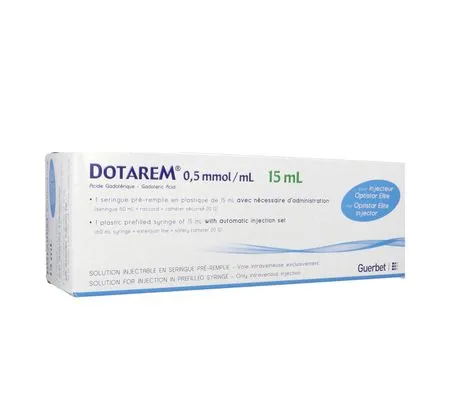
DOTAREM 0,5 mmol/mL, injectable solution in prefilled syringe
Forms and presentations
Injectable solution in prefilled syringe.
Clear, colourless to pale yellow solution.
Osmolality: 1350 mOsm.kg-1
Viscosity at 20°C: 3,2 mPa.s
Viscosity at 37°C: 2,0 mPa.s
pH: 6,5 at 8,0
Composition
For 100 mL of solution:
Gadoteric acid*....................................................................................................................................27,932 g
corresponding to DOTA............................................................................................................................20,246 g
corresponding to gadolinium oxide.....................................................................................................9,062 g
*Gadoteric acid: gadolinium complex of 1, 4, 7, 10 tetra-azacyclododecane N, N', N'', N'''tetra-acetic acid.
Contrast agent concentration: 0,5 mmol/mL
Meglumine, water for injection preparations.
Indications
This medicinal product is for diagnostic use only.
Dotarem should only be used when the diagnosis is necessary and this diagnosis cannot be obtained by magnetic resonance imaging (MRI) without contrast enhancement.
Magnetic resonance imaging for:
• brain and spinal cord pathologies,
• spinal pathologies,
• and other whole-body pathologies (including angiography).
Dosage and administration
Dosage
The lowest dose providing sufficient contrast enhancement for diagnostic purposes should be used. The dose should be calculated based on the patient's body mass and should not exceed the recommended dose per kilogram of body mass, detailed in this section.
Adult population :
The recommended dose is 0,1 mmol/kg, i.e. 0,2 mL/kg, in adults.
In angiography, when the results of the ongoing examination make it necessary, a second injection during the same session is possible.
In a few exceptional cases such as confirming the uniqueness of a metastasis or detecting leptomeningeal tumors, a second injection of 0,2 mmol/kg may be administered.
Special populations
Renal impairment
The adult dose applies to patients with mild to moderate renal impairment (GFR ≥ 30 mL/min/1,73 m²).
Dotarem must not be administered to patients with severe renal impairment (GFR < 30 mL/min/1,73 m²) and in the perioperative period of liver transplantation except after a thorough assessment of the benefit/risk ratio and only if the diagnostic information is essential and cannot be obtained by means of an MRI without contrast enhancement (see section Warnings and precautions).
If it is necessary to administer Dotarem, the dose must not exceed 0,1 mmol/kg of body weight. Do not administer more than one dose during the MRI examination. Due to the lack of information on repeated administrations, Dotarem injections must not be repeated unless the interval between injections is at least seven days.
Elderly subjects (from 65 years)
No dose adjustment is necessary. Use with caution in elderly subjects (see section Warnings and precautions).
Hepatic function impairment
The adult dose applies to these patients. Caution is recommended, particularly in the perioperative period of liver transplantation.
Paediatric population (0-18 years)
Brain and spine MRI / whole body MRI: the recommended and maximum dose is 0,1 mmol/kg of body weight. Do not administer more than one dose during the MRI examination.
Due to the immaturity of renal function in neonates up to the age of 4 weeks and in infants up to the age of one year, Dotarem must only be used in these patients after careful assessment and at a dose not exceeding 0,1 mmol/kg of body weight. Do not administer more than one dose during the MRI examination. Due to the lack of information on repeated administrations, Dotarem injections must not be repeated, unless the interval between injections is at least seven days.
Angiography: Gadoteric acid is not recommended for angiography in children under 18 years of age due to insufficient data on efficacy and safety in this indication.
Method of administration
The product must be administered by strict intravenous injection.
Intravascular administration of the contrast agent should, if possible, be performed with the patient lying down. After administration, the patient must remain under observation for at least half an hour, as experience shows that the majority of adverse effects occur during this period.
Paediatric population (0 – 18 years)
Depending on the quantity of gadoteric acid to be administered to the child, it is preferable to use gadoteric acid vials and a single-use syringe of a volume suited to that quantity in order to obtain greater accuracy of the injected volume.
In newborns and infants, the required dose must be administered manually.
Contraindications
Hypersensitivity to gadoteric acid, meglumine or any medicinal product containing gadolinium.
Warnings and precautions
Gadoteric acid must not be used intrathecally. Serious cases, which may be life-threatening and in some cases have resulted in death, mainly characterised by neurological reactions (such as coma, encephalopathy, convulsions), have been reported following intrathecal administration. Gadoteric acid must be administered strictly by intravenous injection. Extravasation may cause local intolerance reactions, requiring the usual local care.
The usual precautionary measures for an MRI examination must be taken, such as excluding patients with a cardiac pacemaker, a ferromagnetic vascular clip, an infusion pump, a neurostimulator, cochlear implants, or those suspected of having a metallic foreign body, particularly in the eye.
Hypersensitivity
• As with other gadolinium-containing contrast agents, hypersensitivity reactions, sometimes fatal, may occur (see section Adverse effects "Undesirable effects"). These hypersensitivity reactions may be of an allergic nature (so-called anaphylactic reactions when severe) or non-allergic. They may be immediate (within less than 60 minutes), or delayed (up to 7 days). Anaphylactic reactions are immediate and may result in death. They are dose-independent, may occur at the first administration of the product, and are often unpredictable.
• There is always a risk of hypersensitivity regardless of the dose injected.
• Patients who have previously experienced a reaction during a prior administration of a gadolinium-based MRI contrast agent have an increased risk of a further reaction upon re-administration of the same agent, or possibly another, and are therefore considered to be at risk.
• Injection of gadoterate acid may worsen the symptoms of existing asthma. In patients with asthma not controlled by treatment, the decision to administer gadoterate acid must be made after a thorough assessment of the benefit/risk ratio.
• As observed with iodinated contrast agents, hypersensitivity reactions may be more difficult to treat in patients on beta-blockers, particularly if they are asthmatic. These patients may be refractory to standard treatment of hypersensitivity reactions with beta-agonists.
• Before injection of any contrast agent, the patient must be questioned about a history of allergy (for example allergy to seafood, pollinosis, urticaria), sensitivity to contrast agents and asthma, as the reported incidence of adverse reactions to contrast agents is higher in patients with these conditions, and premedication with an antihistamine and/or a corticosteroid may be considered.
• This examination must be performed under medical supervision. If a hypersensitivity reaction occurs, administration of the contrast agent must be stopped immediately and, if necessary, specific treatment initiated. An intravenous access must therefore be maintained throughout the examination. To allow immediate emergency measures, appropriate medicinal products (e.g. epinephrine and antihistamines), an endotracheal intubation tube and a ventilator must be ready and within reach.
Renal impairment
Before administration of gadoteric acid, laboratory tests to look for impaired renal function are recommended in all patients.
Cases of nephrogenic systemic fibrosis (NSF) have been reported after injection of certain gadolinium-containing contrast agents in patients with acute or chronic severe renal insufficiency (creatinine clearance < 30 mL/min/1,73m²). Patients due to undergo liver transplantation are particularly at risk, as the incidence of acute renal insufficiency is high in this group. Since cases of NSF may occur with gadoteric acid, this product must be administered to patients with severe renal insufficiency or during the pre- or post-operative period of liver transplantation only after a thorough assessment of the benefit/risk ratio and only if the diagnosis cannot be obtained by other means than MRI with gadolinium injection.
Performing haemodialysis shortly after administration of gadoteric acid could facilitate elimination of this product from the body. It has not been established that initiating haemodialysis can prevent or treat NSF in patients who are not already on haemodialysis.
Elderly patients
As renal elimination of gadoteric acid may be impaired in elderly subjects, it is particularly important to look for possible renal dysfunction in subjects aged 65 years and over.
Paediatric population
Newborns and infants
Due to the immaturity of renal function in newborns up to the age of 4 weeks and in infants up to the age of one year, gadoterate acid should only be administered to these patients after a thorough examination of the situation.
Central nervous system disorders
As with any gadolinium-based contrast agent, special precautions are necessary in patients with a low seizure threshold. Precautionary measures must be taken, e.g. close monitoring. All equipment and medicines needed to deal with possible convulsions must be prepared in advance so that they are ready for use.
Interactions
No interaction with other medicines has been observed. No formal interaction studies have been carried out.
Concomitant medicinal products to be taken into account
Beta-blockers, vasoactive substances, angiotensin-converting enzyme inhibitors, angiotensin receptor antagonists: these medicinal products reduce the effectiveness of cardiovascular compensatory mechanisms for blood pressure disorders; the radiologist must be informed before injection of the gadolinium complex and must have resuscitation facilities available.
Fertility, pregnancy and breastfeeding
Pregnancy
Data on the use of gadolinium-containing contrast agents, including gadoteric acid, in pregnant women are limited. Gadolinium can cross the placental barrier. It is not known whether exposure to gadolinium is associated with adverse effects in the foetus. Animal studies have not shown direct or indirect harmful effects on reproduction (see section Preclinical safety.). Gadoteric acid should not be used during pregnancy unless the clinical condition of the patient requires administration of this product.
Breast-feeding
Gadolinium-containing contrast agents are excreted in breast milk in very small quantities (see section Preclinical safety). At clinical doses, no effect is expected in breastfed infants due to the small amount excreted in milk and the low intestinal absorption. The physician and the breastfeeding mother must decide whether to continue or discontinue breastfeeding during the 24 hours following administration of gadoteric acid.
Driving and using machines
The effects on the ability to drive vehicles and use machines have not been studied.
Outpatients who drive vehicles or use machines must take into account the possible occurrence of nausea.
Adverse effects
Adverse reactions associated with the use of gadoterate acid are generally of mild to moderate intensity and transient in nature. Injection site reactions, nausea and headache are the most frequently observed adverse reactions.
In clinical trials, the most common uncommon adverse reactions (≥ 1/1 000 to < 1/100) were nausea, headache, injection site reactions, feeling cold, hypotension, somnolence, dizziness, feeling hot, burning sensation, rash, asthenia, dysgeusia and hypertension.
The adverse reactions most frequently encountered during administration of gadoterate acid since marketing are nausea, vomiting, pruritus, and hypersensitivity reactions.
In hypersensitivity reactions, the most frequently observed effects are skin effects, which may be localised, extensive or generalised. These reactions most often occur immediately (during the injection or within one hour of the start of the injection) or sometimes delayed (one hour to a few days after the injection), and then present as skin reactions.
Immediate reactions comprise one or more effects, occurring concomitantly or successively, most often including cutaneous, respiratory, gastrointestinal, joint and/or cardiovascular manifestations, each of which may be a precursor of an evolving state of shock and very rarely may progress to death.
Isolated cases of nephrogenic systemic fibrosis (NSF) have been reported with gadoteric acid, most often in patients who had also received other gadolinium-containing contrast agents (see section Warnings and precautions).
Adverse effects are presented in the table below by System Organ Class and by frequency using the following categories: very common (≥ 1/10), common (≥1/100 to 1<1/10), uncommon (≥1/1 000 to 1<1/100), rare (≥1/10 000 to <1/1 000), very rare (<1/10 000), frequency not determinable (cannot be estimated from the available data). The data presented are derived from clinical trials conducted in 2 822 patients where available, or from a group of observational studies comprising 185 500 patients.
|
System organ class |
Frequency: adverse reactions |
|
Immune system disorders |
Uncommon: hypersensitivity Very rare: anaphylactic reaction, anaphylactoid reaction |
|
Psychiatric disorders |
Rare: anxiety Very rare: agitation |
|
Nervous system disorders |
Uncommon: headache, dysgeusia, dizziness, somnolence, paraesthesia (including burning sensation) Rare: presyncope Very rare: coma, convulsions, syncope, tremor, parosmia
|
|
Eye disorders |
Rare: eyelid oedema Very rare: conjunctivitis, ocular hyperaemia, blurred vision, excessive lacrimation |
|
Cardiac disorders |
Rare: palpitations Very rare: tachycardia, cardiac arrest, arrhythmia, bradycardia |
|
Vascular disorders |
Uncommon: hypotension, hypertension Very rare: pallor, vasodilatation |
|
Respiratory, thoracic and mediastinal disorders |
Rare: sneezing Very rare: cough, dyspnoea, nasal congestion, respiratory arrest, bronchospasm, laryngospasm, pharyngeal oedema, dry throat, pulmonary oedema |
|
Gastrointestinal disorders |
Uncommon: nausea, abdominal pain Rare: vomiting, diarrhoea, salivary hypersecretion |
|
Skin and subcutaneous tissue disorders |
Uncommon: skin rashes, Rare: urticaria, pruritus, hyperhidrosis Very rare: erythema, Quincke's oedema, eczema Frequency not known: nephrogenic systemic fibrosis |
|
Musculoskeletal and connective tissue disorders |
Very rare: muscle cramps, muscle weakness, back pain |
|
General disorders and administration site conditions |
Uncommon: sensation of heat, sensation of cold, asthenia, injection site reactions (extravasation, pain, discomfort, oedema, inflammation, sensation of cold) Rare: chest pain, chills Very rare: malaise, chest discomfort, pyrexia, facial oedema, injection site necrosis (in case of extravasation), superficial phlebitis |
|
Investigations |
Very rare: decreased oxygen saturation |
The following adverse reactions have been reported with other intravenous contrast agents for MRI:
|
System Organ Class |
Adverse reaction |
|
Blood and lymphatic system disorders |
Haemolysis |
|
Psychiatric disorders |
Confusion |
|
Eye disorders |
Transient blindness, eye pain |
|
Ear and labyrinth disorders |
Tinnitus, ear pain |
|
Respiratory, thoracic and mediastinal disorders |
Asthma |
|
Gastrointestinal disorders |
Dry mouth |
|
Skin and subcutaneous tissue disorders |
Bullous dermatitis |
|
Renal and urinary disorders |
Urinary incontinence, renal tubular necrosis, acute renal failure |
|
Investigations |
Prolonged PR interval on electrocardiogram, increased serum iron, increased bilirubin, increased ferritin, abnormal liver function tests |
Adverse reactions in children
The safety profile of the product in children has been evaluated during clinical trials as well as in studies conducted after marketing of the product. No particularities specific to children have been observed compared with the safety profile in adults. The most frequent adverse reactions are gastrointestinal symptoms or signs of hypersensitivity.
Reporting of suspected adverse reactions
Reporting suspected adverse reactions after authorisation of the medicinal product is important. It allows continued monitoring of the benefit/risk balance of the medicinal product. Healthcare professionals are asked to report any suspected adverse reactions via: National Agency for the Safety of Medicines and Health Products (ANSM) and the network of Regional Pharmacovigilance Centres Website: https://signalement.social-sante.gouv.fr/
Overdose
Gadoteric acid can be removed from the body by haemodialysis. However, it has not been shown that haemodialysis is appropriate for the prevention of nephrogenic systemic fibrosis (NSF).
Pharmacodynamics
Pharmacotherapeutic class: Paramagnetic contrast agent for MRI, ATC code: V08 CA02
Gadoteric acid has paramagnetic properties that allow contrast enhancement in MRI. It has no specific pharmacodynamic activity and proves to be of great biological inertness.
Pharmacokinetics
Injected intravenously, gadoteric acid is distributed mainly throughout all the extracellular fluids of the body. It is not bound to plasma albumin.
In patients with normal renal function, the plasma half-life is approximately 90 minutes. Elimination occurs by glomerular filtration in unchanged form.
Plasma clearance is slowed in cases of renal impairment.
Gadoteric acid is weakly excreted in milk and crosses the placental barrier slowly.
Preclinical safety
Non-clinical data from conventional safety pharmacology, repeated-dose toxicity, genotoxicity and reproductive function studies revealed no particular risk for humans.
The acute toxicity of intravenously injected gadoteric acid has been studied in mice and rats. The results show that the occurrence of effects (convulsive signs, transient respiratory disorders) arises at doses far removed from those planned in clinical use.
Administration of gadoteric acid at daily doses up to 15 times the dose envisaged in clinical use and for 28 days does not produce any notable effect apart from reversible vacuolisation of the proximal tubular cells of the kidney.
Animal studies have shown negligible secretion of gadoteric acid into maternal milk (less than 1% of the administered dose).
No teratogenic effect has been demonstrated in rats and rabbits.
No mutagenic effect has been demonstrated in the reactive systems used.
INCOMPATIBILITIES
In the absence of compatibility studies, this medicinal product must not be mixed with other medicinal products.
SPECIAL PRECAUTIONS FOR DISPOSAL AND OTHER HANDLING
Screw the plunger onto the syringe and inject the quantity of product required for the examination intravenously.
The detachable traceability label placed on the syringes must be stuck into the patient's file in order to allow precise monitoring of the gadolinium-based contrast agent used. The dose administered must also be recorded. If electronic patient records are used, the name of the product, the batch number and the dose must be recorded in the patient's record.
Any unused product or waste must be disposed of in accordance with the regulations in force.
Prescription, supply and reimbursement
| Marketing authorisation (AMM) |
|
Hospital model(s) (Ser/10ml).
Collection.
IMMEUBLE RIMBAUD 22 AVENUE DES NATIONS
93420 VILLEPINTE
Tel: 01 45 91 50 00 ww.guerbet.com/fr-fr
Source: VIDAL · Updated on 10/11/2026. This information does not replace advice from a healthcare professional.