
Medicines
SPC of 18/10/2019
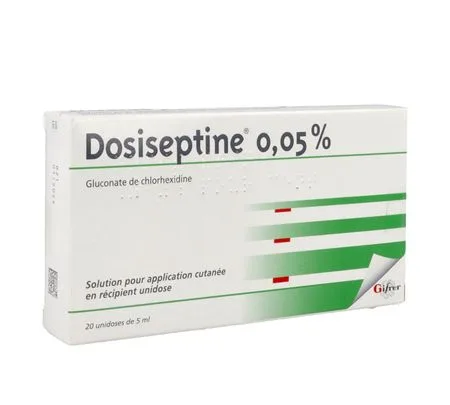
DOSISEPTINE 0,05 %, solution for cutaneous application in single-dose container
Composition
Chlorhexidine gluconate................................................................................................................................... 0,05 g
For 100 mL of solution for cutaneous application in single-dose container
Nonoxinol 9, gluconolactone, purified water.
Indications
Antiseptic agents are not sterilising: they temporarily reduce the number of micro-organisms on the skin and mucous membranes.
Cleaning and antisepsis of superficial and limited-extent wounds.
Dosage and administration
Dosage
Two applications per day.
Method of administration
Cutaneous use.
The solution is ready to use. It may be applied directly to wounds.
Contraindications
- Sensitisation to chlorhexidine (or to its chemical class).
- Do not apply in the eyes, ears, or on mucous membranes.
- This product must not enter the auditory canal, in particular in cases of tympanic perforation, nor, in general, be brought into contact with nerve tissue or the meninges.
Warnings and precautions
Special warnings
- For external use only.
- Due to the nature of the excipient, DOSISEPTINE 0,05 %, solution for cutaneous application in single-dose container must not be used for antisepsis of internal cavities (lavages, irrigations).
- Risk of sensitisation to chlorhexidine.
- Although the transcutaneous absorption of chlorhexidine is very low, the risk of systemic passage cannot be ruled out.
These systemic effects could be favoured by repeated applications, use over a large surface, under occlusive dressing, on damaged skin (in particular burnt skin), a mucous membrane, or the skin of a premature infant or infant (due to the surface/weight ratio and the occlusive effect of nappies in the diaper area).
- This specialty may not be used for disinfection of medico-surgical equipment nor for antisepsis of healthy skin before a surgical procedure (antisepsis of the operative field and antisepsis of puncture, injection or transfusion sites).
- Once the packaging of an antiseptic preparation has been opened, microbial contamination is possible. However, single-unit presentations of low volume reduce this risk.
- The use of chlorhexidine solutions, alcoholic or aqueous, for skin antisepsis before an invasive procedure has been associated with chemical burns in newborns. Based on reported cases and published literature, this risk appears to be higher in premature children, particularly those born before 32 weeks of gestation and within the first 2 weeks of life.
- Remove all soaked materials, gowns or surgical drapes before proceeding with the procedure. Do not use excessive quantities and do not leave the solution in skin folds or on the patient, or on sheets or any other material in direct contact with the patient. When occlusive dressings are used on areas previously exposed to DOSISEPTINE 0,05 %, solution for cutaneous application in single-dose container, all precautions must be taken to ensure there is no excess product before applying the dressing.
Precautions for use
- Any antiseptic should be used with caution where a systemic effect may be feared, particularly in infants, in cases of damaged skin, or over a large surface (see Special Warnings).
Interactions
Combinations not recommended
Given the possible interferences (antagonism, inactivation), simultaneous or successive use of antiseptics should be avoided, except with other cationic compounds.
Take care with physico-chemical incompatibilities, particularly with all anionic derivatives (see section Incompatibilities).
Fertility, pregnancy and breastfeeding
Use with caution in pregnant or breastfeeding women, due to a lack of usable clinical data.
Adverse effects
- Risks of systemic effects (see section Warnings and precautions).
- A few rare cases of idiosyncrasy (in particular anaphylactic shock) have been observed with chlorhexidine.
- Possibility of allergic contact eczema.
- Chemical burns in newborns (frequency unknown).
Reporting of suspected adverse reactions
Reporting suspected adverse reactions after authorisation of the medicinal product is important. It allows continued monitoring of the benefit/risk balance of the medicinal product. Healthcare professionals are asked to report any suspected adverse reactions via the national reporting system: National Agency for the Safety of Medicines and Health Products (ANSM) and the network of Regional Pharmacovigilance Centres - Website:www.signalement-sante.gouv.fr.
Overdose
In case of massive oral ingestion, perform gastric lavage. The acute oral toxicity of chlorhexidine is low (digestive absorption almost negligible).
Pharmacodynamics
Pharmacotherapeutic class: ANTISEPTICS AND DISINFECTANTS (D. DERMATOLOGY), ATC code: D08 AC 02
Broad-spectrum bactericidal antiseptic.
Chemical group: bisdiguanide.
Spectrum of activity of chlorhexidine: chlorhexidine exerts, in vitro, a bactericidal activity on gram-positive germs and, to a lesser degree, gram-negative germs within less than 5 minutes.
Fungicidal activity on Candida albicans.
Its activity is partially inhibited by organic matter (serum...) and phospholipids.
INCOMPATIBILITIES
Chlorhexidine behaves as a cationic compound: it is therefore incompatible with all anionic derivatives. It precipitates at pH above 8, in the presence of numerous anions.
INSTRUCTIONS FOR THE PREPARATION OF RADIOPHARMACEUTICALS
Detailed information on this medicinal product is available on the ANSM website.
Prescription, supply and reimbursement
| Marketing authorisation (AMM) |
|
| Price: |
|
Not reimbursed by Social Security (10Unit/5ml).
Hospital model(s) (30 Unidoses/100 ml, 30 Unidoses/45 ml).
Collect (30 Unidoses/100 ml, 30 Unidoses/45 ml, 20 Unidoses/5 ml).
10 AVENUE DES CANUTS - BP 165
69120 VAULX-EN-VELIN
Tel: 09 70 80 93 39 contact@gifrer.fr
https://www.gifrer.fr/
Source: VIDAL · Updated on 10/11/2026. This information does not replace advice from a healthcare professional.