
Medicines
SmPC of 28/07/2026
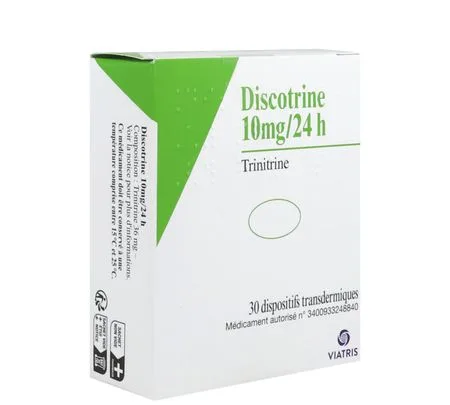
DISCOTRINE 10 mg/24 hours, transdermal patch
Composition
Trinitrine.....................................................................................................................................................36,00 mg
For a transdermal patch
Adhesive
Copolymer of isooctyl acrylate and acrylamide (93/7), ethyl oleate, glyceryl monolaurate.
Adhesive backing
Low-density polyethylene film.
Adhesive protection
Polyester film (siliconised on one side).
Dosage and administration
Reserved for adults.
Dosage
Nitrate derivatives are administered intermittently over the nycthemeral cycle, with a daily nitrate-free interval, in order to avoid the phenomenon of therapeutic tolerance, which is well established when nitrate derivatives are administered continuously.
This nitrate-free interval should be chosen during the period when the patient does not experience attacks. The duration of the nitrate-free interval of 8 to 12 hours must be respected. The timing of the associated anti-anginal treatment (beta-blocker and/or calcium antagonist) should be chosen to ensure therapeutic coverage during this nitrate-free interval.
In the preventive treatment of angina attacks, the phenomenon of tolerance is well established. Controlling prescription methods so as to respect a nitrate-free interval ensures nitrate derivatives have recognised therapeutic efficacy. The times of application and removal of the transdermal patch must be clearly stated on the prescription. The response to nitrate derivatives varies from patient to patient, and the lowest effective dose should be prescribed at the start of treatment.
The treatment regimen is as follows : application of one patch per day, starting with the least-dosed patch, i.e. 5 mg/24 h per day. In case of insufficient efficacy, the dose will be increased to one transdermal patch of 10 mg/24 h per day, i.e. 0,4 mg per hour, then if necessary to one transdermal patch of 15 mg/24 h per day, i.e. 0,6 mg per hour.
Method of administration
The patch must be stuck to the skin at a healthy, dry and clean site where hair is sparse (lateral chest wall, for example). For good adhesion, it is useful to apply the system firmly by pressing with the palm of the hand for about ten seconds.
After the prescribed application duration, remove and discard the used system, then take care to apply the new system at a different site. Do not reapply a system to the same site until several days have passed, in order to avoid local irritation phenomena.
In case of spontaneous detachment, a new system should be put in place (at a different site).
Contraindications
This medicine must never be used in cases of
• Hypersensitivity to nitrate derivatives or to any of the other constituents,
• Shock state, severe hypotension (systolic blood pressure below 90 mm Hg),
• Severe hypovolaemia
• In combination with phosphodiesterase 5 (PDE5) inhibitors (see sections Interactions and Warnings and precautions) :
- In any patient treated with a nitrate derivative, in whatever form, a phosphodiesterase 5 (PDE5) inhibitor must not be prescribed as long as the patient is under the effect of the nitrate derivative, because of the risk of significant hypotension (synergistic effect) that may worsen myocardial ischemia and in particular cause an acute coronary event.
- In case of treatment with sildenafil, nitrate derivatives are contraindicated in whatever form. In particular, any coronary patient should be warned that, if they experience anginal pain during sexual activity, they must in no case take an immediate-acting nitrate derivative. Likewise, in a patient without coronary history presenting a first anginal episode following sexual activity, it is advisable to check by questioning whether sildenafil was possibly taken (most often within the hour preceding sexual activity) and, if so, to refrain from any nitrate treatment.
In general, according to the available data, the interval to be observed before administering a nitrate derivative to a patient exposed to sildenafil is not precisely known, but can be estimated at a minimum of 24 hours.
- In case of treatment with riociguat, because of the risk of significant hypotension (synergistic effect) (see section Interactions)
This medicine should GENERALLY NOT BE USED in cases of:
• obstructive cardiac failure (for example, in the presence of mitral or aortic stenosis or constrictive pericarditis),
• acute-phase inferior-wall myocardial infarction with extension to the right ventricle,
• intracranial hypertension,
• during breastfeeding.
Warnings and precautions
Special warnings
This medicine is not a curative treatment for an angina attack, nor is it indicated as initial treatment for unstable angina or myocardial infarction, either in the pre-hospital phase or during the first days of hospitalization.
In case of collapse or a state of shock, remove the device (see section Contraindications).
As with all nitrate derivatives, when switching from long-term treatment with DISCOTRINE to another medicine, discontinuation of trinitrin must be done gradually and a replacement treatment must be introduced during the period of trinitrin discontinuation.
In case of recent myocardial infarction or acute heart failure, treatment with DISCOTRINE must be started with caution, under strict medical supervision and/or hemodynamic monitoring.
The device must be removed before performing external electrical cardioversion or diathermy treatment.
Removal of the transdermal device should be considered an integral part of the management of patients presenting with significant hypotension.
If an angina attack occurs during the symptom-free interval (as well as outside it), a reassessment of the coronary artery disease is required, and an adjustment of treatment should be discussed (drug treatment and possibly revascularization).
Association of nitrate derivatives with phosphodiesterase 5 (PDE5) inhibitors:
The combination of a nitrate derivative, whatever its nature or mode of administration, with sildenafil risks causing a significant and abrupt drop in blood pressure, which may in particular lead to presyncope, syncope or an acute coronary event (see sections Interactions and Contraindications).
The use of topical products, particularly with prolonged use, may cause sensitization phenomena. In this case, treatment must be suspended and appropriate therapeutic measures must be implemented.
Precautions for use
The effective dose must be reached gradually because of the risk of arterial hypotension and severe headaches in some subjects, except when the transdermal route is used as a relay from an intravenous form of nitrate derivatives.
Vasodilator and antihypertensive substances, diuretics, and alcohol may increase the hypotension caused by nitrate derivatives, especially in elderly people.
It is not logical to combine trinitrin with molsidomine or nicorandil since their mechanisms of action are similar.
Hypoxemia
Caution is advised in patients presenting with arterial hypoxemia secondary to severe anemia (including forms induced by G6PD deficiency) because the biotransformation of trinitrin is reduced in these patients.
Likewise, caution is needed in patients presenting with hypoxemia and a ventilation/perfusion ratio imbalance due to lung disease or ischemic heart failure.
In patients with alveolar hypoventilation, intrapulmonary vasoconstriction occurs in order to divert perfusion from areas of alveolar hypoxia towards better-ventilated regions of the lung (Euler–Liljestrand mechanism).
Patients suffering from angina pectoris, myocardial infarction, or cerebral ischaemia often present abnormalities of the small airways (in particular alveolar hypoxia). In this case, intrapulmonary vasoconstriction occurs in order to divert perfusion from areas of alveolar hypoxia towards better-ventilated regions of the lung. Since trinitrin is a potent vasodilator, it could reverse this protective vasoconstriction and, consequently, result in increased perfusion of poorly ventilated areas, worsening the ventilation/perfusion imbalance and leading to a further decrease in partial arterial oxygen pressure.
Hypertrophic cardiomyopathy
Treatment with nitrate derivatives may worsen angina caused by hypertrophic cardiomyopathy.
Tolerance to sublingual trinitrin
When tolerance to transdermal trinitrin devices occurs, the effect of sublingual trinitrin on exercise tolerance may be partially reduced.
Interactions
Contraindicated combinations
+ Phosphodiesterase type-5 inhibitors (sildenafil or other)
Risk of significant hypotension (synergistic effect) which may worsen the state of myocardial ischaemia and in particular cause acute coronary accident.
+ Riociguat
Risk of significant hypotension (synergistic effect). Concomitant use of DISCOTRINE with riociguat, a soluble guanylate cyclase stimulator, is contraindicated (see section Contraindications), since it may cause hypotension.
Associations to be taken into account
Calcium channel blockers, angiotensin-converting enzyme inhibitors, beta-blockers, diuretics, antihypertensives, tricyclic antidepressants, neuroleptics, major psychotropic drugs
Risk of significant hypotension.
Alcohol
Risk of significant hypotension.
Dihydroergotamine
Increased bioavailability of dihydroergotamine. Particular care is required in patients with coronary artery disease, as dihydroergotamine opposes the effect of trinitrin and may induce coronary vasoconstriction.
Non-steroidal anti-inflammatory drugs (except acetylsalicylic acid)
Decreased therapeutic response to DISCOTRINE.
Amifostine and acetylsalicylic acid
Increased antihypertensive effects of DISCOTRINE.
Dapoxetine
Risk of increased adverse effects, notably dizziness or syncope.
Fertility, pregnancy and breastfeeding
Pregnancy
There is no reliable data on teratogenicity in animals.
Clinically, there is currently no sufficiently relevant data to assess a possible teratogenic or foetotoxic effect of trinitrin when administered during pregnancy.
As with any medicine, DISCOTRINE should be used with caution during pregnancy, particularly during the first trimester, unless absolutely necessary. The benefits for the mother should be weighed against the risk to the child.
Breast-feeding
In the absence of data on passage into breast milk, breastfeeding is not recommended during the duration of treatment.
Fertility
There is no data on the effect of DISCOTRINE on fertility.
Driving and using machines
At the start of treatment, there is a risk of orthostatic hypotension, which may be accompanied by dizziness, presyncope, or, exceptionally, syncope.
Adverse effects
Adverse drug reactions are classified by System Organ Class (SOC) according to the MedDRA classification, in decreasing order of frequency and severity.
• Very common (≥ 1/10);
• Common (≥ 1/100, < 1/10);
• Uncommon (≥ 1/1 000, < 1/100);
• Rare (≥ 1/10 000, < 1/1 000);
• Very rare (< 1/10 000),
Not determinable (cannot be estimated from the available data)
Central nervous system disorders
Common: headache1
Very rare: dizziness
Frequency not known: syncope1
Cardiac disorders
Rare: tachycardia2
Vascular disorders
Rare: orthostatic hypotension, vasomotor flushing2
Gastrointestinal disorders
Very common: nausea, vomiting
Skin and subcutaneous tissue disorders
Uncommon: contact dermatitis
General disorders and administration site conditions
Uncommon: erythema at the application site, pruritus, burning sensation, irritation3
Investigations
Rare: increased heart rate
1 Like all other nitrate derivatives, DISCOTRINE frequently causes dose-dependent headaches due to cerebral vasodilation. These headaches often subside after a few days despite continued treatment. If headaches persist during intermittent treatment, they should be treated with mild analgesics. If headaches do not respond to analgesic treatment, the dose of trinitrine should be reduced or treatment discontinued.
2 A slight reflex increase in heart rate may be controlled, if necessary, by combining with a beta-blocker.
3 Upon removal of the transdermal system, mild skin redness usually disappears within a few hours. The application site should be changed regularly to avoid any local irritation.
The following adverse effects have been reported during post-marketing experience and come from spontaneous reports and published cases. As these effects were reported voluntarily by a population of undefined size, their frequency cannot be reliably estimated, hence their classification in the "Frequency not known" category. Within each system organ class, adverse drug reactions are presented in decreasing order of seriousness.
• Cardiac disorders: palpitations.
• Skin and subcutaneous tissue disorders: generalised rash.
Reporting of suspected adverse reactions
Reporting suspected adverse reactions after authorisation of the medicinal product is important. It allows continued monitoring of the benefit/risk balance of the medicinal product. Healthcare professionals are asked to report any suspected adverse reaction via the national reporting system: National Agency for the Safety of Medicines and Health Products (ANSM) and the network of Regional Centres of Pharmacovigilance - Website: https://signalement.social-sante.gouv.fr/
Overdose
The risk of overdose is very low. If several devices are applied, systemic side effects are possible: nausea, vomiting, methemoglobinemia. These manifestations can be quickly treated by removing the devices and providing specialized care (leg elevation or possibly a compression bandage on the legs).
Pharmacodynamics
Pharmacotherapeutic class: VASODILATOR USED IN CARDIOLOGY/NITRATE DERIVATIVE, ATC code: C01DA02: Cardiovascular system
Mechanism of action
Nitrate derivatives are donors of nitric oxide (NO). NO, by stimulating the formation of cyclic GMP, leads to relaxation of vascular smooth muscle fibers.
The main actions of nitrate derivatives are as follows:
• predominant venous vasodilation responsible for a decrease in cardiac venous return, and therefore in cardiac preload;
• coronary vasodilation which, combined with a decrease in left ventricular telediastolic pressure linked to the decrease in venous return, results in a redistribution of coronary perfusion toward the subendocardial zones, which are particularly vulnerable to ischemia;
• an antispasmodic action at the coronary level;
• peripheral arteriolar vasodilation at high doses, resulting in a reduction of peripheral vascular resistance, and therefore of cardiac afterload.
These effects contribute at rest and during exertion to a decrease in myocardial oxygen demand (reduction of cardiac workload related to pre- and afterload) and to an increase in oxygen supply (coronary vasodilation and redistribution), which underlie the indications of nitrate derivatives in angina.
Furthermore, the decrease in cardiac venous return, accompanied by a decrease in pulmonary capillary pressures, combined with the reduction of afterload at high doses of nitrate derivatives, underlie the indications of certain derivatives in left or global heart failure.
Pharmacokinetics
Absorption
This transdermal device is designed to ensure continuous and controlled release of trinitrine from a polyethylene film coated with active ingredient in a polymer matrix.
Distribution
After application of the device to the skin, trinitrine enters the circulation directly in active form (no first-pass effect in the liver).
The release rate of trinitrine, approximately 10 mg per 24 hours for the 10 mg/24 hours device, is adapted to the average skin absorption capacity and ensures constant plasma concentrations between 2 and 24 hours after application.
After removal of the device, plasma trinitrine levels fall rapidly to become negligible after approximately 1 hour.
Biotransformation
The main metabolites are nitrate derivatives (1.3 and 1.2 mononitrates).
These metabolites are partially eliminated as glucuronide-conjugated derivatives.
Elimination
Elimination is essentially urinary.
SPECIAL PRECAUTIONS FOR DISPOSAL AND OTHER HANDLING
No special requirements.
Any unused medicinal product or waste material should be disposed of in accordance with local requirements.
Prescription, supply and reimbursement
| Marketing authorisation (AMM) |
|
| Price: |
|
Collection.
1 RUE DE TURIN
69007 LYON
Tel: 04 37 25 75 00 https://www.viatris.fr/
Source: VIDAL · Updated on 10/11/2026. This information does not replace advice from a healthcare professional.