
Medicines
SPC of 16/03/2023
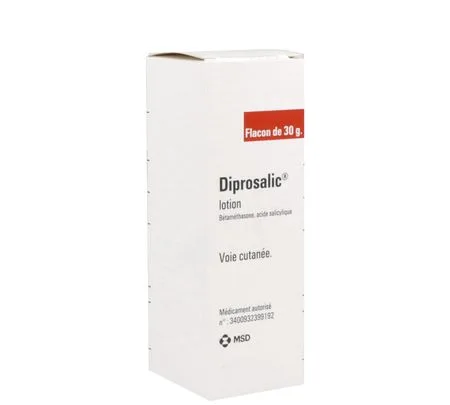
DIPROSALIC, lotion
Composition
Betamethasone dipropionate .................................................................................................. 0,064 g
Corresponding quantity of betamethasone ............................................................................... 0,050 g
Salicylic acid ........................................................................................................................... 2,000 g
For 100 g of lotion.
Hydroxypropylmethylcellulose, sodium hydroxide, sodium edetate, isopropyl alcohol, purified water.
Indications
- Corticosteroid-responsive dermatoses with a keratotic or squamous component.
- Preferred indications where topical corticosteroid therapy is considered the best treatment:
- lichenification.
- Indications where corticosteroid therapy is one of the usual treatments:
- psoriasis,
- lichen,
- seborrhoeic dermatitis, except on the face.
- DIPROSALIC is presented in two forms:
- the ointment form,
- the lotion form, more particularly suited to the treatment of conditions of the scalp, hairy areas and skin folds.
Dosage and administration
Gently spread the lotion over the lesions and work it in with light massage.
In scalp conditions, the lotion should be applied parting by parting, extending well beyond the area to be treated.
Applications will be limited to 2 per day for one to two weeks; in maintenance treatment, a single daily application may be sufficient. Increasing the number of applications risks worsening undesirable effects without improving therapeutic effects.
Treatment of large areas requires particular monitoring (number of bottles used).
Treatment should be discontinued progressively by spacing out applications, by using a less potent or less concentrated corticosteroid, or by alternating with a base without dermocorticoid.
Contraindications
- hypersensitivity to the active substances or to any of the excipients listed in section Composition,
- primary bacterial, viral, fungal and parasitic infections, even if they include an inflammatory component,
- ulcerated lesions,
- acne and rosacea.
Warnings and precautions
Special warnings
- Prolonged use of potent corticosteroids on the face exposes to the occurrence of corticosteroid-induced and paradoxically corticosteroid-responsive dermatitis, with rebound after each discontinuation. A progressive withdrawal, which is particularly difficult, is then necessary.
- Due to the passage of the corticosteroid into the general circulation, treatment over large areas or under occlusion may cause the systemic effects of general corticosteroid therapy, particularly in infants and young children. They consist of Cushingoid syndrome and slowed growth: these effects disappear when treatment is stopped, but abrupt cessation may be followed by acute adrenal insufficiency.
- Salicylic acid, under the same conditions, may be responsible for salicylate intoxication.
- DIPROSALIC is not intended for ophthalmic use or for application to the eyelids or mucous membranes.
Precautions for use
- In infants and young children, it is preferable to avoid DIPROSALIC. Particular caution is needed regarding occlusion phenomena that may occur in skin folds or under diapers.
- In case of bacterial or fungal infection of a corticosteroid-responsive dermatosis, either precede the use of the corticosteroid with specific treatment or, possibly and in certain cases only, use a combination of corticosteroid plus specific treatment.
- Use under occlusion must be monitored due to the risk of superinfection.
- If local intolerance appears, treatment must be discontinued and the cause must be investigated.
- In patients sensitive to salicylates, in particular children, use with caution in all circumstances likely to favour systemic passage (see section Pharmacokinetics).
Visual disturbances may occur during systemic or local corticosteroid therapy (notably by nasal, inhaled and intra-ocular route). In case of blurred vision or appearance of any other visual symptom during corticosteroid therapy, an ophthalmological examination is required to look for visual disorders, notably cataract, glaucoma, or a rarer lesion such as central serous chorioretinopathy, described with the administration of corticosteroids by systemic or local route.
Interactions
Given the local use of this product: at the recommended doses, topical betamethasone is not likely to cause clinically significant drug interactions.
Fertility, pregnancy and breastfeeding
Pregnancy
Clinical data on a large number of pregnancies exposed systemically to corticosteroids have not shown an increase in the overall rate of malformations, although animal studies with systemic administration have shown a teratogenic effect.
In humans, no particular malformative effect has been reported with salicylic acid. The fetal toxicity reported with NSAIDs is not expected with DIPROSALIC given the very low systemic concentrations under normal conditions of use.
Use of DIPROSALIC during pregnancy may be considered in strict compliance with the conditions of use: application to a skin surface < 10 % of body surface area, treatment duration limited to 4 weeks.
The mother may show prolongation of bleeding time, as may the newborn if treatment is continued until delivery.
Breast-feeding
Corticosteroids and salicylic acid pass into breast milk. Given topical use, DIPROSALIC may be administered during breastfeeding.
Do not apply to the breasts.
Adverse effects
- Prolonged use of a high-potency corticosteroid may cause skin atrophy, telangiectasia (to be particularly feared on the face), striae (especially at the root of the limbs and occurring more readily in adolescents), ecchymotic purpura secondary to atrophy, and skin fragility.
- On the face, corticosteroids may cause perioral dermatitis or create or worsen rosacea (see sections Warnings and precautions and Contraindications).
- Delayed healing of atonic wounds, pressure sores and leg ulcers may be observed (see section Contraindications).
- Possibility of systemic effects related to the corticosteroid and/or salicylic acid (see section Warnings and precautions).
- The following adverse effects have been reported: acneiform or pustular eruptions, hypertrichosis, depigmentation.
- Secondary infections, particularly under occlusive dressings or in skin folds, and allergic contact dermatitis have also been reported with the use of topical corticosteroids.
- Blurred vision (see also section Warnings and precautions) has been reported with the use of corticosteroids (frequency not known).
Reporting of suspected adverse reactions
Reporting suspected adverse reactions after authorisation of the medicinal product is important. It allows continued monitoring of the benefit/risk balance of the medicinal product. Healthcare professionals are asked to report any suspected adverse reactions via the national reporting system: National Agency for the Safety of Medicines and Health Products (ANSM) and the network of Regional Pharmacovigilance Centres - Website: https://signalement.social-sante.gouv.fr/.
Overdose
Symptoms :
Excessive or prolonged use of topical corticosteroids may cause inhibition of the hypothalamic-pituitary-adrenal axis resulting in secondary adrenal insufficiency and may give rise to manifestations of hypercorticism, including Cushing's disease.
Excessive or prolonged use of topical preparations containing salicylic acid may cause the symptoms of salicylate intoxication.
Treatment :
Appropriate symptomatic treatment is indicated. The symptoms of acute hypercorticism are usually reversible. Correct electrolyte disorders if necessary.
In case of chronic toxicity, a gradual withdrawal of corticosteroids is advised. Treatment of salicylate intoxication is symptomatic.
Salicylic acid must be eliminated rapidly. Administer orally a sodium bicarbonate solution to alkalinise the urine and increase diuresis.
Pharmacodynamics
Pharmacotherapeutic class: corticosteroids with strong activity, other combinations, ATC code: D07XC01
DIPROSALIC is a strong-activity dermocorticosteroid (class II) combined with salicylic acid. The dermocorticoid acts on the inflammatory process and the pruritic effect associated with it. It has vasoconstrictive (anti-exudative) properties and inhibits cell multiplication and synthesis processes in the dermis and epidermis. Keratolytic action of salicylic acid.
Pharmacokinetics
Systemic passage of the corticosteroid, assessed by its impact on cortisolemia, always exists. The extent of the passage and of systemic effects depends on the surface area to be treated, the degree of epidermal alteration and the duration of treatment. Likewise, the systemic passage of salicylic acid is linked to these factors.
Prescription, supply and reimbursement
| Marketing authorisation (AMM) |
|
| Price: |
|
- Indication(s) appearing in the marketing authorisation at the date of publication of this decree
Collection.
176 RUE MONTMARTRE
75002 PARIS
Tel: 01 57 77 32 00 info.medicale.fr@organon.com
https://www.organon.com/france/
Source: VIDAL · Updated on 10/11/2026. This information does not replace advice from a healthcare professional.