
Medicines
SmPC of 30/11/2022
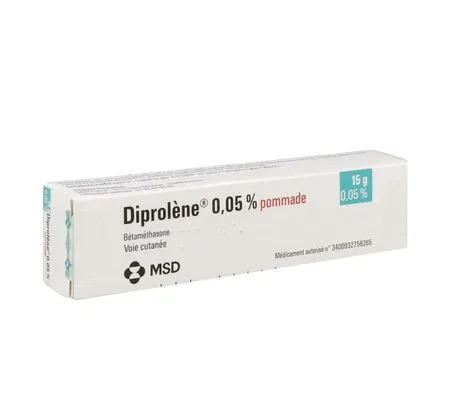
DIPROLENE 0,05 %, ointment
Composition
Micronised betamethasone dipropionate ...................................................................................0,064 g
Corresponding quantity of betamethasone ................................................................................0,050 g
For 100 g of ointment.
Excipient with known effect :
This medicine contains 100,0 mg of propylene glycol (E1520) and 20,0 mg of propylene glycol stearate (E477) in each gram of ointment, which is equivalent to 1 044 mg of propylene glycol per unit (10 g tube), 1 566 mg of propylene glycol per unit (15 g tube), 3 132 mg of propylene glycol per unit (30 g tube), 5 220 mg of propylene glycol per unit (50 g tube) or 10 440 mg of propylene glycol per unit (100 g tube).
Propylene glycol (E1520), white wax, propylene glycol stearate (E477), white petrolatum.
Indications
- Corticosteroid-sensitive lesions, limited in surface area, that have resisted a corticosteroid of the lower category.
- Limited and resistant plaques of psoriasis particularly in palmoplantar localisations, lichenification (neurodermatitis), discoid lupus erythematosus, lichen.
- Hypertrophic scars.
Remark : after a generally brief initial treatment, the relay is possibly provided by a corticosteroid of a lower class.
Dosage and administration
- Applications are limited to 2 per day.
An increase in the number of daily applications would risk worsening adverse effects without improving therapeutic effects. - Treatment of large surface areas requires monitoring of the number of tubes used.
- Spread the product over the lesions and work it in with gentle massage.
- Treatment discontinuation will be gradual, by reducing the frequency of applications and/or by using a less potent or less concentrated corticosteroid.
Contraindications
- Primary bacterial, viral, fungal and parasitic infections, even if they include an inflammatory component,
- Ulcerated lesions,
- Acne and rosacea,
- Hypersensitivity to the active substance or to any of the excipients listed in section Composition,
- Infants (see warnings).
Warnings and precautions
Special warnings
- Prolonged use on the face of class I, II and III corticosteroids exposes to the occurrence of corticosteroid-induced and paradoxically corticosteroid-sensitive dermatitis, with rebound after each discontinuation. A gradual withdrawal, particularly difficult, is then necessary.
- Because of the strength of action of this corticosteroid, in case of use over large areas or under occlusion, significant absorption of the product with passage into the circulation may occur, leading to the systemic effects of corticosteroid therapy by oral or parenteral route (particularly in infants and young children: see contraindications), and notably a temporary suppression of adrenal function (Cushingoid syndrome and slowing of growth); these adverse events disappear on discontinuation of treatment, but abrupt discontinuation may be followed by acute adrenal insufficiency.
- In children, treatment should only be exceptional and under strict supervision.
Precautions for use
- Be particularly wary of spontaneous occlusion phenomena that may occur in skin folds or under impermeable underpants.
- In case of bacterial or fungal infection of a corticosensitive dermatosis, either the corticosteroid use should be preceded by a specific treatment, or possibly, and in certain cases only, use a combination of corticosteroid and specific treatment.
- If local intolerance appears, treatment must be discontinued and the cause must be investigated.
- In case of palpebral application, the duration of treatment must be limited. Prolonged application indeed exposes to risks of ptosis due to muscular involvement of the levator palpebrae, glaucoma, rebound effect.
Visual disturbances may occur during systemic or local corticosteroid therapy (notably by nasal, inhaled and intra-ocular route). In case of blurred vision or appearance of any other visual symptom during corticosteroid therapy, an ophthalmological examination is required to look for visual disorders, notably cataract, glaucoma, or a rarer lesion such as central serous chorioretinopathy, described with the administration of corticosteroids by systemic or local route.
Fertility, pregnancy and breastfeeding
Pregnancy
The safety of this medicine during pregnancy has not been established; its use is therefore not recommended during the first three months of pregnancy.
Adverse effects
With prolonged use, the following are to be feared: skin atrophy, telangiectasias (to be particularly feared on the face), striae (particularly at the root of the limbs, and occurring more readily in adolescents); ecchymotic purpura secondary to atrophy, skin fragility.
On the face, corticosteroids may cause perioral dermatitis or create or worsen rosacea (see sections Warnings and precautions and Contraindications).
A delay in healing of atonic wounds, bedsores, leg ulcers may be observed (see section Contraindications).
Possibility of systemic effects (see section Warnings and precautions).
The following have been reported: acneiform or pustular eruptions, hypertrichosis, depigmentation.
Blurred vision (see also section Warnings and precautions) has been reported with the use of corticosteroids (frequency not known).
Reporting of suspected adverse reactions
Reporting suspected adverse reactions after authorisation of the medicinal product is important. It allows continued monitoring of the benefit/risk balance of the medicinal product. Healthcare professionals are asked to report any suspected adverse reactions via the national reporting system: National Agency for the Safety of Medicines and Health Products (ANSM) and the network of Regional Pharmacovigilance Centres - Website: www.signalement-sante.gouv.fr.
Pharmacodynamics
Pharmacotherapeutic class: high-potency corticosteroids, ATC code: D07AC01.
The presence of propylene glycol in the formulation of this specialty increases the vasoconstrictive effect of betamethasone dipropionate, leads to systemic penetration of the active ingredient; the activity of betamethasone dipropionate is enhanced. The specialty DIPROLENE is a dermocorticoid of very high potency (class I).
SPECIAL PRECAUTIONS FOR DISPOSAL AND OTHER HANDLING
No special requirements.
Any unused medicinal product or waste material should be disposed of in accordance with local requirements.
Prescription, supply and reimbursement
| Marketing authorisation (AMM) |
|
| Price: |
|
Collection.
176 RUE MONTMARTRE
75002 PARIS
Tel: 01 57 77 32 00 info.medicale.fr@organon.com
https://www.organon.com/france/
Source: VIDAL · Updated on 10/11/2026. This information does not replace advice from a healthcare professional.