
Medicines
SmPC of the 06/09/2023
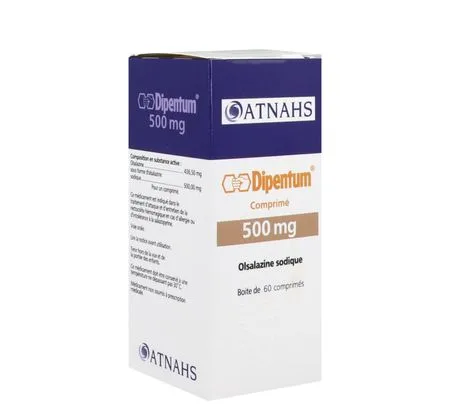
DIPENTUM 500 mg, tablet
Composition
Olsalazine......................................................................................................................................................436,50 mg
as olsalazine sodium.............................................................................................................500,00 mg
For one tablet.
Magnesium stearate, anhydrous colloidal silica, povidone K30, crospovidone.
Indications
Induction and maintenance treatment of ulcerative colitis, particularly in cases of allergy or intolerance to sulfasalazine.
Dosage and administration
Dosage
RESERVED FOR ADULTS AND CHILDREN OVER 6 YEARS.
The tablets must be absorbed at regular intervals throughout the day, immediately after meals.
In adults
Initial (loading) treatment:
3 to 4 tablets per day (i.e. 1,5 to 2 g), in 3 to 4 regularly spaced doses.
It is advised to start this treatment gradually (for example with two tablets) in order to improve tolerability. Dose increases should be slower, with lower doses and longer intervals, if digestive disorders occur.
In cases of insufficient therapeutic response and in the absence of side effects, the daily dose may be increased up to 3 g (i.e. 6 tablets), without exceeding 1 g (i.e. 2 tablets) per dose.
Maintenance treatment:
1 tablet 2 times a day.
In children over 6 years (due to the risk of aspiration).
Initial (loading) treatment:
1 to 3 tablets per day depending on age and weight.
Maintenance treatment:
1 tablet 2 times a day.
Method of administration
Oral use.
Contraindications
Hypersensitivity to olsalazine, to salicylates or to any of the excipients.
Severe renal or hepatic impairment.
Warnings and precautions
When prescribing to a subject intolerant to other salazines, medical supervision is required at the start of treatment and upon any resumption of the medicinal product.
In patients with severe allergy or asthma, signs of worsening should be monitored.
It is recommended to monitor patients with hepatic impairment.
It is recommended to monitor renal function before initiating treatment with olsalazine and at least twice a year thereafter.
Patients and their families must be informed of the risk of haematotoxicity and of the need to contact their doctor immediately if symptoms such as fever, sore throat, mouth ulcers, bruising or bleeding appear.
Interactions
Associations to be taken into account
Azathioprine, Mercaptopurine
Risk of increased myelosuppressive effect of azathioprine and mercaptopurine due to inhibition of their hepatic metabolism by the aminosalicylic acid (ASA) derivative, particularly in subjects with partial thiopurine methyltransferase (TPMT) deficiency.
Fertility, pregnancy and breastfeeding
Pregnancy
Olsalazine has been shown to cause developmental toxicity in the foetus, evidenced by reduced foetal weight, delayed ossification and immaturity of foetal visceral organs when administered during organogenesis in rats at doses corresponding to 5 to 20 times that administered to humans (100 to 400 mg/kg).
There are no adequate and well-controlled studies in pregnant women.
Olsalazine should be used during pregnancy only if the potential benefit justifies the potential risk to the foetus.
Breast-feeding
Small amounts of the active metabolite of olsalazine (5-ASA) may pass into breast milk. Adverse effects (diarrhoea) have been reported in infants during use of 5-ASA while breastfeeding. Unless the benefit of treatment outweighs the risks, olsalazine should not be taken by breastfeeding women; otherwise, it is advised to stop breastfeeding.
Driving and using machines
The effects on the ability to drive vehicles and use machines have not been studied.
However, given the pharmacodynamic profile of olsalazine and the reported adverse effect profile, no effect on the ability to drive vehicles and use machines is expected.
Adverse effects
The most frequent adverse effects are diarrhoea, generally transient but which may require dose reduction or treatment discontinuation if severe (approximately 5% of cases).
Other adverse effects reported with olsalazine are presented below by system organ class and frequency estimate according to the following classification:
Very common (≥ 1/10); common (≥ 1/100 to < 1/10); uncommon (≥ 1/1 000 to < 1/100); rare (≥ 1/10 000 to < 1/1 000); very rare (< 1/10 000); frequency not known (cannot be estimated from the available data)
General disordersand administration site conditions
Common: headache
Uncommon: fever
Blood and lymphatic system disorders
Uncommon: thrombocytopenia
Frequency not known: aplastic anaemia, eosinophilia, haemolytic anaemia, leukopenia, neutropenia, pancytopenia.
Gastrointestinal disorders
Common: diarrhoea, nausea
Uncommon: vomiting, dyspepsia
Frequency not known: abdominal pain, pancreatitis
Hepatobiliary disorders
Uncommon: increased hepatic enzymes
Frequency not known: hepatitis, increased bilirubin
Skin and subcutaneous tissue disorders
Common: skin rash
Uncommon: pruritus, alopecia, photosensitivity reactions, urticaria
Frequency not known: angioneurotic oedema
Cardiac disorders
Uncommon: tachycardia
Frequency not known: myocarditis (contraindicating any re-introduction), palpitations, pericarditis
Renal and urinary disorders
Frequency not known: tubulo-interstitial nephritis
Thoracic and mediastinal respiratory disorders
Uncommon: dyspnoea
Frequency not known: interstitial lung disease
Musculoskeletal and systemic disorders
Frequent: arthralgia
Uncommon: myalgia
Nervous system disorders
Uncommon: dizziness, paraesthesia
Frequency not known: peripheral neuropathy
Psychiatric disorders
Uncommon: depression
Eye disorders
Frequency not known: blurred vision
Reporting of suspected adverse reactions
Reporting suspected adverse reactions after authorisation of the medicinal product is important. It allows continued monitoring of the benefit/risk balance of the medicinal product. Healthcare professionals are asked to report any suspected adverse reactions via the national reporting system: National Agency for the Safety of Medicines and Health Products (ANSM) and the network of Regional Pharmacovigilance Centres - Website: https://signalement.social-sante.gouv.fr/.
Overdose
Few data are available.
In case of overdose, nausea, vomiting and diarrhoea may be observed. It is recommended to institute monitoring of haematological status, acid-base balance, electrolytes, as well as hepatic and renal function, and to implement symptomatic treatment. No known antidote exists.
Pharmacodynamics
Pharmacotherapeutic class: INTESTINAL ANTI-INFLAMMATORY AGENTS, ATC code: A07EC03.
Olsalazine consists of two molecules of 5-amino-salicylic acid (5-ASA), the active metabolite responsible for the therapeutic activity.
It has been shown that patients with UC who are at highest risk of developing colorectal cancer are those with long-standing colitis (more than eight years of disease duration), extensive colitis lesions (reaching or extending beyond the left colon), associated primary sclerosing cholangitis, or a first-degree family history of colon cancer.
A meta-analysis of 9 observational studies (3 cohort studies and 6 case-control studies) including 334 cases of colorectal cancer and 140 cases of dysplasia, for a total of 1932 patients with UC, showed that the risk of colorectal cancer was approximately 50% lower in patients taking 5-aminosalicylic acid (5-ASA) regularly than in those taking 5-ASA irregularly or not taking it.
The reduction in colorectal cancer risk with 5-ASA, if confirmed, would involve both mechanisms related to the anti-inflammatory properties and the intrinsic antitumour properties of the molecule.
Pharmacokinetics
Systemic absorption of olsalazine is minimal, and more than 98% of an oral dose of olsalazine reaches the colon, where it is cleaved into 5-ASA by the action of colonic bacterial enzymes (azo-reductases). At this level, part of the 5-ASA is metabolised to acetyl-5-amino-salicylic acid (Ac-5-ASA). The majority of the 5-ASA is eliminated in the faeces as a mixture of 5-ASA and Ac-5-ASA; 15 to 20% of the total amount of Ac-5-ASA is eliminated in the urine. The concentration of 5-ASA in the colon is 1000 times higher than the serum concentration.
Prescription, supply and reimbursement
| Marketing authorisation (AMM) |
|
| Price: |
|
Collection.
76-78 AVENUE DU MIDI CS 30077
63808 COURNON D'AUVERGNE CEDEX
Tel: 04 73 69 28 28 www.csp-epl.com
Source: VIDAL · Updated on 10/11/2026. This information does not replace advice from a healthcare professional.