
Medicines
Update of 25/07/2025
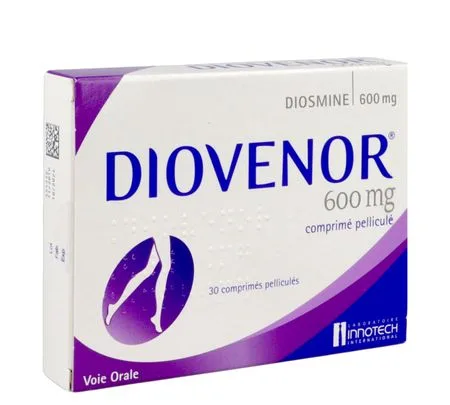
DIOVENOR® 600 mg film-coated tablet
diosmin
Forms and presentations
Film-coated tablet: Boxes of 15 and of 30, under blister packs.Composition
| p tab | |
| Diosmin
|
600 mg |
| (quantity expressed as anhydrous and pure diosmin) | |
Excipient with known effect: carminic acid red.
Indications
- Improvement of symptoms related to venolymphatic insufficiency: heavy legs, pain, restless legs upon waking from the first sleep.
- Adjunctive treatment of functional disorders of capillary fragility.
- Treatment of functional signs related to hemorrhoidal crisis.
Dosage and administration
Dosage- Venous insufficiency: 1 tablet per day at the time of a meal.
- Hemorrhoidal crisis: 2 to 3 tablets per day at the time of meals.
Paediatric population:
The safety and efficacy of Diovenor in children and adolescents under the age of 18 years have not been established.
Method of administration:
Oral use.
Contraindications
Hypersensitivity to the active substance or to any of the excipients listed in section Composition.Warnings and precautions
This medicine contains an azo agent, carminic acid red (E 124), which may cause allergic reactions.
- Hemorrhoidal crisis:
Administration of this product does not replace specific treatment of other anal diseases.
Treatment should be of short duration.
If the symptoms do not subside rapidly, a proctological examination must be performed and the treatment must be reviewed.
Interactions
No clinically relevant drug interaction has been reported to date with diosmin.
Fertility, pregnancy and breastfeeding
Pregnancy:There are no data or there are limited data on the use of diosmin in pregnant women.
Studies conducted in animals have not shown direct or indirect harmful effects on reproduction (see Preclinical safety).
As a precaution, it is preferable to avoid the use of Diovenor during pregnancy.
Breastfeeding:
It is not known whether diosmin or its metabolites are excreted in human milk. A risk to newborns/infants cannot be excluded. A decision must be made either to discontinue breast-feeding or to discontinue/abstain from treatment with Diovenor, taking into account the benefit of breast-feeding for the child and the benefit of the treatment for the woman.
Fertility:Reproductive toxicity studies have not shown an effect on the fertility of male and female rats (see Preclinical safety).
Driving and using machines
No specific studies of the effects of diosmin on the ability to drive vehicles and use machines have been performed. However, given the overall safety profile of diosmin, Diovenor has no or negligible effect on the ability to drive vehicles and use machines.Adverse effects
The following undesirable effects are presented by MedDRA system organ class and by frequency defined as follows: very common (≥ 1/10), common (≥ 1/100, < 1/10), uncommon (≥ 1/1 000, < 1/100), rare (≥ 1/10 000, < 1/1 000), very rare (< 1/10 000) and not known (cannot be estimated from the available data).
| System organ class | Common | Uncommon | Rare |
| Gastrointestinal disorders* | Gastralgia | Bloating, diarrhoea, dyspepsia, nausea | Vomiting |
| Skin and subcutaneous tissue disorders | Allergic reactions such as rash, pruritus, urticaria, angioedema |
* Gastrointestinal disorders rarely lead to discontinuation of treatment.
Reporting of suspected adverse reactions:Reporting suspected adverse reactions after authorisation of the medicinal product is important. It allows continuous monitoring of the benefit/risk balance of the medicinal product. Healthcare professionals should report any suspected adverse reaction via the national reporting system: National Agency for the Safety of Medicines and Health Products (ANSM) and the network of Regional Pharmacovigilance Centres. Website: https://signalement.social-sante.gouv.fr.
Overdose
No cases of overdose associated with undesirable effects have been reported with Diovenor administered alone.
Pharmacodynamics
Pharmacotherapeutic class: Vasoprotector/Agent acting on capillaries (ATC code: C05CA03: cardiovascular system).
Venotonic and vasoprotector causing vasoconstriction, an increase in vessel resistance and a decrease in their permeability.
Various pharmacodynamic studies have been conducted to demonstrate these properties.
- In humans:
-
Venotonic properties:
- Increase in the vasoconstrictor action of adrenaline, noradrenaline and serotonin on superficial veins of the hand or on an isolated saphenous vein.
- Increase in venous tone, demonstrated by measurement of venous capacitance using strain-gauge plethysmography; reduction in the volume of venous stasis.
- The venoconstrictor effect is related to the dose administered.
- Reduction in mean venous pressure in both the superficial and deep systems, demonstrated by a double-blind placebo-controlled trial under Doppler control.
- Increase in systolic and diastolic blood pressure in postoperative orthostatic hypotension.
- Activity following saphenectomy.
- Increase in the vasoconstrictor action of adrenaline, noradrenaline and serotonin on superficial veins of the hand or on an isolated saphenous vein.
-
Vasculoprotective properties:
- Increase in capillary resistance, an effect related to the oral dose administered.
- Increase in capillary resistance, an effect related to the oral dose administered.
Pharmacokinetics
Absorption:
After oral administration of Diovenor, diosmin is metabolised to diosmetin by intestinal bacteria. Diosmetin is then absorbed and found in the blood compartment in glucuroconjugated and sulfoconjugated form. It has been demonstrated that diosmetin-3-glucuroconjugate is one of the main metabolites of diosmin.
The peak plasma concentration is reached between 12 and 15 hours after taking Diovenor.
Distribution:
In animals, the pharmacokinetic study of diosmin labelled with carbon 14 showed preferential distribution of radioactivity in the vena cava and saphenous veins.
Elimination
In animals, elimination is urinary (79%), faecal (11%) and biliary (2,4%), with the existence of an enterohepatic cycle.
In humans, diosmetin-3-glucuroconjugate is found in urine.
Preclinical safety
Non-clinical data from repeated-dose toxicity, genotoxicity and reproductive toxicity studies did not reveal any particular risk for humans.
Storage conditions
- Shelf life
- 5 years.
No special precautions for storage.
HANDLING/DISPOSAL INSTRUCTIONS
No special requirements.
Any unused medicinal product or waste material should be disposed of in accordance with local requirements.
Prescription, supply and reimbursement
| Marketing authorisation (AMM) | 3400933726829 (1994, SmPC rev 23.06.2025) 15 tablets - not marketed in France. |
| 3400933726997 (1994, SmPC rev 23.06.2025) 30 tablets - marketed in France. |
| Not reimbursed by Social Security. |
LABORATOIRE INNOTECH INTERNATIONAL
22, av Aristide-Briand. 94110 Arcueil
Tel: 01 46 15 29 00. Fax: 01 45 46 40 15
Pharmacovigilance and Medical Information:
Fax: 01 46 15 18 28
E-mail: information.vigilance@innothera.com
Source: VIDAL · Updated on 10/11/2026. This information does not replace advice from a healthcare professional.