Medicines
Update of 18/07/2023
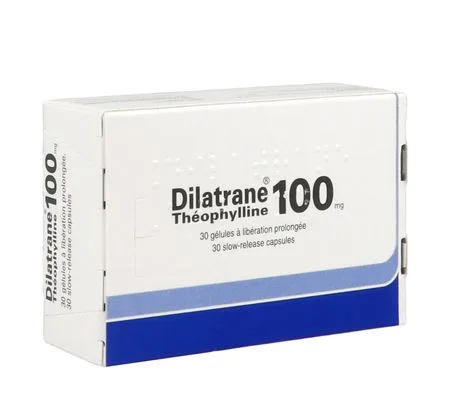
DILATRANE® prolonged-release capsule at 100 mg and at 200 mg
theophylline
Forms and presentations
Prolonged-release capsule at 100 mg or at 200 mg: Boxes of 30, under blister packs.Composition
| per capsule | |
| Theophylline
|
100 mg |
| or | 200 mg |
Indications
Continuous symptomatic treatment of persistent asthma and other chronic obstructive bronchopneumopathies.Theophylline is not the first-line treatment for asthma.
Dosage and administration
Dosage- The 100 mg dosage does not allow delivery of a dose suitable for children weighing less than 20 kg (approximately 6 years).
- The 200 mg dosage does not allow delivery of a dose suitable for children weighing less than 40 kg (approximately 13 years).
The dosage will be adapted to individual susceptibility according to the therapeutic effect and adverse effects.
Treatment will be started with a moderate initial dose in order to test individual tolerance; this will then be gradually adjusted by increasing or decreasing the dose in steps until a therapeutic effect without adverse effects is obtained.
Plasma levels reach a steady state after at least 3 consecutive days of well-conducted treatment; this minimum period must be respected to assess the therapeutic effect before each dose increase.
In case of therapeutic insufficiency and in the absence of signs of intolerance, the dose will be gradually increased under control of theophyllinemia, in steps of 2 mg/kg/day.
In children older than 30 months, below a daily dose of 16 mg/kg/day (adjusted in cases of obesity to ideal weight) and not exceeding, in all cases, 400 mg/day, and in the absence of risk factors for decreased plasma clearance, monitoring of theophyllinemia is nevertheless not essential to the safety of use of the product.
Effective plasma theophylline concentrations are usually between 5 and 12 µg/ml, but concentrations of up to a maximum of 20 µg/ml may be necessary. The toxicity threshold of theophyllinemia is 20 µg/ml.
- Capsule at 100 mg:
-
- Child aged 6 to 8 years (20 to 25 kg):
-
- Recommended initial dose: 10 to 14 mg/kg/day.
- Usually effective dose: 13 to 20 mg/kg/day.
- Recommended initial dose: 10 to 14 mg/kg/day.
- The daily dose will be divided into 2 doses.
-
- Child aged 9 to 16 years (over 25 kg):
-
- Recommended initial dose: 10 to 12 mg/kg/day.
- Usually effective dose: 10 to 16 mg/kg/day.
- Recommended initial dose: 10 to 12 mg/kg/day.
- The daily dose will be divided into 2 doses.
- Capsule at 200 mg:
-
- Child aged 13 to 16 years (over 40 kg):
-
- Recommended initial dose: 10 to 12 mg/kg/day.
- Usually effective dose: 10 to 16 mg/kg/day.
- Recommended initial dose: 10 to 12 mg/kg/day.
- The daily dose will be divided into 2 doses.
- Capsules at 100 and 200 mg:
-
- Adults:
-
- Recommended initial dose: 5 to 8 mg/kg/day.
- Usually effective dose: 7 to 12 mg/kg/day, not to exceed 800 mg per day.
- Recommended initial dose: 5 to 8 mg/kg/day.
- The daily dose will be divided into 2 doses.
- In cases of obesity, the dose will be adjusted to ideal weight (average weight relative to height measured on standard weight-for-height growth charts).
- Other strengths are available for dose adjustment.
Method of administration:
Oral use.
The capsule will be swallowed with a glass of water.
The capsule must not be opened.
Contraindications
- Child under 30 months.
- Intolerance to theophylline.
- Acute intermittent porphyria.
- Association with enoxacin.
- Association not recommended with erythromycin and viloxazine.
Warnings and precautions
Warnings:
Due to large inter-individual variations in theophylline metabolism, doses must be adjusted according to clinical efficacy, adverse effects and/or blood levels (see Posology and Method of administration). Overdose may result from inappropriate doses, repeated intakes at too short intervals, potentiation by concomitant medications, or decreased metabolism (see InteractionsPharmacokinetics).
Theophylline must be used with great caution in young children, who are extremely sensitive to the action of xanthine bases: convulsive seizures, neurological events sometimes with irreversible sequelae, and deaths have been reported in cases of overdose.
Prolonged-release theophylline is not the treatment of an asthma attack.
This medicine contains sucrose. Its use is not recommended in patients with sucrose intolerance.
Precautions for useUse with caution and under monitoring of theophyllinemia in cases of:
- acute heart failure (reduce doses due to the risk of overdose),
- coronary insufficiency,
- obesity (adjust the dosage relative to ideal weight),
- hyperthyroidism,
- hepatic insufficiency (reduce doses due to the risk of overdose),
- history of seizures,
- association with cimetidine, allopurinol, fluconazole, ciprofloxacin, norfloxacin, pefloxacin, fluvoxamine, mexiletine, ticlopidine, pentoxifylline, thiabendazole and with an enzyme inducer (see Interactions),
- of prolonged fever of more than 24 hours, above 38 °C, particularly in young children (halve the dosage due to the risk of overdose, through decreased clearance of theophylline).
Interactions
- Contraindicated combinations:
-
- Enoxacin: risk of theophylline overdose (significant decrease in theophylline catabolism).
- Enoxacin: risk of theophylline overdose (significant decrease in theophylline catabolism).
- Combinations not recommended:
-
- Erythromycin: risk of theophylline overdose (decrease in its hepatic elimination), particularly dangerous in children. Other macrolides, currently considered to have no interaction, may be used. However, in Legionnaires' disease, erythromycin remains the reference antibiotic and may be used under close clinical monitoring with possible monitoring of theophyllinemia.
- Viloxazine: increase in theophyllinemia with risk of overdose (decrease in theophylline metabolism). If the association cannot be avoided, close clinical monitoring with possible monitoring of plasma theophylline concentrations.
- Erythromycin: risk of theophylline overdose (decrease in its hepatic elimination), particularly dangerous in children. Other macrolides, currently considered to have no interaction, may be used. However, in Legionnaires' disease, erythromycin remains the reference antibiotic and may be used under close clinical monitoring with possible monitoring of theophyllinemia.
- Associations subject to precautions for use:
-
- Cimetidine (dosage ≥ 800 mg), fluconazole, ciprofloxacin, norfloxacin, pefloxacin, fluvoxamine, mexiletine, ticlopidine, ritonavir, tacrine, pentoxifylline: increase in theophyllinemia with risk of overdose.
- Thiabendazole: increase in theophyllinemia with risk of overdose, due to decreased hepatic metabolism of theophylline.
- Allopurinol: increase in theophyllinemia in case of high allopurinol dosages (600 mg/day).
- Carbamazepine, phenobarbital, phenytoin, primidone, rifabutin, rifampicin (enzyme inducers): decrease in theophyllinemia and theophylline activity.
- Cimetidine (dosage ≥ 800 mg), fluconazole, ciprofloxacin, norfloxacin, pefloxacin, fluvoxamine, mexiletine, ticlopidine, ritonavir, tacrine, pentoxifylline: increase in theophyllinemia with risk of overdose.
-
- Action to be taken:
- Clinical monitoring and possibly of theophyllinemia; if applicable, adjustment of theophylline dosage during the associated treatment and after its discontinuation.
- Associations to be taken into account:
-
- Clarithromycin, josamycin, roxithromycin: risk of increased plasma levels of theophylline, particularly in children.
- Clarithromycin, josamycin, roxithromycin: risk of increased plasma levels of theophylline, particularly in children.
Fertility, pregnancy and breastfeeding
Pregnancy:Studies conducted in animals have demonstrated a teratogenic effect in one species only.
Clinically, analysis of a large number of exposed pregnancies apparently revealed no malformative or fetotoxic effect of theophylline. However, only epidemiological studies would make it possible to verify the absence of risk.
Furthermore, at the end of pregnancy, theophylline is metabolized to caffeine by demethylation, which may cause tachycardia and hyperexcitability in the newborn.
Consequently, the use of theophylline should be considered during pregnancy only if necessary. In the case of treatment at the end of pregnancy, neonatal monitoring for a few days is required.
Breastfeeding:
Theophylline passes into breast milk, which may cause hyperexcitability in the newborn. Consequently, breastfeeding is not recommended.
Adverse effects
The reported adverse effects are listed below by System Organ Class (SOC) and by frequency. Frequencies cannot be estimated from the available data (frequency unknown).
| SOC (MedDRA) | Frequency | Adverse reaction |
| Psychiatric disorders | Frequency not known | Irritability
Agitation Nervousness Excitation Insomnia |
| Nervous system disorders | Frequency not known | Headache
Tremors Convulsions |
| Cardiac disorders | Frequency not known | Tachycardia
Palpitations |
| Gastrointestinal disorders | Frequency not known | Nausea
Vomiting Epigastric pain |
These adverse effects may be the first signs of an overdose. The onset of convulsions is a sign of confirmed intoxication, but may be the first sign, particularly in children.
Paediatric population:
In children with gastro-oesophageal reflux, administration of theophylline may worsen the reflux.
Rarely, possibility of digestive ulcerations with haemorrhage and obstructive syndrome.
Reporting of suspected adverse reactions:Reporting suspected adverse reactions after authorisation of the medicinal product is important. It allows continuous monitoring of the benefit/risk balance of the medicinal product. Healthcare professionals should report any suspected adverse reaction via the national reporting system: National Agency for the Safety of Medicines and Health Products (ANSM) and the network of Regional Pharmacovigilance Centres. Website: https://signalement.social-sante.gouv.fr.
Overdose
Paediatric population:
Agitation, irritability, nervousness, logorrhoea, tremors, mental confusion, repeated vomiting, hyperthermia, tachycardia, ventricular fibrillation, palpitations, convulsions, hypotension, hypokalaemia, hyperglycaemia, metabolic acidosis, respiratory disorders, hyperventilation followed by respiratory depression.
In adults:
Signs of overdose vary from one subject to another; are observed mainly:- nausea, vomiting, epigastric pain;
- tachycardia, hypotension;
- irritability, nervousness, tremors, headaches, insomnia, excitation, disorientation, delirium;
- hypokalaemia, hyperglycaemia, metabolic acidosis;
- convulsions, hyperthermia and cardiac arrest.
Action to be taken:
- Gastric lavage, intensive care in a specialised setting, activated charcoal by oral route.
- Theophylline is dialysable.
Pharmacodynamics
Pharmacotherapeutic class: Xanthine (R: respiratory system).
- Mechanism of action:
- Theophylline is a xanthine base; it exerts a bronchodilator action by relaxation of bronchial smooth muscles.
-
In addition, it exerts other actions:
- relaxation of smooth muscles of the urinary and biliary tracts and of the lower oesophageal sphincter;
- central stimulation, respiratory analeptic, psychostimulant, convulsant agent at high doses;
- coronary vasodilation, cardiac stimulation with increased oxygen requirements (so-called "malignant" coronary dilator);
- diuretic action.
- relaxation of smooth muscles of the urinary and biliary tracts and of the lower oesophageal sphincter;
Pharmacokinetics
Absorption of theophylline is very good after oral administration.
The Tmax is between 3 and 7 hours.
Plasma protein binding is approximately 50 to 60 %.
The volume of distribution is 0,45 to 0,50 l/kg.
Metabolism of theophylline is essentially hepatic (90 % of the absorbed dose); elimination is then mainly renal, 10 to 13 % are excreted unchanged.
The plasma half-life of theophylline varies considerably between individuals. It varies with age; it is shorter in children than in adults. It is, however, considerably increased in premature and newborn infants.
It is increased in cases of severe hepatocellular insufficiency, acute cardiac failure, respiratory insufficiency, obesity, acute upper respiratory tract infection or severe bronchial obstruction, fever, during a diet rich in carbohydrates and with alcohol intake.
It is decreased in smokers and with a diet rich in proteins.
Theophylline crosses the foetoplacental barrier.
Theophylline passes into milk, where it is found at levels of approximately 75 % of plasma levels.
Storage conditions
- Shelf life
- 3 years.
Store at a temperature below 25 °C.
HANDLING/DISPOSAL INSTRUCTIONS
No special requirements.
Prescription, supply and reimbursement
LIST II| Marketing authorisation (AMM) | 3400930317747 (1983/97, SmPC rev 17.07.2019) 100 mg. |
| 3400930317686 (1983/97, SmPC rev 17.07.2019) 200 mg. |
| Not reimbursed by Social Security. Collect. |
SERP
Le Triton, 5, rue du Gabian. MC 98000 Monaco
Tel: 00 377 97 77 87 05. Fax: 00 377 92 16 78 27
Source: VIDAL · Updated on 10/11/2026. This information does not replace advice from a healthcare professional.