
Medicines
SmPC of 05/11/2025
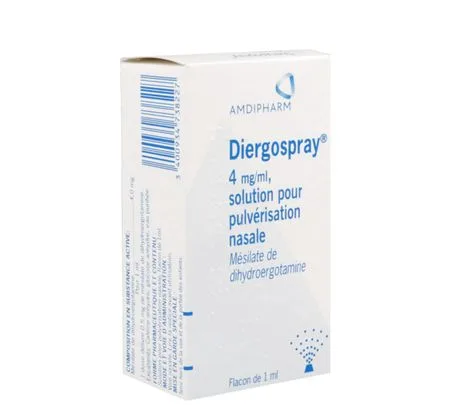
DIERGOSPRAY 4 mg/ml, nasal spray solution
Forms and presentations
Solution for nasal spray.
DIERGOSPRAY nasal spray solution is a solution for local application using a spray device.
The solution is clear, colourless to slightly yellow, brown-yellow or green-yellow.
Composition
Dihydroergotamine mesilate..................................................................................................................4,0 mg
For 1 ml of nasal spray solution.
1 dose delivers 0,5 mg of dihydroergotamine mesilate.
Anhydrous caffeine, anhydrous glucose, purified water.
Dosage and administration
The solution in the bottle has been specially developed for intranasal administration and must not be injected.
Dosage
One spray (0,5 mg) of DIERGOSPRAY nasal spray solution in each nostril at the onset of the migraine headache.
Fifteen minutes later, in patients for whom the first dose of DIERGOSPRAY nasal spray solution (1 mg) was not sufficient, a further spray (0,5 mg) may be administered in each nostril, resulting in a total dose of four sprays (2,0 mg) per attack.
The following recommendations must be observed:
The maximum dose of DIERGOSPRAY nasal spray solution not to be exceeded in 24 h is 2 mg (= 4 sprays) and the maximum dose not to be exceeded per week is 8 mg (= 16 sprays).
After treatment of a migraine attack with DIERGOSPRAY nasal spray solution, an interval of at least 24 hours must be observed before treating a new attack with dihydroergotamine (as nasal spray or injectable form) or with any other medicinal product containing ergotamine, sumatriptan or another 5-hydroxytryptamine 1 receptor agonist.
After treatment of a single migraine attack under the conditions described above (1 mg or 2 mg respectively), the spray device and the spray solution must be discarded.
Elderly patients
The use of DIERGOSPRAY nasal spray solution is not recommended in patients over 65 years of age in the absence of efficacy and safety data.
Hepatic impairment
Caution is recommended in patients with mild to moderate hepatic impairment, in particular in patients with cholestatic hepatitis (see sections Warnings and precautions and Pharmacokinetics). DIERGOSPRAY nasal spray solution is contraindicated in patients with severe hepatic impairment (see section Contraindications).
Paediatric population
The use of DIERGOSPRAY nasal spray solution is not recommended in patients under 16 years of age in the absence of efficacy and safety data.
Method of administration
Instructions for use
The nasal spray solution must be prepared just before use (i.e. as soon as the migraine headache begins). Once the spray device is assembled, it must be used within 8 hours.
1. Lift one edge of the blue cap without detaching it from the metal collar.
2. Remove the cap and the metal collar. The blue cap and the metal collar should come off in one piece. If the blue cap tears, remove the metal collar, taking extreme care with the edges, which may be sharp.
3. Carefully remove the rubber stopper from the bottle.
4. Gently remove the protective cap from the lower part of the spray device.
5. Insert the nasal spray pump into the open bottle and fix it by turning clockwise.
6. While holding the bottle upright, gently remove the blue protective cap from the nasal tip.
7. The spray must be primed before first use: hold the nasal spray upright and press firmly downwards 4 times. Priming normally results in a little liquid being sprayed out.
8. Hold the spray upright, insert the tip into one nostril and spray once. Make the second spray into the other nostril. Sniff strongly through the nose several times to prevent the solution from running out of the nostrils. Avoid blowing the nose immediately after spraying.
Replace the blue protective cap and keep the spray within reach in case it needs to be used again. It is not necessary to re-prime the pump.
Contraindications
• Hypersensitivity to ergot alkaloids or to any of the excipients listed in section Composition.
• Conditions predisposing to angiospastic reactions: coronary insufficiency (in particular unstable or spastic angina), severe infectious states (septicaemia), shock, obliterative vascular disease, peripheral vascular diseases such as Raynaud's syndrome, history of transient ischaemic attack or cerebral ischaemia, or poorly controlled arterial hypertension.
• Temporal arteritis.
• Treatment of familial hemiplegic migraine.
• Treatment of basilar migraine.
• Pregnancy and breast-feeding (see section Fertility, pregnancy and breastfeeding).
• Patients with severe hepatic impairment.
• Patients concomitantly treated with potent CYP3A inhibitors such as macrolide antibiotics, HIV protease inhibitors, azole antifungals and other medicinal products (see section Interactions).
• Patients concomitantly treated with peripheral vasoconstrictors, including those containing ergot derivatives, sumatriptan and other 5-hydroxytryptamine1 (5-HT1) receptor agonists (see section Interactions).
Warnings and precautions
DIERGOSPRAY nasal spray solution is not intended for the prophylactic treatment of migraine and must not be used continuously over the long term because of the risk of serious adverse effects and complications related to its use.
Dihydroergotamine may cause serious adverse effects known as fibrosis, including retroperitoneal, cardiac, pulmonary and pleural fibrosis, and ergotism (including severe cases of constriction of peripheral blood vessels), which may be fatal.
Patients with a history of drug-related fibrosis, such as retroperitoneal and pleural fibrosis, must be monitored closely.
Prolonged use of dihydroergotamine or other ergot derivatives should be avoided as it may lead to dependence.
Chronic daily use of DIERGOSPRAY nasal spray solution, or its use beyond the recommended doses, should be avoided as it may lead to vasospasm.
Chronic overuse of DIERGOSPRAY nasal spray solution may cause rebound headaches. If this situation is suspected, treatment must be discontinued.
In rare cases, vasospasm may be observed, particularly in the lower limbs. If signs and symptoms of vasospasm occur, DIERGOSPRAY nasal spray solution must be stopped and treatment with peripheral vasodilators must be initiated (see section Overdose).
The patient should be informed of the maximum doses of DIERGOSPRAY nasal spray solution not to be exceeded and told the first symptoms of overdose: paraesthesia (e.g. numbness, tingling) in the fingers and toes, nausea and vomiting unrelated to the migraine, symptoms of myocardial ischaemia and precordial pain. As soon as symptoms of overdose appear, treatment must be stopped and the patient must consult their doctor immediately.
Particular monitoring is recommended in patients with rhinitis, nasal congestion and allergic rhinitis, as well as in patients with mild to moderate hepatic impairment and especially in cases of cholestatic hepatitis.
Note : the solution contained in the tinted glass bottle is intended for nasal use only and must not be injected.
Interactions
Potent inhibitors of CYP3A4
Concomitant administration of potent inhibitors of cytochrome P450 3A (CYP3A) and DIERGOSPRAY nasal spray solution is contraindicated. Potent CYP3A inhibitors include: macrolide antibiotics (e.g. erythromycin, troleandomycin, clarithromycin, telithromycin) and tetracycline, HIV protease inhibitors (e.g. ritonavir, indinavir, nelfinavir, fosamprenavir, amprenavir, atazanavir), reverse transcriptase inhibitors (e.g. delavirdine, efavirenz), imidazole-derived antifungals (e.g. ketoconazole, micanazole) and triazole derivatives (e.g. itraconazole, voriconazole, posaconazole) (see section Contraindications). Concomitant administration may lead to increased exposure to dihydroergotamine and ergot toxicity (vasospasm, ischaemia and possible necrosis of the extremities and other tissues).
Vasoconstrictors
Concomitant use of vasoconstrictors including products containing ergotamine, rye ergot alkaloids and sympathomimetics is contraindicated since it may worsen vasoconstriction, cause ischaemia and possible necrosis of the extremities and other tissues (see section Contraindications).
Given the vasoconstrictive properties of dihydroergotamine, the use of nicotine (for example: heavy smoking, nicotine replacement therapy) should be undertaken with caution.
DIERGOSPRAY nasal spray solution must be taken at least 24 hours before or 6 hours after sumatriptan, almotriptan, rizatriptan and zolmitriptan. In addition, concomitant use with eletriptan, frovatriptan or naratriptan must be separated by at least 24 hours due to the increased risk of vasoconstriction.
Weak to moderate CYP3A4 inhibitors
Weak to moderate CYP3A4 inhibitors such as grapefruit juice, saquinavir, cimetidine, metronidazole, quinupristin/dalfopristin, clotrimazole, fluconazole, nefazodone, fluoxetine, fluvoxamine and zileuton may also increase exposure to ergotamine, and caution is recommended when used concomitantly.
There are no other known pharmacokinetic interactions with other P450 isoenzymes.
Although combination with beta-blockers (for example propranolol) is generally well tolerated, caution is required in patients with peripheral circulatory disorders.
Fertility, pregnancy and breastfeeding
Pregnancy
The use of DIERGOSPRAY nasal spray solution is contraindicated during pregnancy.
Clinical experience with parenteral dihydroergotamine suggests that, due to its uterotonic activity and vasoconstrictive effects on the placenta and umbilical cord, dihydroergotamine may be harmful to the foetus.
Animal studies have demonstrated reprotoxicity (see section Preclinical safety).
Breast-feeding
Dihydroergotamine is likely to be excreted in breast milk. The use of DIERGOSPRAY nasal spray solution is therefore contraindicated in breastfeeding women.
Fertility
No data on the effect of dihydroergotamine on fertility in humans are available. In rats, no effect on male and female fertility was observed after intranasal and oral administration of dihydroergotamine at doses above the maximum recommended daily dose in humans.
Driving and using machines
Patients experiencing dizziness or other central nervous system disorders, including visual disturbances, while using DIERGOSPRAY nasal spray solution must not drive or operate machinery.
Adverse effects
The most frequently reported adverse reactions are: rhinitis, nausea and vomiting, dysgeusia, dose-dependent reactions at the application site (for example nasal obstruction, rhinorrhoea), diarrhoea, pharyngitis, dizziness and flushing.
The frequency classification uses the following convention: very common (≥1/10), common (≥1/100 to <1/10), uncommon (≥1/1000 to <1/100), rare (≥1/10000 to <1/1000), frequency not known (cannot be estimated from the available data).
Within each frequency group, adverse reactions are presented in order of decreasing seriousness.
|
Immune system disorders |
|
|
Rare: |
Hypersensitivity reactions (skin rash, facial oedema, urticaria, dyspnoea) |
|
Nervous system disorders |
|
|
Uncommon: |
Paraesthesia/hypoaesthesia, dizziness, dysgeusia |
|
Cardiac disorders |
|
|
Rare: |
Symptoms of myocardial ischaemia |
|
Vascular disorders |
|
|
Uncommon: |
Flushing |
|
Rare: |
Arterial spasm (particularly in the lower extremities) (see sections Warnings and precautions and Overdose) |
|
Respiratory, thoracic and mediastinal disorders |
|
|
Uncommon: |
Nasal congestion, rhinitis |
|
Rare: |
Pharyngitis, dyspnoea |
|
Undetermined: |
Epistaxis |
|
Musculoskeletal and connective tissue disorders |
|
|
Undetermined: |
Muscle spasms |
|
Gastrointestinal disorders |
|
|
Uncommon: |
Nausea, vomiting |
|
Rare: |
Diarrhoea |
|
Undetermined: |
Abdominal pain |
|
General disorders and administration site conditions |
|
|
Uncommon: |
Reactions at the site of administration |
|
Rare: |
Chest pain |
Ergotism may occur in some patients who have taken dihydroergotamine orally continuously for years. Development of fibrotic changes, in particular of the pleura and retroperitoneum, has been observed. Cases of fibrotic changes of the heart valves have been reported (see section Warnings and precautions). Chronic use may lead to dependence (see section Warnings and precautions).
Reporting of suspected adverse reactions
Reporting suspected adverse reactions after authorisation of the medicinal product is important. It allows continued monitoring of the benefit/risk balance of the medicinal product. Healthcare professionals are asked to report any suspected adverse reaction via the national reporting system: National Agency for the Safety of Medicines and Health Products (ANSM) and the network of Regional Centres of Pharmacovigilance - Website: https://signalement.social-sante.gouv.fr
Overdose
Symptoms
No cases of overdose with DIERGOSPRAY nasal spray solution have been reported. However, symptoms similar to those observed after ingestion of an excessive oral dose can be expected: nausea, vomiting, headache, tachycardia, dizziness, peripheral signs and symptoms of vasospasm (for example numbness, tingling and pain in the extremities), symptoms of myocardial ischaemia, chest pain and coma. It should be noted that the onset of angiospastic symptoms may be delayed by 24 hours relative to administration.
Management
After discontinuation of use, treatment of overdose is symptomatic and requires close monitoring of the cardiovascular system.
In cases of severe angiospastic reactions, intravenous administration of a peripheral vasodilator (such as nitroprusside, phentolamine, or dihydralazine), local application of heat to the affected areas, and preventive treatment of tissue lesions are recommended. In case of coronary spasm, appropriate treatment such as administration of nitroglycerin should be initiated.
Pharmacodynamics
Pharmacotherapeutic group: Ergot alkaloids, ATC code: N02CA01
Mechanism of action
Dihydroergotamine has a moderate to high affinity for various serotonergic receptor subtypes. It possesses a particularly potent agonist activity at 5-HT1D receptors, which is thought to underlie its antimigraine efficacy.
This agonist activity results in a decrease in the function of neurons related to 5-HT and, as a result, there is an effect on elements of the cranial vasculature and/or it prevents neurogenic inflammation and the resulting stimulation of nociceptive receptors.
Administration of DIERGOSPRAY nasal spray solution has a rapid onset of action. During migraine attacks of mild to severe intensity, DIERGOSPRAY nasal spray solution relieves headache and associated symptoms such as phonophobia and photophobia.
Pharmacokinetics
Absorption
After nasal administration, dihydroergotamine is rapidly absorbed (Tmax of approximately 45 min). Its absolute bioavailability is approximately 43 ± 24 %.
Distribution
Binding of dihydroergotamine to plasma proteins is 93 %; its apparent volume of distribution is approximately 800 litres at steady state.
Biotransformation
70 to 80 % of plasma concentrations represent unchanged substance, indicating lower metabolism of dihydroergotamine via the nasal route than via the oral route.
Elimination
Total body clearance is approximately 1,5 litres/min, mainly reflecting hepatic clearance. Plasma elimination is biphasic with a terminal half-life of approximately 10 hours. Excretion occurs mainly via faeces through bile. After nasal administration, urinary excretion of the parent substance and metabolites is approximately 2 %.
Preclinical safety
Reproductive toxicity
At oral doses up to 30 mg/kg per day, dihydroergotamine was not teratogenic in pregnant rats and rabbits and had no effect on peri- or postnatal development in rats and rabbits. Oral administration of 5 mg/kg per day to pregnant monkeys was not teratogenic. However, after intravenous and nasal administration, developmental toxicity (decreased foetal body weight and/or delayed skeletal ossification) was observed in experimental animals. This observation has been attributed to a decrease in uteroplacental blood flow resulting from prolonged vasoconstriction of uterine vessels and/or an increase in myometrial tone induced by dihydroergotamine.
Genotoxicity
In vitro mutagenicity tests gave contradictory results. In vivo models showed no sign of mutagenic activity of dihydroergotamine, which is therefore considered to have no genotoxic potential.
Carcinogenicity
Studies of carcinogenicity in rats (intranasal administration of 0,08, 0,24 or 0,8 mg per day) and in mice (subcutaneous administration with 0,5, 1,5 or 5 mg/kg per day) allowed the conclusion that dihydroergotamine had no carcinogenic effect.
An increased incidence of fibrosarcomas at the injection site in the mouse study (at 5 mg/kg per day) was considered related to the mode of administration (subcutaneous) and not relevant to intermittent use in humans.
Prescription, supply and reimbursement
| Marketing authorisation (AMM) |
|
| Price: |
|
Collection.
76-78 AVENUE DU MIDI CS 30077
63808 COURNON D'AUVERGNE CEDEX
Tel: 04 73 69 28 28 www.csp-epl.com
Source: VIDAL · Updated on 10/11/2026. This information does not replace advice from a healthcare professional.