
Medicines
SmPC of 10/03/2025
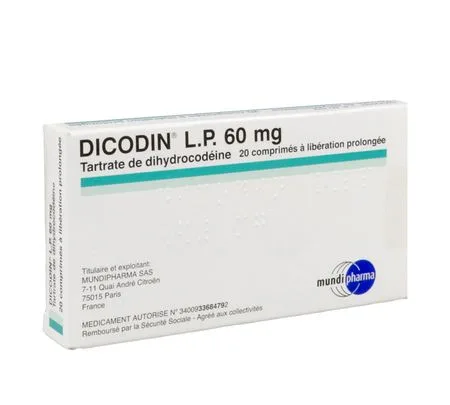
DICODIN L.P. 60 mg, prolonged-release tablet
Forms and presentations
Prolonged-release tablet. Tablet engraved DHC on one side and 60 on the other.
Composition
Dihydrocodeine tartrate .........................................................................................................................60 mg
Quantity corresponding to dihydrocodeine base.......................................................................................40 mg
For one prolonged-release tablet.
Excipients with known effect: lactose (anhydrous), 58,4 mg.
Anhydrous lactose, hydroxyethylcellulose, cetostearyl alcohol, magnesium stearate, talc.
Indications
DICODIN L.P. 60 mg, prolonged-release tablet is indicated in adults (from 15 years of age) for the symptomatic treatment of moderate-intensity pain.
Dosage and administration
This presentation is reserved for adults (from 15 years of age).
Dosage
The dosage must be adjusted to the intensity of the pain; the lowest effective dose should generally be used, for the shortest possible duration.
If long-term treatment of pain with DICODIN L.P. is necessary, given the nature and severity of the condition, careful and regular monitoring should be carried out (interspersing therapeutic breaks if necessary) in order to check whether, and to what extent, continuation of treatment is necessary.
Adults (from 15 years of age)
1 prolonged-release tablet of 60 mg, to be repeated if necessary after 12 hours, not exceeding 2 tablets per day (maximum dose).
Caution: take into account all medicines to avoid opioid overdose, including medicines obtained without prescription (see section Interactions).
Paediatric population
Children under 15 years of age:
DICODIN L.P. 60 mg, prolonged-release tablet is contraindicated in children under 15 years of age (see section Contraindications).
Special populations
Elderly subject
In elderly patients, dihydrocodeine requires dose adjustment (treatment started at a reduced dose with subsequent adjustment according to clinical response).
Renal impairment
In patients with renal impairment, dihydrocodeine requires dose adjustment (treatment started at a reduced dose with subsequent adjustment according to clinical response).
Hepatic impairment
In patients with hepatic impairment, dihydrocodeine requires dose adjustment (treatment started at a reduced dose with subsequent adjustment according to clinical response).
Method of administration
Oral use.
Swallow the tablet whole with a glass of water; do not break, chew, crunch, or crush it.
Contraindications
This medicine must never be used in the following cases:
• Hypersensitivity to the active substance or to any of the excipients listed in section Composition,
• Respiratory insufficiency, whatever the degree of insufficiency, due to the depressant effect of DHC on the respiratory centres,
• Severe hepatocellular and/or renal insufficiency,
• Children under 15 years,
• In combination with sodium oxybate (see section Interactions).
Warnings and precautions
Special warnings
Respiratory depression
The main risk in case of opioid abuse is respiratory depression.
Opioids can cause sleep-related breathing disorders, including central sleep apnoea (CSA) and sleep-related hypoxaemia, which may lead to nocturnal awakenings and daytime somnolence. Use of opioids may increase the risk of CSA in a dose-dependent manner in some patients. Opioids may also cause worsening of pre-existing sleep apnoea (see section Adverse effects). In patients who present with CSA, reduction of the total opioid dose should be considered.
Tolerance, physical dependence and withdrawal
Cases of dependence have been reported with dihydrocodeine.
With prolonged use, the patient may develop tolerance to the medicine and need progressively increased doses to maintain analgesia.
Prolonged use of this medicine may lead to physical dependence, and a withdrawal syndrome may occur upon abrupt cessation of treatment.
On stopping treatment, it is advised to gradually reduce doses to prevent the onset of this withdrawal syndrome.
Psychological dependence (addiction), abuse profile and history of drug and/or alcohol addiction
Dihydrocodeine presents a risk of abuse and dependence equivalent to other opioids. Dihydrocodeine may give rise to misuse (misuse) and abuse by persons with a latent or manifest risk of addictive disorders. Psychological dependence may occur after administration of opioid analgesics, including dihydrocodeine.
DICODIN L.P. should be used with caution in patients with a history of drug addiction (including alcohol abuse) and mental health disorders.
Dihydrocodeine is not appropriate for substitution treatment in patients with opioid dependence.
Prolonged-release tablets must be swallowed whole without being chewed, crunched or crushed. Administration of chewed, crunched or crushed prolonged-release dihydrocodeine tablets leads to rapid release and absorption of a potentially fatal quantity of dihydrocodeine, which may result in signs of overdose (see section Overdose).
Parenteral injection of oral forms for misuse may cause serious adverse effects that may be fatal.
This medicine contains lactose. Patients with galactose intolerance, total lactase deficiency or glucose-galactose malabsorption syndrome (rare hereditary diseases) must not take this medicine.
Special precautions for use
Opioids, such as dihydrocodeine, may have a pharmacological action on the hypothalamic-pituitary or gonadal axis. Certain changes have been observed, such as an increase in prolactin levels and a decrease in plasma cortisol, testosterone, luteinising hormone and follicle-stimulating hormone. These hormonal changes may manifest as clinical symptoms.
Metabolism by CYP2D6
Dihydrocodeine is a semi-synthetic analogue of codeine. Similarities exist between the metabolism of codeine and dihydrocodeine in the formation of (O-demethylated) metabolites catalysed by CYP2D6. There are genetic differences in the expression of the enzyme CYP2D6. For codeine, this results in a risk of lack of efficacy in slow metabolisers and a risk of opioid toxicity in ultra-rapid metabolisers. The clinical implications of genetic polymorphisms of CYP2D6 have not been sufficiently elucidated for dihydrocodeine (see section Pharmacokinetics).
Risk related to concomitant use of sedative medicines such as benzodiazepines or other related medicines.
Concomitant use of DICODIN LP and sedatives such as benzodiazepines or other related medicines may result in sedation, respiratory depression, coma and death. Because of these risks, concomitant prescribing with these sedative medicines should be reserved for patients for whom alternative treatment options are not possible. If the decision is taken to prescribe DICODIN LP concomitantly with sedative medicines, the lowest effective dose should be used and the duration of treatment should be as short as possible.
Patients must be closely monitored to watch for the occurrence of signs and symptoms of respiratory depression and sedation.
In this regard, it is strongly recommended to inform patients and their carers so that they are aware of these symptoms (see section Interactions)
Action on the gastrointestinal tract and other smooth muscles:
Dihydrocodeine decreases the tone and peristalsis of the longitudinal fibres and increases the tone of the circular fibres, at the level of the antrum of the stomach and the duodenum, which causes spasm of the sphincters (pylorus, ileocaecal valve, anal sphincter, sphincter of Oddi, bladder sphincter). Digestion of food in the small intestine is delayed and propulsive contractions are decreased. The propulsive peristaltic waves at the level of the colon are decreased, while muscle tone is increased to the point of causing spasm, resulting in constipation.
Dihydrocodeine requires particular monitoring:
• in patients who have undergone cholecystectomy. Indeed, dihydrocodeine may cause an acute abdominal pain syndrome of biliary or pancreatic type, most often associated with biological abnormalities, suggestive of spasm of the sphincter of Oddi.
• in patients presenting with constipation: it is important to look for and manage constipation or an obstructive syndrome before and during treatment.
• in patients presenting with sleep apnoea.
• in patients presenting with chronic cor pulmonale.
• in patients presenting with chronic obstructive pulmonary disease (COPD).
• in patients presenting with bronchial asthma.
• in patients presenting with respiratory depression with hypoxia.
• in patients presenting with prostatic hypertrophy.
• in patients with head trauma, intracranial lesions or increased intracranial pressure, or a reduced level of consciousness of unknown origin.
Interactions
It must be taken into account that many medicines or substances may add together their central nervous system depressant effects and contribute to decreased alertness. These include morphine derivatives (analgesics, antitussives and substitution treatments), neuroleptics, barbiturates, benzodiazepines, anxiolytics other than benzodiazepines (for example meprobamate), hypnotics, tricyclic or sedative antidepressants (amitriptyline, doxepin, mianserin, mirtazapine, trimipramine), sedative H1 antihistamines, central antihypertensives, MAOIs, baclofen and thalidomide.
Contraindicated combinations (see section Contraindications)
+ Sodium oxybate
Increased risk of respiratory depression, which may be fatal in the event of overdose.
Combinations not recommended
+ Partial morphine antagonists (naltrexone, nalmefene)
Risk of reduced analgesic effect. If necessary, increase the doses of the opioid derivative.
+ Alcohol consumption.
Impaired alertness may make driving vehicles and using machines dangerous.
Avoid taking alcoholic beverages and medicines containing alcohol.
Potentiation by alcohol of the sedative effect of morphine analgesics
+ Sedative medicines, such as benzodiazepines or related substances
The concomitant use of opioids with sedative medicinal products such as benzodiazepines or related medicinal products increases the risk of sedation, respiratory depression, coma and death due to an additive depressant effect on the central nervous system. The dose and duration of concomitant use must be limited (see section Warnings and precautions).
+ Mixed agonist-antagonist opioids (buprenorphine, nalbuphine, pentazocine)
Reduction of analgesic effect through competitive receptor blockade, with risk of onset of withdrawal syndrome.
Associations to be taken into account
+ Other analgesics morphine agonists (alfentanil, codeine, dextromoramide, fentanyl, hydromorphone, morphine, oxycodone, pethidine, phenoperidine, remifentanil, sufentanil, tapentadol, tramadol),
Increased risk of respiratory depression, which may be fatal in the event of overdose.
+ Morphine-like antitussives (dextromethorphan, noscapine, pholcodine),
Increased risk of respiratory depression, which may be fatal in the event of overdose.
+ True morphinic antitussives (codeine, ethylmorphine),
Increased risk of respiratory depression, which may be fatal in the event of overdose.
+ Barbiturates
Increased risk of sedation and respiratory depression which may lead to coma and death, particularly in the elderly. Doses and duration of the combination should be limited as far as possible.
+ Other sedative medicines
Increased central depression. Impaired alertness may make driving vehicles and using machines dangerous.
+ Anticholinergic medicines
Significant risk of colonic akinesia, with severe constipation.
Fertility, pregnancy and breastfeeding
Pregnancy
Animal data are insufficient to exclude any reproductive toxicity. Data on the use of dihydrocodeine in pregnant women are limited. Consequently, DICODIN L.P. is not recommended during pregnancy.
Furthermore, in case of administration at the end of pregnancy, the morphinomimetic properties of this medicinal product should be taken into account and neonatal monitoring should be considered:
- risk of withdrawal syndrome in the newborn in case of prolonged administration at the end of pregnancy, regardless of the dose;
- theoretical risk of respiratory depression in the newborn after high doses, even with short-term treatment, before or during delivery.
Breast-feeding
The passage of dihydrocodeine into breast milk is not known. Given the risks of respiratory depression in the newborn, it is preferable to avoid using DICODIN L.P. during breastfeeding.
Fertility
Not applicable.
Driving and using machines
Due to the possible decrease in alertness, DICODIN L.P. may have a minor or moderate influence on the ability to drive vehicles and use machines. Caution is advised in sensitive subjects or when dihydrocodeine is taken at the same time as central nervous system depressants or alcohol.
Adverse effects
The most frequent adverse effects at usual doses are: constipation, abdominal pain, dry mouth, nausea and vomiting, headache, drowsiness.
The incidence of adverse effects classified by system organ class is presented below. The definition of frequency categories is as follows:
Very common (≥1/10), Common (≥1/100, <1/10), Uncommon (≥1/1000, <1/100), Rare (≥1/10 000, <1/1000), Very rare (<1/10 000), Not known (cannot be estimated from the available data).
Immune system disorders
Frequency not known Angioedema (Quincke's edema).
Psychiatric disorders
Common Hallucinations,
Frequency not known Confusional state, drug dependence (see section Warnings and precautions), dysphoria, Abuse.
Prolonged use leads to a risk of drug dependence (see section Warnings and precautions).
There is a risk of dependence and withdrawal syndrome upon abrupt discontinuation, which may be observed in the user and in the newborn of a mother who has been intoxicated with codeine (see section Fertility, pregnancy and breastfeeding).
Nervous system disorders
Very common Somnolence, headache,
Common Dizziness,
Frequency not known Convulsions, sedation, sleep apnoea syndrome (see section Warnings and precautions).
Vascular disorders
Frequency not known Hypotension.
Respiratory, thoracic and mediastinal disorders
Frequency not known Respiratory depression, bronchospasm.
Gastrointestinal disorders
Very common Abdominal pain, constipation, dry mouth, nausea, vomiting,
Frequency not known Diarrhoea, paralytic ileus (related to constipation).
Hepatobiliary disorders
Frequency not known Spasm of the sphincter of Oddi,
Skin and subcutaneous tissue disorders
Common Hyperhidrosis,
Frequency not known Pruritus, urticaria, rash.
Disorder of the kidney and urinary tract
Frequency not known Urinary retention.
General disorders and administration site conditions
Common Asthenia
Frequency not known Withdrawal syndrome, neonatal withdrawal syndrome.
At supratherapeutic doses
Risk of dependence and withdrawal syndrome upon abrupt discontinuation, which may be observed in the user and in the newborn of a drug-addicted mother.
Reporting of suspected adverse reactions
Reporting suspected adverse reactions after authorisation of the medicinal product is important. It allows continued monitoring of the benefit/risk balance of the medicinal product. Healthcare professionals are asked to report any suspected adverse reactions via the national reporting system: National Agency for the Safety of Medicines and Health Products (ANSM) and the network of Regional Pharmacovigilance Centres - Website: https://signalement.social-sante.gouv.fr.
Overdose
Symptoms
The signs of an overdose of dihydrocodeine are: somnolence which may progress to coma, miosis, vomiting, hypotension, hypothermia, signs of histamine release, acute depression of the respiratory centres (cyanosis, bradypnoea), which may be fatal in the most severe cases.
Emergency management
Ensure airway patency (aspiration), maintain ventilation and circulation according to the symptoms.
In case of overdose, naloxone may be administered.
Precaution
In subjects dependent on morphine-mimetics, an injection of naloxone at a high dose may cause a withdrawal syndrome. In these subjects, naloxone must be injected at progressive doses.
Pharmacodynamics
Pharmacotherapeutic class: opioid analgesic, ATC code: N02AA08
(N: central nervous system)
Dihydrocodeine is a pure opioid agonist.
Action on the central nervous system:
Dihydrocodeine has an analgesic activity whose potency is approximately one tenth that of morphine.
Dihydrocodeine may produce respiratory depression through direct action on the respiratory centres of the brainstem.
Action on the respiratory centres:
Dihydrocodeine exerts a depressant action.
Pharmacokinetics
Prolonged-release form allowing twice-daily oral administration.
The molecular structure of dihydrocodeine differs from that of codeine only by the saturation of the 7,8 bond.
Oral bioavailability is limited due to a 1st-pass hepatic effect: the biotransformation reactions are similar to those of codeine (demethylation, oxidation and especially conjugation) leading to inactive products – elimination of metabolites is renal. A possible renal metabolism is discussed.
The metabolism of dihydrocodeine shows important similarities with the metabolism of codeine. Dihydrocodeine is also a substrate of the polymorphic enzyme CYP2D6. This enzyme catalyses the conversion of dihydrocodeine to dihydromorphine via the O-demethylation pathway (see section Warnings and precautions).
Prescription, supply and reimbursement
Prescription duration limited to 84 day(s).
Prescription on a secure prescription form (meeting the specifications set by the order of 31 March 1999).
| Marketing authorisation (AMM) |
|
| Price: |
|
Collection.
76-78 AVENUE DU MIDI CS 30077
63808 COURNON D'AUVERGNE CEDEX
Tel: 04 73 69 28 28 www.csp-epl.com
Source: VIDAL · Updated on 10/11/2026. This information does not replace advice from a healthcare professional.