
Medicines
SmPC of 19/12/2022
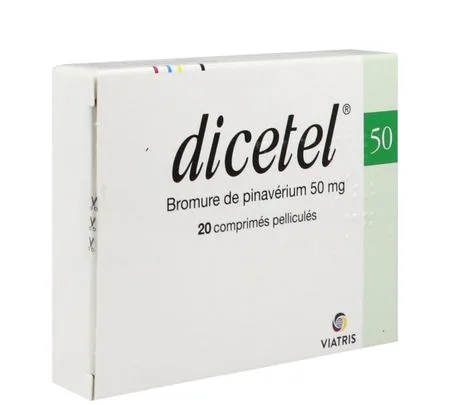
DICETEL 50 mg, film-coated tablet
Forms and presentations
Film-coated tablet.
Round, biconvex tablet, yellowish to orange in color, engraved 50 on one side.
Composition
Pinaverium bromide........................................................................................................................50,000 mg
For a film-coated tablet.
Excipient with known effect: lactose.
Uncoated tablet : Colloidal hydrophobic silica, microcrystalline cellulose, talc, magnesium stearate, pregelatinized maize starch, lactose monohydrate.
Film coating : basic butyl methacrylate copolymer, talc, sodium lauryl sulfate, stearic acid, hypromellose, yellow iron oxide (E172), red iron oxide (E172).
Indications
Symptomatic treatment of pain, bowel disturbances and intestinal discomfort associated with functional bowel disorders;
Dosage and administration
Dosage
In adults
The dosage is 3 to 4 tablets per day.
Exceptionally, this dosage may be increased to 6 tablets per day.
Paediatric population
The efficacy and safety of use of pinaverium bromide have not been studied in children (see section Warnings and precautions).
Method of administration
The tablets must be swallowed without chewing or sucking, with a large glass of water in the middle of meals in order to avoid contact of pinaverium with the esophageal mucosa (risk of esophageal lesions, see section Adverse effects).
Do not swallow the tablets while lying down, nor just before bedtime.
Contraindications
Hypersensitivity to the active substance or to any of the excipients listed in section Composition.
Warnings and precautions
Due to a risk of upper digestive damage including esophageal ulcerations, it is important to strictly follow the method of administration. Caution is recommended in patients with pre-existing esophageal lesions and/or a hiatal hernia, who must pay particular attention to following the method of administration (see sections Dosage and administration and Adverse effects). Tablets must be swallowed in a sitting position, without being chewed or sucked, with a large glass of water in the middle of the meal. Do not lie down for 30 minutes after taking.
DICETEL 50 mg, film-coated tablet must not be administered to children given the absence of efficacy and tolerability data.
This medicine contains lactose. Patients with galactose intolerance, total lactase deficiency or glucose-galactose malabsorption syndrome (rare hereditary diseases) must not take this medicine.
This medicine contains 0,04 mg of sodium per tablet, which is equivalent to 0,002 % of the maximum recommended daily dietary intake by the WHO of 2 g of sodium per adult.
Interactions
Associations to be taken into account
+ Anticholinergic medicines
Concomitant administration with anticholinergic substances may increase the spasmolytic effect.
Fertility, pregnancy and breastfeeding
Pregnancy
There are no relevant data on the use of pinaverium bromide in pregnant women. Animal studies are insufficient regarding effects on gestation, or on embryonic/fetal development, or on parturition or postnatal development. The potential risk in humans is not known. DICETEL 50 mg, film-coated tablet should not be used during pregnancy, unless absolutely necessary.
In addition, the presence of bromide must be taken into account. Indeed, administration of pinaverium bromide at the end of pregnancy could affect the newborn neurologically (hypotonia, sedation).
Breast-feeding
There is no sufficient information on the excretion of DICETEL 50 mg, film-coated tablet in human or animal breast milk. The available physicochemical and pharmacodynamic/toxicological data on DICETEL 50 mg, film-coated tablet show excretion in breast milk, and a risk to the infant cannot be excluded. DICETEL 50 mg, film-coated tablet should not be used during breastfeeding.
Fertility
Studies in rats evaluating the effect of pinaverium bromide on fertility and reproductive functions showed adverse effects on female fertility at a dose of 50 mg/kg, and the no observed adverse effect level (NOAEL) was 25 mg/kg. The no observed adverse effect level (NOAEL) on male fertility was 50 mg/kg.
Driving and using machines
The effects on the ability to drive vehicles and use machines have not been studied.
Adverse effects
Risk of dysphagia, esophagitis and even upper gastrointestinal ulceration, including esophageal ulcerations, which may be favored by failure to follow intake recommendations (see sections Dosage and administration and Warnings and precautions).
The following adverse effects have been reported during post-marketing surveillance of DICETEL 50 mg, film-coated tablet.
The available data do not allow the frequency to be estimated precisely.
Gastrointestinal system disorders :
Digestive disorders such as abdominal pain, diarrhea, nausea, vomiting and dysphagia.
Skin and subcutaneous tissue disordersSubcutaneous tissue disorders :
Rash, pruritus, urticaria, erythema.
Immune system disorders:
Hypersensitivity reactions (including Quincke's edema).
Reporting of suspected adverse reactions
Reporting suspected adverse reactions after authorisation of the medicinal product is important. It allows continued monitoring of the benefit/risk balance of the medicinal product. Healthcare professionals are asked to report any suspected adverse reaction via the national reporting system: National Agency for the Safety of Medicines and Health Products (ANSM) and the network of Regional Centres of Pharmacovigilance - Website: www.signalement-sante.gouv.fr.
Overdose
At doses above 600 mg, digestive disorders such as diarrhea, nausea, vomiting and abdominal pain may occur. In post-marketing pharmacovigilance, only one case of accidental overdose without adverse effects has been reported. There is currently no specific antidote. Symptomatic treatment may be recommended.
Pharmacodynamics
Pharmacotherapeutic class: OTHER MEDICINES FOR FUNCTIONAL BOWEL DISORDERS, ATC code: A03AX04.
Pinaverium bromide is a spasmolytic whose effects are exerted selectively at the level of the digestive tract. It is a calcium antagonist that inhibits calcium entry into the intestinal smooth muscle cell. In animals, pinaverium directly and indirectly reduces the effects of sensory afferent stimulation. It has no anticholinergic effect. It is also devoid of cardiovascular effects.
Pharmacokinetics
After oral administration, pinaverium bromide is rapidly absorbed, reaching peak plasma concentration within one hour. The medicine is intensively metabolized and eliminated by the liver.
The elimination half-life is 1,5 hour. The absolute bioavailability of the oral form is very low (< 1%). Elimination occurs mainly in the feces.
Plasma protein binding of pinaverium bromide is high (95-97%).
Preclinical safety
Toxicity
The toxicity of pinaverium bromide after oral administration is low. Signs of toxicity were essentially limited to general signs of toxicity, gastrointestinal symptoms and symptoms affecting the central nervous system.
Genotoxicity and carcinogenic potential
Pinaverium bromide did not show any genotoxic or carcinogenic effect.
Reproductive toxicity
Studies in rats evaluating the effect of pinaverium bromide on fertility and reproductive functions showed undesirable effects on female fertility at a dose of 50 mg/kg, and the no-observed-adverse-effect level (NOAEL) was 25 mg/kg. The no-observed-adverse-effect level (NOAEL) for male fertility was 50 mg/kg. Pinaverium bromide did not show any significant effect on pre- or post-natal development.
Embryo-foetal development studies in rats and rabbits did not show any teratogenic effects. The no-observed-adverse-effect level (NOAEL) was 50 mg/kg in rats and 60 mg/kg in rabbits.
Higher doses of 150 mg/kg in rats and 180 mg/kg in rabbits showed marked maternal toxicity.
The passage of pinaverium bromide across the placenta and into breast milk has not been studied.
Prescription, supply and reimbursement
| Marketing authorisation (AMM) |
|
| Price: |
|
Collection.
1 RUE DE TURIN
69007 LYON
Tel: 04 37 25 75 00 https://www.viatris.fr/
Source: VIDAL · Updated on 10/11/2026. This information does not replace advice from a healthcare professional.