
Medicines
SmPC of 22/07/2025
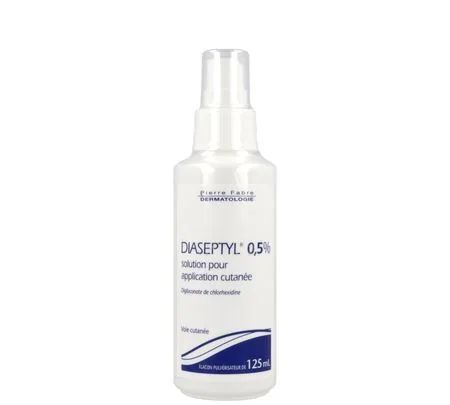
DIASEPTYL 0,5%, solution for cutaneous application
Composition
Chlorhexidine digluconate solution ...........................................................................................0,5 g
As a chlorhexidine digluconate solution at 20 %.
For 100 g
Decylglucoside (ORAMIX NS 150), glycerol, triethanolamine, purified water
Indications
This medicine is indicated in premature infants, newborns, infants, children, adolescents and adults for the antisepsis of superficial wounds of limited extent.
Remark : antiseptic agents are not sterilising: they temporarily reduce the number of micro-organisms.
Dosage and administration
Dosage
2 cutaneous applications per day.
Duration of treatment: 7 to 10 days.
Method of administration
Cutaneous use.
The solution is ready to use.
Solution for cutaneous application in bottles of 125 ml, 250 ml or 500 ml:
It is to be applied directly to the wounds.
Solution for cutaneous application in spray bottles of 75 or 125 ml:
Spray the solution directly onto the wounds.
For external use only. This medicine is not intended to be injected or for oral administration.
Contraindications
- Hypersensitivity to the active substance or to any of the excipients listed in section Composition.
- Do not apply in the eyes, ears or on mucous membranes.
- This product must not enter the auditory canal, in particular in cases of tympanic perforation, nor, in general, be brought into contact with nerve tissue or the meninges.
- This specialty must not be used for disinfecting micro-surgical equipment nor for antisepsis of healthy skin before a surgical procedure.
Warnings and precautions
Special warnings
- For external use only.
- This medicine may cause a local allergic reaction (i.e. a risk of sensitisation to chlorhexidine) or a serious generalised reaction, due to the presence of chlorhexidine, which may occur a few minutes after application (see section Adverse effects).
- DIASEPTYL must not come into contact with the eyes. Serious cases of persistent corneal lesions, which may require corneal transplantation, have been reported following accidental ocular exposure to medicines containing chlorhexidine. During application, extreme care should be taken to ensure that DIASEPTYL is confined to the intended site of application. If DIASEPTYL comes into contact with the eyes, rinse promptly and thoroughly with water. Advice should be sought from an ophthalmologist.
- On contact with the ears and mucous membranes, a risk of middle ear irritation, ototoxicity and mucous membrane irritation is possible. In this case, the patient must rinse with water.
- As soon as the packaging of an antiseptic preparation is opened, microbial contamination is possible.
Precautions for use
- Any antiseptic must be used with caution when a systemic effect is likely to occur, particularly in infants, in cases of damaged skin or over a large surface area.
- Although the transcutaneous absorption of chlorhexidine is very low, the risk of systemic passage cannot be ruled out.
Systemic effects could be promoted by repeated applications, use over a large cutaneous surface, under an occlusive dressing, on damaged skin (particularly burned skin), a mucous membrane, or the skin of premature infants or infants (due to the body surface area/weight ratio and the occlusive effect of diapers in the napkin area).
Interactions
No drug interaction studies have been performed.
Given possible interferences (antagonism, inactivation), or physicochemical incompatibilities, the simultaneous use of other cutaneous antiseptic products (in particular anionic derivatives) should be avoided except with other cationic components. In particular, this medicine must not be used at the same time as ordinary alkaline soap (see section Incompatibilities).
Fertility, pregnancy and breastfeeding
Pregnancy
There are no sufficient data on the use of chlorhexidine in pregnant women. Animal studies do not indicate direct or indirect harmful effects on reproduction (see section Preclinical safety).
As a precautionary measure, it is preferable to avoid using DIASEPTYL during pregnancy.
Breast-feeding
It is not known whether chlorhexidine or its metabolites are excreted in breast milk. A risk to the breastfed infant cannot be ruled out.
DIASEPTYL must not be used during breastfeeding.
Fertility
Chlorhexidine has no effect on fertility in animal studies.
Adverse effects
Undesirable effects are listed below by MedDRA system organ class and by frequency. Frequency is defined according to the following convention: very common (≥ 1/10), common (≥ 1/100 to < 1/10), uncommon (≥ 1/1 000 to < 1/100), rare (≥ 1/10 000 to < 1/1 000), very rare (< 1/10 000), frequency not known (cannot be estimated from the available data).
|
System organ class |
MedDRA Terms
|
|
Immune system disorders |
Hypersensitivity*
|
|
Eye disorders |
Eye irritation***
|
|
Skin and subcutaneous tissue disorders |
Contact dermatitis |
* Risk of local allergy (i.e. contact allergy) or generalised allergy to chlorhexidine, which may lead to anaphylactic shock.
** This could be life-threatening if immediate medical care is not provided. It may manifest as breathing difficulties, facial swelling, or severe skin rash. If the patient experiences an allergic reaction to chlorhexidine, they must immediately stop using the product and seek appropriate medical care.
*** In the context of accidental exposure.
**** Cases of severe corneal erosion and significant permanent visual impairment due to accidental ocular exposure have been reported after marketing authorisation, which led to the need for corneal transplantation in some patients (see section Warnings and precautions).
Reporting of suspected adverse reactions
Reporting suspected adverse reactions after authorisation of the medicinal product is important. It allows continued monitoring of the benefit/risk balance of the medicinal product. Healthcare professionals are asked to report any suspected adverse reactions via the national reporting system: National Agency for the Safety of Medicines and Health Products (ANSM) and the network of Regional Pharmacovigilance Centres - Website: https://signalement.social-sante.gouv.fr/.
Overdose
In case of massive oral ingestion, perform gastric lavage. Acute toxicity per os of chlorhexidine is low (digestive absorption is almost negligible).
Contact a poison control centre.
Pharmacodynamics
Pharmacotherapeutic class: ANTISEPTICS AND DISINFECTANTS - Biguanides and amidines, ATC code: D08AC02.
- Broad-spectrum bactericidal antiseptic;
- Chemical group: bisbiguanide;
- Spectrum of activity of Chlorhexidine: Chlorhexidine exerts, in less than 5 minutes, in vitro, a bactericidal activity against Gram-positive germs and, to a lesser degree, Gram-negative germs;
- Levuricidal activity on Candida albicans.
Pharmacokinetics
No formal pharmacokinetic study has been carried out.
Absorption
The transcutaneous absorption of chlorhexidine through healthy skin is negligible (low or even nil), even in the newborn.
Preclinical safety
Non-clinical data from the literature reveal no particular risk for humans based on repeated-dose toxicity, genotoxicity, carcinogenic potential and reproductive and developmental toxicity studies.
Prescription, supply and reimbursement
| Marketing authorisation (AMM) |
|
| Price: |
|
Not reimbursed by social security (Fl/75ml).
Collect (Fl powder/125ml).
CHARTREUSE INDUSTRIAL PARK
81106 CASTRES CEDEX
Tel: 01 49 10 80 00 Tel (Freephone): 0 800 326 326
https://www.pierrefabremedicament.fr/
Source: VIDAL · Updated on 10/11/2026. This information does not replace advice from a healthcare professional.