
Medicines
SmPC of 21/08/2023
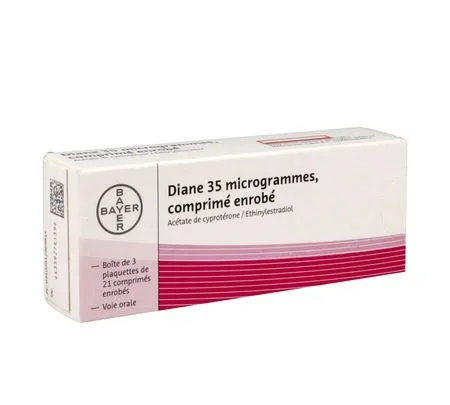
DIANE 35 µg, coated tablet
Composition
For a coated tablet:
Cyproterone acetate: 2,000 mg
Ethinylestradiol: 0,035 mg
Excipients with known effect : one coated tablet contains 31,115 mg of lactose monohydrate and 19,371 mg of sucrose.
Core : lactose monohydrate, maize starch, povidone K25, talc, magnesium stearate.
Coating : sucrose, povidone K90, macrogol 6 000, calcium carbonate, talc, titanium dioxide, glycerol, montan glycol wax, yellow iron oxide (E172).
Indications
Treatment of moderate to severe acne linked to androgen sensitivity (whether or not associated with seborrhoea) and/or hirsutism, in women of childbearing potential.
For the treatment of acne, DIANE 35 micrograms, coated tablet should be used only after failure of topical treatment or systemic antibiotic treatments.
As DIANE 35 micrograms, coated tablet is also a hormonal contraceptive, it must not be used in combination with other hormonal contraceptives (see section Contraindications).
Dosage and administration
Dosage
- DIANE 35 micrograms, coated tablet: as initial treatment must be started as follows:
- 1st cycle: daily intake at the same time of one tablet, starting on the first day of the cycle for 21 days.
- Subsequent cycles: after a treatment break of 7 days, resume the next blister pack for 21 days.
- DIANE 35 micrograms, coated tablet: as a switch from an oral oestrogen-progestogen contraceptive, must be started as follows:
- Take the 1st tablet preferably on the day after taking the last active tablet of the oral oestrogen-progestogen contraceptive, or at the latest on the day following the usual tablet-free interval, or the day after taking the last placebo tablet of the oral oestrogen-progestogen contraceptive.
Duration of treatment
At least three months are needed to obtain an improvement in symptoms. The need to continue treatment must be regularly evaluated by the treating physician.
Stopping treatment with DIANE 35 micrograms, coated tablet should prompt discussion with the patient about the need for contraception.
If DIANE 35 micrograms, coated tablet is resumed after a break of at least one month, the increased risk of venous thromboembolic events should be taken into account (see section Warnings and precautions).
Missed one or more tablets:
Missing a tablet exposes to a risk of pregnancy. If the omission is noticed within 12 hours of the usual time of intake, take the forgotten tablet immediately, and continue treatment normally by taking the next tablet at the usual time.
If the omission is noticed more than 12 hours after the normal time of intake, the contraceptive effect is no longer assured. Take the last forgotten tablet immediately and continue treatment until the end of the blister pack, simultaneously using a mechanical contraceptive method (condoms, spermicides...) until the next blister pack is started, including during menstruation.
Action to take in case of gastrointestinal disorders:
In cases of severe gastrointestinal disorders (for example: vomiting or diarrhoea), absorption of a tablet may not be complete; therefore additional contraceptive measures must be taken.
If vomiting occurs within 3-4 hours after taking a tablet, the same instructions as those given for missed tablets must apply (see above "Missed one or more tablets").
Additional information concerning special populations
Paediatric population
DIANE 35 microgram, coated tablet is not indicated before menarche.
Geriatric population
DIANE 35 microgram, coated tablet is not indicated after menopause.
Patients with renal impairment
DIANE 35 microgram, coated tablet has not been specifically studied in patients with renal impairment. The available data do not suggest any change in treatment for these patients.
Method of administration
Oral use.
Contraindications
Do not use this medicine in the pathologies and/or situations described below:
- Concomitant use of another hormonal contraceptive (see section Indications and Interactions),
- In combination with St John's wort (see section Interactions),
- In combination with dasabuvir, ombitasvir and paritaprevir (see section Interactions),
- Presence or history of venous thrombosis (deep venous thrombosis, pulmonary embolism),
- Presence or history of arterial thrombosis (myocardial infarction, for example) or prodromes (angina and transient ischaemic attack, for example),
- Presence or history of cerebrovascular accident (stroke),
- Presence of a severe risk factor or multiple risk factors for venous or arterial thrombosis (see section Warnings and precautions) such as:
- diabetes with vascular symptoms,
- severe hypertension,
- severe dyslipoproteinaemia.
- Hereditary or acquired predisposition to venous or arterial thrombosis, such as activated protein C (APC) resistance, antithrombin III deficiency, protein C deficiency, protein S deficiency, hyperhomocysteinaemia or the presence of antiphospholipid antibodies (anticardiolipin antibodies, lupus anticoagulant);
- Ongoing liver disease;
- Active or previous hepatic tumour (benign or malignant);
- Known or suspected hormone-dependent malignant tumour (example: genital organs or breasts);
- Vaginal bleeding of unknown origin;
- History of migraine with focal neurological signs;
- Hypersensitivity to the active substance(s) or to any of the excipients listed in section Composition.
Concomitant use of DIANE 35 microgram, coated tablet with medicines containing ombitasvir/paritaprevir/ritonavir and dasabuvir or with medicines containing glecaprevir/pibrentasvir or sofosbuvir/velpatasvir/voxilaprevir is contraindicated (see section Interactions).
- Meningioma or history of meningioma.
Warnings and precautions
DIANE 35 micrograms, coated tablet is an estroprogestogen combination composed of a progestogen, cyproterone acetate, and an estrogen, ethinylestradiol, and is administered for 21 days during each menstrual cycle. Its composition is similar to that of a combined oral contraceptive (COC).
Duration of treatment
At least three months are necessary to obtain an improvement in symptoms. The need to continue treatment must be regularly evaluated by the treating physician (see section Dosage and administration).
Stopping treatment with DIANE 35 micrograms, coated tablet should prompt discussion with the patient about the need for contraception.
The clinical and epidemiological data concerning estroprogestogen combinations are mainly derived from data obtained with other oral estroprogestogen combinations. This is why the warnings presented below also apply to DIANE 35 micrograms, coated tablet.
If one of the conditions/risk factors mentioned below is present, the benefits of using DIANE 35 micrograms, coated tablet, must be assessed individually against the possible risks for the patient and discussed with her before starting to use DIANE 35 micrograms, coated tablet.
In case of worsening, exacerbation or first occurrence of one of these conditions or one of these risk factors, the patient must contact her physician. The physician will then have to decide whether it is necessary to stop using DIANE 35 micrograms, coated tablet.
VENOUS AND ARTERIAL THROMBOEMBOLIC RISK
Before prescribing, it is important to systematically look for venous and arterial thromboembolic risk factors and to take into account contraindications or precautions for use.
The occurrence of symptoms that may suggest the imminence of a complication requires discontinuation of treatment: severe and unusual headaches, eye disorders, elevated blood pressure, clinical signs of phlebitis and pulmonary embolism.
Vascular disorders
- The use of DIANE 35 micrograms, coated tablet is associated with an increased risk of venous thromboembolism compared with non-use. The excess risk of venous thromboembolic events (VTE) is highest during the first year of use of DIANE 35 micrograms, coated tablet or when the patient resumes her treatment or when she uses it after an interval without oral contraceptive of at least one month. Venous thromboembolic events may be fatal in 1 to 2 % of cases.
- Epidemiological studies have shown that the incidence of VTE is 1,5 to 2 times higher in users of DIANE 35 micrograms, coated tablet than in users of combined oral contraceptives (COCs) containing levonorgestrel, and could be similar to the risk observed with COCs containing desogestrel/gestodene/drospirenone.
- It is possible that among users of DIANE 35 micrograms, coated tablet, there are patients who may inherently have an increased cardiovascular risk, such as that associated with polycystic ovary syndrome.
- Epidemiological studies have also shown an association between the use of hormonal contraceptives and an increased risk of arterial thromboembolism (myocardial infarction, transient ischemic attack).
- Extremely rarely, cases of thrombosis have also been reported elsewhere, for example in the hepatic, mesenteric, renal, cerebral or retinal veins and arteries, in users of hormonal contraceptives.
- Symptoms of venous or arterial thrombosis or of stroke may include: unusual unilateral pain and/or swelling of the leg; sudden severe chest pain, radiating or not to the left arm; sudden shortness of breath; sudden onset of cough; unusual, severe, prolonged headache; sudden partial or total loss of vision; diplopia; speech disorders or aphasia; dizziness; loss of consciousness with or without focal seizures; very marked weakness or numbness suddenly affecting one side of the body or part of the body; motor disorders; acute abdominal pain.
- Arterial thromboembolic events may be fatal.
The venous thromboembolic risk increases in the following cases:
- age;
- smoking (the risk is all the higher the more the patient smokes and the older she is, particularly after 35 years). Women over 35 years should be strongly advised not to smoke if they wish to use DIANE 35 micrograms, coated tablet;
- family history (venous thromboembolic events in siblings or a parent at a relatively young age). If a hereditary predisposition is suspected, the patient should be referred to a specialist for advice before any decision concerning the use of a hormonal contraceptive;
- prolonged immobilization, major surgical intervention, any surgery on the legs or major trauma. In these situations, it is advisable to suspend use of the medicine (at least four weeks in advance in the case of planned surgery) and to resume it only at least two weeks after complete remobilization. Anti-thrombotic treatment should be considered if use of DIANE 35 micrograms, coated tablet has not been stopped in advance;
- obesity (body mass index greater than 30 kg/m2).
The arterial thromboembolic or stroke risk increases in the following cases:
- age;
- smoking (the risk is all the higher the more the patient smokes and the older she is, particularly after 35 years). Women over 35 years should be strongly advised not to smoke if they wish to use DIANE 35 micrograms, coated tablet;
- dyslipoproteinemia;
- obesity (body mass index greater than 30 kg/m2) ;
- arterial hypertension;
- migraine;
- cardiac valvulopathy;
- atrial fibrillation;
- family history (arterial thrombosis in siblings or a parent at a relatively young age). If a hereditary predisposition is suspected, the patient should be referred to a specialist for advice before any decision concerning the use of a hormonal contraceptive.
Other medical conditions that have been associated with adverse vascular events include diabetes, systemic lupus erythematosus, hemolytic uremic syndrome, chronic inflammatory bowel diseases (such as Crohn's disease or ulcerative colitis) and sickle cell disease.
The increased risk of thromboembolism in the postpartum period must be taken into account (for more information, see section Fertility, pregnancy and breastfeeding).
The increase in frequency or severity of migraines during use of DIANE 35 microgrammes, coated tablet (which may be a precursor sign of a stroke (CVA)) may constitute a reason for immediate discontinuation of DIANE 35 microgrammes, coated tablet.
Women using DIANE 35 microgrammes, coated tablet must be specifically advised to contact their doctor in case of symptoms suggestive of possible thrombosis. If thrombosis is suspected or confirmed, use of DIANE 35 microgrammes, coated tablet must be discontinued. Due to the teratogenicity of certain oral anticoagulant treatments, another method of contraception should be considered if necessary.
GYNAECOLOGICAL CANCERS
Some epidemiological studies suggest that oral oestroprogestogen combinations could be associated with an increased risk of cervical cancer in long-term users of oral oestroprogestogen combinations (> 5 years). However, it has not been established to what extent this increased risk is related to confounding factors such as sexual behaviour and other factors like the papilloma virus human (HPV).
A meta-analysis of 54 epidemiological studies concluded that there is a slight increase in relative risk (RR = 1,24) of breast cancer in women taking oral oestroprogestogen combinations. This increased risk gradually disappears over the 10 years following discontinuation of an oral oestroprogestogen combination.
As breast cancer is rare in women under 40 years of age, the higher number of cancers diagnosed in regular users or new users of an oral oestroprogestogen combination remains small relative to the overall risk of breast cancer.
These studies do not establish a causal relationship. It is possible that, in users of oral oestroprogestogen combinations, this increased risk is due to earlier diagnosis of breast cancer, the biological effects of this oral oestroprogestogen combination, or a combination of both. Breast cancers diagnosed in users tend to be clinically less advanced compared with those diagnosed in women who have never used them.
OTHER
In rare cases, benign liver tumours, and in even rarer cases, malignant liver tumours have been reported in users of oral oestroprogestogen combinations.
In isolated cases, these tumours have led to life-threatening intra-abdominal haemorrhage. In women taking oral oestroprogestogen combinations, the occurrence of upper abdominal pain, enlargement of the liver or signs of intra-abdominal haemorrhage should prompt consideration of a liver tumour.
In women with hypertriglyceridaemia or a family history of hypertriglyceridaemia, an increased risk of pancreatitis may occur with use of oral oestroprogestogen combinations.
A moderate increase in blood pressure has been observed in many women taking oral oestroprogestogen combinations or taking DIANE 35 microgrammes, coated tablet. This increase is rarely clinically significant.
However, if elevated blood pressure readings persist, treatment with DIANE 35 microgrammes, coated tablet should be discontinued and arterial hypertension managed.
If it is considered necessary to continue treatment with DIANE 35 microgrammes, coated tablet, it may be resumed after blood pressure has normalised with antihypertensive treatment.
The onset or worsening of the following conditions has been observed during pregnancy or in women taking oral oestroprogestogen combinations, although a causal role of oestroprogestogens has not been established: jaundice and/or pruritus due to cholestasis, gallstones, porphyria, systemic lupus erythematosus, haemolytic uraemic syndrome, Sydenham's chorea, herpes gestationis, hearing impairment due to otosclerosis.
Exogenous oestrogens may induce or exacerbate symptoms of hereditary or acquired angioedema.
The occurrence of acute or chronic hepatic abnormalities may require discontinuation of treatment until liver function parameters return to normal.
Recurrence of cholestatic jaundice and/or pruritus associated with cholestasis that occurred during a previous pregnancy or prior use of steroid hormones should prompt discontinuation of treatment.
Oral oestroprogestogen combinations may have an effect on peripheral insulin resistance and glucose tolerance; however, it is not necessarily required to modify treatment in diabetic patients using a low-dose oral oestroprogestogen combination (containing less than 0,05 mg of ethinylestradiol). Diabetic women should nevertheless be closely monitored, particularly when starting an oral oestroprogestogen combination.
Cases of worsening of endogenous depression, epilepsy, Crohn's disease and ulcerative colitis have been observed with oral oestroprogestogen combinations.
Depressive mood and depression are well-known undesirable effects associated with the use of hormonal contraceptives (see section Adverse effects). Depression can be severe and is a well-known risk factor for suicidal behaviour and suicide. Women should be advised to contact their physician in the event of mood changes and depressive symptoms, including shortly after treatment initiation.
Chloasma may occur, particularly in women with a history of gravidic chloasma. Women predisposed to chloasma with oral oestroprogestogen combinations should avoid exposure to the sun or ultraviolet rays.
Reduced efficacy:
The efficacy of DIANE 35 microgrammes, coated tablet may be reduced in case of missed tablets (see section Dosage and administration), gastrointestinal disorders (see section Dosage and administration) or concomitant use of certain medicinal products (see section Interactions).
Meningioma :
Cases of meningiomas (single and multiple) have been reported with use of cyproterone acetate, mainly at high doses of 25 mg and above and over prolonged periods (see section Pharmacodynamics). If a meningioma is diagnosed in a patient, any treatment containing cyproterone, including DIANE 35 microgrammes, coated tablet, must be discontinued as a precautionary measure.
Cycle disorders:
Metrorrhagia and "spotting" may occur, particularly during the first months of use. They generally stop spontaneously and there is no need to discontinue treatment. If these bleedings persist or appear for the first time after prolonged use, investigation for a possible organic cause is warranted.
In some women taking an oral estrogen-progestogen combination, withdrawal bleeding may not occur during the hormone-free interval. If the oral estrogen-progestogen combination has been taken as described in the section Dosage and administration, it is unlikely that the woman is pregnant. However, if the oral estrogen-progestogen combination was not taken correctly before the absence of the first withdrawal bleed, or if two successive withdrawal bleeds do not occur, pregnancy should be ruled out before continuing treatment.
Clinical examination:
A complete medical examination (including a clinical examination, and collection of medical and family history) is required before and periodically during treatment; this will take into account the contraindications (see section Contraindications) and warnings (see section Warnings and precautions).
The frequency and nature of examinations performed will take into account established medical recommendations and will be adapted to each patient. They will generally include: weight, blood pressure, breasts, genital organs, cervicovaginal smear, triglyceride and cholesterol levels, blood glucose.
Women will be advised to read the product leaflet carefully and to follow the recommendations it contains.
Women must also be informed that DIANE 35 microgram coated tablet does not protect against HIV infection (AIDS) or other sexually transmitted diseases.
Excipients:
This medicine contains sucrose. Its use is not recommended in patients with fructose intolerance, glucose-galactose malabsorption syndrome or sucrase/isomaltase deficiency.
This medicine contains lactose. Its use is not recommended in patients with galactose intolerance, total lactase deficiency or glucose-galactose malabsorption syndrome (rare hereditary disorders).
Interactions
NB: the summary of product characteristics of associated medicines should be consulted to identify any possible interactions.
- Effects of other medicines on DIANE 35 microgram coated tablet
Enzyme induction may be observed after only a few days of treatment. Maximal enzyme induction is generally observed within the first weeks. After discontinuation of treatment, enzyme induction may persist for approximately 4 weeks.
Substances decreasing COC clearance (enzyme inhibitors):
The clinical relevance of potential interactions with enzyme inhibitors remains unknown.
Concomitant administration of potent CYP3A4 inhibitors may increase plasma concentrations of estrogen, progestogen, or both.
Daily doses of 60 to 120 mg of etoricoxib taken concomitantly with a combined hormonal contraceptive containing 0,035 mg of ethinylestradiol were shown to increase plasma concentrations of ethinylestradiol by 1,4 to 1,6 times, respectively.
- Effects of estrogen/progestogen combinations on other medicines:
Clinical data suggest that ethinylestradiol inhibits the clearance of CYP1A2 substrates, thereby leading to a small (e.g. theophylline) or moderate (e.g. tizanidine) increase in their plasma concentrations.
Contraindicated combinations
+ HORMONAL CONTRACEPTIVE
Concomitant use of another hormonal contraceptive (see section Contraindications).
+ ST JOHN'S WORT
Decreased plasma concentrations of the oral estrogen-progestogen combination due to the enzyme-inducing effect of St John's wort, with risk of reduced efficacy or even loss of contraceptive effect, the consequences of which may possibly be serious (occurrence of pregnancy).
+ DASABUVIR; OMBITASVIR; PARITAPREVIR
Increased hepatotoxicity.
In clinical trials conducted in patients treated for hepatitis C virus (HCV) infection and receiving medicines containing ombitasvir/paritaprevir/ritonavir and dasabuvir, with or without ribavirin, transaminase (ALT) elevations greater than 5 times the upper limit of normal (ULN) were observed, significantly more frequently in women using medicines containing ethinylestradiol, such as combined hormonal contraceptives (CHCs). In addition, in patients treated with glecaprevir/pibrentasvir or sofosbuvir/velpatasvir/voxilaprevir, ALT elevations were observed in women using medicines containing ethinylestradiol such as CHCs (see section Contraindications).
Therefore, users of DIANE 35 microgram coated tablet must switch to an alternative contraceptive method (e.g. progestogen-only contraception or non-hormonal methods) before starting treatment with these medicine combinations. DIANE 35 microgram coated tablet may be restarted 2 weeks after completion of treatment with these medicine combinations.
Combinations not recommended
+ ENZYME INDUCERS
Anticonvulsants (phenobarbital, phenytoin, fosphenytoin, primidone, carbamazepine, oxcarbazepine); rifabutin; rifampicin; dabrafenib; eslicarbazepine; letermovir; lorlatinib; lumacaftor; pitolisant; non-nucleoside reverse transcriptase inhibitors (nevirapine and efavirenz).
Preferably use another contraceptive method, in particular a mechanical type, for the duration of the combination and one subsequent cycle.
Decreased contraceptive efficacy due to increased hepatic metabolism of the oral estroprogestogen combination.
+ LAMOTRIGINE
Avoid starting an oral estroprogestogen combination during the lamotrigine dose-adjustment period.
Risk of decreased concentrations and efficacy of lamotrigine due to increased hepatic metabolism.
+ MODAFINIL
Preferably use another contraceptive method, in particular a mechanical type (condom or intrauterine device), for the duration of the combination and one subsequent cycle.
Risk of decreased contraceptive efficacy during treatment and for one cycle after stopping modafinil, due to its enzyme-inducing potential.
+ RITONAVIR-BOOSTED PROTEASE INHIBITORS
Preferably use another contraceptive method, in particular a mechanical type (condom or intrauterine device), for the duration of the combination and one subsequent cycle.
Risk of decreased contraceptive efficacy due to decreased concentrations of the hormonal contraceptive, caused by increased hepatic metabolism due to ritonavir.
+ TOPIRAMATE
Preferably use another contraceptive method, in particular a mechanical type (condom or intrauterine device), for the duration of the combination and one subsequent cycle.
For topiramate doses ≥ 200 mg/day: risk of decreased contraceptive efficacy due to decreased estrogen concentrations.
+ VEMURAFENIB
Risk of decreased estroprogestogen concentrations, with the consequent risk of inefficacy.
Associations requiring precautions for use
+ APREPITANT
Preferably use another contraceptive method, in particular a mechanical type, for the duration of the combination and one subsequent cycle.
Decreased estroprogestogen concentrations, with risk of reduced contraceptive efficacy.
+ BOSENTAN
Use a reliable additional or alternative contraceptive method during the duration of the combination and for one following cycle.
Risk of decreased contraceptive efficacy due to increased hepatic metabolism of the oral estroprogestogen combination.
+ ELVITEGRAVIR
Use an additional mechanical method (condom or IUD) during the duration of the combination, and for one cycle after stopping elvitegravir.
Decreased contraceptive efficacy due to increased hepatic metabolism of the hormonal contraceptive by elvitegravir.
+ FELBAMATE
Use an additional mechanical method (condom or IUD) during the duration of the combination, and for one cycle after stopping felbamate.
Risk of decreased contraceptive efficacy during treatment and for one cycle after stopping felbamate, due to its enzyme-inducing potential.
+ GRISEOFULVIN
Preferably use another contraceptive method, in particular a mechanical type, for the duration of the combination and one subsequent cycle.
Risk of decreased contraceptive efficacy due to increased hepatic metabolism of the oral estroprogestogen combination.
+ LAMOTRIGINE
Clinical monitoring and adjustment of the lamotrigine dose when starting an oral estroprogestogen combination and after its discontinuation.
Risk of decreased concentrations and efficacy of lamotrigine due to increased hepatic metabolism.
+ RUFINAMIDE
Decreased contraceptive efficacy due to increased hepatic metabolism of the hormonal contraceptive by rufinamide.
Preferably use another contraceptive method, particularly a mechanical one (condom or IUD), during the duration of the combination, and for one cycle after stopping rufinamide.
Other forms of interactions
Laboratory tests
The use of oral estroprogestogen combinations may influence the results of certain laboratory tests.
Fertility, pregnancy and breastfeeding
Pregnancy
- For ethinylestradiol : in clinical practice, unlike diethylstilbestrol, the results of numerous epidemiological studies allow a malformation risk, in early pregnancy, from estrogens administered alone or in combination to be ruled out to date.
- For cyproterone acetate : animal studies have shown a dose-dependent feminising effect of cyproterone acetate.
In clinical practice, the risk is potential, in the case of high doses administered during the period of sexual differentiation (from the 8th week of amenorrhea to approximately 17 weeks of amenorrhea).
However, no effect of this type has been reported to date in a follow-up of about one hundred pregnancies.
- DIANE 35 micrograms, coated tablet is not indicated during pregnancy.
If there is doubt about the possibility of pregnancy, a test will be performed before starting treatment.
Discovery of a pregnancy during treatment does not justify termination of the pregnancy; however, treatment with DIANE 35 micrograms, coated tablet must be stopped.
Breast-feeding
The active substances are excreted in breast milk.
The use of DIANE 35 micrograms, coated tablet should be avoided during breastfeeding.
Driving and using machines
The effects on the ability to drive vehicles and use machines have not been studied.
Adverse effects
Summary of the safety profile
The most frequently reported adverse effects with DIANE 35 micrograms, coated tablet are: nausea, abdominal pain, weight gain, headache, depressed mood, mood changes, breast pain, breast tension. They occur in at least 1 % of patients.
There is an increased thromboembolic risk in all women using DIANE 35 micrograms, coated tablet (see section Warnings and precautions).
List of adverse effects
The adverse effects reported with DIANE 35 micrograms, coated tablet are listed below by System Organ Class and by frequency. Frequencies are defined according to the following categories: rare (≥ 1/10 000 to < 1/1 000) and frequency not known (cannot be estimated from the available data).
|
Immune system disorders |
|
|
Frequency not known: |
Hypersensitivity
|
|
Metabolism and nutrition disorders |
|
|
Frequency not known: |
Fluid retention |
|
Psychiatric disorders |
|
|
Frequency not known: |
Depressed mood
|
|
Nervous system disorders |
|
|
Frequency not known: |
Headache
|
|
Eye disorders |
|
|
Frequency not known: |
Eye irritation from contact lenses |
|
Vascular disorders: |
|
|
Rare: |
Thromboembolic events |
|
Frequency not known: |
Increased blood pressure/hypertension |
|
Gastrointestinal disorders |
|
|
Frequency not known: |
Nausea, Vomiting
|
|
Skin and subcutaneous tissue disorders |
|
|
Frequency not known: |
Rash
|
|
Disorders of the reproductive system and breast |
|
|
Frequency not known: |
Breast pain
|
|
Investigations |
|
|
Frequency not known: |
Weight gain
|
The following serious adverse effects, described in section Warnings and precautions, have been reported in women using DIANE 35 micrograms, coated tablet:
- Venous thromboembolic events (phlebitis, deep vein thrombosis, pulmonary embolism).
- Arterial thromboembolic events (in particular myocardial infarction, cerebrovascular accident).
Effects on discontinuation of treatment: post-treatment amenorrhoea.
Amenorrhoea with anovulation (occurring more readily in women with a history of irregular cycles) may be observed on discontinuation of treatment. It generally disappears spontaneously. If it persists, before any new prescription, investigation for a possible pituitary pathology is required.
Description of certain particular adverse effects
An increased risk of arterial and venous thrombotic and thromboembolic events, including myocardial infarction, stroke, transient ischaemic attacks, venous thrombosis and pulmonary embolism, has been observed in women using CHCs. For detailed information, see section Warnings and precautions.
The following serious adverse effects have been reported in women using oestroprogestative contraceptive combinations and are described in the section Warnings and precautions :
- venous thromboembolic events;
- arterial thromboembolic events;
- hypertension;
- hepatic tumours;
- onset or worsening of conditions for which the association with COCs is not certain: Crohn's disease, ulcerative colitis, epilepsy, uterine fibroid, porphyria, systemic lupus erythematosus, herpes gestationis, Sydenham's chorea, haemolytic uraemic syndrome, cholestatic jaundice;
- chloasma;
- chronic or acute disturbances of liver function that may necessitate discontinuation of a COC until liver function values return to normal
- hyperlipidaemias (hypertriglyceridaemia and/or hypercholesterolaemia), diabetes;
- intermenstrual bleeding, oligomenorrhoea, amenorrhoea;
- prolactin-secreting pituitary adenoma (possibly revealed by galactorrhoea);
- dizziness, visual changes.
The frequency of breast cancer diagnosis is very slightly increased in COC users. As breast cancer is rare in women under 40 years, this increase is small compared with the overall risk of breast cancer. The causal relationship with the use of an oral oestroprogestative combination remains unknown. For further information, refer to the sections Contraindications and Warnings and precautions.
Interactions
Breakthrough bleeding and/or contraceptive failure may result from interactions between oral contraceptives and other medicinal products (enzyme inducers) (see section Interactions).
Reporting of suspected adverse reactions
Reporting suspected adverse reactions after authorisation of the medicinal product is important. It allows continued monitoring of the benefit/risk balance of the medicinal product. Healthcare professionals are asked to report any suspected adverse reactions via the national reporting system: National Agency for the Safety of Medicines and Health Products (ANSM) and the network of Regional Pharmacovigilance Centres - Website: https://signalement.social-sante.gouv.fr
Overdose
Overdose may manifest as gastrointestinal signs (nausea, vomiting...), menstrual disturbances and withdrawal bleeding. Withdrawal bleeding may also occur in girls before menarche if they accidentally take the medicine.
Pharmacodynamics
Pharmacotherapeutic class: antiandrogens and oestrogens, ATC code: G03HB01
Oestrogen-low-dose antiandrogenic combination, DIANE 35 micrograms, coated tablet, possesses the properties of both substances:
- the specific antiandrogenic effect of cyproterone acetate, by competitive inhibition of the binding of 5-α dihydrotestosterone to the cytosolic receptor of target cells, which slows the production and excretion of sebum, and hair growth and development.
Derived from 17-α-hydroxyprogesterone, it has a progestogenic action. Its antigonadotropic action is amplified by that of ethinylestradiol. Cyproterone acetate has no oestrogenic action but an antioestrogenic effect, nor any harmful action on adrenal cortex function. - the trophic effect on the endometrium and the antigonadotropic action of 35 μg of ethinylestradiol.
Meningioma
Based on the results of a French cohort epidemiological study, an association, dependent on the cumulative dose, between cyproterone acetate and the risk of meningioma was observed. This study relied on data from the French National Health Insurance Fund (CNAM) and included a population of 253 777 women using cyproterone tablets at 50 mg-100 mg. The incidence of meningiomas treated by surgery or radiotherapy was compared between women exposed to high doses of cyproterone acetate (cumulative dose ≥ 3 g) and women with low exposure to cyproterone acetate (cumulative dose < 3 g). A relationship between cumulative dose and level of risk was demonstrated.
|
Cumulative dose of cyproterone acetate |
Incidence rate (per patient-years) |
HRadjusted (CI at 95 %)a |
|
|
Low exposure (< 3 g) |
4,5/100 000 |
Ref. |
|
|
Exposed to ≥ 3 g |
23,8/100 000 |
6,6 [4,0-11,1] |
|
|
12 to 36 g |
26/100 000 |
6,4 [3,6-11,5] |
|
|
36 to 60 g |
54,4/100 000 |
11,3 [5,8-22,2] |
|
|
More than 60 g |
129,1/100 000 |
21,7 [10,8-43,5] |
|
a Adjusted for age as a time-dependent variable and for oestrogens at inclusion
A cumulative dose of 12 g may correspond, for example, to one year of treatment at 50 mg/day for 20 days each month.
Pharmacokinetics
After rapid and complete absorption, the two active substances each follow their own metabolic pathway:
- circulating ethinylestradiol is transformed into a sulfoconjugated derivative. Its plasma half-life is approximately 4 hours. It is eliminated with a half-life of approximately 24 hours in urine and feces. The urinary metabolites are glucuronoconjugated.
- cyproterone acetate passes into the plasma circulation without significant hepatic first-pass effect. Its plasma half-life is approximately 4 hours. It has a certain affinity for adipose tissue from which it is released regularly to join the general circulation. It is eliminated with a half-life of approximately 2 days after mainly hepatic metabolism. Elimination is complete, with 1/3 in urine and 2/3 in feces, at 80 % as metabolites, the most important of which is the 15-β-hydroxycyproterone.
In vitro, ethinylestradiol is a reversible inhibitor of CYP2C19, CYP1A1 and CYP1A2, as well as a "suicide" inhibitor of CYP3A4/5, CYP2C8, and CYP2J2.
Preclinical safety
Toxicological studies were conducted on each component and their combination. Acute toxicity studies do not indicate a particular risk in the event of accidental ingestion of a high dose of the estro-progestogen.
Repeated-administration studies do not indicate a particular risk for humans. However, it is known that sex steroids can promote the growth of certain hormone-dependent tissues and tumors.
Standard mutagenesis tests in vivo and in vitro have not revealed any mutagenic or genotoxic potential. However, more recent studies have shown that cyproterone acetate, like other steroid derivatives and other active ingredients of different chemical nature, could induce the formation of DNA adducts (accompanied by an increase in DNA repair) in rat and monkey liver cells as well as in human hepatocytes.
This formation of DNA adducts was observed at exposure doses that could be reached with the recommended therapeutic regimens for cyproterone acetate.
Administered in vivo In female rats, cyproterone acetate causes, like other progestogens, an increased frequency of occurrence of focal liver lesions, possibly pre-neoplastic, with alteration of cellular enzymes.
The clinical significance of these experimental results remains unknown. The clinical data accumulated to date do not suggest an increased incidence of liver tumours in humans.
Prescription, supply and reimbursement
| Marketing authorisation (AMM) |
|
BAYER HEALTHCARE SAS
1, rue Claude-Bernard. 59000 Lille
Standard: Tel: 03 28 16 34 00
Medical information and Pharmacovigilance:
Tel (toll-free number): 08 00 87 54 54
https://www.bayer.fr
Source: VIDAL · Updated on 10/11/2026. This information does not replace advice from a healthcare professional.