
Medicines
SmPC of the 28/05/2026
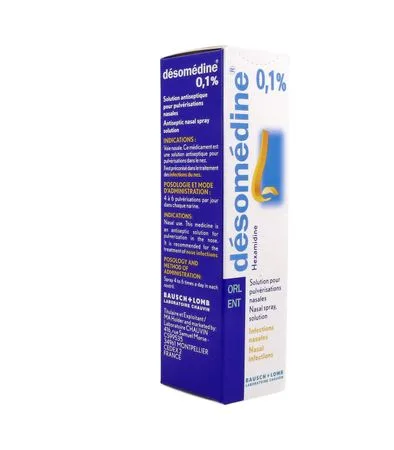
DESOMEDINE 0,1 %, solution for nasal spray
Composition
For 100 mL of solution:
Hexamidine diisethionate: 100,0 mg
Excipients with known effect: boric acid, borax.
This medicine contains 1,713 mg of boric acid and 0,027 mg of borax per spray, which is equivalent to 0,30 mg of Boron per spray.
Sodium chloride, boric acid, borax, water for injections.
Dosage and administration
Dosage
4 to 6 sprays per day in each nostril.
Paediatric population
There is no justified use of DESOMEDINE 0,1 %, solution for nasal spray in the paediatric population.
Contraindications
Hypersensitivity to the active substance or to any of the excipients listed in section Composition.
Warnings and precautions
Special warnings
Risk of allergy.
Risk of selection of resistant strains.
Precautions for use
The usual treatment will not exceed 10 days; beyond that, the course of action should be re-evaluated.
Hexamidine, like all cationic agents, is incompatible with anionic agents.
Paediatric population
Due to the presence of boron, this medicine must not be administered to a child under 12 years of age, as it may harm their future fertility (see section Fertility, pregnancy and breastfeeding).
Interactions
Combinations not recommended
Given possible drug interactions (antagonism, inactivation), particularly with anionic compounds, the simultaneous or successive use of other antiseptics is not recommended.
Fertility, pregnancy and breastfeeding
Pregnancy
There are limited data on the use of hexamidine diisethionate in pregnant women.
When this medicine is used nasally, negligible exposure to hexamidine is expected. DESOMEDINE 0,1 % solution for nasal spray may be used during pregnancy.
Breast-feeding
It is not known whether hexamidine diisethionate and/or its metabolites are excreted in human milk.
Given its physicochemical properties and nasal administration, negligible passage into breast milk is expected. Therefore, DESOMEDINE 0,1 % solution for nasal spray may be used during breast-feeding.
Fertility
There is no data on the effects of hexamidine on fertility in animals and in humans. However, due to the presence of boron, this medicine must not be administered to a child under 12 years of age, as it may harm their future fertility (see section Warnings and precautions).
Driving and using machines
No impact of DESOMEDINE 0,1 %, nasal spray solution on the ability to drive vehicles and use machines is expected.
Adverse effects
- Possibility of local irritation occurring
- Risk of sensitisation.
Reporting of suspected adverse reactions
Reporting suspected adverse reactions after authorisation of the medicinal product is important. It allows continued monitoring of the benefit/risk balance of the medicinal product. Healthcare professionals are asked to report any suspected adverse reactions via the national reporting system: National Agency for the Safety of Medicines and Health Products (ANSM) and the network of Regional Pharmacovigilance Centres - Website: https://signalement.social-sante.gouv.fr/.
Overdose
In case of overdose (excessive repeated use), symptoms may include tingling, irritation or burning in the nose. Nasal irrigation with physiological saline is recommended.
Pharmacodynamics
Pharmacotherapeutic class: Antiseptic, ATC code: S03AA05.
Hexamidine (belonging to the diamidine family) is a cationic antibacterial agent and has surfactant properties.
In vitro, its activity is exerted on Gram-positive bacteria and is not inhibited by pus, serum or organic debris.
Special storage precautions
Store at a temperature not exceeding 25 °C.
This medicine must not be kept more than 30 days after opening the bottle.
Write the opening date clearly on the packaging.
SPECIAL PRECAUTIONS FOR DISPOSAL AND OTHER HANDLING
No special requirements.
Any unused medicinal product or waste material should be disposed of in accordance with local requirements.
Prescription, supply and reimbursement
| Marketing authorisation (AMM) |
|
CHAUVIN Laboratory
416, rue Samuel-Morse. CS 99535. 34961 Montpellier
Tel: 04 67 12 30 30
Source: VIDAL · Updated on 10/11/2026. This information does not replace advice from a healthcare professional.