
Medicines
SmPC of 21/10/2022
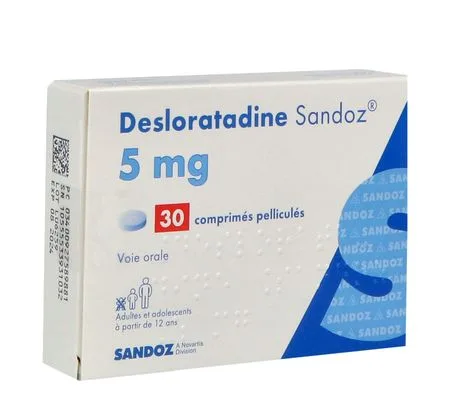
DESLORATADINE SANDOZ 5 mg, film-coated tablet
Forms and presentations
Film-coated tablet.
Light blue, round, biconvex film-coated tablet, engraved "5" on one side.
Diameter 6,50 ± 0,10 mm.
Composition
Each tablet contains 5 mg of desloratadine.
Core:
Maize starch, microcrystalline cellulose, hypromellose, anhydrous colloidal silica, hydrogenated vegetable oil (type 1).
Coating:
Opadry blue 03B50689 (hypromellose E464, titanium dioxide E171, macrogol 400 E1521, indigotine (E132)).
Indications
DESLORATADINE SANDOZ is indicated in adults and adolescents aged 12 years and older for the symptomatic treatment of:
- allergic rhinitis (see section Pharmacodynamics),
- urticaria (see section Pharmacodynamics).
Dosage and administration
Dosage
Adults and adolescents (aged 12 years and older)
The recommended dose of DESLORATADINE SANDOZ is one tablet once a day.
Treatment modalities for intermittent allergic rhinitis (presence of symptoms for less than 4 days per week or for a period of less than 4 weeks) should take into account the course of the symptoms, with treatment possibly being discontinued after symptoms disappear and restarted when they recur.
For persistent allergic rhinitis (presence of symptoms for 4 days or more per week and for more than 4 weeks), continuous treatment may be proposed to patients during periods of allergen exposure.
Paediatric population
In adolescents aged 12 to 17 years, experience with the use of desloratadine in clinical efficacy studies is limited (see sections Adverse effects and Pharmacodynamics).
The safety and efficacy of DESLORATADINE SANDOZ 5 mg film-coated tablets have not been established in children aged less than 12 years. No data are available.
Method of administration
Oral use.
The tablet may be taken at the time of or away from meals.
Contraindications
Hypersensitivity to the active substance or to any of the excipients listed in section Composition or to loratadine.
Warnings and precautions
Convulsions
Desloratadine should be administered with caution to patients with a personal or family history of convulsions, and particularly in young children (see section Adverse effects) who are prone to the occurrence of first-time convulsive seizures during treatment with desloratadine. Discontinuation of desloratadine administration by healthcare professionals should be considered in case of a convulsive seizure during treatment.
Desloratadine should be used with caution in cases of severe renal impairment (see section Pharmacokinetics).
Interactions
In clinical trials carried out with desloratadine tablets, in which patients received erythromycin or ketoconazole in combination, no clinically significant interaction was observed (see section Pharmacodynamics).
Paediatric population
Interaction studies were only carried out in adults.
In a clinical pharmacology study, no potentiation of the detrimental effects of alcohol on performance tests was demonstrated when combined with DESLORATADINE SANDOZ tablets (see section Pharmacodynamics). However, cases of alcohol intolerance and intoxication have been reported since marketing. Therefore, caution is recommended in case of concomitant alcohol intake.
Fertility, pregnancy and breastfeeding
Pregnancy
In a large number of pregnancies (more than 1 000 pregnancies), no malformative or toxic effect of desloratadine has been demonstrated for the fetus or newborn. Animal studies have not demonstrated direct or indirect harmful effects on reproduction (see section Preclinical safety). As a precaution, it is preferable to avoid the use of desloratadine during pregnancy.
Breast-feeding
Desloratadine has been identified in breastfed newborns/infants of treated women. The effect of desloratadine on newborns/infants is unknown. A decision must be made either to discontinue breastfeeding or to discontinue/abstain from treatment with desloratadine, taking into account the benefit of breastfeeding for the child relative to the benefit of treatment for the woman.
Fertility
No data are available to document the impact on fertility in humans.
Driving and using machines
Based on available clinical studies, desloratadine has a negligible, if not non-existent, effect on the ability to drive vehicles and use machines. Patients should be informed that although most people do not feel drowsiness, there is inter-individual variability. Consequently, patients should be advised to test their response to this medicine before any activity requiring vigilance, such as driving vehicles or using machines.
Adverse effects
Summary of the safety profile
In clinical trials conducted in the various indications, such as allergic rhinitis and chronic idiopathic urticaria, at the recommended dose of 5 mg per day, adverse reactions with desloratadine were reported in 3 % more patients than those treated with placebo. The most frequently reported adverse reactions with an incidence higher than placebo were: fatigue (1,2 %), dry mouth (0,8 %) and headache (0,6 %).
Paediatric population
In a clinical study conducted in 578 adolescent patients, aged 12 to 17 years, the most frequent adverse reaction was headache; it occurred in 5,9 % of patients treated with desloratadine and in 6,9 % of patients receiving placebo.
Tabulated summary of adverse reactions
The frequency of adverse effects reported in clinical trials with an incidence higher than placebo and other adverse effects reported since marketing are listed in the following table. Frequencies are defined as: very common (≥ 1/10), common (≥ 1/100 to < 1/10), uncommon (≥ 1/1 000 to < 1/100), rare (≥ 1/10 000 to < 1/1 000), very rare (< 1/10 000) and not known (cannot be estimated from the available data).
|
System Organ Classes |
Frequency |
Adverse effects reported with desloratadine |
|
Metabolism and nutrition disorders |
Frequency not known |
Increased appetite |
|
Psychiatric disorders |
Very rare Frequency not known |
Hallucinations Behavioural abnormality, aggressiveness, depressed mood |
|
Nervous system disorders |
Common Very rare |
Headache Vertigo, somnolence, insomnia, psychomotor hyperactivity, convulsions |
|
Visual disorders |
Frequency not known |
Dry eye |
|
Cardiac disorders |
Very rare Frequency not known |
Tachycardia, palpitations Prolongation of the QT interval |
|
Gastrointestinal disorders |
Common Very rare |
Dry mouth Abdominal pain, nausea, vomiting, dyspepsia, diarrhoea |
|
Hepatobiliary disorders |
Very rare |
Increases in liver enzymes, increased bilirubin, hepatitis |
|
|
Frequency not known |
Jaundice |
|
Skin and subcutaneous tissue disorders |
Frequency not known |
Photosensitivity |
|
Musculoskeletal and systemic disorders |
Very rare |
Myalgia |
|
General disorders and administration site conditions |
Common Very rare |
Fatigue Hypersensitivity reactions (such as anaphylaxis, angioedema, dyspnoea, pruritus, rash and urticaria) |
|
|
Frequency not known |
Asthenia |
|
Investigations |
Frequency not known |
Weight gain |
Paediatric population
Other adverse reactions reported since marketing with an unknown frequency in the paediatric population include QT interval prolongation, arrhythmia, bradycardia, behavioural abnormalities, aggression, weight gain and increased appetite.
A retrospective observational safety study showed an increased frequency of first-episode convulsive seizures in patients aged 0 to 19 years treated with desloratadine compared with periods without desloratadine. In children aged 0 to 4 years, the absolute increase was 37,5 per 100 000 patient-years (confidence interval (CI) at 95% 10,5-64,5) for a usual rate of first-episode seizures of 80,3 per 100 000 patient-years.
In patients aged 5 to 19 years, the absolute increase was 11,3 per 100 000 patient-years (CI 95% 2,3-20,2) for a usual rate of 36,4 per 100 000 patient-years (see section Warnings and precautions).
Reporting of suspected adverse reactions
Reporting suspected adverse reactions after authorisation of the medicinal product is important. It allows continued monitoring of the benefit/risk balance of the medicinal product. Healthcare professionals are asked to report any suspected adverse reaction via the national reporting system: National Agency for the Safety of Medicines and Health Products (ANSM) and the network of Regional Centres of Pharmacovigilance - Website: www.signalement-sante.gouv.fr.
Overdose
The safety profile observed since marketing in cases of overdose is similar to that observed at therapeutic doses, but the adverse reactions may be of greater intensity.
Treatment
In case of overdose, elimination by the usual methods of the unabsorbed active substance should be considered. Symptomatic treatment and appropriate therapeutic measures are recommended.
Desloratadine is not removed by haemodialysis; it is not known whether it is removed by peritoneal dialysis.
Symptoms
In a repeated-dose clinical trial, no clinically significant effect was observed when desloratadine was administered at doses up to 45 mg (nine times the therapeutic dose).
Paediatric population
The safety profile observed since marketing in cases of overdose is similar to that observed at therapeutic doses, but the adverse reactions may be of greater intensity.
Pharmacodynamics
Pharmacotherapeutic class: Anti-H antihistamines1, ATC code: R06A X27.
Mechanism of action
Desloratadine is a non-sedating, long-acting antihistamine exerting a selective antagonist effect on peripheral H1 receptors. After oral administration, desloratadine selectively blocks peripheral H1 histamine receptors because it does not diffuse into the central nervous system.
The antiallergic properties of desloratadine have been demonstrated from studies in vitro. An inhibition of the release of pro-inflammatory cytokines such as: IL-4, IL-6, IL-8, and IL-13 by human mast cells/basophils, as well as an inhibition of the expression of the adhesion molecule P-selectin on endothelial cells, has been demonstrated. The clinical relevance of these observations remains to be confirmed.
Clinical efficacy and safety data
In a repeated-dose clinical trial, in which up to 20 mg per day of desloratadine were administered for 14 days, no statistically or clinically significant cardiovascular effect was observed. In a clinical pharmacology trial, in which desloratadine was administered at a dose of 45 mg per day (nine times the therapeutic dose) for ten days, no prolongation of the QT interval was observed.
Repeated-dose interaction studies with ketoconazole and erythromycin did not show any clinically significant changes in plasma concentrations of desloratadine.
Desloratadine does not diffuse readily into the central nervous system. In controlled clinical studies, at the recommended dose of 5 mg per day, there was no increase in the incidence of somnolence compared with placebo. Desloratadine administered once daily at the single dose of 7,5 mg did not impair psychomotor performance during clinical trials. In a single-dose study performed in adults, desloratadine 5 mg did not modify standard measures of performance during aircraft flight, including the exacerbation of subjective sleepiness or piloting activities of an aircraft.
During clinical pharmacology trials, concomitant administration with alcohol did not increase the somnolence or performance impairment induced by alcohol. No significant difference was demonstrated between groups of subjects treated with desloratadine and those receiving placebo during psychomotor tests, whether the product was administered alone or in combination with alcohol.
In patients with allergic rhinitis, desloratadine relieved symptoms such as sneezing, nasal discharge and pruritus, but also ocular pruritus, tearing and redness, and palatal pruritus. Desloratadine adequately controlled symptoms throughout the entire nychthemeron.
Paediatric population
The efficacy of desloratadine tablets has not been clearly demonstrated in studies conducted in adolescent patients aged 12 to 17 years.
In addition to the established classifications of seasonal and perennial allergic rhinitis, allergic rhinitis may also be classified as intermittent allergic rhinitis and persistent allergic rhinitis according to the duration of symptoms. Intermittent allergic rhinitis is defined by the presence of symptoms for less than 4 days per week or for less than 4 weeks. Persistent allergic rhinitis is defined by the presence of symptoms for 4 days or more per week and for more than 4 weeks.
Desloratadine reduced the disabling nature of seasonal allergic rhinitis, as shown by the total score of the quality-of-life questionnaire in rhinoconjunctivitis. The greatest improvement was observed in the domain of practical problems and daily activities limited by symptoms.
Chronic idiopathic urticaria has been studied as a clinical model of urticarial manifestations, since the underlying pathophysiology is similar, regardless of etiology, and because chronic patients can be recruited more easily prospectively. Histamine release being a factor responsible for all urticarial conditions, desloratadine is expected to be effective in relieving symptoms of other urticarial manifestations, in addition to chronic idiopathic urticaria, as recommended in clinical guidelines.
In two six-week placebo-controlled trials in patients with chronic idiopathic urticaria, desloratadine was shown to be effective in relieving pruritus and in reducing the number and size of urticarial lesions from the end of the first dose. In each trial, the effects were maintained throughout the nychthemeron. As in other trials of antihistamines in chronic idiopathic urticaria, the few patients identified as non-responders to antihistamines were excluded. A decrease in pruritus of more than 50% was observed in 55% of patients treated with desloratadine versus 19% of patients treated with placebo. Treatment with desloratadine also significantly reduced interference with sleep and daily activity, parameters assessed on a four-point scale.
Pharmacokinetics
Absorption
Plasma desloratadine levels can be detected within 30 minutes after administration. Desloratadine is well absorbed, with a maximum concentration reached after approximately 3 hours; the terminal phase half-life is approximately 27 hours. The accumulation factor of desloratadine corresponds to its half-life (approximately 27 hours) and its once-daily dosing schedule. The bioavailability of desloratadine is dose-dependent over a range of 5 mg to 20 mg.
In a pharmacokinetic trial in which the demographic characteristics of patients were comparable to those of the general population likely to present with seasonal allergic rhinitis, 4% of subjects presented a higher concentration of desloratadine. This percentage may vary according to ethnic origin. The maximum concentration of desloratadine observed around the 7th hour was approximately 3 times higher and the terminal-phase half-life was approximately 89 hours. The safety profile of the product observed in these subjects was not different from that of the general population.
Distribution
Desloratadine is moderately bound (83% - 87%) to plasma proteins. After once-daily administration of desloratadine (5 mg to 20 mg) for 14 days, no clinical findings suggested accumulation of the product.
Biotransformation
The enzyme involved in the metabolism of desloratadine has not yet been identified and, therefore, the risk of interaction with other medicinal products cannot be totally excluded. In vivo, desloratadine does not inhibit cytochrome P3A4 and studies in vitro have shown that the active substance does not inhibit cytochrome P2D6 and that it is neither a substrate nor an inhibitor of P-glycoprotein.
Elimination
In a clinical trial conducted with a single dose of 7,5 mg of desloratadine, the fate of desloratadine was not modified by food (high-calorie, high-fat breakfast). In another trial, grapefruit juice did not modify the fate of desloratadine.
Renal impairment
The pharmacokinetic parameters of desloratadine in patients with chronic renal failure (CRF) and in healthy subjects were compared in a single-dose study and in a repeated-dose study. In the single-dose study, systemic exposure to desloratadine was approximately 2 and 2,5 times higher in subjects with mild to moderate CRF and severe CRF, respectively, than in healthy subjects. In the repeated-dose study, steady state was reached after the 11th day, and exposure to desloratadine was approximately 1,5 times higher in subjects with mild to moderate CRF and approximately 2,5 times higher in subjects with severe CRF than in healthy subjects. In both studies, the variations in systemic exposure (AUC and Cmax) to desloratadine and to 3-hydroxydesloratadine were not clinically significant.
Preclinical safety
Desloratadine is the main active metabolite of loratadine. Non-clinical studies conducted with desloratadine and loratadine demonstrated that there was no qualitative or quantitative difference in the toxicity profile of desloratadine and loratadine at comparable levels of desloratadine exposure.
Non-clinical data from conventional safety pharmacology, repeated-dose toxicity, genotoxicity, carcinogenesis, and reproductive and developmental function studies did not reveal any particular risk for humans. The absence of carcinogenic potential was demonstrated in studies conducted with desloratadine and loratadine.
Prescription, supply and reimbursement
| Marketing authorisation (AMM) |
|
| Price: |
|
- Indication(s) listed in the marketing authorisation at the date of publication of this order (OPA/Alu/PVC/15 blister, OPA/Alu/PVC/30 blister)
Collection.
9 PLACE MARIE-JEANNE BASSOT
92300 LEVALLOIS-PERRET
Tel: 01 49 64 48 00 Tel (Green number): 0800 455 799
serviceclient.pharmacie@sc-sandoz.com
https://www.sandoz.fr/contactez-nous/
Source: VIDAL · Updated on 10/11/2026. This information does not replace advice from a healthcare professional.