
Medicines
SmPC of the 20/07/2026
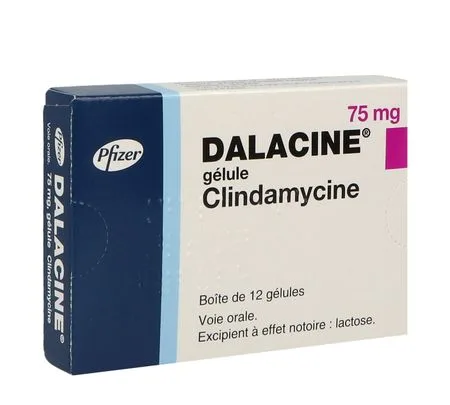
DALACINE 75 mg, capsule
Composition
Clindamycin base .................................................................................................................................75,00 mg
As clindamycin hydrochloride hydrate
For one capsule.
Excipient with known effect: lactose.
Maize starch, talc, magnesium stearate, lactose.
Composition of the capsule shell : gelatin, indigotine, quinoline yellow (E104), titanium dioxide (E171).
Indications
They derive from the antibacterial activity and pharmacokinetic characteristics of clindamycin. They take into account both the clinical studies conducted with the medicinal product and its place among the antibacterial products currently available.
For curative use
They are limited to severe infections, due to germs defined as susceptible, in their manifestations:
• ENT,
• bronchopulmonary,
• stomatological,
• cutaneous,
• genital,
• osteoarticular,
• postoperative intra-abdominal,
• septicemic,
with the exception of meningeal infections, even with susceptible germs, due to insufficient diffusion of this antibiotic into the CSF.
For prophylaxis
Prophylaxis of infective endocarditis during dental care and procedures involving the upper airways during outpatient care in case of allergy to beta-lactams.
Official recommendations concerning the appropriate use of antibacterial agents should be taken into account.
Dosage and administration
Dosage
Curative treatment:
Adults: 600 to 2400 mg/24 hours, in 2, 3 or 4 doses.
Prophylactic treatment:
Adults: 600 mg per os within the hour preceding the procedure.
Paediatric population
DALACINE capsules are not suitable for children who are unable to swallow them whole.
Use of the capsules may not be appropriate for providing the exact doses required in mg/kg for the treatment of children.
Clindamycin dosage in children is to be adjusted according to total body weight, regardless of obesity.
Curative treatment:
Children over 6 years: 8 to 25 mg/kg/24 hours, in 3 to 4 doses.
Prophylactic treatment:
Children over 6 years: 15 mg/kg per os within the hour preceding the procedure.
Method of administration
Capsules must be taken whole, swallowed with a large glass of water. Administration must be taken in an upright position (standing or sitting), without lying down for at least 30 minutes after administration.
The absorption of clindamycin is essentially not modified by concomitant food intake.
Contraindications
This medicine must never be used:
• in case of hypersensitivity to the active substance, as well as to lincomycin or to any of the excipients mentioned in section Composition
• in children under 6 years, due to the pharmaceutical form,
• in case of breastfeeding (see section Fertility, pregnancy and breastfeeding).
Warnings and precautions
Antibiotic-associated colitis
Pseudomembranous colitis and antibiotic-associated colitis have been observed with virtually all antibacterial agents, including clindamycin (see section Adverse effects); their severity varies from mild to life-threatening. Consequently, it is important to consider this diagnosis if diarrhoea occurs during or after administration of any antibiotic. If antibiotic-associated colitis occurs, clindamycin must be stopped immediately; a physician must be consulted and appropriate treatment, including specific treatment against Clostridium difficile must be initiated. Medicinal products that inhibit peristalsis are contraindicated in this situation.
Hypersensitivity
Severe hypersensitivity reactions, including Kounis syndrome, and severe cutaneous reactions, such as drug reaction with eosinophilia and systemic symptoms (DRESS), Stevens-Johnson syndrome (SJS), toxic epidermal necrolysis (Lyell syndrome) and acute generalised exanthematous pustulosis (AGEP), have been reported in patients receiving clindamycin treatment.
Kounis syndrome has been defined as cardiovascular symptoms secondary to an allergic or hypersensitivity reaction associated with constriction of the coronary arteries and potentially leading to myocardial infarction.
If any of these severe hypersensitivity reactions occurs, clindamycin must be stopped and appropriate treatment must be initiated (see sections Contraindications and Adverse effects).
Clindamycin is to be used with caution in patients with a history of asthma or other allergies.
The occurrence, at the start of treatment, of a generalised febrile erythema associated with pustules should raise suspicion of acute generalised exanthematous pustulosis (see section Adverse effects); it requires discontinuation of treatment and contraindicates any further administration of clindamycin.
Hepatic impairment
An increase in serum levels and a prolongation of the elimination half-life of clindamycin have been documented in patients with hepatic impairment.
In case of prolonged treatment, liver function and kidney function tests must be performed.
Cases of acute kidney injury, including acute renal failure, have rarely been reported. In patients with pre-existing renal impairment or taking concomitant nephrotoxic treatments, monitoring of renal function should be considered (see section Adverse effects).
Long-term treatment
Long-term treatments should only be carried out under monitoring of the blood count, liver enzymes and renal function.
Administration of antibiotics, particularly in cases of prolonged use, is associated with the emergence and selection of bacteria with decreased susceptibility or with the development of fungi. In case of superinfection, appropriate treatment must be initiated.
This medicinal product must not be used in the treatment of meningitis because clindamycin does not diffuse sufficiently into the cerebrospinal fluid (see section Indications).
Oesophageal lesions
Due to the risk of oesophageal lesions, it is important to ensure that the administration conditions are respected (see sections Dosage and administration and Adverse effects).
Excipients
This medicine contains lactose. Patients with galactose intolerance, total lactase deficiency or glucose-galactose malabsorption syndrome (rare hereditary diseases) must not take this medicine.
Interactions
Associations requiring precautions for use
+ Vitamin K antagonists
Increased effect of the vitamin K antagonist and risk of bleeding.
More frequent monitoring of INR. Possible adjustment of the vitamin K antagonist dosage during treatment with clindamycin and after its discontinuation. and after its discontinuation.
+ Gastrointestinal topicals, antacids and adsorbents
Gastrointestinal topicals, charcoal and antacids (aluminium, calcium and magnesium salts), with or without alginates, reduce the digestive absorption of certain other medicinal products taken concomitantly. Medicinal products for which a reduction in digestive absorption has been demonstrated include acetylsalicylic acid, H2 antihistamines and lansoprazole, bisphosphonates, cation exchange resins, certain classes of antibiotics (fluoroquinolones, tetracyclines, lincosamides) and certain antituberculosis agents, digitalis glycosides, glucocorticoids, thyroid hormones, phenothiazine neuroleptics, sulpiride, certain beta-blockers, penicillamine, ions (iron, phosphorus, fluoride), chloroquine, ulipristal, fexofenadine.
As a precaution, these topicals or antacids should be taken apart from any other medication (more than 2 hours apart, if possible).
+ Ciclosporin
Decreased blood concentrations of the immunosuppressant with risk of loss of immunosuppressive activity. Reinforced monitoring of ciclosporin blood levels and possible increase in its dose.
+ Cytochrome P450 (CYP) inducer 3A4
Clindamycin is mainly metabolised by CYP3A4 and, to a lesser extent, by CYP3A5, to form the major metabolite clindamycin sulfoxide as well as the minor metabolite N-desmethylclindamycin. Therefore, inhibitors of CYP3A4 and CYP3A5 may reduce the clearance of clindamycin, and inducers of these isoenzymes may increase the clearance of clindamycin. In the presence of potent inducers of CYP3A4 such as rifampicin, monitoring for loss of efficacy is necessary.
Studies in vitro indicate that clindamycin does not inhibit CYP1A2, CYP2C9, CYP2C19, CYP2E1 or CYP2D6 and only moderately inhibits CYP3A4. Consequently, clinically significant interactions between clindamycin and co-administered medicinal products metabolised by these cytochromes are unlikely.
+ Tacrolimus
Decreased blood concentrations of the immunosuppressant with risk of loss of immunosuppressive activity. Reinforced monitoring of tacrolimus blood levels and possible increase in its dose.
Specific problems with INR imbalance
Numerous cases of increased vitamin K antagonist activity have been reported in patients receiving antibiotics. A marked infectious or inflammatory context, age and general condition of the patient appear to be risk factors. In these circumstances, it is difficult to distinguish between the infectious disease and its treatment in the occurrence of the INR imbalance. However, certain classes of antibiotics are more frequently implicated: these include fluoroquinolones, macrolides, tetracyclines, cotrimoxazole and certain cephalosporins.
Fertility, pregnancy and breastfeeding
Pregnancy
In embryo-foetal development studies performed (see section Preclinical safety), no toxicity on development has been observed except at doses producing toxicity in the mother.
Clindamycin crosses the placenta.
Data on exposure to clindamycin by systemic or topical route in pregnant women in the first trimester of pregnancy are limited.
Available data on exposure during the second and third trimesters are numerous and no increase in fetal risk has been reported.
Thus, given the available data, as a precaution it is preferable to avoid using clindamycin during the first trimester of pregnancy.
During the second and third trimester of pregnancy, clindamycin may be used if necessary.
Breast-feeding
The passage of clindamycin into breast milk is low and the quantities ingested are far below paediatric therapeutic doses after systemic use.
Consequently, breastfeeding is possible when taking this antibiotic. However, reconsider continuing breastfeeding (or review the medicine) if diarrhoea, blood in the stools, candidiasis or a skin rash occurs in the infant.
Fertility
Fertility studies conducted in rats receiving clindamycin showed no effect on fertility or reproductive capacity.
Driving and using machines
DALACINE has no or negligible effect on the ability to drive vehicles and use machines.
Adverse effects
The table below lists the adverse effects identified during clinical trials and post-marketing surveillance, by system organ class and frequency.
By system organ class, adverse effects are listed below in order of frequency, then by clinical importance, using the following categories: very common (≥1/10); common (≥1/100 to <1/10); uncommon (≥1/1 000 to <1/100); rare (≥1/10 000 to <1/1 000); very rare (<1/10 000); frequency not known (cannot be estimated from the available data).
|
System organ class |
Common ≥1/100 to <1/10 |
Uncommon ≥1/1 000 to <1/100 |
Rare ≥1/10 000 to <1/1 000 |
Very rare <1/10 000 |
Not known (frequency cannot be estimated from the available data) |
|
Infections and infestations |
Pseudomembranous colitis*# |
|
|
|
Colitis at Clostridium difficile#, Vaginal infection# |
|
Blood and lymphatic system disorders |
|
|
|
|
Agranulocytosis#, Neutropenia#, Thrombocytopenia#, Leukopenia#, Eosinophilia, Thrombocytopenic purpura
|
|
Immune system disorders |
|
|
|
|
Anaphylactic shock#, Anaphylactic reaction#, Hypersensitivity reactions such as Quincke's edema and anaphylaxis in some patients allergic to penicillin# |
|
Nervous system disorders |
|
|
|
|
Dysgeusia |
|
Cardiac disorders |
|
|
|
|
Kounis syndrome# |
|
Gastrointestinal disorders |
Diarrhoea, Abdominal pain |
Vomiting, Nausea |
|
|
Oesophageal ulcer#,§, Esophagitis#,§ |
|
Hepatobiliary disorders |
|
|
|
|
Jaundice# |
|
Skin and subcutaneous tissue disorders |
|
Maculopapular rash, Urticaria |
|
|
Toxic epidermal necrolysis (Lyell syndrome)#, Stevens-Johnson syndrome (SJS)#, DRESS syndrome (drug reaction with eosinophilia and systemic symptoms)#, Acute generalised exanthematous pustulosis (AGEP)#,
Exfoliative dermatitis#, Bullous dermatosis#, Cutaneous vasculitis#, Erythema multiforme, Pruritus, Morbilliform eruption#, Symmetrical drug-related intertriginous and flexural exanthema# |
|
Renal and urinary disorders |
|
|
|
|
Acute kidney injury* |
|
Investigations |
Abnormal liver function tests |
|
|
|
|
* see section Warnings and precautions
# post-marketing data
§ Possible occurrence of esophagitis and esophageal ulcerations, particularly favored by taking the medicine in a lying position and/or with a small amount of water.
Reporting of suspected adverse reactions
Reporting suspected adverse reactions after authorisation of the medicinal product is important. It allows continued monitoring of the benefit/risk balance of the medicinal product. Healthcare professionals are asked to report any suspected adverse reaction via the national reporting system: National Agency for the Safety of Medicines and Health Products (ANSM) and the network of Regional Centres of Pharmacovigilance - Website: https://signalement.social-sante.gouv.fr/.
Pharmacodynamics
Pharmacotherapeutic class: Lincosamides, ATC code: J01FF01.
Clindamycin is an antibiotic of the lincosamide family.
Mechanism of action
Clindamycin inhibits bacterial protein synthesis by binding to the 50S subunit of the bacterial ribosome. At usual doses, clindamycin has bacteriostatic activity in vitro.
Pharmacokinetic-pharmacodynamic relationship
The percentage of time during which the antibiotic concentration remains above the minimum inhibitory concentration (MIC) of the bacterium between two administrations (%T>MIC) is the parameter most predictive of clindamycin efficacy.
Resistance
Resistance to clindamycin is most often due to mutations at the antibiotic's binding site on the rRNA or to methylation of specific nucleotides of the 23S RNA of the 50S ribosomal subunit. These alterations may result in cross-resistance in vitro to macrolides and to streptogramin B (MLS phenotypeB).
Resistance mechanisms may be due to active efflux.
Resistance to clindamycin may be inducible by macrolides in bacterial strains resistant to macrolides.
There is complete cross-resistance between clindamycin and lincomycin.
The incidence of clindamycin resistance is higher among methicillin-resistant staphylococcal strains and penicillin-less-susceptible pneumococcal strains.
Critical concentrations
The critical concentrations or minimum inhibitory concentration (MIC) breakpoints from which the susceptibility of the bacterial strain is interpreted are established by the European Committee on Antimicrobial Susceptibility Testing (EUCAST) for clindamycin and are as follows: https://www.ema.europa.eu/documents/other/minimum-inhibitory-concentration-mic-breakpoints_en.xlsx
Antibacterial activity spectrum
The prevalence of acquired resistance may vary by geography and over time for certain species. It is therefore useful to have information on local resistance prevalence, especially for the treatment of severe infections. If necessary, specialist advice should be sought, mainly when the usefulness of the drug in certain infections may be called into question because of the level of local resistance prevalence.
|
Classes |
|
USUALLY SUSCEPTIBLE SPECIES |
|
Gram-positive aerobes |
|
Bacillus cereus |
|
Corynebacterium diphtheriae |
|
Staphylococcus spp. methicillin-sensitive |
|
Streptococcus agalactiae |
|
Gram-negative aerobes |
|
Campylobacter |
|
Anaerobes |
|
Actinomyces |
|
Capnocytophaga |
|
Clostridium perfringens |
|
Eubacterium |
|
Fusobacterium |
|
Gardnerella vaginalis |
|
Porphyromonas |
|
Prevotella |
|
Propionibacterium acnes |
|
Veillonella |
|
Other |
|
Chlamydia trachomatis |
|
Leptospires |
|
Mycoplasma hominis |
|
Mycoplasma pneumoniae |
|
INCONSISTENTLY SUSCEPTIBLE SPECIES |
|
(Acquired resistance ≥ 10%) |
|
Gram-positive aerobes |
|
Enterococcus faecium |
|
Erysipelothrix |
|
Staphylococcus spp. methicillin-resistant |
|
Streptococcus pneumoniae |
|
Streptococcus pyogenes |
|
Oral streptococci |
|
Anaerobes |
|
Bacteroides |
|
Clostridium (other than difficile and perfringens) |
|
Mobiluncus |
|
Peptococcus |
|
Peptostreptococcus |
|
Propionibacterium acnes |
|
NATURALLY RESISTANT SPECIES |
|
Gram-positive aerobes |
|
Corynebacterium jeikeium |
|
Enterococcus spp. (other than Enterococcus faecium) |
|
Listeria |
|
Nocardia asteroides |
|
Rhodococcus equi |
|
Gram-negative aerobes |
|
Non-fermenting Gram-negative bacilli |
|
(Acinetobacter, Pseudomonas, ...) |
|
Enterobacterales |
|
Haemophilus |
|
Legionella |
|
Branhamella catarrhalis |
|
Neisseria |
|
Pasteurella |
|
Anaerobes |
|
Clostridium difficile |
|
Other |
|
Mycobacteria |
|
Ureaplasma urealyticum |
Anti-parasitic activity
Clindamycin possesses an activity in vitro and in vivo on Toxoplasma gondii.
Pharmacokinetics
Absorption
After oral administration, clindamycin is absorbed rapidly and almost completely (90 % of the ingested dose).
Simultaneous administration of food practically does not modify the plasma concentrations obtained.
Distribution
• Serum concentration In healthy adults, a serum peak plasma concentration of the order of 2-3 mg/L is obtained one hour after oral intake of 150 mg of clindamycin hydrochloride, and 4-5 mg/L after oral administration of 300 mg. The plasma concentration then declines slowly but remains above 1 mg/L for more than 6 hours.
The plasma concentration increases linearly with the ingested dose.
In diabetics, slightly lower serum concentrations than in healthy subjects have been reported.
The mean biological half-life is 2,5 hours.
• Binding to plasma proteins:
It is significant: on the order of 80 to 94 %.
• Humoral and tissue diffusion:
Clindamycin is distributed into extracellular and intracellular fluids and reaches a very high tissue concentration.
Diffusion into the cerebrospinal fluid is very low.
Biotransformation
The metabolism of clindamycin is hepatic.
Studies in vitro Studies on human liver and intestinal microsomes indicate that clindamycin is mainly oxidised by CYP3A4, with a minor contribution from CYP3A5, to form clindamycin sulfoxide as well as a minor metabolite, N-desmethylclindamycin.
Elimination
Approximately 10% of active compounds are eliminated in the urine and 3,6% in the feces; the remainder is excreted as inactive compounds.
Serum concentrations of clindamycin are not modified by haemodialysis or peritoneal dialysis.
Obese patients
An analysis of pharmacokinetic data in obese and non-obese paediatric patients aged 2 to under 18 years and in obese and non-obese adults aged 18 to 20 years showed, based on a pharmacokinetic model, that clindamycin clearance and volume of distribution normalised by total body weight are comparable irrespective of obesity.
Preclinical safety
In oral embryo-fetal development studies in rats and in subcutaneous embryo-fetal development studies in rats and rabbits, no developmental toxicity was observed except at doses producing maternal toxicity.
Genotoxicity studies did not show any genotoxic activity. No carcinogenesis study has been carried out with clindamycin.
INCOMPATIBILITIES
There is a physicochemical incompatibility with the following medicinal products: ampicillin, phenytoin, barbiturates, aminophylline, calcium gluconate, magnesium sulfate.
Prescription, supply and reimbursement
Possible repackaging
| Marketing authorisation (AMM) |
|
| Price: |
|
Collection.
23-25 DOCTOR LANNELONGUE AVENUE
75668 PARIS CEDEX 14
Tel: 01 58 07 30 00 Toll-free tel: 07 88 77 30 29
https://www.pfizer.fr/
Source: VIDAL · Updated on 10/11/2026. This information does not replace advice from a healthcare professional.