
Medicines
SmPC of 08/04/2026
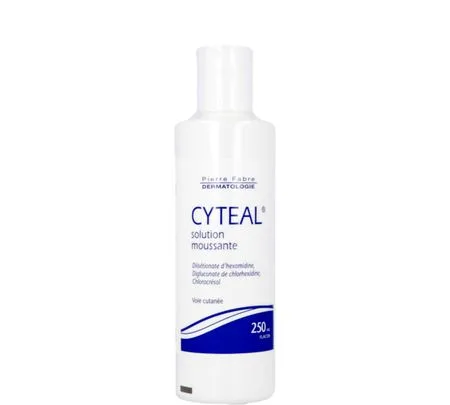
CYTEAL, foaming solution
Forms and presentations
Foaming solution for cutaneous application.
Pale yellow viscous solution. Foams when shaken.
Composition
Hexamidine diisethionate............................................................................................................................0,10 g
Chlorhexidine digluconate (20 % m/v solution)..............................................................................0,50 ml
Chlorocresol...................................................................................................................................................0,30 g
For 100 ml of foaming solution.
Excipients with known effect:
Fragrance containing the following allergens: anise alcohol, benzyl alcohol, benzyl benzoate, cinnamyl alcohol, citral, coumarin, limonene, eugenol, geraniol, linalool, oakmoss.
Cocamidopropyl betaine, coconut fatty acid diethanolamide, edetic acid, coniferol* fragrance, lactic acid, purified water.
* composition of coniferol fragrance: Galbanum resinoid, Elemi resinoid, Pimenta racemosa essential oil, isobornyl acetate, 2-methylundecanal.
Fragrance containing the following allergens: anise alcohol, benzyl alcohol, benzyl benzoate, cinnamyl alcohol, citral, coumarin, limonene, eugenol, geraniol, linalool, oakmoss.
Indications
CYTEAL is indicated in premature infants, newborns, infants, children, adolescents and adults for cleansing of skin and mucosal conditions that are primarily bacterial or likely to become superinfected.
Note: Antiseptic agents are not sterilizing. They temporarily reduce the number of microorganisms.
Dosage and administration
Dosage
One to two applications per day for 7 to 10 days.
This product is used like a liquid soap for external use: neat or diluted to 1/10 with water.
Method of administration
Treated areas must always be rinsed thoroughly with water after use.
Undiluted: CYTEAL is used neat by painting onto limited lesions. Apply then rinse thoroughly with water.
Diluted: CYTEAL is used diluted in the bath or shower, as a wash or soak like a liquid soap, on infected skin lesions. Then rinse thoroughly with water.
The diluted solution must not be stored but must be used immediately.
EXTERNAL USE. CUTANEOUS ROUTE. DO NOT INJECT. DO NOT SWALLOW.
Contraindications
• Hypersensitivity to the active substances or to any of the excipients listed in section Composition.
• Do not apply in the eyes or ears.
• This product must not enter the ear canal, particularly in cases of tympanic perforation, nor, in general, be brought into contact with nerve tissue or the meninges.
• This preparation must not be used:
- for antisepsis of healthy skin before a surgical procedure (antisepsis of the operative field and antisepsis of puncture, injection or transfusion sites),
- for disinfection of medical and surgical equipment.
Warnings and precautions
Special warnings
As with all detergent substances, rinse the treated area thoroughly after use.
In the absence of data on transcutaneous absorption, the risk of systemic effects cannot be excluded. They are favoured by repeated applications and are all the more to be feared when the antiseptic is used over a large area, under an occlusive dressing, on damaged skin (in particular burned skin), a mucous membrane, or the skin of a premature infant or infant (due to the surface-to-weight ratio and the occlusive effect of nappies in the diaper area).
Cases of contact dermatitis (including allergic) have been reported with hexamidine, chlorhexidine and chlorocresol, as well as with two excipients contained in the cutaneous solution (see section Adverse effects). In case of severe symptoms, CYTEAL must be discontinued and patients must consult a doctor before any further use.
Due to the presence of chlorhexidine, this medicine may cause a serious generalised allergic reaction that could occur within minutes of exposure.
CYTEAL must not come into contact with the eyes. Serious cases of persistent corneal damage, which may require corneal transplantation, have been reported following accidental ocular exposure to medicines containing chlorhexidine. During application, extreme caution should be exercised to ensure that CYTEAL is confined to the intended site of application. If CYTEAL comes into contact with the eyes, rinse promptly and thoroughly with water. Advice should be sought from an ophthalmologist.
As soon as the packaging of an antiseptic preparation is opened, microbial contamination is possible.
If the bottle is larger than 250 ml : The volume of this bottle, larger than 250 ml, carries a risk of contamination of the solution in case of prolonged use after opening.
This medicine contains perfume containing allergens (anisyl alcohol, benzyl alcohol, benzyl benzoate, cinnamyl alcohol, citral, coumarin, limonene, eugenol, geraniol, linalool, oakmoss) which may cause allergic reactions.
Interactions
No interaction studies have been performed.
Given possible interferences (antagonism, inactivation...), the simultaneous or successive use of other products for cutaneous use should be avoided. In particular, do not use at the same time as ordinary alkaline soap.
Fertility, pregnancy and breastfeeding
Pregnancy
There are no data on the use of the combination of hexamidine diisethionate, chlorhexidine digluconate and chlorocresol in pregnant women.
Studies performed in animals with CYTEAL have not shown direct or indirect harmful effects on reproduction (see section Preclinical safety).
As a precaution, it is preferable to avoid using CYTEAL during pregnancy.
Breast-feeding
No effect on the breastfed newborn/infant is expected, as the excretion of CYTEAL's active substances into breast milk is negligible.
CYTEAL may be used during breastfeeding. As a precaution, it is recommended not to apply CYTEAL to the breasts during breastfeeding.
Fertility
Studies performed in animals have not shown any effect of CYTEAL on fertility under normal conditions of use (see section Preclinical safety).
Driving and using machines
CYTEAL has no or negligible influence on the ability to drive vehicles and use machines.
Adverse effects
List of adverse effects in table form:
The adverse effects listed below are presented by MedDRA system organ class and by frequency. The frequency of adverse effects is defined as follows: very common (> 1/10), common (> 1/100, < 1/10), uncommon (> 1/1 000, < 1/100), rare (> 1/10 000, < 1/1 000), very rare (< 1/10 000), frequency not known (cannot be estimated from the available data).
Within each frequency group, adverse effects are presented in decreasing order of severity.
|
SYSTEM ORGAN CLASS'ORGANS |
MedDRA term Frequency not known |
|
Immune system disorders |
Anaphylactic shock1 Hypersensitivity
Contact dermatitis |
|
Eye disorders |
Eye irritation2 Erosion of the cornea, epithelial lesion/corneal lesion, significant permanent visual impairment3 |
|
Skin and subcutaneous tissue disorders |
Reaction at the site of application'application4
|
1 Reported with chlorhexidine.
2 Eye irritation: in case of accidental exposure.
3 Cases of severe corneal erosion and significant permanent visual impairment due to unintentional ocular exposure have been reported after marketing, which required corneal transplantation in some patients (see section Warnings and precautions).
4 Local reactions of intolerance: tingling, itching, sensation of skin burning, skin dryness, redness, particularly in case of repeated use.'Local reactions of intolerance: tingling, itching, sensation of skin burning, skin dryness, redness, particularly in case of'repeated use.
Description of selected adverse reactions
Anaphylactic shock
Risk of generalised allergy to chlorhexidine which may lead to anaphylactic shock that could be life-threatening if immediate medical care is not provided. This allergy may manifest as breathing difficulties, facial swelling, severe skin rash.
If a patient has an allergic reaction to chlorhexidine, they must immediately discontinue use of the product and consult a doctor.
Contact dermatitis
Cases of allergic contact dermatitis due to chlorocresol or chlorhexidine have been reported.
Contact eczema (risk of local allergy to chlorhexidine, particularly in case of use on damaged skin, on mucous membranes or on leg ulcers).
Contact eczema may aggravate superinfected lesions.
Contact dermatitis to hexamidine presents certain features of the Arthus phenomenon, suggesting the involvement of humoral immunological mechanisms. Hexamidine is likely to cause sensitisation. Its frequency increases with the severity of epidermal involvement. Its clinical appearance generally differs from classic contact eczema: the skin rash is often infiltrated and composed of hemispherical papular or papulo-vesicular lesions, isolated or grouped. More numerous and coalescent at the site of application of the antiseptic, these lesions then disperse into isolated elements. Their regression is often slow.
Cases of contact dermatitis probably due to cocamidopropyl betaine and coconut fatty acid diethanolamide, two excipients contained in the skin solution, have been reported after marketing (see section Warnings and precautions).
Reporting of suspected adverse reactions
Reporting suspected adverse reactions after authorisation of the medicinal product is important. It allows continued monitoring of the benefit/risk balance of the medicinal product. Healthcare professionals are asked to report any suspected adverse reaction via the national reporting system: National Agency for the Safety of Medicines and Health Products (ANSM) and the network of Regional Centres of Pharmacovigilance - Website: https://signalement.social-sante.gouv.fr/.
Overdose
Symptoms
No cases of overdose have been reported.
Management
In case of accidental ingestion, do not perform gastric lavage (foaming product).
General supportive measures should be instituted as deemed necessary by the physician.
Pharmacodynamics
Pharmacotherapeutic class: ANTISEPTICS AND DISINFECTANTS - Chlorhexidine in combination, ATC code: D08AC52.
Solution to be diluted for cutaneous or mucous membrane application, containing:
- chlorhexidine, a cationic antiseptic of the biguanide family,
- hexamidine, a cationic antiseptic of the diamidine group,
- chlorocresol of the halogenophenol family.
Antiseptic of low activity, bacteriostatic not bactericidal, trichomonacidal, partially inhibited by organic matter.
Formation of complexes with: cork, rubber and other polymers, macromolecules, anionic (soaps) and non-ionic surfactants.
Pharmacokinetics
Absorption
No formal pharmacokinetic study has been carried out with CYTEAL.
• Chlorhexidine Digluconate : due to its cationic nature, chlorhexidine binds strongly to the skin and has been shown to be very poorly absorbed through the skin.
• Hexamidine diisethionate: transcutaneous resorption of hexamidine through healthy skin is very slow.
• Chlorocresol: No data are available in humans. The literature shows that the permeability of human epidermis to many phenolic compounds may be related to octanol/water partition coefficients. Under the recommended conditions of use of CYTEAL, zero or limited absorption of chlorocresol is expected.
Penetration of the active substances into the skin is low when the therapeutic dosage is respected. The location of application, the size of the treated area, the condition of the skin (damaged or intact skin) and the duration of treatment must be taken into account (see section Warnings and precautions).
Preclinical safety
The available non-clinical data reveal no particular risk for humans under the recommendations for use, including rinsing after use, based on conventional studies of safety pharmacology, repeated-dose toxicity and local tolerance, genotoxicity, carcinogenic potential, and reproductive and developmental toxicity.
Ocular irritation, primary skin irritation and vaginal irritation studies have demonstrated that the product is irritating to the eyes and non-irritating to the skin and vaginal mucosa.
SPECIAL PRECAUTIONS FOR DISPOSAL AND OTHER HANDLING
No special requirements.
Any unused medicinal product or waste material should be disposed of in accordance with local requirements.
Prescription, supply and reimbursement
| Marketing authorisation (AMM) |
|
| Price: |
|
Bottle of 500 ml: Not reimbursed Social security.
Collection.
CHARTREUSE INDUSTRIAL PARK
81106 CASTRES CEDEX
Tel: 01 49 10 80 00 Tel (Freephone): 0 800 326 326
https://www.pierrefabremedicament.fr/
Source: VIDAL · Updated on 10/11/2026. This information does not replace advice from a healthcare professional.