
Medicines
SmPC of 25/04/2017
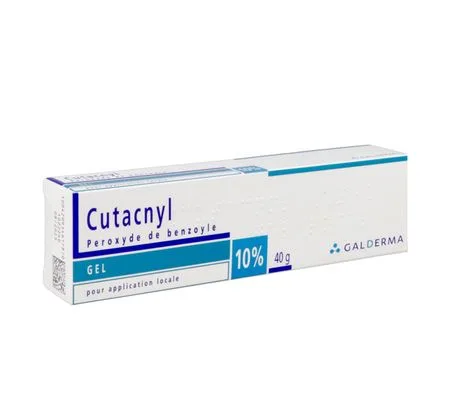
CUTACNYL 10 PERCENT, gel for topical application
Composition
Benzoyl peroxide hydrated
Quantity corresponding to anhydrous benzoyl peroxide.................................................................10 g
For 100 g of gel
Excipient with known effect: propylene glycol
Carbomer 940, disodium edetate, sodium docusate, anhydrous colloidal silica, propylene glycol, poloxamer 182, sodium hydroxide solution at 10 percent, glycerol, methacrylic copolymer, purified water.
Indications
Acne vulgaris.
Cutacnyl 2,5 % and Cutacnyl 5 % will preferably be used in the following cases:
- early acne in adolescents,
- in patients with fragile skin, particularly children, fair-haired or red-haired subjects,
- at the start of treatment, during a trial period, to ensure good tolerance of the product,
- as maintenance therapy for blanched acne.
Dosage and administration
Dosage
To be adapted according to therapeutic response and individual tolerance (see section Warnings and precautions).
In general, 1 to 2 daily applications. In patients with sensitive skin it is recommended to apply the gel 1 times per day.
1 application every 2-3 days as maintenance therapy for Cutacnyl 2,5 % and Cutacnyl 5 %.
Method of administration
Cutacnyl should be applied in a thin layer over all affected areas of skin that has been cleansed and dried. Apply Cutacnyl with light massage using the fingertips until the product is fully absorbed.
Wash hands after using the product.
Store away from heat. Avoid proximity to a flame.
Contraindications
Hypersensitivity to benzoyl peroxide or to any of the excipients mentioned in section Composition.
Warnings and precautions
For external use only.
Precise information provided to the patient may prevent premature and unjustified discontinuation of treatment.
Slight irritation is possible (mild burning sensation, redness and peeling of the skin), especially at the start of treatment. It does not indicate intolerance or allergy to the topical product as long as it remains moderate. It is nevertheless advisable to test individual sensitivity by preceding the start of treatment with a "test patch" (repeated applications to a small area of skin for 10 to 15 consecutive days).
To reduce these irritation phenomena:
- do not apply to skin already irritated by previous treatments or suffering from sunburn erythema,
- as a general rule, avoid concomitant use with other topical keratolytic or detergent therapies,
- use a mild soap bar (washing no more than twice a day), refrain from any cosmetic or other perfumed or alcohol-containing product,
- do not expose yourself repeatedly to the sun and UV rays,
- particular caution is recommended for subjects with fair skin and on certain more fragile skin areas (face, neck, décolletage, supraclavicular hollow),
- avoid contact with the eyes and eyelids, the mouth, the nostrils, the alae of the nose and the mucous membranes. In case of accidental application on mucous membranes (eyes, mouth, nostrils) or on the eyelids, rinse very thoroughly with water,
- if irritation phenomena prove troublesome, space out applications and/or use the less concentrated form,
- if troublesome irritation persists despite the precautions for use, treatment should be discontinued,
- due to the risk of sensitisation, this medicine must not be applied to damaged skin (wound, skin erosion or acute skin inflammation),
- contact of CUTACNYL 10 PER CENT with colored material (such as hair and dyed fabrics) may cause bleaching or discolouration of it,
- this medicine contains propylene glycol and may cause skin irritation.
Cutacnyl may cause skin swelling and vesicles. If this symptom occurs, treatment must be discontinued.
Interactions
The data available to date do not suggest the existence of clinically significant interactions.
Fertility, pregnancy and breastfeeding
Pregnancy
There are no published reports in animals mentioning an effect of benzoyl peroxide on reproductive functions, fertility, teratogenicity, embryotoxicity or peri- and post-natal development. The widespread use of benzoyl peroxide in acne for several decades at concentrations below 10 % has not been associated with this type of effect in humans. CUTACNYL gel should be used in pregnant women only if clearly necessary.
Breast-feeding
In the absence of data on the excretion of benzoyl peroxide into milk in animals or humans, and because many medicines are excreted into human milk, it is recommended that benzoyl peroxide be used with caution in breastfeeding women, and the preparation must not be applied to the breast to avoid any transfer of product to the newborn.
Driving and using machines
Benzoyl peroxide has no or negligible effect on the ability to drive vehicles and use machines.
Adverse effects
Adverse effects are listed by System Organ Class and by frequency using the following convention: very common (> 1/10), common (> 1/100, < 1/10), uncommon (> 1/1 000, < 1/100), rare (> 1/10 000, < 1/1 000), very rare (< 1/10 000), frequency not known (cannot be estimated from the available data).
Adverse effects are presented in the table below:
|
System organ class |
Frequency |
Adverse effects |
|
Immune system disorders |
Not known |
Allergic reactions (Hypersensitivity, anaphylactic reactions) |
|
Eye disorders |
Not known |
Eyelid oedema |
|
Skin and subcutaneous tissue disorders |
Very common |
Dry skin, erythema, desquamation (skin exfoliation), skin burning sensation |
|
Common |
Pruritus, skin irritation (irritant contact dermatitis) |
|
|
Not known |
Facial swelling, skin rash, photosensitivity, skin pain (tingling), allergic contact dermatitis |
Reporting of suspected adverse reactions
Reporting suspected adverse reactions after authorisation of the medicinal product is important. It allows continued monitoring of the benefit/risk balance of the medicinal product. Healthcare professionals are asked to report any suspected adverse reactions via the national reporting system: National Agency for the Safety of Medicines and Health Products (ANSM) and the network of Regional Pharmacovigilance Centres - Website: www.ansm.sante.fr.
Overdose
Benzoyl peroxide gel is indicated only for topical treatment. In case of excessive application of the product, no systemic effect is expected. Excessive topical application of benzoyl peroxide does not give better results or faster results but may induce severe irritation. In this case, treatment must be interrupted and symptomatic treatment instituted.
In case of accidental ingestion, appropriate symptomatic measures must be taken.
Pharmacodynamics
Pharmacotherapeutic class: ANTI-ACNE PREPARATIONS FOR TOPICAL USE, ATC code: D10AE01.
In the current state of our knowledge, the pathogenesis of acne combines several factors:
- Seborrhoeic hypersecretion (under the dependence of androgens),
- Sebum retention, due to an abnormality of keratinisation of the infrainfundibulum of the pilosebaceous follicle, leading to the formation of comedones and microcysts (essential semiological elements),
- Inflammatory reaction induced by saprophytic germs (Propionibacterium acnes, Staphylococcus epidermidis...) and certain irritating components of sebum, leading to the formation of inflammatory papules, pustules and nodules.
Benzoyl peroxide acts essentially through an antibacterial action on P. acnes, the main agent responsible for inflammatory phenomena; it is also moderately keratolytic and sebostatic.
The predominantly aqueous formula of the excipient (86 % water) reduces the risks of irritation sometimes observed at the start of treatment.
The extreme fineness of the microfine benzoyl peroxide particles gives dermal gels optimal homogeneity.
Pharmacokinetics
Benzoyl peroxide penetrates the skin where it is transformed into benzoic acid, which passes into the systemic circulation.
Preclinical safety
Non-clinical data from conventional safety pharmacology, repeated-dose toxicology, genotoxicity, carcinogenesis and reproductive function studies did not reveal any particular risk for humans.
The well-known adverse effects of benzoyl peroxide include mild to moderate irritation after dermal application and a sensitising potential after a number of exposures. Benzoyl peroxide is rapidly and completely metabolised to benzoic acid in the skin, which, after absorption, is eliminated in the urine with limited systemic exposure.
Prescription, supply and reimbursement
| Marketing authorisation (AMM) |
|
| Price: |
|
Collection.
TOUR EUROPLAZA - LA DEFENSE 4 20 AVENUE ANDRÉ PROTHIN
92927 PARIS-LA-DEFENSE CEDEX
Tel: 01 58 86 45 45 Tel (Toll-free): 0 800 200 400
info.france@galderma.com
https://www.galderma.com/fr-fr/france
Source: VIDAL · Updated on 10/11/2026. This information does not replace advice from a healthcare professional.