
Medicines
Update of 10/07/2025
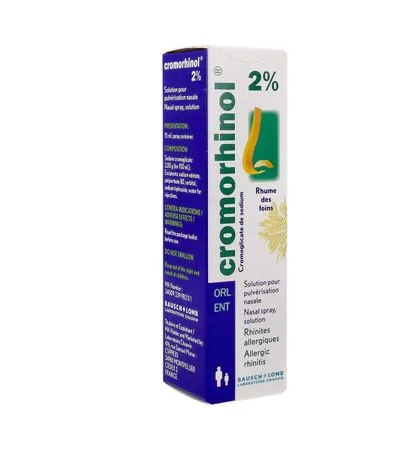
CROMORHINOL® 2 % nasal spray solution
cromoglicic acid
Forms and presentations
Nasal spray solution at 2 %: Spray bottle of 15 mL.Composition
| per vial | |
| Cromoglicic acid sodium salt
|
300 mg |
Excipient with known effect: polysorbate 80.
This medicine contains 0,0140 mg of polysorbate 80 per spray, which is equivalent to 0,10 mg/mL.
Indications
It is indicated in the treatment of seasonal allergic rhinitis (hay fever) or non-seasonal allergic rhinitis (animal hair, moulds, mites...).Dosage and administration
- Adult and child:
- 1 spray in each nostril 4 to 6 times a day.
- The duration of treatment will depend on the duration of exposure to the allergen.
Contraindications
Hypersensitivity to the active substance or to any of the excipients listed in section Composition, in particular to polysorbates.Warnings and precautions
This medicine contains polysorbates and may cause allergic reactions.
Fertility, pregnancy and breastfeeding
Pregnancy:Animal studies have not shown any teratogenic effect.
In the absence of a teratogenic effect in animals, a malformative effect in humans is not expected. Indeed, to date, substances responsible for malformations in humans have proven teratogenic in animals in well-conducted studies in two species.
Clinically, analysis of a large number of exposed pregnancies apparently revealed no particular malformative or foetotoxic effect of cromoglicic acid. However, only epidemiological studies would allow verification of the absence of risk.
Consequently, cromoglicic acid may be prescribed during pregnancy, if needed.
Breastfeeding:
There is no data on the passage of sodium cromoglicate into breast milk.
However, given the absence of toxicity, breastfeeding is possible during treatment with this medicine.
Adverse effects
- Possibility of occurrence of hypersensitivity reactions to sodium cromoglicate.
- A brief nasal irritation may occur at the start of treatment after spraying.
The symptoms are usually transient.
Rarely, epistaxis may occur.
Reporting of suspected adverse reactions:Reporting suspected adverse reactions after authorisation of the medicinal product is important. It allows continuous monitoring of the benefit/risk balance of the medicinal product. Healthcare professionals should report any suspected adverse reaction via the national reporting system: National Agency for the Safety of Medicines and Health Products (ANSM) and the network of Regional Pharmacovigilance Centres. Website: https://signalement.social-sante.gouv.fr.
Overdose
No overdose incidents have been described with sodium cromoglicate.
In case of suspected overdose, symptomatic treatment and medical monitoring are required.
Pharmacodynamics
Pharmacotherapeutic class: ANTI-ALLERGICS, ATC code: S01GX01.
Sodium cromoglicate exerts a direct local action at the level of the mucous membranes (bronchial, nasal, conjunctival, digestive). Its mechanism of action remains poorly elucidated.
It prevents the release of the chemical mediators of anaphylaxis by stabilising the membrane of the mast cell.
Sodium cromoglicate has no direct effect at the level of peripheral receptors.
Pharmacokinetics
Sodium cromoglicate is not metabolised. The study of urinary elimination of the product labelled with 14C shows low absorption through the nasal mucosa (of the order of 2 to 5 %). The major part is swallowed, absorption via the digestive tract being slow and very limited (approximately 0,5 %).
The absorbed portion is eliminated, as after intravenous administration, in unchanged form, substantially equally via the biliary and urinary routes.
Preclinical safety
There are no other pre-clinical data available considered relevant from the point of view of clinical safety other than those presented in the other sections of the monograph.
Storage conditions
- Shelf life
- 3 years.
This medicine does not require any particular storage precautions.
HANDLING/DISPOSAL INSTRUCTIONS
- Before any use, remove the cap by pulling it upwards. The spray pump is ready for use.
- At first use, hold the bottle upright and press the spray pump two or three times to prime the pump.
- After blowing your nose and keeping the bottle upright, insert the nasal tip into one nostril and block the other with your finger. Press the spray pump briefly, inhale through the nose, then exhale slowly through the mouth.
- Repeat the same procedure in the other nostril.
- Wipe the nasal tip, then replace the cap to avoid accidental spraying.
Prescription, supply and reimbursement
| Marketing authorisation (AMM) | 3400933998301 (1995, SmPC rev 21.11.2024). |
| Not reimbursed by Social Security. |
CHAUVIN Laboratory
416, rue Samuel-Morse. CS 99535. 34961 Montpellier
Tel: 04 67 12 30 30
Source: VIDAL · Updated on 10/11/2026. This information does not replace advice from a healthcare professional.