
Medicines
SmPC of 19/12/2024
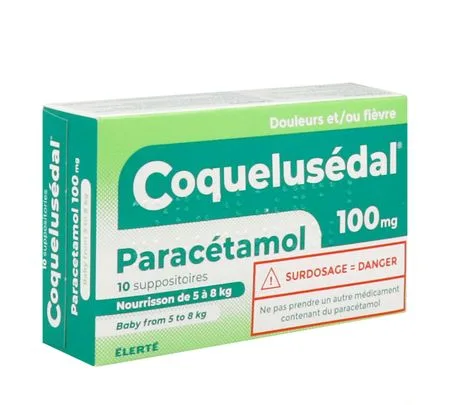
COQUELUSEDAL PARACETAMOL 100 mg, suppository
Composition
Paracetamol ................................................................................................................................................100 mg
Soft hydro-alcoholic extract of grindelia ................................................................................................10 mg
Soft hydro-alcoholic extract of gelsemium ..............................................................................................5 mg
For one suppository.
Propylene glycol, solid hemisynthetic glycerides.
Dosage and administration
Method of administration
Rectal route.
Dosage
This presentation is reserved for infants weighing from 5 to 8 kg (i.e. approximately 2 to 9 months).
In infants, it is imperative to respect the dosages defined according to the infant's weight and therefore to choose an appropriate presentation. The approximate ages according to weight are given for information only.
The recommended daily dose of paracetamol depends on the infant's weight; it is approximately 60 mg/kg/day, to be divided into 4 doses, i.e. approximately 15 mg/kg every 6 hours.
The dosage is one suppository at 100 mg, to be renewed if necessary after 6 hours, not exceeding 4 suppositories per day.
Due to the risk of local toxicity, administration of a suppository is not recommended more than 4 times a day, and treatment by the rectal route should be as short as possible.
In case of diarrhea, administration of a suppository is not recommended.
Recommended maximum doses (see section . Special warnings and precautions for useWarnings and precautions).
Frequency of administration
Systematic intake helps avoid fluctuations in pain or fever.
In infants and children, they must be regularly spaced, including at night, preferably every 6 hours, and at least 4 hours.
Renal impairment
In cases of severe renal impairment (creatinine clearance below 10 ml/min), the interval between two doses should be at least 8 hours.
Contraindications
Hypersensitivity to paracetamol or to the other excipients,
Hepatocellular insufficiency,
Recent history of proctitis, anitis or rectal bleeding.
Warnings and precautions
Warning
To avoid a risk of overdose; check that no paracetamol is present in the composition of other medicines.
Recommended maximum doses:
In children under 37 kg, the total daily dose of paracetamol must not exceed 80 mg/kg/day (see section Overdose).
In children from 38 to 50 kg, the total daily dose of paracetamol must not exceed 3 g per day (see section Overdose).
In adults and children over 50 kg, THE TOTAL DAILY DOSE OF PARACETAMOL MUST NOT EXCEED 4 GRAMS PER DAY (see section OverdoseOverdose).
With suppositories, there is a risk of local toxicity, which is more frequent and intense the longer the duration of treatment, the higher the administration rate and the higher the dose.
Precautions for use
In infants and children treated with 60 mg/kg/day of paracetamol, combination with another antipyretic is only justified in case of inefficacy.
Cases of high anion gap metabolic acidosis (HAGMA) due to pyroglutamic acidosis have been reported in patients with serious illness such as severe renal failure and sepsis, or in patients suffering from malnutrition or other sources of glutathione deficiency (for example, chronic alcoholism) who have been treated with paracetamol at therapeutic doses for a prolonged period or with a combination of paracetamol and flucloxacillin. In case of suspected HAGMA due to pyroglutamic acidosis, it is recommended to stop paracetamol immediately and to carry out close monitoring. Measurement of urinary 5-oxoproline may be useful to identify pyroglutamic acidosis as the underlying cause of HAGMA in patients with multiple risk factors.
In case of diarrhoea, the suppository form is not suitable.
Interactions
Associations requiring precautions for use
+ Oral anticoagulants:
Risk of increased effect of the oral anticoagulant and of bleeding risk when paracetamol is taken at maximum doses (4 g/day) for at least 4 days. Regular monitoring of INR. Possible adjustment of the oral anticoagulant dosage during paracetamol treatment and after its discontinuation.
+ Flucloxacillin:
Precautions must be taken when paracetamol is used at the same time as flucloxacillin, as concomitant intake has been associated with high anion gap metabolic acidosis due to pyroglutamic acidosis, particularly in patients with risk factors (see section Warnings and precautions).
Interactions with paraclinical tests:
Taking paracetamol may interfere with blood glucose measurement by the glucose oxidase-peroxidase method in cases of abnormally high concentrations.
Taking paracetamol may distort the measurement of blood uric acid by the phosphotungstic acid method.
Fertility, pregnancy and breastfeeding
COQUELUSEDAL PARACETAMOL 100 mg, suppository is intended for infants. However, in case of use in pregnant women or breastfeeding women, the following information should be noted:
Pregnancy
Paracetamol:
Numerous data in pregnant women indicate no malformative or foeto/neonatal toxicity. Epidemiological studies on neurological development in children exposed to paracetamol in utero show inconclusive results.
Plant-based substances:
There are no data or limited data on the use of soft extracts of grindelia and gelsemium in pregnant women.
Animal studies are insufficient to draw conclusions on reproductive toxicity (see section Preclinical safety).
Consequently, COQUELUSEDAL PARACETAMOL 100 mg, suppository, is not recommended during pregnancy.
Breast-feeding
There is no sufficient data on the excretion of soft extracts of grindelia and gelsemium in breast milk.
Paracetamol is excreted in breast milk. At therapeutic doses, administration of this medicine is possible during breastfeeding.
Fertility
Because of its potential mechanism of action on cyclo-oxygenases and prostaglandin synthesis, paracetamol could impair fertility in women, through an effect on ovulation that is reversible upon discontinuation of treatment.
Effects on male fertility have been observed in an animal study. The relevance of these effects in humans is not known.
Adverse effects
A few rare cases of hypersensitivity reactions such as anaphylactic shock, Quincke's edema, erythema, urticaria, and skin rash have been reported. Their occurrence requires permanent discontinuation of this medicine and related medicines.
Very exceptional cases of thrombocytopenia, leukopenia, and neutropenia have been reported. Rectal and anal irritation.
Cases of high anion gap metabolic acidosis due to pyroglutamic acidosis have been observed in patients with risk factors taking paracetamol (see section Warnings and precautions). Pyroglutamic acidosis may occur in these patients due to low glutathione levels. These metabolism and nutrition disorders have been observed at a frequency "not known" (cannot be estimated from available data).
Reporting of suspected adverse reactions
Reporting suspected adverse reactions after authorisation of the medicinal product is important. It allows continued monitoring of the benefit/risk balance of the medicinal product. Healthcare professionals are asked to report any suspected adverse reaction via the national reporting system: National Agency for the Safety of Medicines and Health Products (ANSM) and the network of Regional Centres of Pharmacovigilance - Website: https://signalement.social-sante.gouv.fr/.
Overdose
Intoxication is to be feared in elderly subjects and especially in young children (therapeutic overdose or frequent accidental intoxication) in whom it can be fatal.
Symptoms: nausea, vomiting, anorexia, pallor, abdominal pain generally appear within the 24 first hours.
An overdose, starting from 10 g of paracetamol in a single dose in adults and 150 mg/kg of body weight in a single dose in children, causes hepatic cytolysis that may lead to complete and irreversible necrosis resulting in hepatocellular failure, metabolic acidosis, encephalopathy that may progress to coma and death.
Simultaneously, an increase in hepatic transaminases, lactate dehydrogenase and bilirubin, and a decrease in the prothrombin level may be observed, appearing 12 to 48 hours after ingestion.
Emergency management:
Immediate transfer to a hospital setting.
Collect one tube of blood to perform the initial plasma paracetamol assay.
Management of overdose classically involves administration of the antidote N-acetylcysteine as early as possible, by intravenous route or oral route if possible before the tenth hour.
Symptomatic treatment.
Pharmacodynamics
Pharmacotherapeutic class: ANALGESIC, ANTIPYRETIC, ATC code: N02BE51
(N. Central nervous system)
(R. Respiratory system)
Pharmacokinetics
Absorption
Via the rectal route, absorption of paracetamol is slower than via the oral route. It is, however, complete. Plasma concentrations are reached 2 or 3 hours after administration.
Distribution
Paracetamol is rapidly distributed in all tissues. Concentrations are comparable in blood, saliva and plasma. Binding to plasma proteins is low.
Metabolism
Paracetamol is primarily metabolised in the liver. The 2 major metabolic pathways are glucuronidation and sulfoconjugation. The latter pathway is rapidly saturable at doses above therapeutic doses. A minor pathway catalysed by cytochrome P450 leads to the formation of a reactive intermediate, (N-acetyl benzoquinone imine), which, under normal conditions of use, is rapidly detoxified by reduced glutathione and eliminated in urine after conjugation with cysteine and mercapturic acid. In contrast, during massive intoxications, the quantity of this toxic metabolite is increased.
Elimination
Elimination is primarily urinary. 90% of the ingested dose is eliminated by the kidney within 24 hours, mainly in glucuronide-conjugated form (60 to 80%) and sulfoconjugated form (20 to 30%). Less than 5% is eliminated in unchanged form. The elimination half-life is approximately 4 to 5 hours.
Pathophysiological variations
Renal insufficiency: in cases of severe renal insufficiency (creatinine clearance less than 10 mL/min), elimination of paracetamol and its metabolites is delayed.
Preclinical safety
No conventional study based on currently accepted standards for assessing reproductive and developmental toxicity is available with paracetamol.
No conventional studies of genotoxicity, carcinogenesis, and reproductive and developmental toxicity are available with the grindelia and gelsemium extracts included in the composition of COQUELUSEDAL PARACETAMOL 100 mg, suppository.
Prescription, supply and reimbursement
| Marketing authorisation (AMM) |
|
181-183 RUE ANDRÉ KARMAN
93300 AUBERVILLIERS CEDEX
Tel: 01 48 34 75 03 laboratoire-elerte@orange.fr
https://www.elerte.fr/
Source: VIDAL · Updated on 10/11/2026. This information does not replace advice from a healthcare professional.