
Medicines
SPC of 17/11/2025
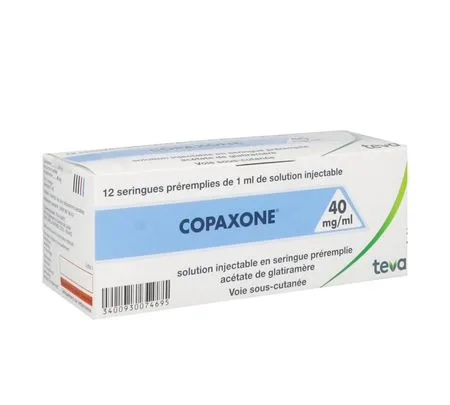
COPAXONE 40 mg/ml, solution for injection in prefilled syringe
Forms and presentations
Solution for injection (clear, free of visible particles, having a pH of 5,5-7,0 and an osmolarity of 300 mOsmol/L).
Prefilled syringe of 1 ml of solution. Box* of 12.
* Each prefilled syringe is individually packaged under blister.
Composition
For 1 prefilled syringe of 1 ml:
Glatiramer: 36 mg (as glatiramer acetate* : 40 mg).
* Glatiramer acetate is the acetate salt of synthetic polypeptides comprising 4 natural amino acids: L-glutamic acid, L-alanine, L-tyrosine and L-lysine with a mean molar fraction of respectively 0,129-0,153, 0,392-0,462, 0,086-0,100 and 0,300-0,374. The mean molecular weight of glatiramer acetate is between 5 000 and 9 000 daltons. Due to the complexity of its composition, no specified polypeptide can be fully characterised, including in terms of amino acid sequence, although the final composition of glatiramer acetate is not entirely random.
Mannitol, water for injections.
Indications
COPAXONE is indicated in the treatment of relapsing-remitting forms of multiple sclerosis (MS) (see section Pharmacodynamics for important information concerning the population in which efficacy has been established).
COPAXONE is not indicated in the treatment of primary or secondary progressive forms of MS.
Dosage and administration
Initiation of treatment with COPAXONE must be supervised by a neurologist or a physician experienced in the treatment of MS.
Dosage
The recommended dose in adults is 40 mg of glatiramer acetate (one prefilled syringe of COPAXONE 40 mg/ml) administered subcutaneously three times a week, at intervals of at least 48 hours.
At present, the duration of treatment cannot be specified.
The decision for long-term treatment will be made on the basis of a personalised clinical assessment, case by case, by the treating physician (neurologist or physician experienced in the treatment of MS).
Renal impairment
COPAXONE has not been studied in patients with renal impairment (see section Warnings and precautions).
Elderly
COPAXONE has not been studied in elderly patients.
Paediatric population
The safety and efficacy of glatiramer acetate in children and adolescents have not been established.
The information available on the use of COPAXONE 40 mg/ml three times a week in children and adolescents under 18 years of age is not sufficient to recommend its use. Therefore, COPAXONE 40 mg/ml three times a week should not be used in this population.
Method of administration
COPAXONE must be administered subcutaneously.
Patients must be trained in the self-injection technique. They must be monitored by a healthcare professional during their first self-injection and for the 30 minutes that follow.
A different injection site must be chosen for each injection, which will reduce the risk of irritation or pain at the injection site. Sites for self-injection include the abdomen, arms, hips and thighs.
The CSYNC device is available for patients wishing to perform their injection using an injection device. The CSYNC device is an autoinjector that must be used with COPAXONE prefilled syringes and has not been tested with other prefilled syringes. The CSYNC device must be used according to the instructions for use provided by the device manufacturer.
Contraindications
COPAXONE is contraindicated in the following cases:
- Hypersensitivity to the active substance (glatiramer acetate) or to any of the excipients mentioned in section Composition.
Warnings and precautions
COPAXONE must be administered by subcutaneous route only. The intravenous or intramuscular routes must not be used.
Glatiramer acetate may cause post-injection reactions as well as anaphylactic reactions (see section Adverse effects) :
Post-injection reactions
The physician must explain to the patient that within minutes following the injection of COPAXONE, a reaction may occur, associating one or more of the following symptoms: vasodilation (flushing), chest pain, dyspnoea, palpitations or tachycardia (see section Adverse effects). The majority of these symptoms are generally transient and resolve spontaneously without sequelae. If a severe adverse event occurs, the patient must immediately stop treatment with COPAXONE and contact their physician or an emergency medical service. Appropriate symptomatic treatment may be initiated if necessary.
There is no data suggesting that a particular patient population is at greater risk of experiencing such reactions. However, caution is required when administering COPAXONE to patients with a history of cardiac disorders. These patients must be monitored regularly during treatment.
Anaphylactic reactions
Anaphylactic reactions may occur shortly after administration of glatiramer acetate, but also several months or even several years after treatment initiation (see section Adverse effects). Cases with a fatal outcome have been reported. Some signs and symptoms may be common to anaphylactic reactions and post-injection reactions.
All patients treated with COPAXONE and their caregivers must be informed of the specific signs and symptoms of anaphylactic reactions and of the need to seek emergency medical care should these symptoms occur (see section Adverse effects).
In the event of an anaphylactic reaction, treatment with COPAXONE must be discontinued (see section Contraindications).
Anti-glatiramer acetate antibodies have been detected in the serum of patients treated long-term with COPAXONE. Maximum levels were reached on average after 3 to 4 months of treatment, after which these levels decreased and stabilised at a level slightly higher than the initial value.
There is no available data suggesting that these anti-glatiramer acetate antibodies are of a neutralising type or that their production may impair the clinical efficacy of COPAXONE.
In patients with renal impairment, renal function must be monitored while they are treated with COPAXONE. Although the existence of glomerular deposition of immune complexes has not been demonstrated, this possibility cannot be excluded.
Rare cases of severe liver injury have been observed (including hepatitis with jaundice, hepatic failure and, in isolated cases, liver transplantation). Liver injury occurred from a few days to a few years after the start of treatment with COPAXONE. In most cases, the severe liver injuries resolved with discontinuation of treatment. In some cases, these reactions occurred in the context of excessive alcohol consumption, pre-existing liver injury or a history of liver injury, and use of other potentially hepatotoxic medicinal products. Patients must be regularly monitored to detect any sign of liver injury and they must be instructed to consult a physician immediately in case of symptoms of liver injury. In case of clinically significant liver injury, discontinuation of treatment with COPAXONE should be considered.
Interactions
Interactions between COPAXONE and other medicinal products have not been systematically evaluated.
Observations from existing clinical trials and post-marketing experience do not suggest significant interactions between COPAXONE and treatments frequently used in patients with MS, including concomitant use of corticosteroids for a period of up to 28 days.
Studies in vitro suggest that glatiramer acetate is strongly bound to plasma proteins, but is neither displaced by nor displaces phenytoin or carbamazepine. Nevertheless, as COPAXONE theoretically has the capacity to affect the distribution of substances bound to plasma proteins, concomitant use of such medicinal products should be closely monitored.
Fertility, pregnancy and breastfeeding
Pregnancy
A large amount of data on pregnant women (more than 1 000 from exposed pregnancies) indicates an absence of malformative or foetal/neonatal toxicity.
COPAXONE may be used during pregnancy if clinically necessary.
Breast-feeding
The physicochemical properties and low oral absorption suggest that exposure of neonates/infants to glatiramer acetate through human breast milk is negligible. A non-interventional retrospective study conducted in 60 breastfed infants of mothers exposed to glatiramer acetate, compared with 60 breastfed infants of mothers not exposed to a disease-modifying treatment, and limited post-marketing data in humans, revealed no negative effect of glatiramer acetate.
COPAXONE may be used during breast-feeding.
Driving and using machines
No studies on the effects on the ability to drive and use machines have been performed.
Adverse effects
Most of the safety data for COPAXONE have been pooled for COPAXONE 20 mg/ml administered by subcutaneous injection once daily. This section presents the pooled safety data from four controlled clinical studies versus placebo conducted with COPAXONE 20 mg/ml administered once daily and from one controlled clinical study versus placebo-controlled study conducted with COPAXONE 40 mg/ml administered three times a week.
A direct comparison of safety between COPAXONE 20 mg/ml (administered once daily) and COPAXONE 40 mg/ml (administered three times a week) in the same study was not performed.
COPAXONE 20 mg/ml (administered once daily)
In all clinical studies conducted with COPAXONE 20 mg/ml, injection site reactions were the most frequent adverse effects and were reported by a majority of patients treated with COPAXONE.
In controlled studies, the percentage of patients reporting these reactions at least once was higher in the groups treated with COPAXONE 20 mg/ml compared with the placebo group (70 % versus 37 %). Injection site reactions reported more frequently in patients treated with COPAXONE 20 mg/ml than in those receiving placebo were: erythema, pain, induration, pruritus, edema, inflammation and hypersensitivity.
Immediate post-injection reactions have been described. They included at least one or more of the following symptoms: vasodilation (flushing), chest pain, dyspnea, palpitations or tachycardia (see section Warnings and precautions). Such a reaction may occur within minutes of injection of COPAXONE. At least one symptom characterizing this immediate post-injection reaction was reported at least once by 31 % of patients receiving COPAXONE 20 mg/ml compared with 13 % in the placebo group.
The adverse effects identified in clinical trials and post-marketing experience are presented in the table below. Data from clinical trials come from 4 pivotal double-blind placebo-controlled trials, in which 512 patients received COPAXONE 20 mg/day and 509 received placebo for up to 36 months. Three trials in relapsing-remitting multiple sclerosis (RRMS) included a total of 269 patients treated with COPAXONE 20 mg/day and 271 patients receiving placebo, for up to 35 months. The fourth trial, conducted in patients who had experienced a first clinical event and who were considered at high risk of developing clinically definite MS, included 243 patients treated with COPAXONE 20 mg/day and 238 patients receiving placebo for up to 36 months.
|
System Organ Class (SOC) |
Very common
|
Common
|
Uncommon
|
Rare
|
Frequency not known
|
|
Infections and infestations |
Infection, influenza |
Bronchitis, gastroenteritis, infection due to Herpes Simplex, otitis media, rhinitis, dental abscess, vaginal candidiasis* |
Abscess, cellulitis, furuncle, herpes zoster, pyelonephritis |
||
|
Benign, malignant and unspecified neoplasms (incl cysts and polyps) |
Benign skin tumor, tumor |
Skin cancer |
|||
|
Blood and lymphatic system disorders |
Lymphadenopathy* |
Leukocytosis, leukopenia, splenomegaly, thrombocytopenia, morphological abnormalities of lymphocytes |
|||
|
Immune system disorders |
Hypersensitivity |
Anaphylactic reaction |
|||
|
Endocrine disorders |
Goiter, hyperthyroidism |
||||
|
Metabolism and nutrition disorders |
Anorexia, weight gain* |
Alcohol intolerance, gout, hyperlipidaemia, increased blood sodium, decreased serum ferritin |
|||
|
Psychiatric disorders |
Anxiety*, depression |
Nervousness |
Abnormal dreams, confusional state, euphoric mood, hallucination, hostility, mania, personality disorder, suicide attempt |
||
|
Nervous system disorders |
Headache |
Dysgeusia, hypertonia, migraine, speech disorder, syncope, tremors* |
Carpal tunnel syndrome, cognitive disorder, convulsions, dysgraphia, dyslexia, dystonia, motor disorder, myoclonus, neuritis, neuromuscular blockade, nystagmus, paralysis, sciatic nerve paralysis, stupor, visual field defect |
||
|
Eye disorders |
Diplopia, eye disorder* |
Cataract, corneal injury, dry eye, eye haemorrhage, ptosis, mydriasis, optic atrophy |
|||
|
Ear and labyrinth disorders |
Ear disorder |
||||
|
Cardiac disorders |
Palpitations*, tachycardia* |
Extrasystoles, sinus bradycardia, paroxysmal tachycardia |
|||
|
Vascular disorders |
Vasodilation* |
Varicose vein |
|||
|
Respiratory, thoracic and mediastinal disorders |
Dyspnoea* |
Cough, seasonal rhinitis |
Apnoea, epistaxis, hyperventilation, laryngospasm, lung disorder, feeling of suffocation |
||
|
Gastrointestinal disorders |
Nausea* |
Anorectal disorder, constipation, dental caries, dyspepsia, dysphagia, faecal incontinence, vomiting* |
Colitis, colonic polyp, enterocolitis, eructation, oesophageal ulcer, periodontitis, rectal haemorrhage, increased salivary gland size |
||
|
Hepatobiliary disorders |
Abnormal liver function tests |
Cholelithiasis, hepatomegaly |
Toxic hepatitis, liver injury |
Hepatic impairment# |
|
|
Skin and subcutaneous tissue disorders |
Skin rash* |
Ecchymosis, hyperhidrosis, pruritus, skin disorder*, urticaria |
Angioedema, contact dermatitis, erythema nodosum, skin nodule |
||
|
Musculoskeletal and systemic disorders |
Arthralgia, back pain* |
Cervicalgia |
Arthritis, bursitis, flank pain, muscular atrophy, osteoarthritis |
||
|
Renal and urinary disorders |
Urinary urgency, pollakiuria, urinary retention |
Hematuria, nephrolithiasis, urinary tract disorder, abnormal urine |
|||
|
Disorders of the reproductive system and breast |
Breast engorgement, erectile dysfunction, pelvic prolapse, priapism, prostatic disorders, abnormal cervical smear, testicular disorders, vaginal hemorrhage, vulvovaginal disorder |
||||
|
General disorders and administration site conditions |
Asthenia, chest pain*, injection site reactions*§, pain* |
Chills*, facial edema*, injection site atrophy♣, local reaction*, peripheral edema, edema, fever |
Cyst, hangover sensation, hypothermia, immediate post-injection reaction, inflammation, injection site necrosis, mucosal disorder |
||
|
Injury, poisoning and procedural complications |
Post-vaccination syndrome |
* Incidence more than 2 % higher (> 2/100) in the group treated with COPAXONE compared with the placebo group. The difference in incidence of adverse reactions without the symbol * is less than or equal to 2 % between the group treated with COPAXONE and the placebo group.
§ The term "injection site reactions" (various types) includes all adverse reactions occurring at the injection site, with the exception of injection site atrophy and injection site necrosis, which are presented separately in the table.
♣ Includes terms corresponding to lipoatrophy localized at injection sites.
# A few cases of liver transplantation have been reported.
In the fourth trial mentioned above, an open-label treatment phase followed the controlled phase versus placebo. No change in the known safety profile of COPAXONE 20 mg/ml was observed during the open-label follow-up period of up to 5 years.
COPAXONE 40 mg/ml (administered three times per week)
The safety of COPAXONE 40 mg/ml was evaluated in a double-blind, placebo-controlled clinical study versus conducted in patients with RR-MS, including a total of 943 patients treated with COPAXONE 40 mg/ml three times a week and 461 patients receiving placebo for 12 months.
In general, the adverse effects observed in patients treated with COPAXONE 40 mg/ml administered three times a week were already known and reported for COPAXONE 20 mg/ml administered once daily. More specifically, injection site reactions (ISR) and immediate post-injection reactions (IPIR) were less frequently reported with COPAXONE 40 mg/ml administered three times a week than with COPAXONE 20 mg/ml administered once daily (respectively 35,5 % versus 70 % for ISR and 7,8 % versus 31 % for IPIR).
Injection site reactions were reported in 36 % of patients treated with COPAXONE 40 mg/ml versus 5 % of patients receiving placebo. Immediate post-injection reactions were reported in 8 % of patients treated with COPAXONE 40 mg/ml versus 2 % of patients receiving placebo.
- Some specific adverse effects may have been noted: Anaphylactic reactions may occur shortly after administration of glatiramer acetate, but also several months or even several years after initiation of treatment (see section Warnings and precautions).
- No injection site necrosis (ISN) has been reported.
- Skin erythema and extremity pain, not reported for COPAXONE 20 mg/ml, were each reported in 2,1 % of patients treated with COPAXONE 40 mg/ml (common: ≥ 1/100, < 1/10).
- Drug-induced liver injury and toxic hepatitis were reported in one patient (0,1 %) treated with COPAXONE 40 mg/ml (uncommon: ≥ 1/1 000, < 1/100).
Reporting of suspected adverse reactions
Reporting suspected adverse reactions after authorisation of the medicinal product is important. It allows continued monitoring of the benefit/risk balance of the medicinal product. Healthcare professionals are asked to report any suspected adverse reactions via the national reporting system: National Agency for the Safety of Medicines and Health Products (ANSM) and the network of Regional Pharmacovigilance Centres - Website: https://signalement.social-sante.gouv.fr/.
Overdose
Symptoms
Some cases of overdose with COPAXONE (up to 300 mg of glatiramer acetate) have been reported. These cases were not associated with any adverse effects other than those mentioned in the section Adverse effects.
Management
In case of overdose, patients should be monitored and appropriate symptomatic and supportive treatment should be initiated.
Pharmacodynamics
Pharmacotherapeutic class: Antineoplastic and immunomodulating agents, Other immunostimulants, ATC code: L03AX13.
Mechanism of action
The mechanism of action by which glatiramer acetate exerts its therapeutic effects in relapsing forms of MS is not fully elucidated, but it is assumed that glatiramer acetate would involve modulation of the immune system.
Studies in animals and in patients with MS suggest that glatiramer acetate acts on cells responsible for innate immunity, notably monocytes, dendritic cells and B lymphocytes, which modulate the adaptive functions of B and T lymphocytes, inducing anti-inflammatory and regulatory cytokine secretion. It is not known whether the therapeutic effect is mediated by the cellular effects described above, as the pathophysiology of MS is only partially understood.
Clinical efficacy and safety
Relapsing/remitting multiple sclerosis
Evidence supporting the efficacy of COPAXONE 40 mg/ml administered by subcutaneous injection three times a week in reducing the frequency of relapses comes from a controlled clinical study versus placebo over 12 months.
In the pivotal clinical trial, relapsing/remitting multiple sclerosis was characterised either by at least one documented relapse in the last 12 months, or by at least two documented relapses in the last 24 months, or by one documented relapse between 12 and 24 months ago with at least one T1 lesion enhanced by gadolinium demonstrated on MRI (magnetic resonance imaging) performed in the last 12 months.
The primary endpoint measure was the total number of confirmed relapses. Secondary endpoints measured by MRI included the cumulative number of new/enlarging T2 lesions on MRI and the cumulative number of enlarging lesions on T1-weighted images, measured at 6th and 12th months.
In total, 1 404 patients were randomised in a 2/1 ratio to receive either COPAXONE 40 mg/ml (n = 943) or placebo (n = 461). Baseline demographic data, MS characteristics and initial MRI parameters were similar in both treatment groups. Patients had a median of 2,0 relapses in the two years preceding selection.
Compared with placebo, patients treated with COPAXONE 40 mg/ml administered three times a week had statistically significant and relevant reductions in the measures of the primary and secondary endpoints, which were consistent with the effect of treatment with COPAXONE 20 mg/ml administered once daily.
The table below presents the values corresponding to the measurements of the primary and secondary endpoints for the intention-to-treat population:
|
Endpoint measurement |
Adjusted mean values |
Value of p |
|
|
COPAXONE
|
Placebo
|
||
|
Annualised relapse rate (ARR) |
0,331 |
0,505 |
p < 0,0001 |
|
Absolute risk difference* (95% confidence interval) |
-0,174 [-0,2841 to -0,0639] |
||
|
Cumulative number of new/enlarging lesions at T2 to 6 and 12 months |
3,650 |
5,592 |
p < 0,0001 |
|
Lesion count ratio at T2** (95% confidence interval) |
0,653 [0,546 to 0,780] |
||
|
Cumulative number of enlarging lesions on T1-weighted images at 6 and 12 months |
0,905 |
1,639 |
p < 0,0001 |
|
Lesion count ratio** (95% confidence interval) |
0,552 [0,436 to 0,699] |
||
* The absolute risk difference is defined as the difference between the adjusted mean ARR of GA 40 mg three times weekly and the adjusted mean ARR of placebo.
** The lesion count ratio is defined as the ratio between the adjusted mean rates of GA 40 mg three times weekly and placebo.
A direct comparison of efficacy and safety between COPAXONE 20 mg/ml (administered once daily) and COPAXONE 40 mg/ml (administered three times weekly) in the same study has not been performed.
COPAXONE 40 mg/ml: The proportion of patients presenting with confirmed disability progression at 3 months is an exploratory endpoint over the 12 months of the placebo-controlled study (GALA). Confirmed disability progression at 3 months was observed in 3% and 3,5% of patients in the placebo group and the COPAXONE group respectively (odds ratio, OR [95% CI]: 1,182 [0,661, 2,117] (p = 0,5726)). Taking into account the open-label extension of the study (up to 7 years), the time to confirmation of disability progression at 6 months constitutes an exploratory endpoint. The relative risk [95% CI] in patients in the intention-to-treat population, between the early-treatment COPAXONE group and the delayed-treatment COPAXONE group was 0,892 [0,688, 1,157] (p = 0,3898).
No data are currently available regarding the use of COPAXONE in the treatment of primary progressive or secondary progressive forms.
Pharmacokinetics
No pharmacokinetic study has been performed in patients. The data in vitro and limited data from healthy volunteers indicate that after subcutaneous administration of glatiramer acetate, the active substance is readily absorbed, and that a large part of the dose is rapidly degraded into smaller fragments, already in the subcutaneous tissue.
Preclinical safety
Non-clinical data from conventional safety pharmacology, repeated-dose toxicity, genotoxicity, carcinogenesis, and reproductive function studies revealed no particular risk for humans other than those included in other sections of the SmPC. Due to the absence of pharmacokinetic data in humans, the correspondence between exposure in humans and that in animals cannot be established.
Deposition of immune complexes in the renal glomeruli has been reported in a small number of rats and monkeys treated for at least 6 months. In a study lasting 2 years in rats, no deposition of immune complexes in the renal glomeruli was observed.
An anaphylactic reaction has been reported after administration to sensitised animals (guinea pig and mouse). The relevance of these findings for humans is unknown.
Injection site toxicity after repeated administration has frequently been observed in animals.
In rats, a slight but statistically significant reduction in body weight gain of the offspring of females treated during pregnancy and throughout lactation was observed at subcutaneous doses ≥ 6 mg/kg/day (2,83 times the maximum recommended daily dose in humans for an adult of 60 kg based on mg/m2) compared with the control group. No other significant effect on offspring growth and behavioural development was observed.
INCOMPATIBILITIES
In the absence of compatibility studies, this medicinal product must not be mixed with other medicinal products.
Special storage precautions
Store the pre-filled syringes in the outer packaging, protected from light.
Store in a refrigerator (between 2 °C and 8 °C).
Do not freeze.
If the pre-filled syringes cannot be stored in a refrigerator, they may be stored for up to one month maximum, between 15 °C and 25 °C.
After this one-month period, if the pre-filled syringes of COPAXONE have not been used and are still in their original packaging, they must be returned to the refrigerator (between 2 °C and 8 °C).
SPECIAL PRECAUTIONS FOR DISPOSAL AND OTHER HANDLING
Single use.
Any unused medicinal product or waste material should be disposed of in accordance with local requirements.
Prescription, supply and reimbursement
Initial prescription and renewal restricted to specialists in neurology. Medicinal product requiring special monitoring during treatment.
| Marketing authorisation (AMM) |
|
| Price: |
|
Exception medicine.
Social security reimbursement at 65%. Collective.
TEVA SANTÉ
100-110, esplanade du Général-de-Gaulle
92931 La Défense cedex
https://www.teva-sante.fr/
Tel Standard: 01 55 91 78 00
Pharmacovigilance/Medical Information:
Source: VIDAL · Updated on 10/11/2026. This information does not replace advice from a healthcare professional.