
Medicines
SmPC of 07/09/2018
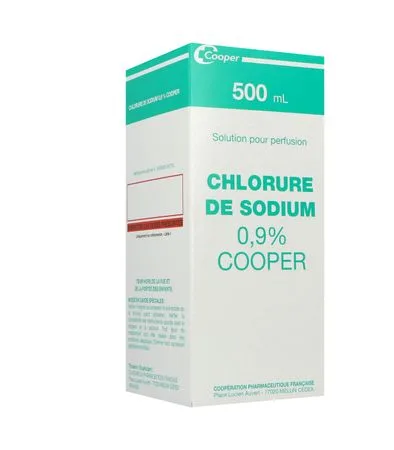
COOPER SODIUM CHLORIDE 0,9 %, injectable solution
Forms and presentations
Solution for injection.
Clear, colourless solution.
Osmolarity 308 mOsm/L
pH between 4,5 and 7
Composition
Sodium chloride.........................................................................................................................................0,9 g
For 100 mL of injectable solution
One ampoule of 1 mL contains 0,009 g of sodium chloride.
One ampoule of 2 mL contains 0,018 g of sodium chloride.
One ampoule of 5 mL contains 0,045 g of sodium chloride.
One ampoule of 10 mL contains 0,09 g of sodium chloride.
One ampoule of 20 mL contains 0,18 g of sodium chloride.
One vial of 125 mL contains 1,125 g of sodium chloride.
One vial of 250 mL contains 2,25 g of sodium chloride.
One vial of 500 mL contains 4,5 g of sodium chloride.
One vial of 1000 mL contains 9 g of sodium chloride.
Sodium (Na+): 154 mmol/L, i.e. 0,154 mmol/mL
Chlorides (Cl-): 154 mmol/L, i.e. 0,154 mmol/mL
Water for injections.
Indications
- Ionic rebalancing through the supply of chloride and sodium.
- Extracellular dehydration.
- Hypovolaemia.
- Vehicle or diluent for compatible medicinal products for parenteral administration.
Dosage and administration
Dosage
Doses may be expressed in mEq or mmol of sodium, mass of sodium or mass of sodium salt (1 g NaCl = 394 mg of Na, 17,1 mEq or 17,1 mmol of Na and Cl).
The dosage, rate and duration of administration must be determined according to several factors including age, weight, clinical condition, concomitant treatment and in particular the patient's hydration status, sodium and chloride ion requirements, and the clinical and biological response to treatment. Fluid balance and serum electrolyte concentrations must be closely monitored.
For the treatment of isotonic extracellular dehydration and sodium depletion, the recommended dosage is:
- Adults : 500 ml to 3000 ml /24 h.
- Paediatric population 20 to 100 ml per 24 h and per kg of body weight. The dosage, flow rate and infusion volume depend on the age, weight, clinical and metabolic status of the patient and on concomitant treatment. The solution must be administered by experienced personnel.
When COOPER SODIUM CHLORIDE 0,9 %, solution for injection is used as a vehicle or diluent for the preparation of other injectable medicinal products, the dosage and infusion rate will depend mainly on the nature and dosage of the medicinal product to be administered.
Maximum infusion rate
The maximum infusion rate depends on the clinical condition.
Most reported cases of osmotic demyelination syndrome occurred following a high rate of correction (see sections Warnings and precautions and Overdose).
Method of administration
Intravenous infusion, intramuscular or subcutaneous injection.
When the solution is used for dilution and administration of additional medicinal products, the instructions for use of the added substances will determine the appropriate volumes, modes and routes of administration for each treatment.
For precautions to be taken before handling or administering the medicinal product, see section Disposal and handling.
Contraindications
- Hyperchloraemia
- Hypernatraemia
- Severe cases of water overload and sodium-water retention, particularly in cases of decompensated heart failure, decompensated hepatic failure (oedematous-ascitic insufficiency of cirrhosis), pre-eclampsia / eclampsia.
The relative contraindications of the added medicinal product(s) must be taken into account.
Warnings and precautions
COOPER SODIUM CHLORIDE 0,9 %, solution for injection is an isotonic solution
Sodium rebalancing must not be carried out at too rapid a rate, in particular due to the risk of serious neurological complications, such as osmotic demyelination syndrome (see sections Dosage and administration and Overdose).
Depending on the volume and infusion rate, intravenous administration of sodium chloride may cause:
- fluid and/or solute overload leading to hyperhydration/hypervolaemia (e.g., congestive states, including peripheral oedema);
- clinically significant electrolyte disturbances and acid-base imbalance.
Use this medicinal product with caution in patients with hypertension, heart failure, hepatocellular insufficiency with oedema and ascites, liver cirrhosis, peripheral or pulmonary oedema, impaired renal function, urinary tract obstruction, metabolic acidosis, pre-eclampsia, hyperaldosteronism, hypervolaemia, hypoproteinaemia or other conditions and treatments (e.g. corticosteroids) associated with sodium and water retention (see section Interactions).
This treatment must be carried out under strict medical supervision, the dosage being adapted according to fluid and electrolyte changes, in particular sodium and chloride ions. Administration must be carried out under regular and careful monitoring.
Extravasation
The catheter site must be regularly checked for signs of extravasation. In the event of extravasation, administration must be stopped immediately, while keeping the inserted cannula or catheter in place for immediate management of the patient. If possible, aspiration should be performed through the inserted cannula/catheter to reduce the amount of fluid in the tissues before removing the cannula/catheter. If an extremity is affected, the limb concerned must be elevated.
Depending on the extravasated product (including products mixed with COOPER SODIUM CHLORIDE 0,9 %, solution for injection, where applicable) and the stage/extent of any lesions, appropriate specific measures must be taken. Therapeutic options may include non-pharmacological, pharmacological and/or surgical interventions. If the affected area deteriorates (persistent pain, necrosis, ulceration), a plastic surgeon must be consulted immediately (see section Adverse effects).
The extravasation site must be checked at least every 4 hours during the first 24 hours, then once a day.
Population geriatric
When selecting the type of injectable solution and the volume/infusion rate for an elderly patient, it is necessary to take into consideration the susceptibility of these patients to cardiac, renal, hepatic or other diseases, as well as their concomitant drug treatments.
Paediatric population
In neonates, infants and children, administration of the product requires increased monitoring.
In the newborn and the premature infant, there may be excess sodium retention due to an immature renal function. In these patients, repeated infusions of sodium chloride must only be carried out after determination of plasma sodium concentrations.
The intravenous infusion device and administration equipment must be checked regularly.
In case of addition of a medicinal product, check compatibility, clarity and colour before use (see section Incompatibilities).
Do not store the mixture (see section Disposal and handling).
Interactions
Associations requiring precautions for use
+ Lithium
Administration of COOPER SODIUM CHLORIDE 0,9 %, solution for injection may lead to decreased lithium concentrations and therefore a risk of reduced lithium efficacy. Indeed, renal clearance of sodium and lithium may be increased during administration of COOPER SODIUM CHLORIDE 0,9 %, solution for injection. Caution is therefore recommended in patients receiving lithium treatment.
+ Corticosteroids
Corticosteroids are associated with hydrosodium retention (with oedema and hypertension). See section Warnings and precautions.
Fertility, pregnancy and breastfeeding
COOPER SODIUM CHLORIDE 0,9 %, solution for injection may be used during pregnancy or breastfeeding, if necessary.
The risks and benefits for each patient must be carefully considered before administering the SODIUM CHLORIDE solution.
Caution is recommended in patients suffering from pre-eclampsia (see sections Contraindications and Warnings and precautions).
When a medicinal product is added, the nature of the medicinal product and its use during pregnancy and breastfeeding must be assessed separately.
Driving and using machines
There is no information on the effects of COOPER SODIUM CHLORIDE 0,9 %, solution for injection on the ability to drive vehicles and use machines.
Adverse effects
The undesirable effects that may occur in patients treated with COOPER SODIUM CHLORIDE 0,9 %, solution for injection by intravenous infusion are listed below.
The adverse effects listed in this section are reported according to the following convention: very common (≥ 1/10), common (≥ 1/100 and < 1/10), uncommon (≥ 1/1000 and < 1/100), rare (≥ 1/10000 and < 1/1000), very rare (< 1/10000) and frequency not known (cannot be estimated from the available data).
|
System Organ Classes (SOC) |
Adverse reactions (MedDRA Terms) |
Frequency |
|
Nervous system disorders |
Tremors |
Not known |
|
Metabolism and nutrition disorders and nutrition |
Hypervolaemia Hypernatraemia Hyperchloraemic metabolic acidosis |
Not known |
|
Skin disorders and subcutaneous tissue |
Urticaria Skin rash Pruritus |
Not known |
|
Vascular disorders |
Venous thrombosis Thrombophlebitis Hypotension |
Not known |
|
General disorders and administration site conditions |
Chills |
|
|
Fever |
|
|
|
Infection at the infusion site |
|
|
|
Infusion site irritation |
Not known |
|
|
Extravasation |
|
|
|
Local reaction |
|
|
|
Localised pain* Necrosis / ulcer* |
|
* Adverse effects that may be associated with extravasation, among others
When COOPER SODIUM CHLORIDE 0,9 %, solution for injection is used as a vehicle or diluent for injectable preparations of other medicinal products, other adverse effects associated with the medicinal product(s) added to the solution may occur.
Reporting of suspected adverse reactions
Reporting suspected adverse reactions after authorisation of the medicinal product is important. It allows continued monitoring of the benefit/risk balance of the medicinal product. Healthcare professionals are asked to report any suspected adverse reactions via the national reporting system: National Agency for the Safety of Medicines and Health Products (ANSM) and the network of Regional Pharmacovigilance Centres - Website:www.ansm.sante.fr.
Overdose
Symptoms of sodium chloride overdose
Excessive administration of COOPER SODIUM CHLORIDE 0,9 %, solution for injection may lead to hypernatraemia resulting in intracellular dehydration, which must be treated in a specialised setting. The general adverse effects of excess sodium include nausea, vomiting, diarrhoea, abdominal cramps, thirst, decreased secretion of saliva and tears, sweating, fever, tachycardia, hypertension, renal failure, cerebral oedema, pulmonary and peripheral oedema, respiratory arrest, headache, dizziness, restlessness, irritability, syncope, muscle contraction and stiffness, convulsions, coma and death.
The clinical signs of osmotic demyelination syndrome are progressive: confusion, dysarthria, dysphagia, limb weakness, then quadriplegia, delirium and finally coma. Clinical symptoms occur several days after too rapid and/or too large a correction of hyponatraemia (see sections Dosage and administration and Warnings and precautions).
Excess chloride in the body may cause a loss of bicarbonate with acidosis.
Treatment
The first measure to take is to reduce the infusion rate or stop the infusion.
Treatment consists of monitoring serum sodium and administering glucose solution for injection. In the event of convulsions, diazepam may be administered.
When COOPER SODIUM CHLORIDE 0,9 %, solution for injection is used as a vehicle or diluent for injectable preparations of other medicines, signs and symptoms of excessive infusion may arise from the added medicine. In case of accidental excessive infusion, interrupt treatment and observe the patient for any appearance of clinical signs and symptoms related to the administered medicine. Institute appropriate symptomatic and supportive treatment, as needed.
Pharmacodynamics
Pharmacotherapeutic class: ELECTROLYTE SOLUTIONS, ATC code: B05XA03
(B: blood and blood-forming organs)
COOPER SODIUM CHLORIDE 0,9 %, solution for injection is an isotonic solution with an osmolarity of approximately 308 mOsm/L
The pharmacodynamic properties of the solution are those of sodium and chloride ions, which maintain fluid and electrolyte balance.
Ions such as sodium move across the cell membrane using various transport mechanisms, including the sodium pump (Na+, K+-ATPase). Sodium plays an important role in neurotransmission and cardiac electrophysiology, as well as in renal metabolism.
In case of addition of a medicinal product, the pharmacodynamics of the preparation will also depend on the added medicinal product.
Pharmacokinetics
Absorption
Since sodium chloride is administered intravenously, its absorption is complete, i.e. 100 %.
Elimination
Sodium and chloride ions are excreted mainly in the urine. Small amounts of sodium are eliminated in the feces and sweat.
In case of addition of a medicinal product, the pharmacokinetics of the preparation will also depend on the medicinal product added.
Preclinical safety
No specific data, as sodium chloride is a physiological component of plasma in both animals and humans.
The safety data of the additive should be considered separately.
INCOMPATIBILITIES
As with all parenteral solutions, the compatibility of medicinal products with the solution must be checked before addition.
The incompatibility of the medicinal product with the COOPER 0,9 % SODIUM CHLORIDE solution must be determined by checking for any change in colour and/or any formation of precipitate, insoluble complex or crystals. Also refer to the leaflet accompanying the medicinal product to be added.
In case of addition of a medicinal product, check whether the medicinal product is compatible with the pH range of the COOPER 0,9 % SODIUM CHLORIDE solution.
When a compatible medicinal product is added to the COOPER 0,9 % SODIUM CHLORIDE solution, the mixture must be administered immediately.
Medicinal products known to be incompatible must not be used.
Shelf life
Before opening:
5 years.
Shelf life after first use:
After opening/dilution, the product must be used immediately.
SPECIAL PRECAUTIONS FOR DISPOSAL AND OTHER HANDLING
Do not use if the ampoule/vial is damaged.
Do not reuse: single use only.
Discard any partially used ampoule/vial.
Do not reconnect a partially used vial.
In case of addition of a medicinal product, mix the solution well before use.
The solution must be visually inspected to detect any particles, any damage to the ampoule/vial and any visible sign of deterioration before administration.
In case of addition of medication, the solution must be administered with sterile equipment and using an aseptic technique. The equipment must be primed with the solution to avoid any introduction of air into the system.
Any unused medicinal product or waste material should be disposed of in accordance with local requirements.
Prescription, supply and reimbursement
| Marketing authorisation (AMM) |
|
| Price: |
|
Not reimbursed by Social Security (10 bouts/5ml, 10 bouts/10ml, 10 bouts/20ml).
Collect (Fl/500ml, Fl/1000ml, Fl/250ml).
PLACE LUCIEN AUVERT
77020 MELUN CEDEX
Tel: 01 64 87 20 00 https://www.cooper.fr/
Source: VIDAL · Updated on 10/11/2026. This information does not replace advice from a healthcare professional.