
Medicines
SmPC of 17/05/2021
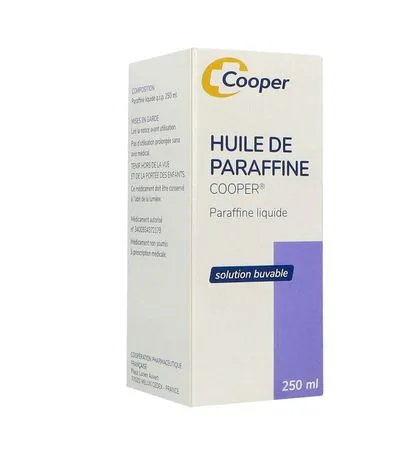
COOPER PARAFFIN OIL, oral solution in bottle
Composition
Liquid paraffin ..................................................................................................q.s. to the bottle capacity
Dosage and administration
Oral use
Dosage
- In adults: 15 to 45 ml, i.e. 1 to 3 tablespoons per day.
- In children over 6 years: 10 to 15 ml (i.e. 2 to 3 teaspoons) per day.
Method of administration
The dose may be taken either in the morning on an empty stomach, or preferably away from meals. If taken in the evening, the patient should be advised not to lie down within 2 hours following intake (see section Warnings and precautions) and to take into account the onset of action (6-8 hours).
Contraindications
Hypersensitivity to paraffin oil,
Obstructive colopathy, given the laxative effect of the medicine,
Abdominal pain syndrome of undetermined and inflammatory cause (ulcerative colitis, Crohn's disease...),
Do not use in people with swallowing difficulties because of the risk of bronchial inhalation and lipoid pneumonia.
Warnings and precautions
Warning
Prolonged use of a laxative is not recommended.
- Drug treatment of constipation is only an adjunct to hygienic-dietary treatment:
- enrichment of the diet with vegetable fibres and fluids;
- Advice on physical activity and rehabilitation of evacuation.
- In children, the prescription of laxatives should be exceptional: it must take into account the risk of hindering the normal functioning of the defecation reflex.
Precautions for use
- Prolonged use of paraffin oil may reduce the absorption of fat-soluble vitamins (A, D, E, K)
- Administration of liquid paraffin to young children, debilitated or bedridden persons, or in cases of gastro-oesophageal reflux should be done with caution because of the risk of bronchial inhalation and lipid pneumonia (see section Adverse effects).
- This oil must not be heated.
Interactions
The data available to date do not suggest the existence of clinically significant interactions.
Fertility, pregnancy and breastfeeding
Given the available data, use in pregnant or breastfeeding women is possible on an occasional basis.
Adverse effects
The following table describes the adverse effects reported with liquid paraffin. The frequency of adverse effects is defined using the following convention: very common (≥ 1/10), common (≥1/100, < 1/10), uncommon (≥ 1/1000, < 1/100), rare (≥ 1/10000, < 1/1000), very rare (< 1/10000), frequency not known (cannot be estimated from the available data).
|
System Organ Class Frequency |
Adverse effects |
|
Gastrointestinal disorders Frequency not known |
Anal seepage, perianal irritation |
|
Respiratory, thoracic and mediastinal disorders Frequency not known |
Lipoid pneumonia following bronchial inhalation of liquid paraffin (see section Warnings and precautions) |
Reporting of suspected adverse reactions
Reporting suspected adverse reactions after authorisation of the medicinal product is important. It allows continued monitoring of the benefit/risk balance of the medicinal product. Healthcare professionals are asked to report any suspected adverse reaction via the national reporting system: National Agency for the Safety of Medicines and Health Products (ANSM) and the network of Regional Centres of Pharmacovigilance - Website: www.signalement-sante.gouv.fr
Overdose
No cases of overdose have been reported. However, use of liquid paraffin at high doses exposes to a risk of:
- steatorrhoea,
- anal seepage,
- and perianal irritation.
In case of overdose, stop treatment (or possibly reduce doses) and apply local symptomatic treatment.
Pharmacodynamics
Pharmacotherapeutic class: LAXATIVE, ATC code: A06AA01
Liquid paraffin is a mechanical-action laxative that acts by lubricating the colonic contents and softening stools.
Its action manifests in 6 to 8 hours orally.
As liquid paraffin is not metabolised, its caloric intake is nil.
Prescription, supply and reimbursement
| Marketing authorisation (AMM) |
|
PLACE LUCIEN AUVERT
77020 MELUN CEDEX
Tel: 01 64 87 20 00 https://www.cooper.fr/
Source: VIDAL · Updated on 10/11/2026. This information does not replace advice from a healthcare professional.