
Medicines
Update of 01/02/2023
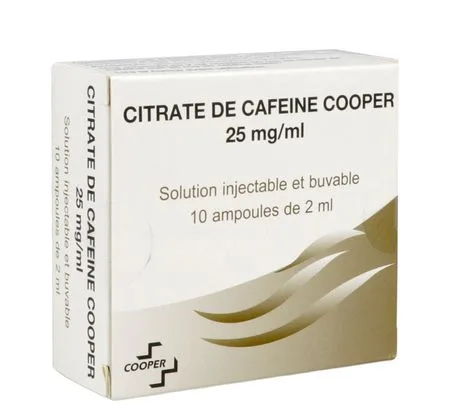
COOPER CAFFEINE CITRATE
Forms and presentations
Injectable and oral solution at 25 mg/ml: Ampoules of 2 ml, box of 10.Composition
| p 1 ml | |
| Caffeine citrate
|
25 mg |
| (i.e. anhydrous caffeine base: 12,5 mg; i.e. anhydrous citric acid: 12,5 mg.) | |
| One ampoule of 2 ml contains 50 mg of caffeine citrate. | |
Indications
Treatment of apnoea in premature newborns.Dosage and administration
Method of administration:
Intravenous or oral route.
Do not inject intramuscularly (see Contraindications).
Dosage
One ampoule of 2 ml contains 50 mg of caffeine citrate, i.e. 25 mg of caffeine base.
- Loading dose: 20 mg/kg/day of caffeine citrate (i.e. 10 mg/kg/day of caffeine base) by slow intravenous route.
- Maintenance dose (generally starting 24 h after the loading dose): 5 mg/kg/24 h of caffeine citrate (i.e. 2,5 mg/kg/24 h of caffeine base) by oral route or IV infusion.
The prescription must specify the dosage in caffeine citrate, as the strength in the name is expressed as caffeine citrate.
Contraindications
- Hypersensitivity to the active substance, to xanthine derivatives or to any of the excipients mentioned in section Composition.
- IM route.
Warnings and precautions
Monitoring of caffeinaemia is essential in order to maintain a therapeutic plasma concentration between 8 and 15 mg/l.
Caffeine should be used with caution in cases of cardiac rhythm disorders, epilepsy or hyperthyroidism.
Combination with other central nervous system stimulants exposes to a risk of potentiation of toxicity (see Interactions).
Due to its relaxant effect at the oesophagogastric junction, caffeine may worsen gastro-oesophageal reflux.
As with all premature infants, newborns treated with caffeine citrate should be closely monitored for signs suggestive of necrotizing enterocolitis (see Undesirable effects). Indeed, a possible association between the use of caffeine citrate and the development of necrotizing enterocolitis in premature newborns has been reported. However, no cause-and-effect relationship between the use of caffeine and neonatal necrotizing enterocolitis has been established.
Interactions
Combinations not recommended:
- Enoxacin (reported in adults): significant increase in caffeine concentrations in the body, which may lead to excitation and hallucinations (decreased hepatic metabolism of caffeine). Risk of caffeine overdose.
Associations to be taken into account:
- Ciprofloxacin, norfloxacin (reported in adults): significant increase in caffeine concentrations in the body (decreased hepatic metabolism of caffeine). Risk of caffeine overdose.
- Cimetidine (in adults and children): possible decrease in hepatic metabolism of caffeine by cimetidine. In newborns, due to the essentially renal elimination of caffeine, the interaction is probably weak.
- Phenytoin: phenytoin may increase the elimination of caffeine. Clinical and biological monitoring (caffeinemia) is necessary.
- Beta-2 mimetics: beta-2 mimetics may potentiate the positive inotropic effect of caffeine. Clinical monitoring is necessary.
- Other psychostimulants: central nervous system stimulants may potentiate the neurotoxic effects of caffeine. Clinical monitoring is necessary.
- Medicinal products inhibiting gastric acid secretion (histamine H2 receptor inhibitors or proton pump inhibitors): inhibition of gastric acid secretion, being associated with bacterial proliferation in the intestine, may potentiate the development of necrotizing enterocolitis (see Warnings and Precautions for UseAdverse effects). As with all premature infants, newborns should be closely monitored for signs suggestive of necrotizing enterocolitis.
Adverse effects
The adverse effects reported with Citrate de caféine Cooper 25 mg/mL, solution for injection and oral solution, are listed below by System Organ Class (SOC) and by frequency. Frequencies are defined according to the following categories: very common (≥ 1/10), common (≥ 1/100, < 1/10), uncommon (≥ 1/1 000, < 1/100), rare (≥ 1/ 10 000 to < 1/1 000), very rare (< 1/10 000) and not known (cannot be estimated from the available data).
| SOC (MedDRA) | Frequency | Adverse reaction |
| Metabolism and nutrition disorders | Not known | Hyperglycaemia |
| Psychiatric disorders | Not known | Agitation*, hyperexcitability* |
| Nervous system disorders | Not known | Tremors*, tremors* |
| Cardiac disorders | Not known | Tachycardia* |
| Gastrointestinal disorders | Not known | Vomiting*, diarrhea*, necrotizing enterocolitis** |
| Renal and urinary disorders | Not known | Polyuria* |
| Investigations | Not known | Abnormal urinary catecholamines |
** A possible association between the use of caffeine citrate and the development of necrotizing enterocolitis in premature newborns has been reported in the literature. However, no cause-and-effect relationship between caffeine use and necrotizing enterocolitis has been established. A multicentre study (n = 2006) assessing the long-term outcome of premature newborns treated with caffeine citrate showed no increase in the frequency of necrotizing enterocolitis in the caffeine group compared with the placebo group. A ten-year case-control study (n = 170) concluded that there was no correlation between cumulative doses of caffeine citrate and the development of necrotizing enterocolitis in newborns. As for all premature infants, newborns treated with caffeine citrate should be closely monitored for signs suggestive of necrotizing enterocolitis.
Reporting of suspected adverse reactions:
Reporting suspected adverse reactions after authorisation of the medicinal product is important. It allows continuous monitoring of the benefit/risk balance of the medicinal product. Healthcare professionals should report any suspected adverse reaction via the national reporting system: National Agency for the Safety of Medicines and Health Products (ANSM) and the network of Regional Pharmacovigilance Centres. Website: https://signalement.social-sante.gouv.fr.
Overdose
- Early symptoms suggestive of an overdose:
- They should prompt a check of the plasma caffeine level and generally occur at plasma levels above 20 mg/L:
-
- Digestive disorders: vomiting, diarrhea, gastric pain.
- Neuropsychiatric disorders: sleep disturbances, tremors, hyperexcitability, agitation (it should be noted that hallucinations and anxiety cannot be detected in a newborn).
- Tachycardia, increased diuresis.
- Digestive disorders: vomiting, diarrhea, gastric pain.
- Symptoms suggestive of a severe overdose:
-
They generally correspond to plasma levels above 50 mg/L:
- stimulation of the central nervous system with convulsions;
- marked increase in diuresis, dehydration;
- abdominal pain, gastrointestinal haemorrhage;
- acidosis, hypokalaemia, hyponatraemia, hyperglycaemia;
- hypercatabolism, hyperthermia, exceptionally rhabdomyolysis;
- cardiac rhythm disorders, exceptionally ventricular tachycardia.
- stimulation of the central nervous system with convulsions;
- Symptomatic treatment:
- Resuscitation in a specialised setting.
Pharmacodynamics
Pharmacotherapeutic class: Central respiratory stimulant/psychostimulant, ATC code: R07AB.
- Caffeine:
- Methylxanthine, stimulant of the central nervous system and respiratory centres.
- Caffeine is a phosphodiesterase inhibitor. This enzyme is responsible for the inactivation of cyclic 3',5' adenosine monophosphate (cAMP). The increase in intracellular cAMP level acts as the mediator responsible for the main pharmacological actions of caffeine.
- Caffeine therefore stimulates the whole central nervous system and in particular the respiratory centres. It may cause vasoconstriction of cerebral vessels. It has effects on the cardiovascular, respiratory and gastrointestinal systems. In addition, it acts on skeletal muscles, renal blood flow, glycogenolysis and lipolysis.
Pharmacokinetics
- Absorption:
- Caffeine is completely and rapidly absorbed orally. Maximum concentrations are obtained 15 to 45 minutes after oral administration. Its bioavailability is approximately 100 %.
- Distribution:
- Caffeine diffuses rapidly into the extravascular space. At the plasma level, it is weakly bound to circulating proteins (approximately 15 %).
- It crosses the blood-brain barrier. Its concentration in the cerebrospinal fluid is equal to that in plasma. Passage into breast milk is also significant, with the concentration there representing 50 % of the plasma concentration.
- Metabolism and excretion:
-
- In adults: caffeine is almost completely metabolized in the liver by oxidation, demethylation and acetylation.
- In newborns: since metabolic capacity is reduced in newborns, caffeine is excreted in the urine, essentially in unchanged form. Caffeine elimination is markedly slower in newborns. Its half-life varies between 36 and 144 hours.
- In adults: caffeine is almost completely metabolized in the liver by oxidation, demethylation and acetylation.
- Dosage adjustment:
- The ventilatory response is correlated with plasma concentrations. The range 8 to 15 mg/l is accepted as the therapeutic zone. Neurological and cardiovascular adverse effects appear at plasma concentrations greater than or equal to 20 mg/l. Due to the high variability of kinetics in newborns, monitoring of plasma concentrations and dosage adjustment are necessary.
INCOMPATIBILITIES
In the absence of compatibility studies, this medicinal product must not be mixed with other medicinal products.
Storage conditions
- Shelf life
- 3 years.
- After opening/reconstitution/dilution: the product must be used immediately.
Store protected from light.
HANDLING/DISPOSAL INSTRUCTIONS
No special requirements.
Prescription, supply and reimbursement
LIST I| Marketing authorisation (AMM) | 3400934535932 (1997 rev 03.05.2021) 10 amp. |
| Price: | 7,42 euros (10 ampoules). |
| Reimbursed by Social Security at 65 %. Collective. | |
COOPER
Coopération Pharmaceutique Française
Place Lucien-Auvert. 77020 Melun cdx
Tel: 01 64 87 20 00
Source: VIDAL · Updated on 10/11/2026. This information does not replace advice from a healthcare professional.