
Medicines
SmPC of 03/01/2022
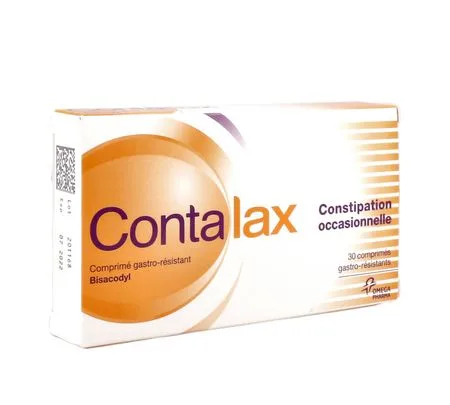
CONTALAX, gastro-resistant tablet
Composition
Bisacodyl........................................................................................................................................................5,0 mg
For a gastro-resistant tablet.
Excipient(s) with known effect: lactose.
Lactose, modified starch (Starx 1500), anhydrous colloidal silica, magnesium stearate, cellulose acetate phthalate, diethyl phthalate.
Dosage and administration
Dosage
Adults :
1 to 2 tablets per day.
Paediatric population (children over 6 years):
1 tablet per day.
Children up to 12 years should only take the treatment on the advice of a doctor.
If diarrhoea occurs, reduce the dosage.
The duration of treatment is limited to 8-10 days.
Method of administration
Oral use.
The tablets should be swallowed with a little water, without chewing them, preferably in the evening at bedtime.
Contraindications
Hypersensitivity to the active substance or to any of the excipients listed in section Composition.
- Patients suffering from intestinal obstruction, chronic inflammatory bowel diseases (ulcerative colitis, Crohn's disease), acute abdominal pain such as appendicitis, severe abdominal pain associated or not with nausea and vomiting, which may be a sign of the severe diseases mentioned above.
- States of severe dehydration with electrolyte depletion.
- Children under 6 years.
Warnings and precautions
Drug treatment of constipation is only an adjunct to hygienic-dietary treatment:
- enrichment of the diet with vegetable fibres and fluids,
- Advice on physical activity and rehabilitation of evacuation.
Prolonged use as part of the treatment of constipation is not recommended;
Prolonged intake may lead to:
- laxative abuse with severe functional colopathy, melanosis coli, hydroelectrolytic abnormalities with hypokalaemia;
- a situation of "dependence" with regular need for laxatives, need to increase the dosage, and severe constipation upon withdrawal.
In case of diarrhoea or abdominal pain, stop the product.
Intestinal fluid losses may cause dehydration (thirst, oliguria). In patients with precarious fluid balance (for example renal insufficiency or elderly patients), bisacodyl must be discontinued and may only be reinstated under medical supervision.
This medicine SHOULD GENERALLY NOT BE USED during pregnancy nor in combination with medicines causing torsades de pointes.
This medicine is not recommended with milk, antacid medicines, proton pump inhibitors (see section Interactions).
This medicine contains lactose. Patients with galactose intolerance, total lactase deficiency or glucose-galactose malabsorption syndrome (rare hereditary diseases) must not take this medicine.
Paediatric population
In children, the prescription of laxatives should be exceptional: it must take into account the risk of interfering with the normal functioning of the defecation reflex. Bisacodyl must not be used in children under 12 years without medical advice.
Interactions
Hypokalaemia-inducing medicines
Hypokalaemia is a factor favouring the occurrence of heart rhythm disorders (torsades de pointes, in particular) and increasing the toxicity of certain medicines, for example digoxin. Therefore, medicines that may cause hypokalaemia are involved in a large number of interactions. These include potassium-depleting diuretics, alone or combined, stimulant laxatives, glucocorticoids, tetracosactide and amphotericin B (IV route).
Combinations not recommended (see also section Warnings and precautions)
+ Milk, antacid medicines, proton pump inhibitors which may reduce the acidity of the upper gastrointestinal tract.
Risk of premature dissolution of the gastro-resistant coating.
Associations requiring precautions for use
+ Digoxin
Hypokalaemia favouring toxic effects of cardiac glycosides. Correct any hypokalaemia beforehand and carry out clinical, electrolyte and electrocardiographic monitoring.
+ Substances liable to cause torsades de pointes (amiodarone, amisulpride, arsenic trioxide, chloroquine, chlorpromazine, citalopram, cocaine, crizotinib, cyamemazine, disopyramide, domperidone, dronedarone, droperidol, erythromycin, escitalopram, flupentixol, fluphenazine, halofantrine, haloperidol, hydroquinidine, hydroxychloroquine, hydroxyzine, levomepromazine, lumefantrine, mequitazine, methadone, moxifloxacin, pentamidine, pimozide, pipamperone, piperaquine, pipotiazine, quinidine, sotalol, spiramycin, sulpiride, tiapride, toremifene, vandetanib, vincamine, zuclopenthixol
Increased risk of ventricular rhythm disorders, in particular torsades de pointes. Correct any hypokalaemia before administering the product and carry out clinical, electrolyte and electrocardiographic monitoring
Associations to be taken into account
+ Other potassium-lowering agents
Increased risk of hypokalaemia. Monitor potassium levels with correction if needed.
Fertility, pregnancy and breastfeeding
Pregnancy
There is no reliable data on teratogenicity in animals.
Clinically, there are currently no sufficiently relevant data to assess a possible teratogenic or foetotoxic effect of bisacodyl when administered during pregnancy.
Consequently, the use of bisacodyl is not recommended during pregnancy. This element is not the systematic argument for advising termination of pregnancy but leads to a cautious approach and targeted prenatal monitoring.
Breast-feeding
Because it passes into breast milk, the use of bisacodyl is not recommended during breastfeeding.
Fertility
The effects on fertility have not been studied
Driving and using machines
The effects of bisacodyl on the ability to drive vehicles and use machines have not been studied. However, patients must be informed that they may experience a vasovagal reaction (for example following abdominal cramps, on defecation) which may lead to dizziness and/or syncope.
Adverse effects
The following undesirable effects have been classified according to system organ class and frequency as defined by MedDRA. The following convention has been used for the classification of undesirable effects: very common (≥1/10), common (≥1/100, <1/10), uncommon (≥1/1000, <1/100), rare (≥1/10000, <1/1000), very rare (<1/10000), frequency not known (cannot be estimated from the available data).
|
System Class/organ |
Frequency |
Adverse effects |
|
Immune system disorders |
unspecified |
Anaphylactic reactions, angioedema, hypersensitivity |
|
Gastrointestinal disorders |
unspecified |
Abdominal cramps, colitis, nausea, vomiting, risk of diarrhoea and abdominal pain (particularly in subjects suffering from irritable colon) |
|
Metabolism and nutrition disorders
|
unspecified |
Hypokalaemia |
|
Renal and urinary system disorders |
unspecified |
Abnormal coloration of urine without clinical significance |
Reporting of suspected adverse reactions
Reporting suspected adverse reactions after authorisation of the medicinal product is important. It allows continued monitoring of the benefit/risk balance of the medicinal product. Healthcare professionals are asked to report any suspected adverse reaction via the national reporting system: National Agency for the Safety of Medicines and Health Products (ANSM) and the network of Regional Centres of Pharmacovigilance - Website: www.signalement-sante.gouv.fr.
Overdose
Symptoms in case of administration of high doses: diarrhoea, abdominal cramps and clinically significant loss of water, potassium and other electrolytes may occur.
Chronic overdose of CONTALAX may cause diarrhoea, abdominal pain, hypokalaemia which may be associated with muscle weakness.
Correction of fluid and electrolyte disorders may be necessary in case of very significant fluid loss. This is particularly important in elderly persons and young subjects. Administration of antispasmodics may be helpful.
Renal tubular damage, metabolic alkalosis, secondary hyperaldosteronism and renal calculi have also been described in association with chronic abuse of laxatives.
Pharmacodynamics
Pharmacotherapeutic class: STIMULANT LAXATIVE, ATC code: A06AB02
(A: alimentary tract and metabolism)
Stimulant laxatives trigger evacuation by increasing intestinal motility and secretions. Their action is located mainly in the large intestine. Regular use may lead to pain and tolerance, more rarely a "laxative disease" with hypokalaemia.
The onset of action is six to twelve hours after oral intake.
Pharmacokinetics
Administered orally, bisacodyl is poorly absorbed and mainly eliminated in the faeces, while the fraction absorbed in the small intestine is deacetylated, then glucuronoconjugated. Finally, it is partially eliminated in this form in the urine. Bisacodyl partly follows the enterohepatic cycle.
Preclinical safety
Signs observed in acute toxicity studies were diarrhoea, decreased motor activity and piloerection in rats at doses of 2 g/kg and in dogs at 15 g/kg.
Repeated-dose toxicity studies in rats, minipigs and rhesus monkeys, lasting up to 26 weeks, showed severe dose-dependent diarrhoea in all species, with the exception of the minipig. No particular histopathological changes, and in particular no nephrotoxicity, were observed. In rats treated for 32 weeks, bisacodyl induced proliferative lesions in the bladder. These lesions are considered specific to the species.
Bisacodyl showed no sign of genotoxicity in standard in vitro genotoxicity studies.
In a carcinogenicity study in transgenic p53 mice over 26 weeks, no tumours attributable to bisacodyl were observed at doses up to 8000 mg/kg/day.
No conventional carcinogenicity study in rats has been performed.
Teratogenicity studies in rats and rabbits were negative at doses up to 1000 mg/kg/day in rabbits (800 times the recommended dose) and in rats up to 80 times the recommended dosage.
Prescription, supply and reimbursement
| Marketing authorisation (AMM) |
|
200 AVENUE DE PARIS
92320 CHÂTILLON
Tel: 01 55 48 18 00 Tel (green number): 0800 943 123
clients.france@perrigo.com
https://www.perrigo.fr/
Source: VIDAL · Updated on 10/11/2026. This information does not replace advice from a healthcare professional.