Medicines
SmPC of 31/10/2017
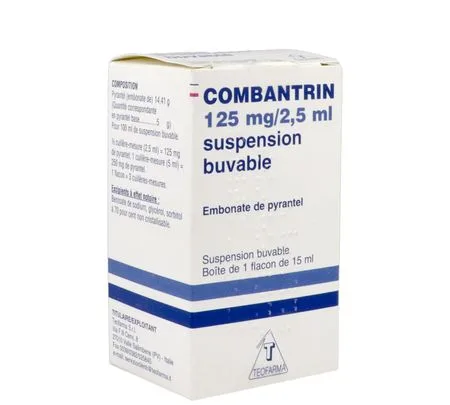
COMBANTRIN 125 mg/2,5 ml, oral suspension
Composition
Pyrantel (embonate of).............................................................................................................................. 14,410 g
(Corresponding quantity of PYRANTEL base...................................................................................5,000 g)
For 100 ml of oral suspension.
½ measuring spoon (2,5 ml) = 125 mg of pyrantel; 1 measuring spoon (5 ml) = 250 mg of pyrantel
1 bottle = 3 measuring spoons
Excipients with known effect: sodium benzoate, glycerol, sorbitol.
Citric acid monohydrate, Simethicone, sodium benzoate, caramel flavouring*, blackcurrant flavouring**, glycerol, soya lecithin, povidone, sorbitol at 70 per cent crystallisable, polysorbate 80, magnesium aluminium silicate, purified water.
*Composition of caramel flavouring : Ethylvanillin, maltol, corylone, vanillin, propylene glycol, butyric acid, diacetyl, ethyl butyrate, ethyl caprylate, ethyl formate, eugenol, liquid fenugreek extract, gamma-nonalactone, pyruvic acid.
**Composition of blackcurrant flavouring : Amyl acetate, benzaldehyde, blackcurrant juice, ethyl acetate, ethyl butyrate, ethyl-2 butyric acid, essential oils of buchu, geranium, juniper berry, sweet orange and concentrated orange, propylene glycol.
Dosage and administration
Oral use.
For adults and children over 12 kg.
Ascariasis, oxyuriasis
The usual dose is 10 mg/kg to 12 mg/kg as a single dose in adults and children, i.e.:
- in children: approximately ½ measuring spoon corresponding to the 2,5 ml graduation per 10 kg of body weight.
- in adults under 75 kg: approximately 3 measuring spoons.
- in adults over 75 kg: approximately 4 measuring spoons.
In oxyuriasis, for definitive parasitic eradication, impose strict hygiene measures and also treat household contacts. To avoid self-reinfection, prescribe a 2 dose 2 to 3 weeks after the initial dose.
Ankylostomiasis
In endemic areas, in case of infestation by Necator americanus or severe infestation by Ancylostoma duodenale, the dose is 20 mg/kg (in 1 or 2 doses), to be renewed for 2 to 3 days, i.e. :
- in children: 1 measuring spoon per 10 kg of body weight.
- in adults weighing less than 75 kg: 6 measuring spoons.
- in adults weighing more than 75 kg: 8 measuring spoons.
In case of light infestation by Ancylostoma duodenale (which is generally the case outside endemic areas), a dose of 10 mg/kg as a single dose may suffice in adults and children.
Contraindications
Hypersensitivity to the active substance or to any of the excipients listed in section Composition.
Warnings and precautions
In case of hepatic impairment, reduce doses.
Pinworm infestation
To prevent reinfestation, rigorous hygiene must be practised: daily washing of the anoperineal region, brushing the nails several times a day. In children, cut the nails very short. Change underwear and nightclothes regularly. Prevent the subject from scratching. Treat all family members at the same time, as the infestation is frequently asymptomatic.
This medicine contains glycerol and may cause headaches and digestive disorders (diarrhoea).
This medicine contains sorbitol. The use of this medicine is not recommended in patients with fructose intolerance.
Due to the presence of sorbitol, this medicine may cause a moderate laxative effect.
Fertility, pregnancy and breastfeeding
Pregnancy
In the absence of a teratogenic effect in animals, a malformative effect in humans is not expected. Indeed, to date, substances responsible for malformations in humans have proven teratogenic in animals in well-conducted studies in two species.
In clinical use, no malformative or foetotoxic effect has appeared to date. However, follow-up of pregnancies exposed to pyrantel is insufficient to exclude any risk.
Consequently, use of this medicine during pregnancy should only be considered if necessary.
Breast-feeding
In the absence of studies, to be avoided during breastfeeding except in cases of strict necessity.
Adverse effects
- Rarely: gastrointestinal disorders (nausea, vomiting, anorexia, diarrhoea, abdominal pain), small and transient increase in transaminases.
- Exceptionally: headache, dizziness, asthenia, sleep disorders, skin rash.
Reporting of suspected adverse reactions
Reporting suspected adverse reactions after authorisation of the medicinal product is important. It allows continued monitoring of the benefit/risk balance of the medicinal product. Healthcare professionals are asked to report any suspected adverse reaction via the national reporting system: National Agency for the Safety of Medicines and Health Products (ANSM) and the network of Regional Centres of Pharmacovigilance - Website: www.ansm.sante.fr.
Overdose
Due to its low absorption rate, plasma concentrations are low. An overdose, even a large one, generally causes only some digestive disorders and some mild, transient disorders of the central nervous system (fatigue, dizziness, headache, sometimes increase in S.G.O.T.). No specific antidote is known. Early gastric lavage is recommended, as is monitoring of respiratory and cardiovascular functions.
Pharmacodynamics
Pharmacotherapeutic class: ANTHELMINTIC (P: parasitology), ATC code: P02CC01
Pyrantel is an anthelmintic acting by neuromuscular blockade, which is active against:
- pinworms (Enterobius vermicularis),
- roundworms (Ascaris lumbricoides),
- and hookworms (Ancylostoma duodenale and Necator americanus).
Pharmacokinetics
Digestive absorption of pyrantel is very low.
After oral administration, more than 50% of the product is excreted unchanged in the faeces. 7% are eliminated in the urine, unchanged and as metabolites.
Prescription, supply and reimbursement
| Marketing authorisation (AMM) |
|
| Price: |
|
Collection.
VIA F.LLI CERVI, 8
27010 VALLE SALIMBENE (PAVIA)
Tel: 00 39 0382 422 008 amministrazione@teofarma.it
https://www.teofarmasrl.it/
Source: VIDAL · Updated on 10/11/2026. This information does not replace advice from a healthcare professional.